Employer-Sponsored Health Insurance: How It Works, What It Costs and Your Rights
How employer-sponsored health coverage works: KFF 2025 premiums ($9,325 single, $26,993 family), who pays what, tax savings, the 10.22% 2027 affordability test and COBRA.

Table of contents

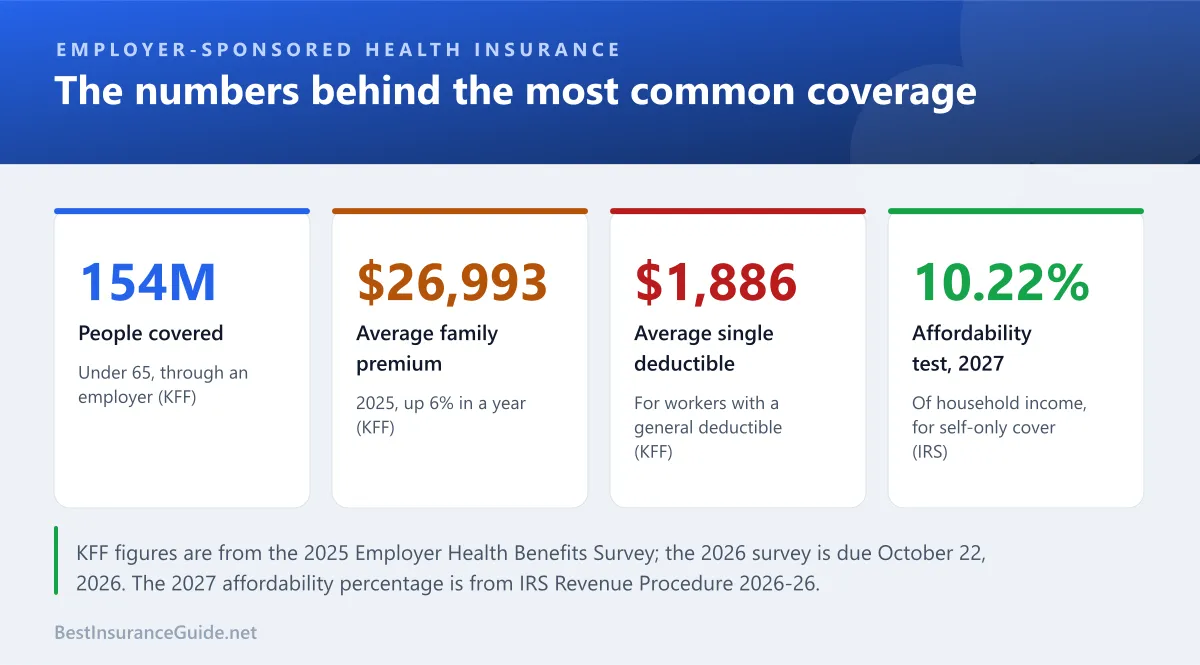
Employer-sponsored health insurance is how most Americans under 65 get covered: about 154 million people, according to KFF. Your employer picks the plans and pays most of the premium, about 84% of the cost of single coverage and 74% of family coverage on average in 2025. You pay the rest from your pay cheque, usually before tax.
We are an independent site; figures below are from KFF’s 2025 Employer Health Benefits Survey and the IRS, and examples are labelled illustrative.
It is getting more expensive. KFF found average premiums reached $9,325 for single coverage and $26,993 for family coverage in 2025, up 5% and 6% in a year, and the Business Group on Health projects employer health costs will rise a median 9.2% in 2027. With workplace open enrollment under way at many employers, here is how the system works and how to get the most from it. KFF publishes its 2026 survey on October 22, and we will update the figures then.
Employer-sponsored health insurance at a glance
| Question | Answer (2025 unless stated) |
|---|---|
| People covered | About 154 million under 65 (KFF) |
| Average annual premium | $9,325 single, $26,993 family |
| Average worker contribution | $1,440 single, $6,850 family |
| Employer share | About 84% single, 74% family |
| Average single deductible | $1,886 for workers with a general deductible |
| Firms offering coverage | About 61% of firms with 10+ workers; 97% of firms with 200+ |
| Most common plan type | PPO, 46% of covered workers |
| ACA affordability threshold | 9.96% of household income (2026), 10.22% (2027) |
How employer health insurance works
- Your employer chooses the plans. Many offer two or three, such as an HMO, a PPO and a high-deductible plan with a health savings account. Our EPO vs PPO and HDHP vs PPO guides explain the trade-offs.
- Your employer pays part of the premium. The rest comes out of your pay, usually every pay period.
- You enroll when you join or at open enrollment. Federal law caps any waiting period for new hires at 90 days.
- You use the plan like any insurance: paying copays, a deductible and coinsurance up to an annual out-of-pocket maximum. Our explainer on the deductible vs out-of-pocket maximum covers how these work.
Fully insured or self-insured. Smaller employers usually buy a fully insured plan from an insurer. Most large employers self-insure: they pay claims themselves and hire an insurer to run the network. That matters because self-insured plans are governed by federal ERISA rules rather than state insurance mandates. Our guide to fully insured vs self-insured plans explains the difference.
What it costs, and who pays
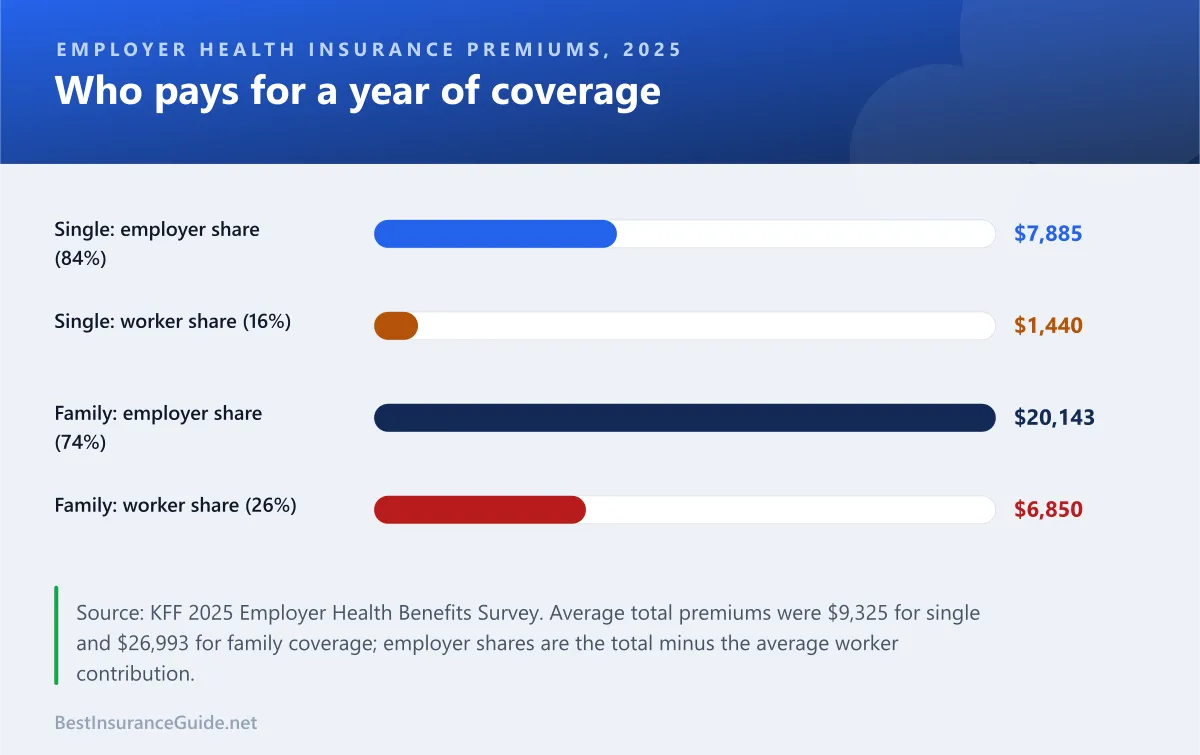
According to KFF’s 2025 survey:
- Single coverage cost $9,325 a year. Workers paid $1,440 on average, about $120 a month, and employers paid the rest.
- Family coverage cost $26,993. Workers paid $6,850, about $571 a month.
- Workers pay a larger share of family coverage (26%) than single coverage (16%), because many employers subsidise the employee more than dependants.
Those are averages. Contributions vary hugely by employer, and workers at small firms often pay a much larger share of family premiums. KFF also found PPO premiums average more than other plan types: $9,818 single and $28,272 family.
The tax break most people do not notice
Employer health insurance is one of the largest tax breaks in the tax code:
- Your employer’s share is not taxable income to you.
- Your share is usually deducted pre-tax through a Section 125 cafeteria plan, so you pay no federal income tax, and no Social Security or Medicare tax, on it. Most states follow suit.
- The total cost of your coverage appears on your W-2 in box 12 with code DD. That is for information only and is not taxed.
Illustrative. Alex pays $6,850 a year for family coverage through payroll. In the 22% federal tax bracket, plus 7.65% Social Security and Medicare tax, paying that pre-tax saves about $2,031 a year compared with paying it from after-tax income.
The same structure lets you put pre-tax money into a health FSA or, with a qualifying high-deductible plan, an HSA. See our guides to 2027 FSA limits, 2027 HSA contribution limits and HSA vs FSA.
The ACA rules employers must follow
Who has to offer coverage
Under the ACA’s employer shared responsibility rules, an applicable large employer, one with 50 or more full-time equivalent employees, must offer coverage to at least 95% of full-time employees (30 or more hours a week) and their children up to age 26. If it does not, or the coverage is unaffordable or below minimum value, it can owe a penalty when a full-time employee receives a marketplace premium tax credit.
Employers with fewer than 50 employees are not required to offer coverage, though many do. Our small business health insurance guide covers their options, including the tax credit for very small firms and the ICHRA, now known as a CHOICE arrangement.
The affordability test
Coverage counts as affordable if the employee’s contribution for the cheapest self-only plan that provides minimum value is no more than a set share of household income:
- 9.96% in 2026;
- 10.22% in 2027, set by IRS Revenue Procedure 2026-26 in July 2026. It is the first time the threshold has been above 10%.
Because employers do not know employees’ household income, most use a safe harbour based on W-2 wages, rate of pay or the federal poverty line.
Minimum value means the plan is designed to pay at least 60% of the total cost of covered benefits for a standard population, and includes substantial hospital and doctor coverage.
Other federal protections
- No pre-existing condition exclusions and no lifetime or annual dollar limits on essential health benefits.
- Children can stay on a parent’s plan until 26, whether or not they are married, students or financially dependent. Our article on staying on a parent’s health insurance covers the details.
- Preventive care such as screenings and vaccines is covered without cost sharing in non-grandfathered plans.
- A summary of benefits and coverage (SBC) must be provided so you can compare plans.
Employer coverage and marketplace subsidies
If your employer offers you coverage that is affordable and provides minimum value, you generally cannot get a marketplace premium tax credit for yourself, even if a marketplace plan would be cheaper.
The “family glitch” fix. Since 2023, family members are judged on the cost of family coverage. If adding your spouse and children would cost more than the affordability percentage of household income, they may qualify for marketplace subsidies even though your own coverage counts as affordable. It is worth checking at ACA open enrollment if your employer’s family premium is high.
Leaving your job: COBRA and other options
When you leave a job, coverage usually ends on your last day or at the end of that month. Your options:
- COBRA, at employers with 20 or more employees, lets you keep the same plan for up to 18 months in most cases. You have 60 days to elect it, and you pay the full premium plus up to 2%, which is why it is often a shock. See our guides to COBRA costs and how long COBRA lasts.
- A marketplace plan, through a 60-day special enrollment period after losing job-based coverage, with subsidies based on your expected income.
- A spouse’s employer plan, which you can usually join within 30 days of losing coverage.
- Medicaid, if your income has fallen. Our Medicaid eligibility 2027 guide explains the limits.
Our article on health insurance without a job compares the options in more detail.
Turning 65 while still working? If your employer has 20 or more employees, you can usually delay Part B without a penalty. Our guide to when to sign up for Medicare explains the rules.
Making the most of open enrollment
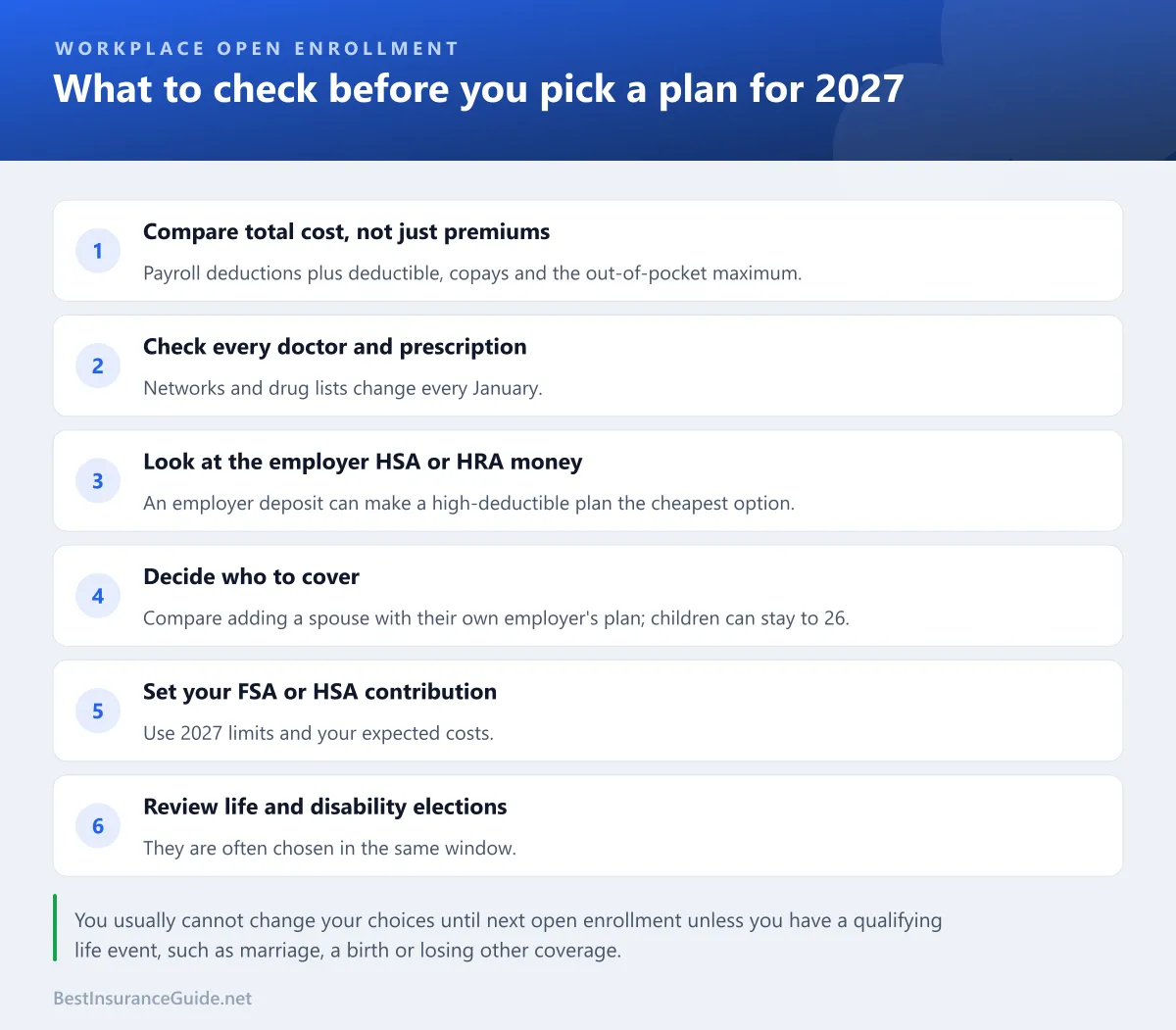
Most employers hold open enrollment in the autumn for coverage starting January 1. Do not just roll over last year’s choices:
- Compare total cost, not just payroll deductions: premiums plus the deductible, copays and the out-of-pocket maximum.
- Check every doctor and prescription against next year’s network and drug list. For example, many employers are changing how they cover GLP-1 weight-loss drugs; see GLP-1 coverage in 2027.
- Count employer HSA or HRA contributions, which can make a high-deductible plan the cheapest choice.
- Decide who to cover. If your spouse has their own employer plan, compare the cost of each covering themselves against one family plan; some employers add a spousal surcharge.
- Set FSA and HSA contributions using the 2027 limits.
- Review life and disability elections made in the same window.
Missed it? You can usually change plans mid-year only after a qualifying life event, such as marriage, divorce, a birth or adoption, or losing other coverage, generally within 30 days, or 60 days for Medicaid and CHIP events.
Related reading
- Small business health insurance explains employers’ options and costs.
- EPO vs PPO compares the four main plan types.
- HDHP vs PPO helps you decide whether a high-deductible plan makes sense.
- How long COBRA coverage lasts covers continuing your plan after a job ends.
- Fully insured vs self-insured explains how your employer funds the plan.
Sources and notes
- KFF, 2025 Employer Health Benefits Survey: premiums, worker contributions, deductibles, offer rates, plan-type enrollment and the 154 million figure. Employer shares in the chart are total premium minus average worker contribution. The 2026 survey is due October 22, 2026.
- IRS, Revenue Procedure 2026-26 (July 2026): 10.22% affordability percentage for 2027; 9.96% for 2026.
- Business Group on Health: projected 9.2% median increase in employer health costs for 2027.
- Federal rules on the 90-day waiting period, dependent coverage to 26, minimum value, Section 125 plans, W-2 code DD reporting, COBRA and HIPAA special enrollment.
- The tax savings example uses hypothetical figures and ignores state tax.
This article is general information, not tax, legal or benefits advice. Your employer’s plan documents and summary of benefits and coverage set out your actual coverage and rights.