Medigap Plan G vs Plan N for 2027: What Each Covers, What It Costs and How To Choose
Plan G vs Plan N Medicare Supplement compared for 2027: what each covers, Plan N copays and excess charges, KFF premium data, the $3,050 high-deductible G and a break-even example.

Table of contents

Medigap Plan G and Plan N cover the same big costs. Both pay the Part A hospital deductible and the 20% Part B coinsurance that Original Medicare leaves you with. The difference is at the edges: Plan G leaves you paying only the Part B deductible ($283 in 2026), while Plan N adds copays of up to $20 per office visit and $50 per ER visit and does not cover Part B excess charges, in exchange for a lower premium.
We are an independent site; figures below come from Medicare.gov, CMS and KFF, and worked examples are labelled illustrative.
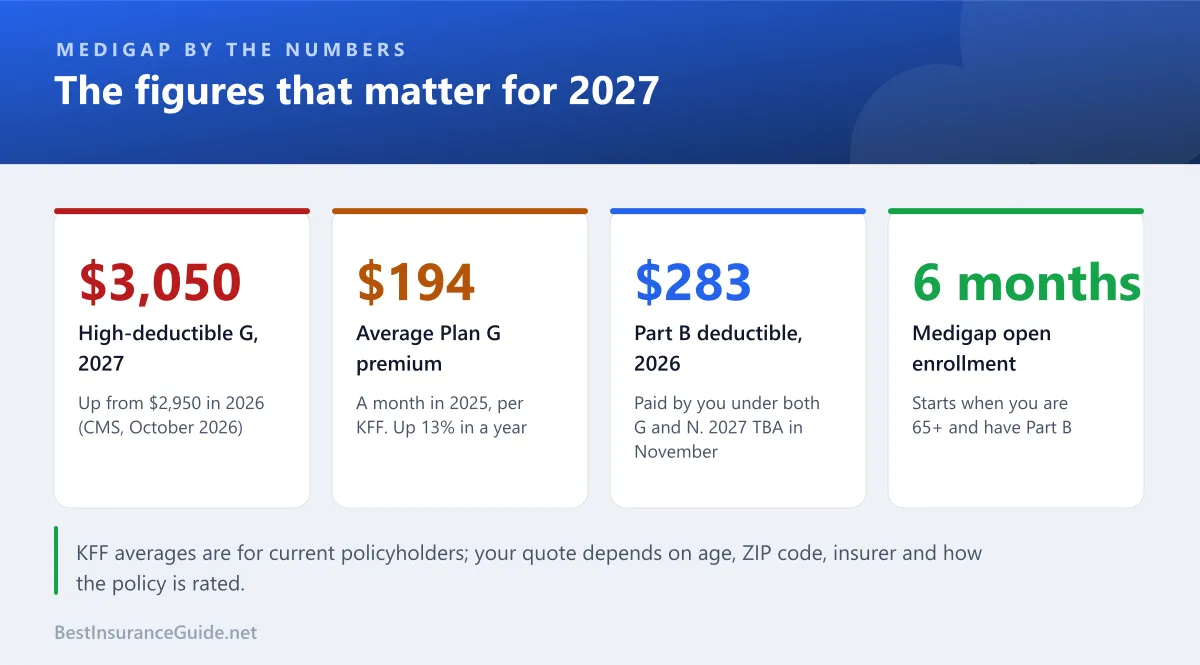
Two pieces of news this month make the comparison timely. CMS set the 2027 deductible for high-deductible Plan G at $3,050, and KFF’s October 2026 Medigap analysis found the average Plan G premium rose 13% in a year to $194 a month.
Plan G vs Plan N at a glance
| Benefit | Plan G | Plan N |
|---|---|---|
| Part A deductible ($1,736 in 2026) | Covered | Covered |
| Part A hospital coinsurance + 365 extra days | Covered | Covered |
| Part B coinsurance (usually 20%) | Covered | Covered, minus copays below |
| Office visit copay | None | Up to $20 for some visits |
| ER visit copay | None | Up to $50 if not admitted |
| Part B deductible ($283 in 2026) | You pay | You pay |
| Part B excess charges (up to 15%) | Covered | Not covered |
| Skilled nursing coinsurance | Covered | Covered |
| Hospice coinsurance, first 3 pints of blood | Covered | Covered |
| Foreign travel emergency | 80% to plan limits | 80% to plan limits |
| Share of Medigap policyholders (KFF) | About 46% | About 10% |
What is Medigap?
Medigap, or Medicare Supplement Insurance, is private insurance that fills the gaps in Original Medicare (Parts A and B). Without it, you pay a hospital deductible for each benefit period, 20% of most doctor and outpatient bills with no annual cap, and a range of other coinsurance.
A few rules shape every choice:
- Plans are standardised. In most states, each lettered plan has the same benefits whichever insurer sells it. A Plan G from one company covers exactly what a Plan G from another does. Only the premium, rate history and service differ. Massachusetts, Minnesota and Wisconsin standardise their plans differently.
- Medigap only works with Original Medicare. It cannot be used with a Medicare Advantage plan.
- There is no drug coverage. You need a separate Part D plan.
- It does not cover dental, vision or hearing, or long-term care. Our guide to dental insurance for seniors on Medicare covers the dental side.
- Plans F and C are closed to newcomers. Anyone new to Medicare on or after January 1, 2020 cannot buy them, which is why Plan G is now the most comprehensive plan most new enrollees can get.
According to KFF, about 12.9 million people held a Medigap policy in 2024, roughly 46% of people in traditional Medicare.
Plan G: what it covers
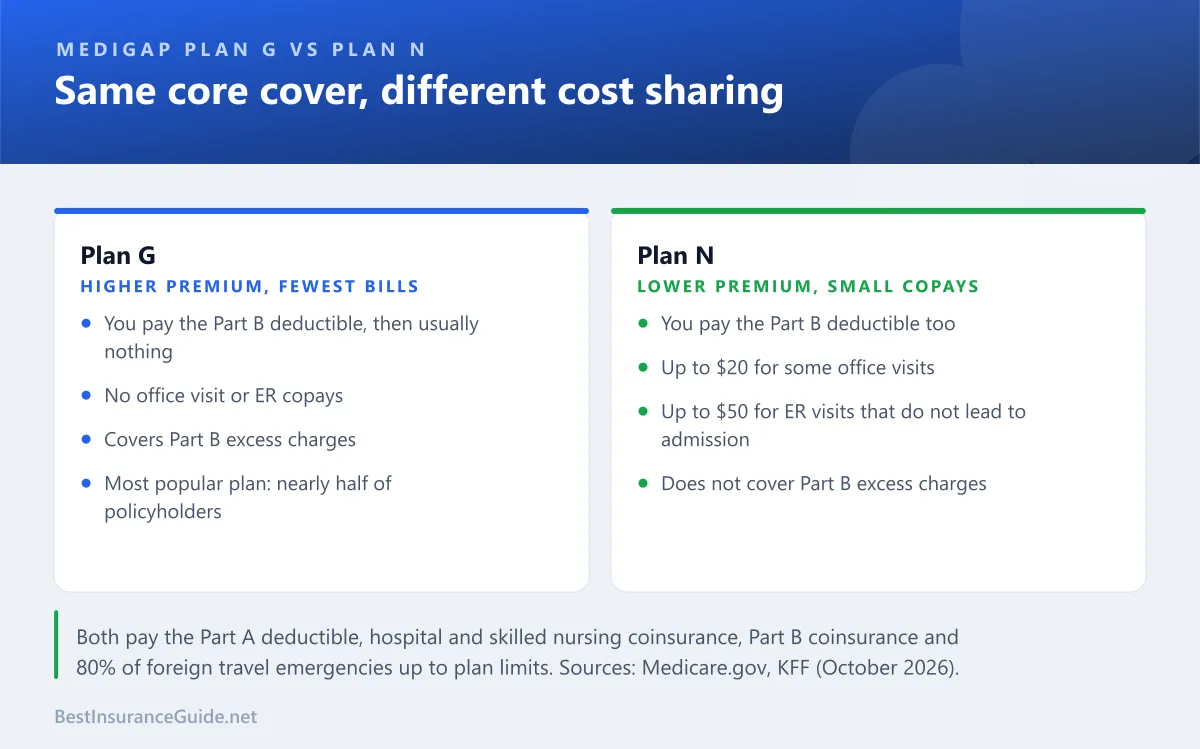
Plan G pays every gap in Original Medicare except the annual Part B deductible. Once you have paid that deductible, $283 in 2026, Medicare pays its share and Plan G pays the rest of Medicare-approved costs for the year.
That includes the item people tend to overlook: Part B excess charges. A doctor who does not accept Medicare’s approved amount as full payment can legally charge up to 15% more. Plan G pays that difference; Plan N does not.
Plan G is the most popular Medigap plan. KFF found nearly half of all policyholders have it, about 6.3 million people, and its share has grown every year since Plan F closed to new enrollees.
High-deductible Plan G for 2027
High-deductible Plan G has the same benefits, but you pay Medicare-covered costs up to a deductible before it pays anything. CMS set that deductible at $3,050 for 2027, up from $2,950 in 2026, after a 3.4% inflation adjustment.
In exchange, premiums are much lower. It can suit healthy people who can absorb up to $3,050 in a bad year and want catastrophic protection at a low monthly cost. Not every insurer sells it in every state.
Plan N: what it covers and what it does not
Plan N covers the same core costs as Plan G, with three differences:
- Office visit copays of up to $20 for some doctor visits.
- ER copays of up to $50 for emergency room visits that do not result in an inpatient admission. If you are admitted, the copay is waived.
- No cover for Part B excess charges. If a doctor charges the 15% excess, you pay it.
You pay the same Part B deductible under both plans.
How much do excess charges matter?
Less than many sales pitches suggest, but they are not zero. Most doctors accept Medicare assignment, which means they cannot charge excess charges at all. And several states restrict them: commonly cited examples include Massachusetts, Minnesota, New York, Ohio, Pennsylvania, Rhode Island and Vermont, though the precise rules differ. Check with your state’s insurance department.
The risk is real if you see specialists who do not accept assignment, or expect a lot of outpatient care such as surgery or cancer treatment.
What do Plan G and Plan N cost?
According to KFF’s October 2026 analysis:
- The average Medigap premium among current policyholders was $244 a month in 2025 (about $2,926 a year).
- The average Plan G premium was $194 a month (about $2,323 a year), up 13% from the year before.
- Plan G averages ranged from $164 in New Mexico to $257 in New York.
KFF did not publish a Plan N average in that analysis. Plan N is generally priced below Plan G from the same insurer, but the size of the gap varies by state, age and company, and it is the single number that decides the comparison. Get both quotes side by side.
Why your quote may look nothing like the average
Insurers set prices in one of three ways, and it matters more than the plan letter:
- Community rated: everyone pays the same premium regardless of age. KFF says nine states require this for people 65 and over: Arkansas, Connecticut, Idaho, Maine, Massachusetts, Minnesota, New York, Vermont and Washington.
- Issue-age rated: based on your age when you buy, so it does not rise because you get older.
- Attained-age rated: rises as you age. It is often cheapest at 65 and most expensive later.
All three types can still rise with inflation and claims. Ask each insurer about its rate increase history, not just today’s price.
Plan G vs Plan N: a worked break-even
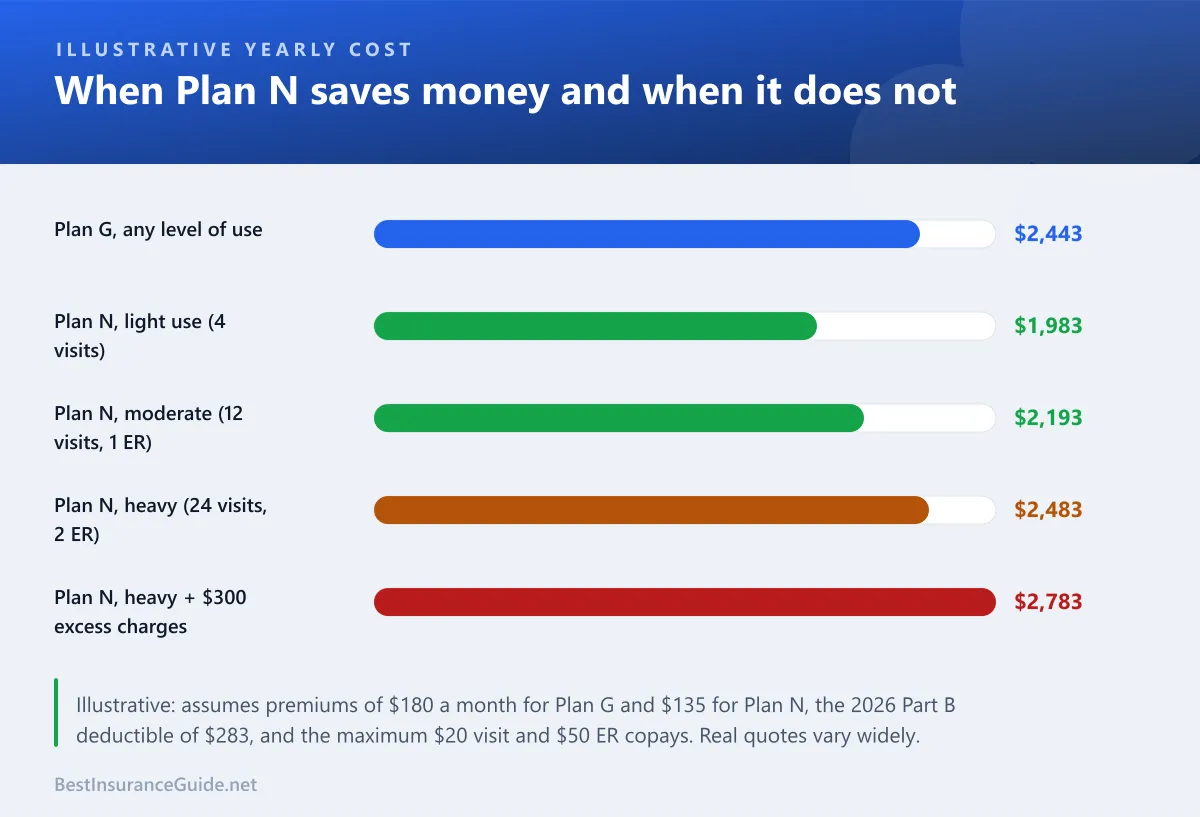
Illustrative. Suppose quotes of $180 a month for Plan G and $135 a month for Plan N, and the 2026 Part B deductible of $283.
- Plan G: $2,160 in premiums + $283 deductible = $2,443 a year, whatever happens.
- Plan N, light use (four office visits at the full $20): $1,620 + $283 + $80 = $1,983, saving $460.
- Plan N, moderate use (12 visits and one ER trip not admitted): $1,620 + $283 + $240 + $50 = $2,193, still $250 cheaper.
- Plan N, heavy use (24 visits and two ER trips): $2,483, about $40 more than Plan G.
- Plan N, heavy use plus $300 of excess charges: $2,783, about $340 more.
The rule of thumb: with a $45 monthly premium gap, Plan N stays cheaper until you have about 27 office visits a year at the full $20 copay, if you do not face excess charges. If the gap between your quotes is smaller, Plan G’s predictability becomes better value.
Which should you choose?
Plan G is usually the better fit if:
- you see specialists often or have a chronic condition;
- you want predictable costs with no bills after the Part B deductible;
- you live in a state that allows excess charges and use doctors who do not accept assignment;
- the premium gap between G and N in your area is small.
Plan N is usually the better fit if:
- you see a doctor only a few times a year;
- your doctors accept Medicare assignment, or your state limits excess charges;
- you want to keep the premium down and can handle occasional $20 and $50 copays.
High-deductible Plan G suits people in good health who have savings to cover up to $3,050 in a bad year.
Think about switching before you buy
This is the most important point, and it is easy to miss. Medigap’s strongest buyer protection is a one-time window. Your six-month Medigap open enrollment period starts the first month you are 65 or older and enrolled in Part B. During it, insurers must sell you any policy they offer at their best rate, regardless of health.
After that, in most states, insurers can use medical underwriting: they can ask health questions and refuse you or charge more. That means starting on Plan N and moving to Plan G later is not guaranteed.
Some states give extra rights. According to KFF, Connecticut, Maine, Massachusetts and New York require insurers to sell policies continuously or annually regardless of health, and states such as California and Oregon have “birthday rules” that let you switch to a plan of equal or lesser benefits each year. Check your state’s rules with your State Health Insurance Assistance Program (SHIP).
If you are still working and delaying Part B, the Medigap window does not start until Part B does. Our guide to when to sign up for Medicare explains the timing.
Medigap or Medicare Advantage?
Medigap is one of two main routes. The other is Medicare Advantage, which replaces Original Medicare with a private plan that often has low or $0 premiums but uses networks, prior authorisation and copays, with an annual out-of-pocket maximum.
The choice matters most at 65, because switching from Medicare Advantage back to Original Medicare later does not guarantee you can buy Medigap without health questions. If you are reviewing plans during this year’s October 15 to December 7 open enrollment, our Medicare 2027 changes guide compares the two and covers Medicare Advantage plans leaving for 2027, which can trigger guaranteed-issue rights to buy Medigap.
How to buy a Medigap plan in five steps
- Decide on the letter first. Compare G, N and high-deductible G against your expected doctor use.
- Get quotes from several insurers for the same letter, since the benefits are identical. Medicare.gov lists plans by ZIP code, and a broker can quote multiple companies.
- Ask how each policy is rated, community, issue-age or attained-age, and for its recent rate increases.
- Buy within your six-month open enrollment period if at all possible.
- Add a Part D plan, because Medigap has no drug coverage. If your income is limited, check Extra Help and the Medicare Savings Program.
Related reading
- When to sign up for Medicare explains every enrollment window and late penalty.
- Medicare 2027 changes covers Part B, Part D and open enrollment.
- Medicare Advantage plans leaving for 2027 covers your rights if your plan exits.
- Medicare Advantage star ratings 2027 shows how plans scored.
- Deductible vs out-of-pocket maximum explains the cost-sharing terms used above.
Sources and notes
- Medicare.gov, “Compare Medigap plan benefits”: plan benefits, Plan N copays, Plan K and L limits, 2026 high-deductible amount.
- CMS, “Deductible Amount for Medigap High Deductible Options F, G & J for Calendar Year 2027” (October 2026): $3,050 deductible, 3.40% CPI-U increase, Plan F and G eligibility from January 1, 2020.
- KFF, “Key Facts About Medigap Enrollment and Premiums for Medicare Beneficiaries” (October 13, 2026): average premiums, Plan G and N shares, state protections and rating rules.
- CMS, 2026 Medicare Parts A & B premiums and deductibles fact sheet: $1,736 Part A deductible, $283 Part B deductible.
- Part B excess charge state restrictions vary; confirm with your state insurance department.
- The Plan N vs Plan G break-even uses hypothetical premiums and is for illustration only.
This article is general information, not personalised insurance advice. Medigap rules and prices vary by state. Your State Health Insurance Assistance Program (SHIP) offers free, unbiased Medicare counselling.