Fully Insured vs Self-Insured Health Plans: What Your Employer Chose
Fully insured vs self-funded health plans: who pays claims, stop-loss and level funding, state vs federal rules, and how to tell which you have.

Table of contents

If you get health insurance through work, your card probably carries the logo of a well-known health insurer. That does not necessarily mean the insurer is paying your medical bills. In most large companies, the employer is paying them, and the insurer is simply processing the claims.
That is the difference between a fully insured and a self-insured (or self-funded) health plan. It is invisible most of the time, but it decides which laws protect you, who you complain to when a claim is denied, and why your plan may cover things your friend’s plan does not.
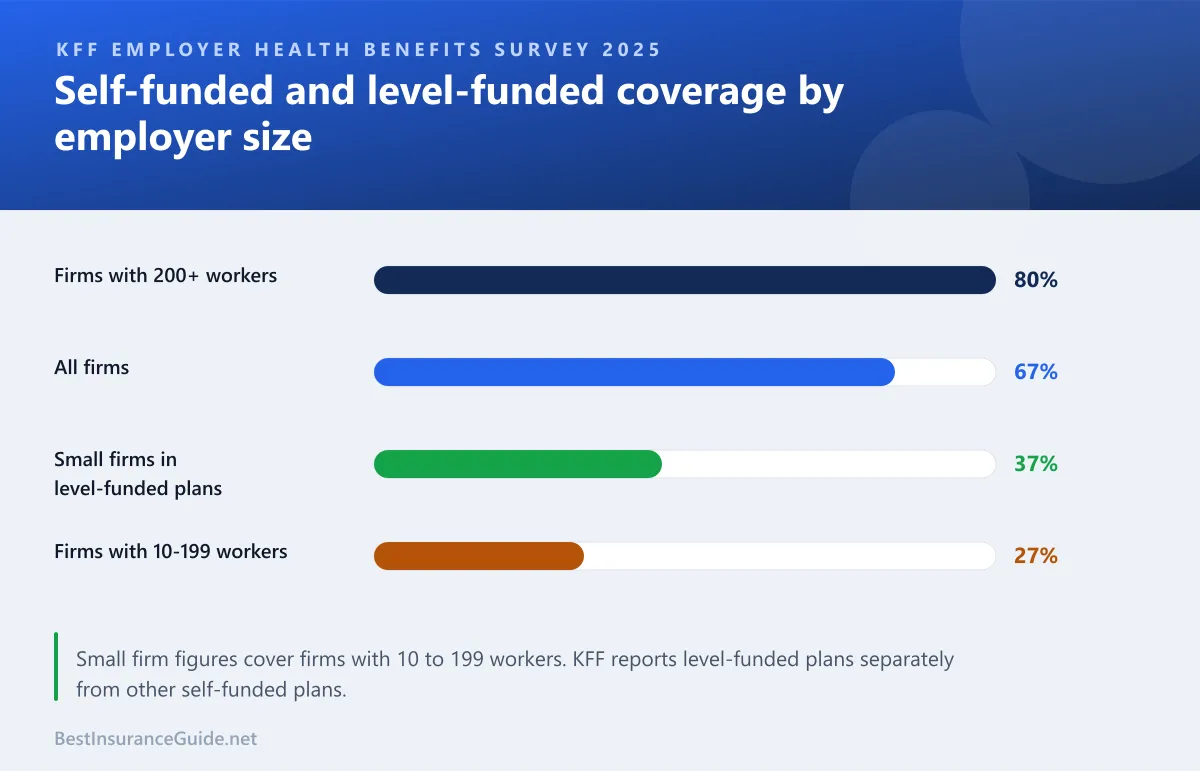
According to KFF’s 2025 Employer Health Benefits Survey, 67% of covered workers are enrolled in self-funded plans. This guide explains how fully insured and self-funded plans work, what stop-loss and level funding are, the trade-offs for employers, and what it all means for employees.
Fully insured health plans
In a fully insured plan, the employer buys a group health insurance policy from an insurance company.
- The employer pays a fixed premium per employee per month, with employees contributing part of it through payroll.
- The insurer pays the claims. If employees have an expensive year, the insurer absorbs the cost. If they have a cheap year, the insurer keeps the difference.
- The insurer carries the risk, and the premium for next year is set based on the group’s experience, the insurer’s pricing and, for small employers, rating rules that limit how much individual health can affect the price.
Fully insured plans are regulated by the state where the policy is issued. They must include any benefits the state mandates, pay state premium taxes, and give employees access to the state insurance department and state external review if a claim is denied. Insurers selling fully insured plans must also meet the ACA’s medical loss ratio rules, which require them to spend most premium dollars on care or refund the difference.
Self-insured (self-funded) health plans
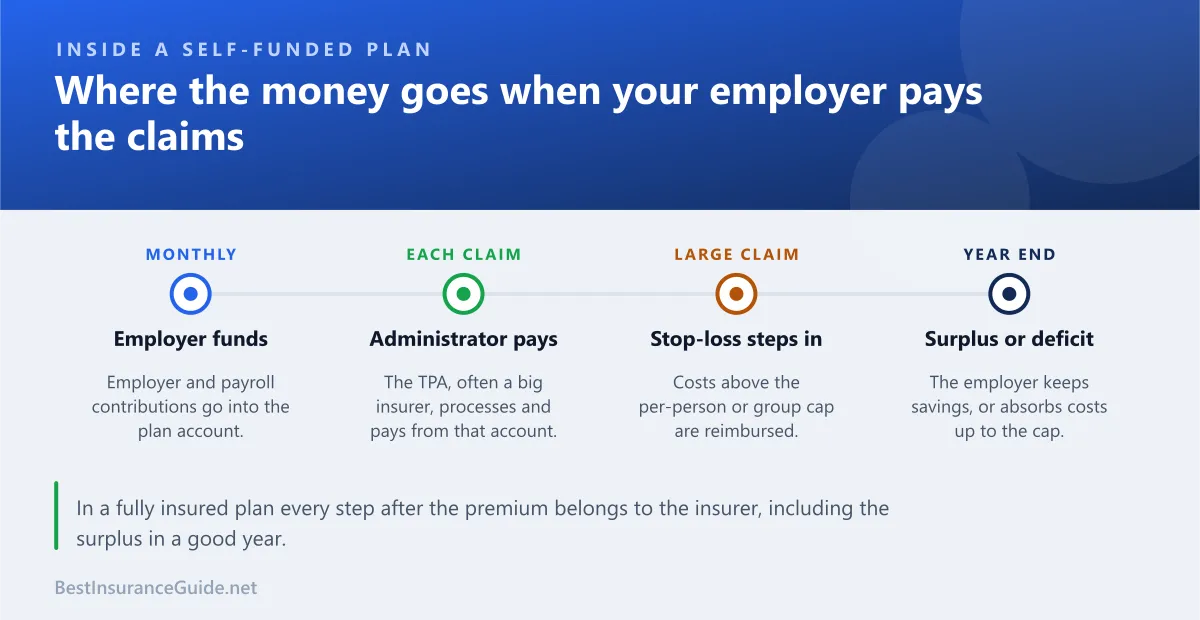
In a self-funded plan, the employer pays employees’ medical claims directly from its own funds.
- The employer sets aside money for expected claims and pays them as they come in, so monthly costs vary.
- A third-party administrator (TPA) handles the paperwork. Often this is a large health insurer acting as administrator, which is why its name is on your card. The employer pays an administrative fee for claims processing, provider networks and customer service.
- Stop-loss insurance caps the employer’s exposure to a very expensive year or a very expensive employee.
- The employer keeps any savings if claims come in lower than expected.
Self-funded plans are governed mainly by federal law, the Employee Retirement Income Security Act (ERISA). Because of ERISA preemption, state insurance mandates and most state insurance regulation do not apply to them.
Fully insured vs self-insured at a glance
| Detail | Fully insured | Self-insured (self-funded) |
|---|---|---|
| Who pays claims | The insurance company | The employer |
| Who carries the risk | The insurer | The employer, up to stop-loss limits |
| Monthly cost to employer | Fixed premium | Variable, based on actual claims plus fixed fees |
| Main regulator | State insurance department | US Department of Labor, under ERISA |
| State benefit mandates | Apply | Generally do not apply |
| State premium taxes | Apply | Generally do not apply to claims |
| Surplus in a good year | Kept by the insurer | Kept by the employer |
| Claims data | Limited access for the employer | Full access for the employer |
| Typical user | Small and mid-sized employers | Large employers, increasingly smaller ones |
Why large employers self-fund
Self-funding has become the default for large employers. KFF’s 2025 survey found 80% of covered workers at firms with 200 or more employees are in self-funded plans, compared with 27% at firms with 10 to 199 workers.
The reasons:
- Cash flow and savings. The employer pays only for the claims that actually happen, plus fixed costs, instead of a premium that includes the insurer’s risk margin and profit. In a good year, the savings stay with the company.
- Plan design freedom. Without state mandates, a multi-state employer can offer one consistent plan everywhere.
- Lower taxes and fees. State premium taxes generally do not apply to the claims a self-funded employer pays.
- Data. The employer can see detailed, de-identified claims data and use it to design wellness programs, choose networks and negotiate with providers.
- Scale. With thousands of employees, claims are predictable enough that the employer does not need an insurer to smooth them out.
The risks of self-funding
The flip side is volatility. A handful of very large claims, such as a premature birth, a cancer diagnosis or a transplant, can cost hundreds of thousands of dollars each. For a smaller employer, one of those can wreck the year’s budget.
Other risks and costs:
- Unpredictable monthly costs, which make budgeting harder.
- Fiduciary responsibility under ERISA for managing the plan in employees’ interest.
- Administrative work, including compliance, reporting and oversight of the TPA.
- Run-out claims: bills for care in one year that arrive after the plan year ends, which still have to be paid if the employer switches to a fully insured plan.
That is what stop-loss insurance is for.
Stop-loss insurance explained
Stop-loss is insurance for the employer, not the employees. It comes in two forms, and most self-funded employers buy both.
Specific stop-loss caps the employer’s cost per person. If the specific deductible is $100,000 and one employee has $400,000 of claims in the year, the employer pays the first $100,000 and the stop-loss insurer reimburses the other $300,000.
Aggregate stop-loss caps the employer’s cost for the whole group. The attachment point is typically set as a percentage above expected claims, commonly in the region of 120% to 125%. If total claims exceed it, the stop-loss insurer pays the excess.
A worked example
A company with 150 employees self-funds with expected annual claims of $1,500,000. It buys specific stop-loss at $100,000 per person and aggregate stop-loss at 125% of expected claims, $1,875,000.
During the year, one employee needs treatment costing $420,000, and everyone else’s claims add up to $1,300,000.
- The employer pays the first $100,000 of the large claim; specific stop-loss reimburses $320,000.
- The employer’s retained claims are $100,000 + $1,300,000 = $1,400,000, below the $1,875,000 aggregate attachment point, so aggregate stop-loss does not pay.
- Add administration fees and stop-loss premiums, and the employer’s total cost is still in line with budget, despite one very expensive claim.
Without stop-loss, that single $420,000 claim would have pushed the year well over budget. With it, the employer’s risk was capped.
A few terms worth knowing:
- Contract basis, such as 12/12 or 12/15, describes which months of incurred and paid claims the stop-loss covers. A contract that covers claims paid a few months after year-end helps with run-out.
- Lasering is when a stop-loss insurer sets a higher deductible for one individual with a known large condition. It shifts more of that person’s cost back to the employer.
- Renewal increases can be steep after a bad year, which is the self-funded equivalent of a premium hike.
Level-funded plans: self-funding for smaller employers
Level funding is the fastest-growing way smaller employers self-fund. KFF found 37% of covered workers at firms with 10 to 199 workers were in level-funded plans in 2025, a figure it reports separately from its self-funded numbers.
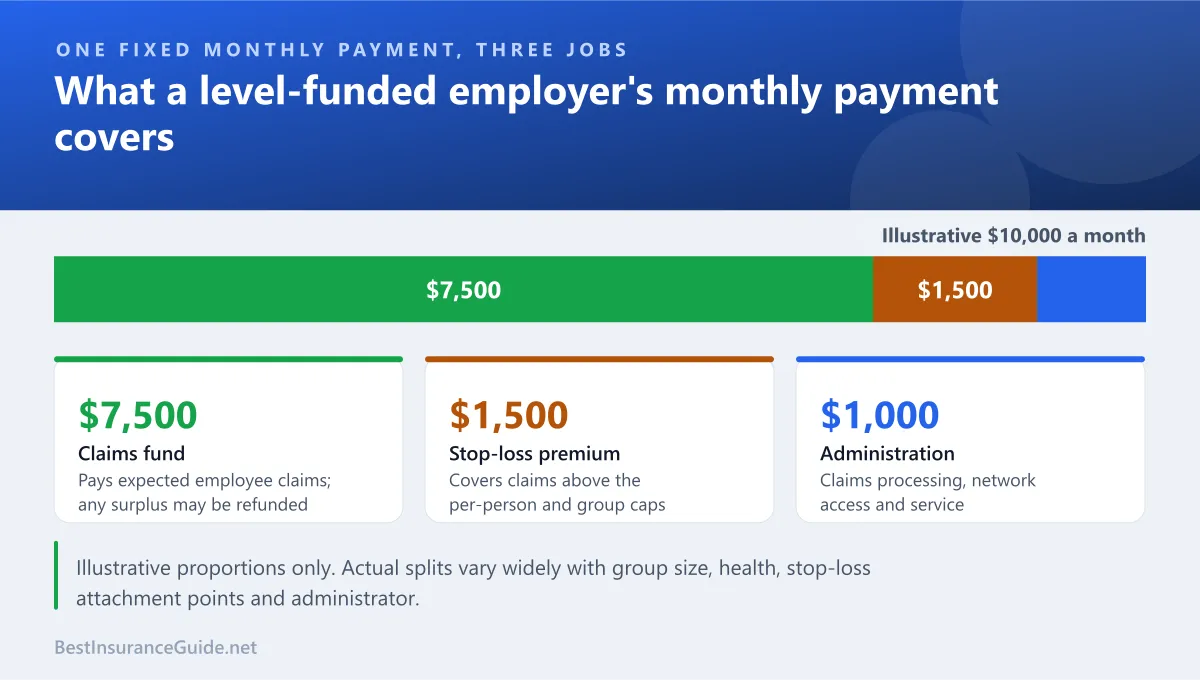
A level-funded plan packages the pieces of self-funding into a single fixed monthly payment that covers:
- a claims fund for expected claims;
- administrative fees for the TPA; and
- stop-loss premiums, usually with low attachment points.
To the employer it feels like a fully insured premium. Legally it is self-funded, so it is governed by ERISA rather than state insurance law. If claims come in lower than the claims fund, many level-funded arrangements return part of the surplus or credit it against the next year. If claims are higher, stop-loss covers the excess.
Level funding can work well for small employers with a relatively healthy workforce. The risk is that stop-loss insurers underwrite the group each year, so an employer with a costly year can see a sharp renewal increase or be pushed back to a fully insured plan. Some states also regulate how low stop-loss attachment points can be for small employers.
What it means for employees
Most employees never notice the difference, but it matters in four situations.
1. Which benefits are required. State mandates, for example rules requiring coverage of certain fertility treatments, hearing aids or specific therapies, generally apply only to fully insured plans. A self-funded plan may choose to cover them or not. Federal rules still apply to most self-funded plans, including the ACA’s annual out-of-pocket maximum, no lifetime or annual dollar limits on essential health benefits they cover, preventive care without cost sharing, coverage for dependents up to age 26 and the federal surprise billing protections.
2. Who to complain to. If a claim is denied on a fully insured plan, after the plan’s internal appeal you can usually request an external review through your state and complain to the state insurance department. On a self-funded plan, external review generally goes through the federal process, and complaints go to the US Department of Labor’s Employee Benefits Security Administration.
3. How your costs work. Deductibles, copays, coinsurance and out-of-pocket maximums work the same way in both types of plan. Our guides to health insurance terms and coinsurance apply to both.
4. Continuation coverage. COBRA applies to both fully insured and self-funded plans at employers with 20 or more employees. On a self-funded plan, the COBRA premium is based on the plan’s cost rather than an insurer’s premium, but the up-to-102% rule is the same. See how much COBRA insurance costs.
How to tell which kind of plan you have
- Read the Summary Plan Description. ERISA requires it to state how the plan is funded. Look for “self-funded,” “self-insured” or “the plan is funded through the general assets of the employer.”
- Check your ID card. Wording such as “administered by” or “claims administrator” often indicates a self-funded plan, while “insured by” or “underwritten by” suggests fully insured.
- Ask HR. Benefits teams can tell you in a sentence.
Which is right for an employer?
Fully insured tends to fit small employers, businesses that need a predictable monthly cost, workforces with high expected claims, and owners who do not want fiduciary and compliance responsibility.
Self-funding tends to fit large employers, multi-state employers wanting one consistent plan, and financially stable companies that can absorb a bad year in exchange for keeping good-year savings.
Level funding sits in between for small and mid-sized employers with a healthier-than-average workforce who want some of the savings and data of self-funding without full exposure.
Whatever the choice, it is usually made with an employee benefits broker, who can model several years of claims under each option. Our guide to insurance brokers and agents explains what a benefits broker should be doing for you.
The bottom line
In a fully insured plan the insurer takes the risk and state law protects employees; in a self-insured plan the employer takes the risk, stop-loss limits the worst case and federal ERISA rules apply. Two-thirds of covered workers are now in self-funded plans, most without realizing it. For employees, the practical difference is which mandates apply and where to go when a claim is denied. For employers, it is a trade between predictable premiums and potential savings.
BestInsuranceGuide.net is an independent publisher and is not affiliated with any insurer, administrator or benefits consultant. Survey figures are from KFF’s 2025 Employer Health Benefits Survey. This article is general information, not legal or benefits advice.