EPO vs PPO vs POS vs HMO: How the Four Health Plan Types Really Differ
EPO vs PPO compared with POS and HMO plans: referrals, out-of-network coverage, premiums and who each suits. Includes KFF enrollment data and a checklist for open enrollment.

Table of contents

EPOs and PPOs work the same way inside their networks: you can see any in-network doctor or specialist without a referral. The difference is what happens outside. A PPO pays part of the cost of out-of-network care; an EPO pays nothing out of network except emergencies. In return, an EPO usually costs less. HMOs and POS plans add a third dimension, referrals from a primary care doctor, to the same trade-off.
We are an independent site; figures below are from KFF’s 2025 Employer Health Benefits Survey and federal rules, and examples are labelled illustrative.
This is the season to get it right. Most employers hold open enrollment in October and November, and HealthCare.gov open enrollment for 2027 runs from November 1, 2026 to January 15, 2027 in most states. KFF publishes its 2026 employer survey on October 22, and we will update the figures below when it does.
EPO vs PPO vs POS vs HMO at a glance
| Feature | HMO | EPO | POS | PPO |
|---|---|---|---|---|
| Out-of-network coverage | Emergencies only | Emergencies only | Yes, at higher cost | Yes, at higher cost |
| Referrals to see specialists | Usually required | Usually not | Usually required | Not required |
| Primary care doctor required | Usually | Usually not | Usually | No |
| Typical premium | Lowest | Low to middle | Middle | Highest |
| Paperwork | Little | Little | More for out-of-network claims | More for out-of-network claims |
| Best for | Lowest cost, happy with network | Network covers all your doctors | Want a gatekeeper plus a safety valve | Maximum choice |
| Share of covered workers, 2025 (KFF) | 12% (KFF includes EPOs) | — | 9% | 46% |
EPO vs PPO: the key difference
What is an EPO?
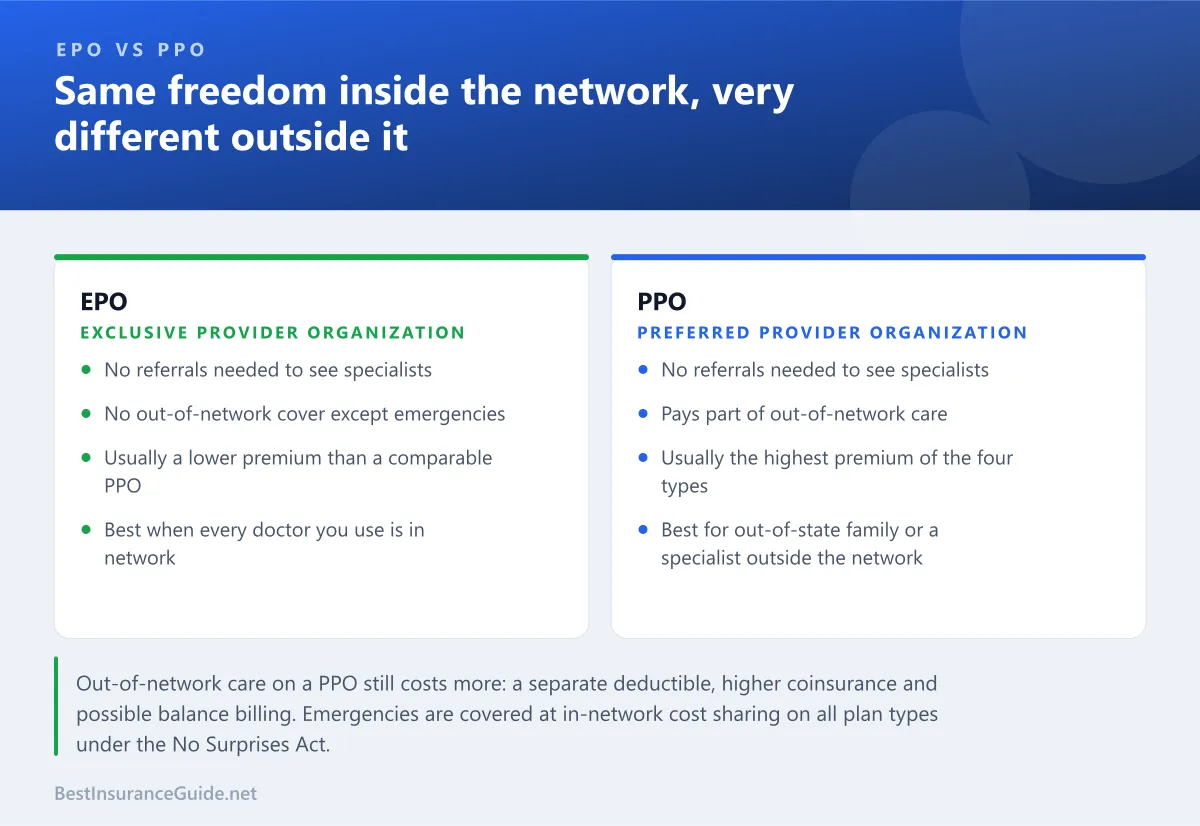
An exclusive provider organization (EPO) has a defined network of doctors and hospitals. You can usually see any in-network provider, including specialists, without a referral. But if you see a provider outside the network, the plan generally pays nothing, and you pay the full bill. The exception is emergency care, which must be covered.
EPOs are common on the ACA marketplace and increasingly offered by employers as a cheaper alternative to a PPO.
What is a PPO?
A preferred provider organization (PPO) also has a network and does not require referrals. The difference is that it pays part of the cost of out-of-network care. That usually means:
- a separate, higher out-of-network deductible;
- higher coinsurance, for example 40% or 50% instead of 20%;
- a separate out-of-pocket maximum, or sometimes none for out-of-network care;
- the possibility of balance billing, where an out-of-network provider charges you the difference between its price and what the plan considers reasonable.
So a PPO’s out-of-network coverage is a safety valve, not a cheap option. Our guide to what out of network means explains balance billing in detail.
Illustrative example
Illustrative. Priya’s daughter starts university in another state. Priya’s employer offers an EPO with a regional network and a PPO with a national network, at a $90 a month difference in Priya’s share of the premium.
- On the EPO, routine care for her daughter out of state, such as a specialist appointment or physiotherapy, is not covered unless the network extends there. Only emergencies are.
- On the PPO, the same care is covered either in the national network or, at higher cost, out of network.
For Priya, the $1,080 a year extra for the PPO may be worth it. For a single person whose doctors are all local and in the EPO network, it probably is not.
What is a POS plan?
A point of service (POS) plan is a hybrid of an HMO and a PPO:
- like an HMO, you usually choose a primary care physician and need referrals to see specialists;
- like a PPO, it pays part of the cost of out-of-network care, typically with higher cost sharing and sometimes a referral requirement even then.
The name comes from choosing, at the point of service, whether to stay in network. According to KFF, 9% of covered workers were in a POS plan in 2025. They suit people who like the co-ordination of a primary care doctor but want some out-of-network protection.
What is an HMO?
A health maintenance organization (HMO) covers care only from its network, apart from emergencies, and usually requires a primary care physician who refers you to specialists. HMOs often have the lowest premiums and simple copays, and some are built around a single medical group or health system.
KFF found 12% of covered workers were in an HMO in 2025, a figure that includes EPOs in KFF’s classification. Our article on HMO vs PPO and your insurance card goes further into HMOs and how to read your card.
Which plan types people actually have
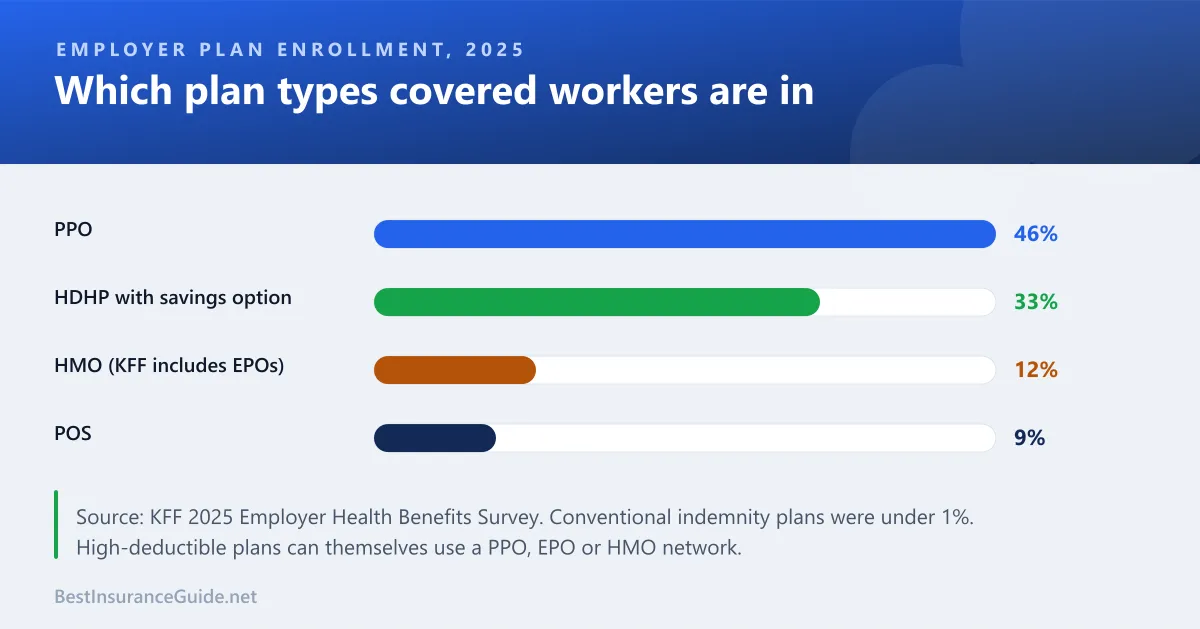
According to the KFF 2025 Employer Health Benefits Survey:
- PPOs remain the most common, covering 46% of workers with employer coverage.
- High-deductible plans with a savings option (HDHP/SO) cover 33%. Those plans are defined by their deductible and HSA or HRA, and they still use a PPO, EPO or HMO-style network underneath. Our HDHP vs PPO guide compares them.
- HMOs cover 12% and POS plans 9%.
KFF also reported that average 2025 PPO premiums were $9,818 for single coverage and $28,272 for family coverage, above the all-plan averages of $9,325 and $26,993.
On the ACA marketplace, the mix is different: in many areas most or all plans are HMOs or EPOs, and PPOs are scarce or expensive. If out-of-network coverage matters to you, filter by plan type when you shop.
How the premiums compare
The general rule is HMO < EPO < POS < PPO, because insurers can negotiate lower prices and control costs more tightly when you stay in network. But it is a rule of thumb, not a law:
- some HMOs and EPOs built around a strong hospital system have excellent networks at low prices;
- some PPOs with a high deductible cost less per month than an HMO with low copays;
- your employer’s contribution can make the plan with the higher sticker price cheaper for you.
Compare the total yearly cost: your share of the premium, plus the deductible and the copays you are likely to pay. Our explainer on deductible vs out-of-pocket maximum shows how to estimate a bad year.
Emergencies and surprise bills
Whatever the plan type, emergency care is covered, including at out-of-network hospitals. Under the federal No Surprises Act:
- you pay no more than your in-network cost sharing for emergency services;
- out-of-network providers cannot balance bill you for emergency care;
- the same protection applies to many out-of-network providers at in-network hospitals, such as anaesthetists, radiologists and assistant surgeons, unless you have given valid written consent.
That means an EPO’s lack of out-of-network cover mainly affects planned, non-emergency care: a specialist you choose, a second opinion at a distant hospital, or routine care for a family member who lives elsewhere.
How to choose: EPO, PPO, POS or HMO
Choose an EPO if:
- every doctor, specialist and hospital you use is in the network;
- you want to see specialists without referrals;
- you want a lower premium than the PPO.
Choose a PPO if:
- you need a specific out-of-network specialist or hospital;
- family members live, study or travel in other states;
- you value choice and can afford the higher premium.
Choose a POS plan if:
- you like having a primary care doctor co-ordinate your care;
- you want a safety valve for occasional out-of-network care.
Choose an HMO if:
- price matters most and you are comfortable with the network;
- you are happy to go through your primary care doctor for referrals.
Five checks before you sign up
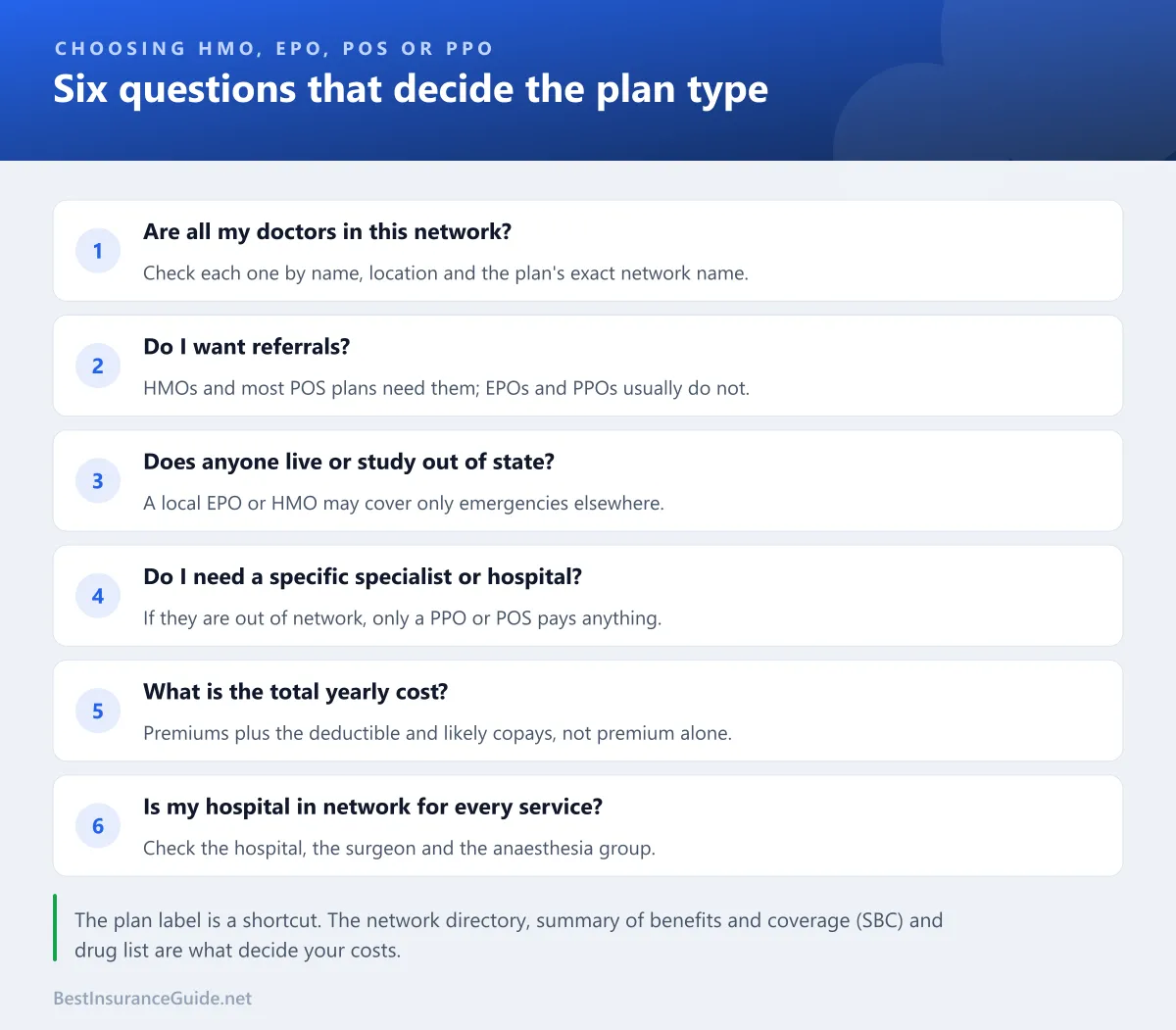
- Search the provider directory for each doctor by name, using the exact network name on the plan, because insurers sell several networks under one brand.
- Check your hospital and the doctors who work there, including the surgeon and anaesthesia group for any planned procedure.
- Check your prescriptions on the plan’s drug list.
- Read the summary of benefits and coverage (SBC) for referral, prior authorisation and out-of-network rules.
- Estimate the total cost for a quiet year and a bad year, not just the premium.
If you are covering yourself without an employer plan, our guide to ACA open enrollment for 2027 covers dates, subsidies and how to shop. Small employers choosing a plan for staff can read our small business health insurance guide.
Related reading
- HMO vs PPO and your insurance card explains referrals and what each number on your card means.
- HDHP vs PPO compares high-deductible plans with traditional PPOs.
- What out of network means covers balance billing and the No Surprises Act.
- Deductible vs out-of-pocket maximum helps you estimate total costs.
- Health insurance terms is a glossary of the jargon on plan documents.
Sources and notes
- KFF, 2025 Employer Health Benefits Survey: enrollment by plan type (PPO 46%, HDHP/SO 33%, HMO 12%, POS 9%) and average premiums. KFF groups EPOs with HMOs. KFF’s 2026 survey is due October 22, 2026.
- HealthCare.gov: open enrollment dates for 2027 coverage; some state exchanges have different deadlines.
- No Surprises Act (federal law, in effect since January 1, 2022): emergency care and out-of-network providers at in-network facilities.
- Plan features describe typical designs. Individual plans vary, so check each plan’s summary of benefits and coverage.
- The worked example uses hypothetical figures.
This article is general information, not personalised insurance advice. Check each plan’s network, drug list and summary of benefits before you enroll.