HDHP vs PPO: Which Health Plan Costs Less for You?
HDHP vs PPO compared: premiums, deductibles, HSAs and networks. What an HDHP is, 2027 IRS limits, and worked cost examples to pick the right plan.

Table of contents

An HDHP and a PPO are the two choices most workers see at open enrollment, and they spread the same costs in very different ways. A high-deductible health plan (HDHP) takes less from every paycheck and lets you open a tax-free health savings account (HSA), but you pay more yourself before the plan starts sharing costs. A preferred provider organization (PPO) costs more each month but less when you visit a doctor, fill a prescription or end up in hospital.
Neither is better for everyone. This guide explains what each plan is, where the money goes in a quiet year and a bad one, and how to choose using the numbers in your own enrollment materials.
This site is independent and not affiliated with any insurer or employer.
HDHP vs PPO at a glance
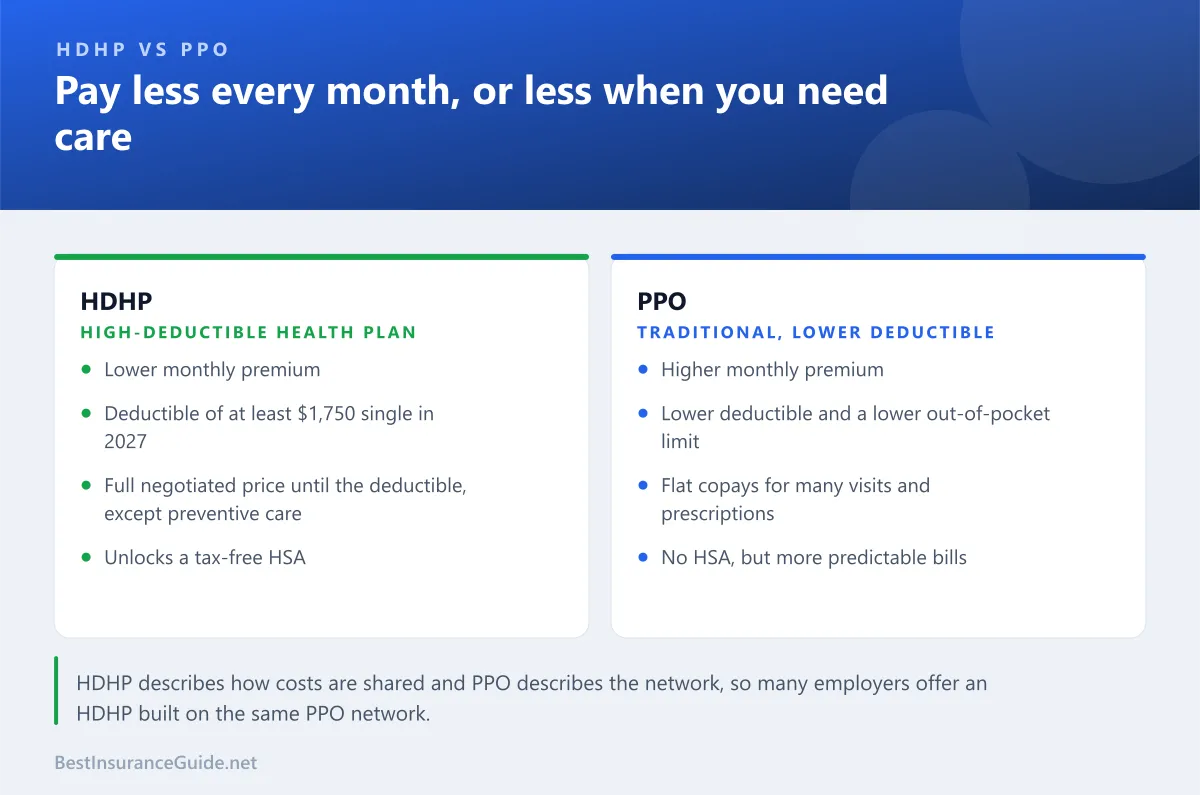
| Feature | HDHP (high-deductible health plan) | PPO (traditional) |
|---|---|---|
| Monthly premium | Lower | Higher |
| Deductible | Higher. At least $1,750 single / $3,500 family in 2027 | Lower, sometimes none for office visits |
| Routine doctor visits | You usually pay the full negotiated price until the deductible is met | Often a flat copay, such as $25–$40 |
| Prescriptions | Usually full price until the deductible, except preventive drugs | Usually a copay tier |
| Preventive care | Covered, usually at no cost in network | Covered, usually at no cost in network |
| Health savings account | Yes, if the plan is HSA-qualified | No |
| Out-of-network care | Depends on the network. Many HDHPs use a PPO network | Usually covered, at a higher cost |
| Best for | Low expected use, savings on hand, an employer HSA contribution | Frequent care, predictable bills, low tolerance for surprises |
The KFF 2025 Employer Health Benefits Survey found that 46% of covered workers are in a PPO and 33% are in a high-deductible plan with a savings option. HMOs (12%) and POS plans (9%) make up most of the rest.
What is an HDHP?
A high-deductible health plan is any health plan with a deductible higher than a traditional plan’s. “HDHP” usually means a plan that meets the IRS definition, because that is what makes you eligible for an HSA. Those IRS limits change every year:
| IRS limit | 2026 | 2027 |
|---|---|---|
| Minimum deductible, self-only | $1,700 | $1,750 |
| Minimum deductible, family | $3,400 | $3,500 |
| Maximum out-of-pocket, self-only | $8,500 | $8,700 |
| Maximum out-of-pocket, family | $17,000 | $17,400 |
Source: IRS Revenue Procedure 2026-24 (2027) and the prior year’s revenue procedure (2026).
So “high-deductible” sets a floor, not a ceiling. Many employer HDHPs have deductibles well above the minimum.
Since 2026, bronze and catastrophic plans bought on an ACA marketplace are treated as HSA-compatible too, even if they don’t meet every HDHP rule. That matters if you buy your own coverage at ACA open enrollment.
What an HDHP pays before the deductible
A common worry is that an HDHP pays nothing until you’ve spent thousands. That’s not quite right. HDHPs can, and most do, cover these before the deductible:
- Preventive care, such as annual physicals, screenings and most vaccines, usually at no cost in network under the Affordable Care Act.
- Certain chronic-condition medications and supplies that IRS guidance treats as preventive, such as blood pressure and cholesterol drugs for people with those conditions. Whether a plan covers them pre-deductible is up to the plan.
- Insulin. Plans may cover selected insulin products before the deductible.
- Telehealth, which HDHPs may cover before the deductible, made permanent from 2025.
What you do pay in full until the deductible is everything else: sick visits, urgent care, most prescriptions, lab work, imaging and hospital care. You pay the plan’s negotiated rate, not the provider’s list price, which is still a real discount.
What is a PPO?
A preferred provider organization is a plan built around a network of doctors and hospitals that have agreed to discounted rates. Its defining features are about access:
- You can see specialists without a referral.
- Out-of-network care is covered, though you pay more and may be billed the difference.
- Routine services often come with fixed copays rather than counting toward a deductible.
The cost of that flexibility is a higher premium. Our guide to HMO vs PPO covers how PPOs compare with HMOs, and what out-of-network means explains the cost of going outside the network.
HDHP vs PPO isn’t really either-or
Strictly speaking, “HDHP” describes how you share costs, while “PPO” describes the network. Many employers offer a “PPO HDHP” or “HSA PPO” that uses the same PPO network as their traditional plan. When your benefits portal shows “HDHP vs PPO”, it is usually comparing:
- a high-deductible PPO with an HSA, and
- a traditional, low-deductible PPO with copays.
If both use the same network, your doctors are the same either way. The decision is purely about cost. Check the network name in each plan summary to confirm.
Where the money goes: premiums vs out-of-pocket costs
Every plan has two kinds of cost:
- Fixed costs: premiums. You pay them every month whether you use care or not.
- Variable costs: deductibles, copays and coinsurance. You pay them only when you use care, up to the plan’s out-of-pocket maximum.
An HDHP lowers the fixed cost and raises the variable cost. A PPO does the reverse. Your total annual cost is premiums plus what you spend on care, minus any employer HSA contribution and tax savings. That’s the number to compare, not the deductible alone. Our guide to deductibles vs out-of-pocket maximums walks through how those limits fit together.
Worked example: one employee, three kinds of year
Here are two hypothetical single-coverage plans of the kind many employers offer. Use your own plan’s figures, because the result depends entirely on them.
| Traditional PPO | HDHP with HSA | |
|---|---|---|
| Your premium | $200 a month ($2,400 a year) | $100 a month ($1,200 a year) |
| Deductible | $1,000 | $3,000 |
| Coinsurance after deductible | 20% | 20% |
| Out-of-pocket maximum | $4,000 | $7,000 |
| Employer HSA contribution | None | $1,000 |
To keep the comparison simple, we assume all care counts toward the deductible in both plans. In reality the PPO’s office-visit copays would make routine visits cheaper.
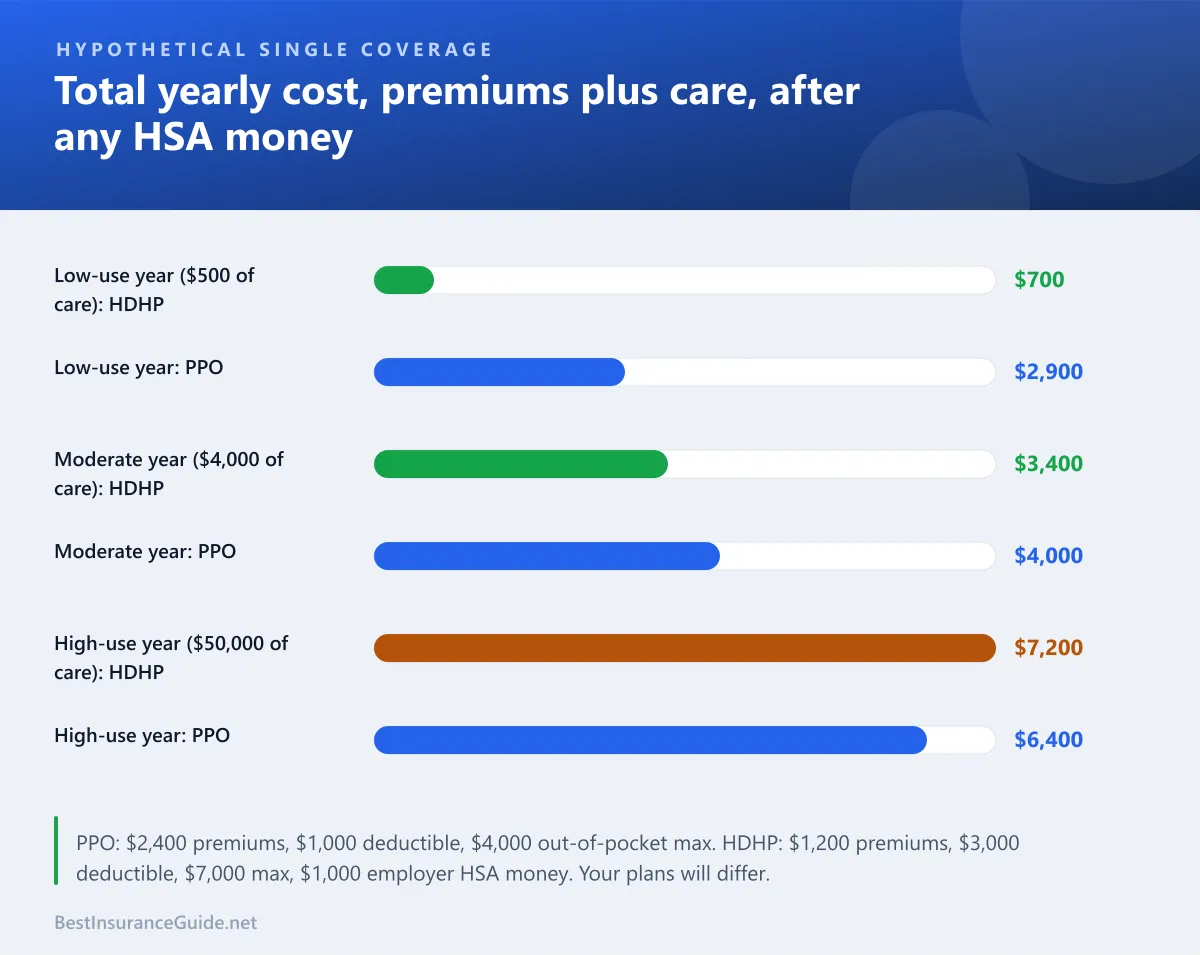
A low-use year: $500 of care. Mostly a checkup, which is free in both plans, plus a sick visit and a prescription.
- PPO: $2,400 premiums + $500 = $2,900
- HDHP: $1,200 premiums + $500 − $1,000 HSA contribution = $700
A moderate year: $4,000 of care. Say an MRI, physical therapy and a few visits.
- PPO: $2,400 + $1,000 deductible + 20% of $3,000 ($600) = $4,000
- HDHP: $1,200 + $3,000 deductible + 20% of $1,000 ($200) − $1,000 = $3,400
A high-use year: $50,000 of care, such as a surgery and hospital stay.
- PPO: $2,400 + $4,000 out-of-pocket maximum = $6,400
- HDHP: $1,200 + $7,000 out-of-pocket maximum − $1,000 = $7,200
In this example the HDHP wins comfortably in a quiet year, still wins in a moderate one, and loses by $800 in a bad one. Two things would widen its lead:
- Tax savings on your own HSA contributions. Putting $2,000 of your pay into the HSA saves roughly $590 in federal income and payroll tax in the 22% bracket.
- The money you don’t spend stays yours. Unused HSA dollars roll over and can be invested.
What would flip the result is a plan pair with a small premium gap, no employer HSA contribution, or a much higher HDHP out-of-pocket maximum.
A quick break-even check
Add up the HDHP’s built-in advantage: annual premium savings + employer HSA contribution. In the example that’s $1,200 + $1,000 = $2,200. Then compare it with the difference in out-of-pocket maximums ($7,000 − $4,000 = $3,000). If the advantage covers most of that gap, the HDHP’s worst case is only slightly worse than the PPO’s, and its typical case is much better.
Who should choose an HDHP
An HDHP is often the better pick if you:
- are generally healthy and expect little care beyond checkups;
- have emergency savings that could cover the deductible without borrowing;
- get an employer HSA contribution, which works like extra pay;
- want to build an HSA as a tax-free fund for future medical costs or retirement;
- are comfortable comparing prices for non-urgent care.
Who should choose a PPO
A PPO tends to make more sense if you:
- have a chronic condition, ongoing therapy or expensive regular prescriptions;
- are planning a pregnancy, surgery or other major care next year;
- would struggle to pay a large deductible at short notice;
- see specialists often, or value out-of-network coverage;
- simply prefer predictable copays to paying full price until the deductible.
For people who expect to hit the out-of-pocket maximum, the comparison is simpler: premiums plus the out-of-pocket maximum, minus any HSA contribution, for each plan. Our guide to what happens when you meet your deductible explains what changes once you reach those limits.
HDHP vs PPO for families
Family coverage changes the math in two ways:
- More people, more care. A family is likelier to have at least one moderate or high-use year, which narrows the HDHP’s advantage.
- How the deductible is shared. Many family HDHPs use an aggregate deductible, where the whole family deductible must be met before the plan pays for anyone. Others use an embedded deductible, where each person also has an individual deductible. Under IRS rules, an embedded individual deductible on an HSA-qualified plan can’t be lower than the minimum family deductible, which is $3,500 in 2027.
The family HSA limit is also higher, $9,000 for 2027, so the tax benefit grows if you can afford to fund it.
Where an HMO fits in
Some employers offer a third option: an HMO. An HMO usually has the lowest premiums and modest copays, but you pick a primary care doctor, need referrals for specialists and get no coverage outside the network except in emergencies. Like a PPO, it can come in a high-deductible version too.
| HDHP with HSA | Traditional PPO | HMO | |
|---|---|---|---|
| Premium | Low | High | Low to moderate |
| Cost when you use care | High until the deductible | Low to moderate | Low to moderate |
| Referrals needed | Depends on the network | No | Usually yes |
| Out-of-network coverage | Depends on the network | Yes, at a higher cost | Emergencies only |
| HSA | Yes | No | Only if it’s an HSA-qualified HMO |
If your doctors are all in the HMO’s network and you don’t mind referrals, an HMO can beat both options on total cost for a moderate year. Our HMO vs PPO guide covers that trade-off.
Questions to ask before you pick
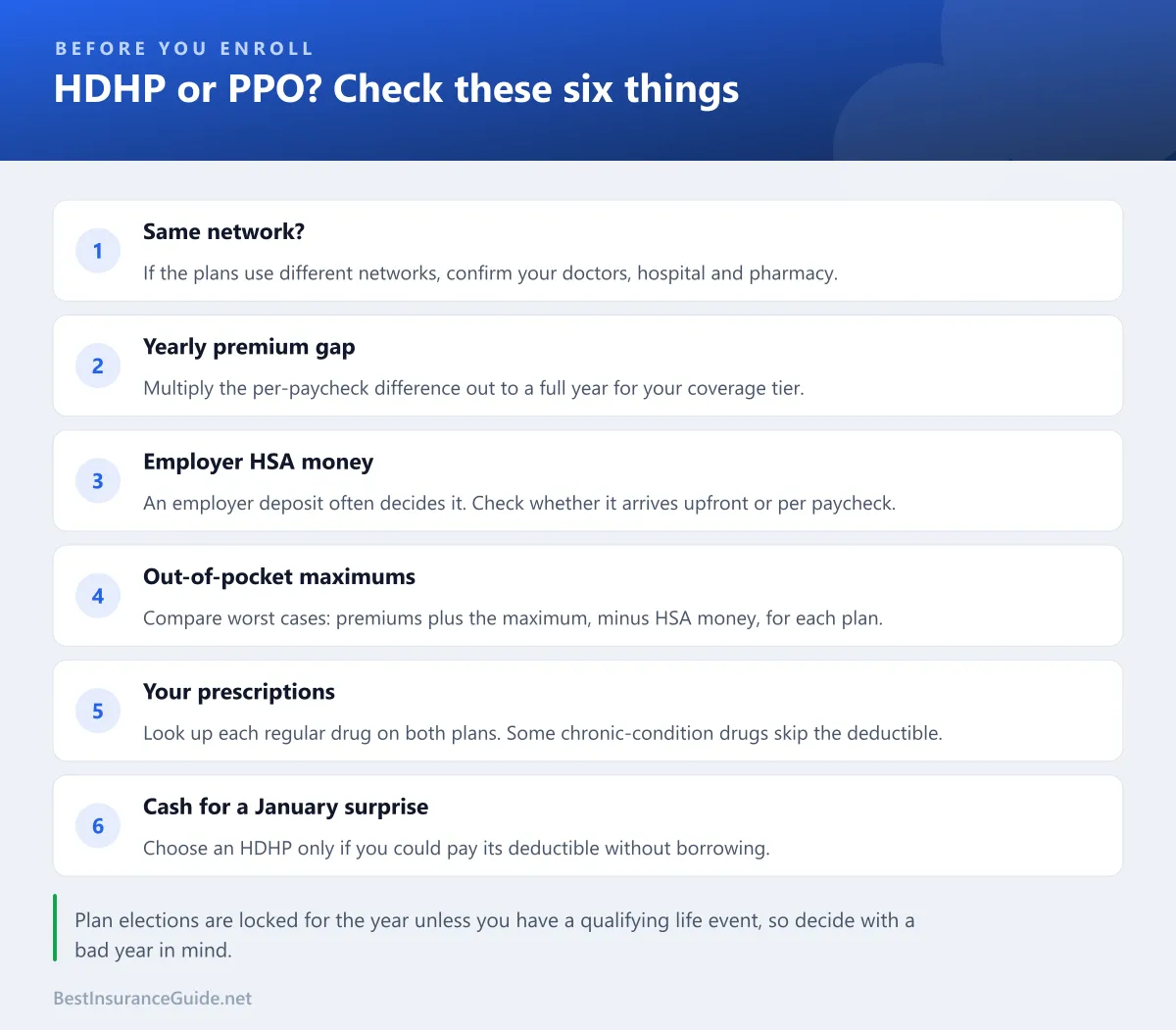
- Do both plans use the same network? If not, check that your doctors, hospital and pharmacy are in network.
- What is the yearly premium difference for your coverage tier?
- Will your employer contribute to an HSA, and is it paid upfront or spread through the year?
- What are the out-of-pocket maximums? Compare worst cases, not just deductibles.
- How are your prescriptions covered on each plan’s drug list?
- Can you cover the HDHP deductible from savings if something happens in January?
Common mistakes
- Comparing deductibles instead of total cost. A higher deductible can still mean a lower total bill.
- Ignoring the employer HSA contribution. It is often the deciding factor.
- Picking an HDHP and then skipping care. Preventive care is still covered. Delaying needed care to save money can cost more later.
- Choosing an HDHP without funding the HSA. Without the tax savings, much of the advantage disappears.
- Forgetting that the choice is locked. You generally can’t switch until next open enrollment unless you have a qualifying life event.
The bottom line
If you’re healthy, have savings and your employer puts money in an HSA, an HDHP is often the cheaper plan over time. If you expect heavy care or need predictable costs, a PPO buys peace of mind. Either way, compare total yearly cost in a typical year and a bad year, then pick the plan whose worst case you can afford.
Related reading
If you choose an HDHP, read HSA vs FSA next, then HSA contribution limits for 2027. For the basics, see what a deductible is, health insurance terms explained and whether prescriptions count towards your deductible.
Sources and notes
- IRS Revenue Procedure 2026-24: 2027 HDHP minimum deductibles, out-of-pocket maximums and HSA limits.
- IRS Publication 969: HDHP and HSA eligibility rules, including preventive care and the embedded-deductible rule.
- KFF 2025 Employer Health Benefits Survey: plan enrollment by type, an average single deductible of $1,886, and average premiums of $9,325 for single and $26,993 for family coverage.
- The plan examples in this article are hypothetical, chosen to illustrate the trade-off. Your employer’s premiums, deductibles and HSA contribution will differ.
This article is general information, not financial, tax or medical advice. Check your plan documents for exact benefits and costs.