How Long Is COBRA Coverage? 18 Months, Sometimes 36
How long COBRA lasts by qualifying event, the 18 and 36 month periods, disability and second event extensions, and the deadlines that matter most.

Table of contents

The duration question has a short answer and the deadlines question matters more. Both are worth getting right in the same week.
The two periods
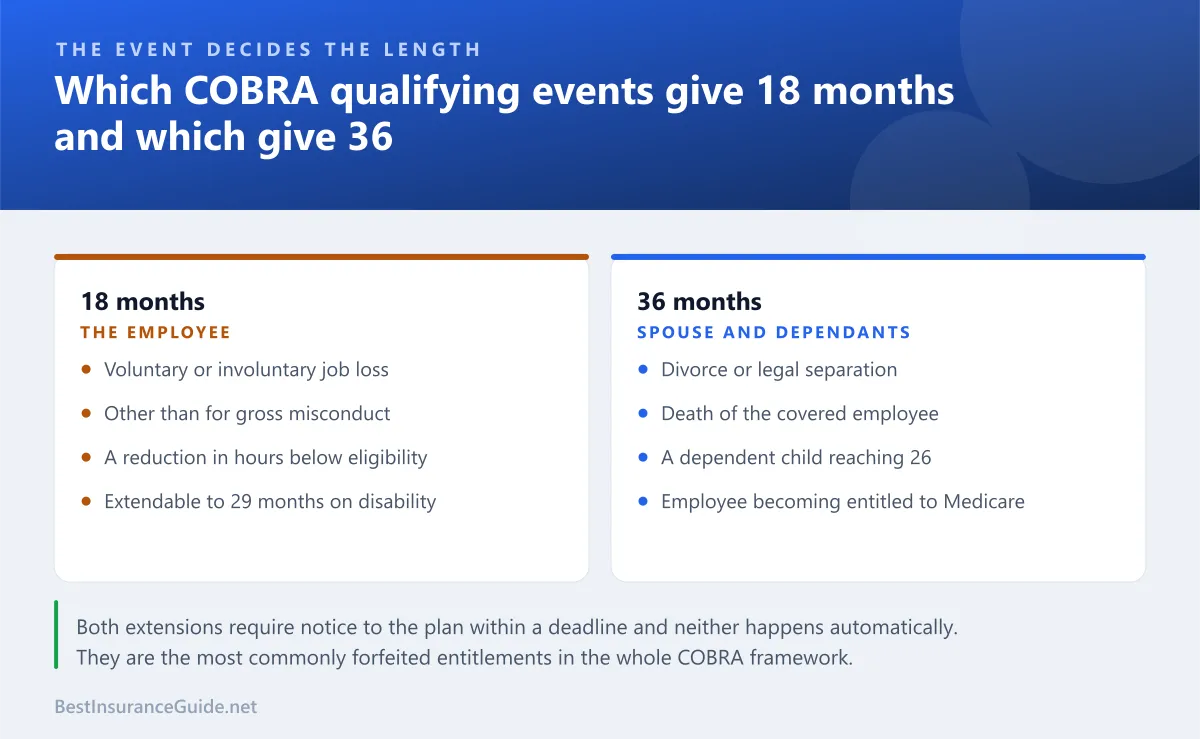
18 months is the standard, following the two most common qualifying events for an employee:
Voluntary or involuntary job loss, other than for gross misconduct.
A reduction in hours below the plan’s eligibility threshold.
36 months applies to a spouse or dependent child following certain other events:
Divorce or legal separation from the covered employee.
Death of the covered employee.
A dependent child ageing off the plan, which is at 26 under current rules.
The covered employee becoming entitled to Medicare, in defined circumstances.
The two extensions
Both exist, both are underused, and both require notice within a deadline.
Disability extension, to 29 months. If a qualified beneficiary is determined by the Social Security Administration to have been disabled at some point during the first 60 days of COBRA coverage, the 18-month period can extend to 29 months for the whole family unit. The determination must be provided to the plan within 60 days of receiving it and before the initial 18 months ends. The premium for the extension months can be higher.
Second qualifying event, to 36 months. If a second qualifying event occurs during the initial 18-month period — for example the employee dies, or the couple divorces — a spouse or dependent’s coverage can extend to a total of 36 months from the original event. Notice must be given to the plan, commonly within 60 days.
Both extensions turn on notifying the plan in time, and neither happens automatically. This is the most commonly forfeited entitlement in the whole COBRA framework.
The deadlines that actually matter
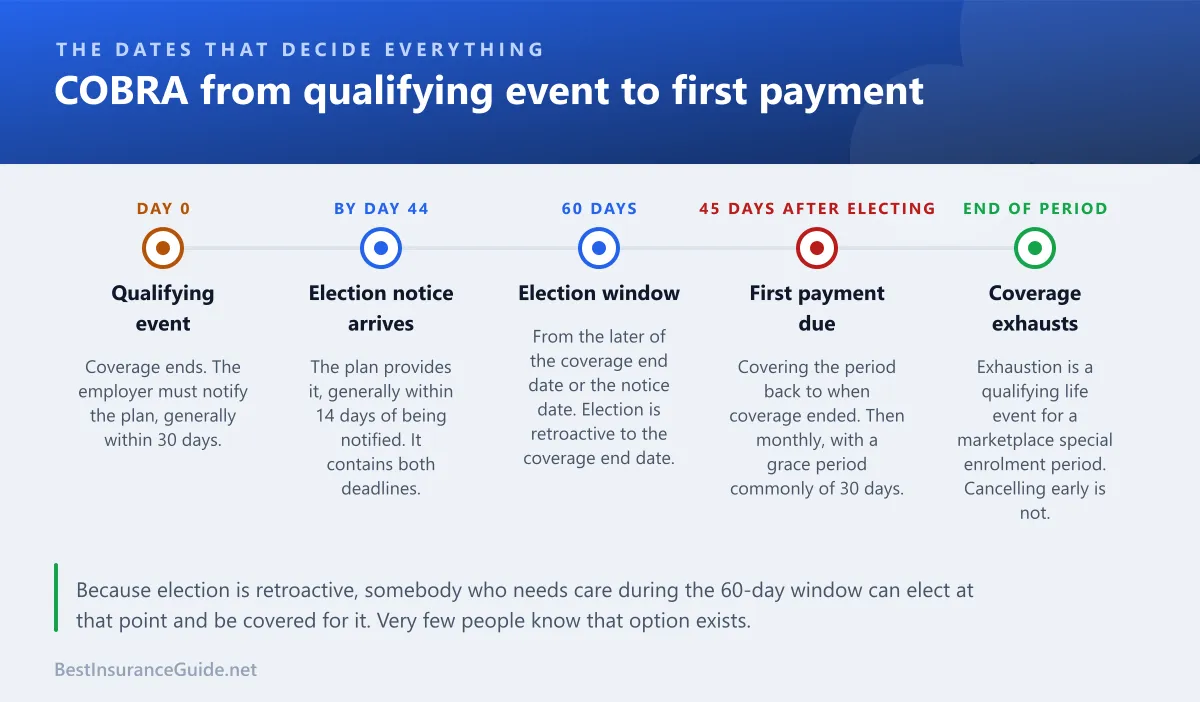
The employer must notify the plan of a qualifying event, generally within 30 days.
The plan must provide an election notice, generally within 14 days after that.
You have 60 days to elect, from the later of the date coverage would end or the date the notice is provided.
You have 45 days from electing to make the first payment, which covers the period back to the date coverage ended.
Subsequent payments are monthly, with a grace period commonly of 30 days.
Two features of that structure are genuinely useful.
Election is retroactive. Coverage runs from the date the old coverage ended, not from the date you elected. That means you can take most of the 60 days to decide, and if nothing happens medically in the meantime, you have lost nothing by waiting.
You can wait and still be covered. The practical version of the above: somebody who needs care during the election window can elect then, retroactively, and be covered for it. That is a real option and very few people know it exists.
The corresponding risk is that a missed payment ends coverage permanently. There is no reinstatement, and the grace period is the whole of the flexibility.
When it ends early
COBRA can terminate before the maximum period in five situations.
Non-payment, beyond the grace period.
The employer ceasing to provide any group health plan to any employees.
Becoming entitled to Medicare after electing COBRA.
Obtaining other group health coverage, such as a new employer’s plan.
Cessation of a disability where the extension was based on it.
Note what is not on that list: getting a new job is not itself a termination event, only becoming covered under the new employer’s plan is.
COBRA against the alternatives
The duration question usually sits inside a bigger decision, and the comparison is worth making properly before the election deadline.
COBRA keeps everything. Same plan, same network, same providers, same formulary, and crucially the same accumulated deductible and out-of-pocket maximum for the plan year. Somebody who has met most of a deductible before losing a job is in a materially different position from somebody who has not.
COBRA costs the full unsubsidised premium plus an administrative charge, commonly up to 2%, or up to 50% during a disability extension. It is expensive because you are now paying the employer’s share as well as your own. Our guide to COBRA insurance cost sets out the arithmetic.
A marketplace plan may be far cheaper with subsidies, which are based on income. Somebody whose income has just dropped may qualify for substantial help.
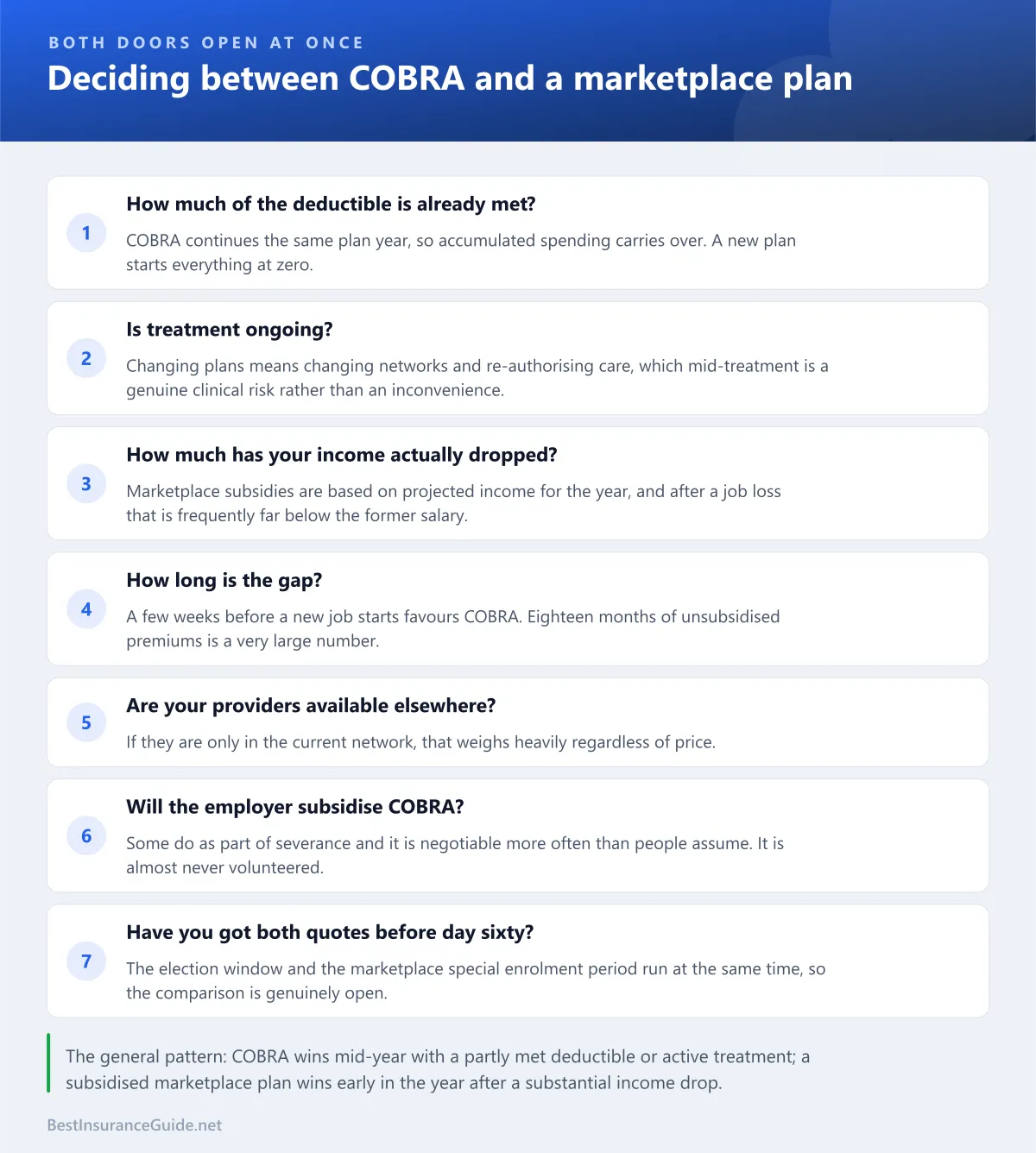
Losing job-based coverage is a qualifying event for a marketplace special enrolment period, so both doors are open at the same moment.
Three situations where COBRA usually wins.
Mid-treatment, where changing plans means changing providers or re-authorising care.
Deductible substantially met, where starting again at zero on a new plan wastes what has been spent.
A short gap, where a new job starts in a few weeks and continuity is worth more than the premium.
Three where a marketplace plan usually wins.
A large income drop, which produces a substantial subsidy.
Early in the plan year, with little accumulated toward the deductible.
A long gap, where 18 months of unsubsidised premiums is a very large number.
Practical points
Do not ignore the election notice. It arrives at a bad time and it contains a hard deadline.
Compare both options before the 60 days expire, using an actual marketplace quote at your current projected income rather than an assumption.
If you elect, set up the payments so they cannot fail. A missed payment beyond the grace period ends coverage with no route back.
If you have a disability determination, provide it to the plan immediately, and within the deadline.
Tell the plan promptly about a second qualifying event, for the same reason.
Track the end date, and start the transition to whatever follows a couple of months before it, since the end of COBRA is itself a qualifying event for a special enrolment period.
The short version
COBRA runs for 18 months after job loss or a reduction in hours, and up to 36 months for a spouse or dependent after divorce, death, or a child ageing off the plan.
Two extensions exist. A disability determination covering the first 60 days extends it to 29 months, and a second qualifying event extends a dependent’s coverage to 36. Both require notice within a deadline and both are routinely forfeited.
You have 60 days to elect and coverage is retroactive, which means the decision can wait while you compare a marketplace plan. Once elected, a missed payment beyond the grace period ends it permanently.
The strongest argument for COBRA is continuity: the same providers, and the deductible and out-of-pocket maximum you have already partly met. The strongest argument against it is the cost, which a marketplace subsidy frequently beats comfortably.
For the cost side, see COBRA insurance cost, and for cover options generally, health insurance without a job.
State continuation, for smaller employers
Federal COBRA generally applies to employers with 20 or more employees. Below that threshold, a different framework may apply.
Most states operate their own continuation laws, frequently called mini-COBRA, covering smaller employers.
Three things differ.
The duration is usually shorter, commonly three to eighteen months depending on the state.
The qualifying events and eligibility rules vary, and are set by state law rather than federally.
The administration differs, sometimes handled by the insurer rather than the employer.
If you worked for a small employer and were told COBRA does not apply, ask specifically about state continuation, because it frequently does and it is not always volunteered.
Two things to do in the first week
Read the election notice properly and write down the two dates that matter: the election deadline, and the deadline for the first payment.
Get a marketplace quote at your projected income for the year, which is the comparison that decides whether COBRA is the right purchase. Losing job-based coverage opens a special enrolment period at the same time as the COBRA election window, so both options are live simultaneously and the choice is genuinely open.
Doing both in the first week rather than the eighth leaves time to decide properly, and the retroactive nature of COBRA election means nothing is lost by taking that time.
Planning the end of COBRA
Because COBRA is finite, the end of it needs planning in the same way the start did.
The end of COBRA is a qualifying life event, opening a marketplace special enrolment period. Exhausting the maximum period counts; voluntarily dropping it partway does not.
That distinction matters enormously. Somebody who cancels COBRA in month ten because it is expensive has not created a qualifying event, and may be unable to enrol anywhere until open enrolment. Somebody whose COBRA runs to its maximum has a clean route into a marketplace plan.
Start the transition two months before the end date. Get a marketplace quote at current projected income, check whether an employer plan is now available, and check Medicaid eligibility if income is low.
Do not let it simply lapse without a plan, which is the outcome that produces a gap.
Two things to confirm with the plan administrator
The exact maximum coverage date, in writing, because the calculation runs from the qualifying event rather than from the election.
Whether any extension applies to your circumstances, particularly a disability determination or a second qualifying event, both of which have their own notice deadlines and are routinely forfeited by people who did not know they existed.
The election decision, summarised
Elect COBRA when you are mid-treatment, when a substantial part of the deductible or out-of-pocket maximum is already met, when the gap is short before new coverage starts, or when your providers are not available on any plan you could buy.
Choose a marketplace plan when income has dropped enough to produce a meaningful subsidy, when it is early in the plan year with little accumulated, or when the gap is long and eighteen months of unsubsidised premiums is a very large number.
Do both calculations before the sixtieth day, because the election window and the marketplace special enrolment period run at the same time and coverage under COBRA is retroactive either way.
Two dates to write down today
The election deadline, which is generally 60 days from the later of the coverage end date or the notice date, and which is absolute.
The maximum coverage end date, which runs from the qualifying event rather than the election, and which is itself a qualifying life event for a marketplace special enrolment period when reached by exhaustion rather than by cancellation.
Those two dates govern the entire decision, and both are stated on documents you have already been sent.
One more thing about the retroactive election
The retroactive nature of a COBRA election is unusual enough to state twice, because very few people use it deliberately.
Coverage runs from the date the old coverage ended, not from the date you elect. Somebody who has not elected and then needs care during the 60-day window can elect at that point, pay the back premiums, and be covered for the treatment.
That makes the election window a genuine option rather than a deadline to guess against, and it is the reason there is no need to rush the decision in the first week. What there is a need to do is diarise the deadline, because the option disappears entirely once it passes.
A note on scope
Nothing here is legal or financial advice. COBRA rules, deadlines, extension provisions and state continuation laws that apply to smaller employers vary and change over time, and some employers and plans are outside the federal framework entirely.
The Department of Labor publishes the authoritative COBRA guidance for employees, your plan administrator is the authoritative source on your specific plan and deadlines, and HealthCare.gov publishes marketplace special enrolment information. This site is independent and not affiliated with any insurer.