HSA vs FSA: The Difference, Which Is Better, and Can You Have Both?
FSA vs HSA explained: 2027 limits, who qualifies, rollover, taxes and when you can have both. Plus HRA vs HSA vs FSA and how to choose at open enrollment.

Table of contents

An HSA and an FSA both let you pay for medical bills with money that is never taxed, but they work in almost opposite ways. A health savings account (HSA) is yours to keep, roll over and invest, but you can only put money in while you are on a qualifying high-deductible health plan. A flexible spending account (FSA) works with nearly any employer plan and gives you the whole year’s money upfront, but anything you don’t spend is mostly lost.
Open enrollment is when most people have to pick, and the choice is often made in a hurry on a benefits portal. This guide sets out the differences side by side, uses the 2027 limits, and walks through who should use which account, and when you can have both.
This site is independent and not affiliated with the IRS, any employer or any account provider.
HSA vs FSA at a glance
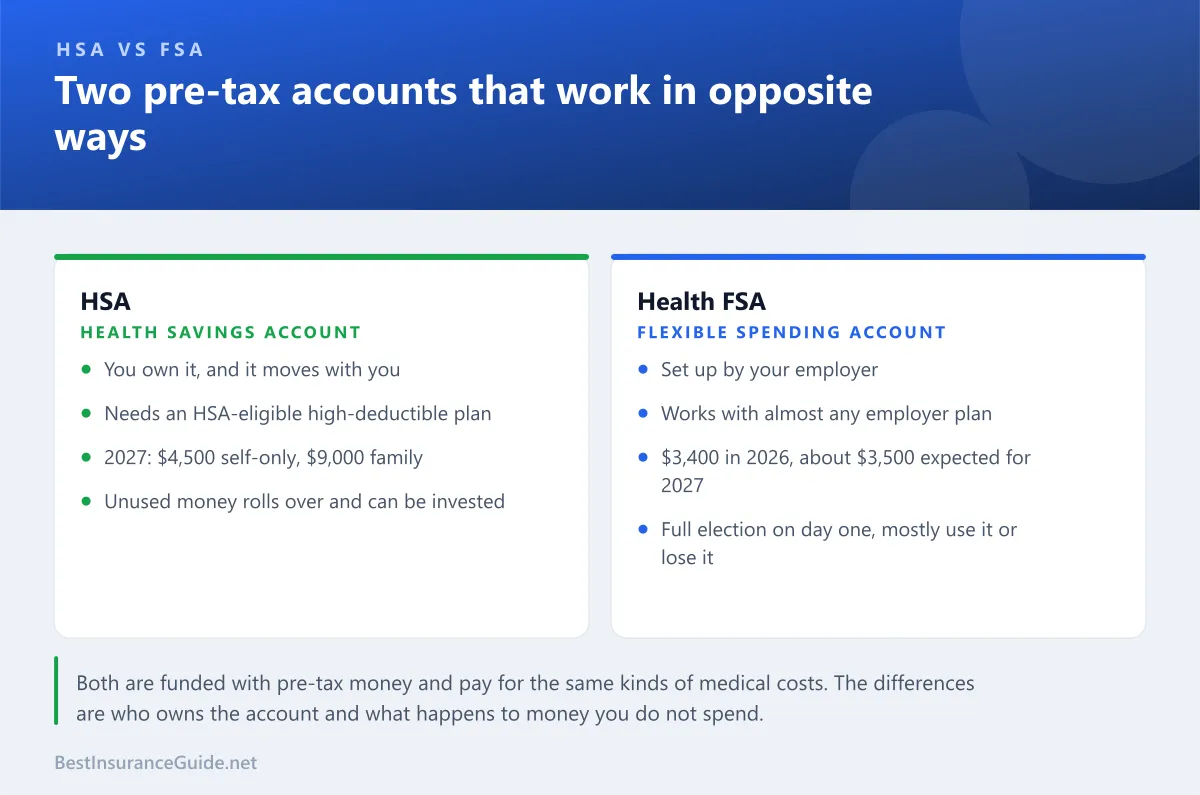
| Feature | HSA (health savings account) | Health FSA (flexible spending account) |
|---|---|---|
| Who owns it | You. It’s a personal account | Your employer’s plan |
| Health plan required | An HSA-eligible high-deductible plan (HDHP), or a bronze or catastrophic marketplace plan | Almost any employer plan |
| 2027 contribution limit | $4,500 self-only / $9,000 family, +$1,000 at 55+ | $3,400 in 2026; 2027 projected ≈$3,500 |
| Who can contribute | You, your employer, anyone on your behalf | You through payroll; your employer may add some |
| Money available | Only what has been deposited so far | Your full annual election from day one |
| Unused money | Rolls over forever | Forfeited, apart from a small carryover or grace period if your plan offers one |
| Invest the balance? | Usually, yes | No |
| Change contributions mid-year? | Yes | Only after a qualifying life event |
| If you leave your job | The account goes with you | Usually ends |
| Self-employed? | Yes, with an eligible plan | No |
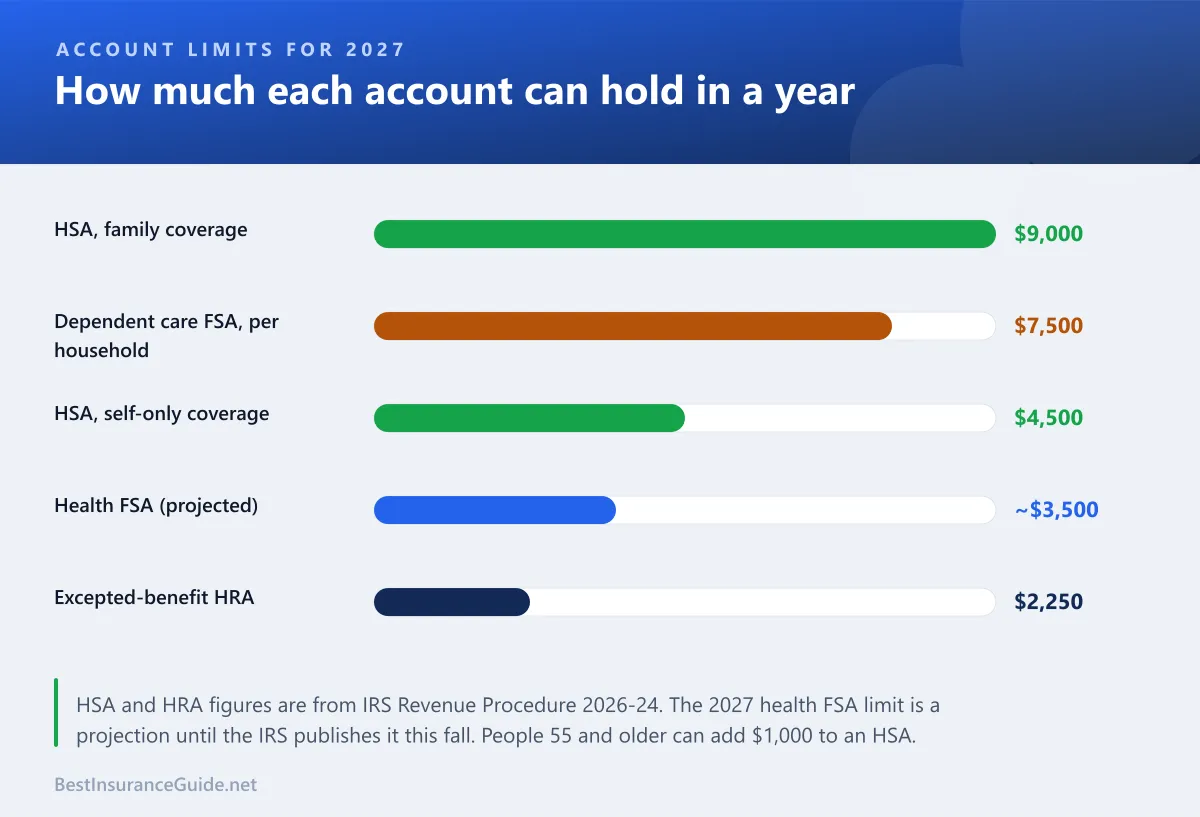
2027 HSA figures: IRS Revenue Procedure 2026-24. 2026 health FSA figure: IRS Revenue Procedure 2025-32. The IRS publishes the 2027 health FSA limit in the fall.
What is an HSA?
A health savings account is a tax-advantaged savings account for medical costs. You open it, usually through your employer or with a bank or brokerage that offers HSAs, and it stays in your name for life.
Its main appeal is the triple tax advantage:
- Money goes in tax-free. Payroll contributions skip federal income tax and the 7.65% Social Security and Medicare tax. Contributions you make directly are deductible on your tax return.
- It grows tax-free. Most HSAs let you invest the balance in funds once it passes a minimum.
- It comes out tax-free when you spend it on qualified medical expenses.
No other common account gets all three. The catch is eligibility. To contribute for a given month you must be covered by an HSA-eligible health plan on the first day of that month, have no other disqualifying coverage, not be enrolled in Medicare and not be claimed as someone’s dependent.
For 2027, an HSA-eligible high-deductible plan must have a deductible of at least $1,750 for self-only or $3,500 for family coverage. Its out-of-pocket maximum can be no higher than $8,700 or $17,400. Since 2026, bronze and catastrophic plans bought through an ACA marketplace also count as HSA-compatible. That matters for anyone choosing a lower-premium plan at ACA open enrollment.
What is an FSA?
A flexible spending account is a benefit your employer sets up. You choose an annual amount during open enrollment, and it is taken from your paychecks in equal pre-tax amounts over the year. You then use the account to pay deductibles, copays, prescriptions, dental work, glasses and similar costs.
Two features set it apart:
- The uniform coverage rule. Your full election is available from the first day of the plan year. Elect $3,000, need $3,000 of dental work in February, and the FSA pays it all, even though you’ve only paid in a few hundred dollars so far.
- Use it or lose it. Money left at the end of the plan year is forfeited, with two possible softeners. Your employer can allow a carryover of a limited amount ($680 from 2026 into 2027) or a grace period of up to two and a half months to spend it, but not both.
There are also two specialist FSAs:
- A limited-purpose FSA pays only for dental and vision costs, so it can sit alongside an HSA.
- A dependent care FSA is for child or adult day care, not medical bills, and its limit is now $7,500 per household.
Our guide to FSA limits for 2027 covers each one in detail.
The key differences, explained
1. Ownership and portability
This is the biggest practical difference. Your HSA is yours. If you change jobs, retire or get laid off, the money comes with you, including anything your employer contributed. An FSA belongs to your employer’s plan. When you leave, you generally lose access for new expenses, and anything you haven’t claimed is forfeited unless you continue the FSA under COBRA.
2. Who can open one
An FSA is available to almost any employee whose employer offers it, whatever their health plan. An HSA depends on your health plan. If your plan isn’t HSA-eligible, an HSA simply isn’t on the table that year, and the FSA is your only pre-tax option for medical costs.
3. How much you can put in
The HSA limit is higher. For 2027 it is $4,500 for self-only coverage and $9,000 for family coverage. People who are 55 or older can add $1,000 on top. The health FSA limit is per employee, so two spouses with their own workplace FSAs can each contribute the maximum. The HSA family limit, by contrast, is shared between spouses.
4. When the money is available
An FSA front-loads your money: the full year’s election is available on January 1. An HSA only lets you spend what has actually been deposited. If you have a large planned bill early in the year, such as a surgery, a birth or braces, an FSA can be easier on cash flow.
That said, you can reimburse yourself from an HSA at any time later for a qualified expense incurred after the account was opened, as long as you keep the receipt. Some people pay medical bills out of pocket, leave the HSA invested, and reimburse themselves years later.
5. What happens to unused money
HSA money never expires. FSA money mostly does. That one rule changes how you should use each account:
- With an FSA, elect only what you’re confident you’ll spend. Base it on predictable costs such as regular prescriptions, glasses, planned dental work and your deductible if you usually meet it.
- With an HSA, it can make sense to contribute the maximum even if you won’t spend it this year, because the balance keeps growing.
6. Changing your mind
You can change your HSA contribution during the year, usually through your payroll portal. An FSA election is locked for the plan year unless you have a qualifying life event, such as marriage, divorce, a birth or adoption, or a change in employment that affects eligibility.
Taxes: how much each account saves
Both accounts save the same tax on each dollar contributed through payroll. Here is a simplified example for someone in the 22% federal bracket, using payroll contributions, which also avoid the 7.65% Social Security and Medicare tax.
| Account | Contribution | Federal tax saved (approx.) |
|---|---|---|
| Health FSA (2026 limit) | $3,400 | ≈$1,008 |
| HSA, self-only (2027 limit) | $4,500 | ≈$1,334 |
| HSA, family (2027 limit) | $9,000 | ≈$2,669 |
Illustrative only. Assumes 22% federal income tax plus 7.65% payroll tax on the full contribution. Your bracket, state tax and payroll cap will change the result.
Two tax wrinkles to know:
- State tax. Most states follow the federal treatment. California and New Jersey do not exempt HSA contributions or earnings from state income tax.
- Non-medical withdrawals. Take HSA money out for something that isn’t a qualified medical expense before 65 and you owe income tax plus a 20% penalty. From 65 the penalty falls away and non-medical withdrawals are taxed like a traditional IRA. That makes an HSA a useful extra retirement account.
Which is better: HSA or FSA?
If you are eligible for an HSA, it is usually the stronger account. The money never expires, it can be invested, and it follows you. But eligibility depends on choosing a high-deductible plan, and that is the real decision.
An HSA plus high-deductible plan often makes sense if you:
- are generally healthy and don’t expect large medical bills;
- have savings that could cover the deductible if something happens;
- get an employer HSA contribution, which is free money;
- want an extra tax-advantaged account for retirement.
An FSA with a traditional plan is often the better fit if you:
- expect frequent care, ongoing prescriptions or a planned procedure;
- prefer lower deductibles and predictable copays;
- want your full year’s money available upfront;
- aren’t offered an HSA-eligible plan at all.
The deeper question is which health plan to choose. Compare the total yearly cost of each option: premiums, plus your likely out-of-pocket costs, minus any employer HSA contribution and tax savings. Our guide to deductibles vs out-of-pocket maximums shows how to work that out in a bad year as well as a typical one, and HDHP vs PPO runs the numbers on two typical employer plans.
Example: same employee, two choices
Maya is single, healthy and expects about $900 of medical costs next year. Her employer offers:
- Plan A: a PPO with a $500 deductible and a health FSA.
- Plan B: a high-deductible plan with a $1,750 deductible, an HSA and a $750 employer contribution. Its premium is $1,200 a year lower.
In Plan B she pays more of her $900 in costs herself, but she is $1,200 ahead on premiums and gets $750 from her employer. Any HSA money she doesn’t spend stays in her account. In a typical year, Plan B wins clearly. In a bad year she would hit Plan B’s higher out-of-pocket maximum sooner, which is why having savings to cover it matters. (Hypothetical figures for illustration.)
Can you have both an HSA and an FSA?
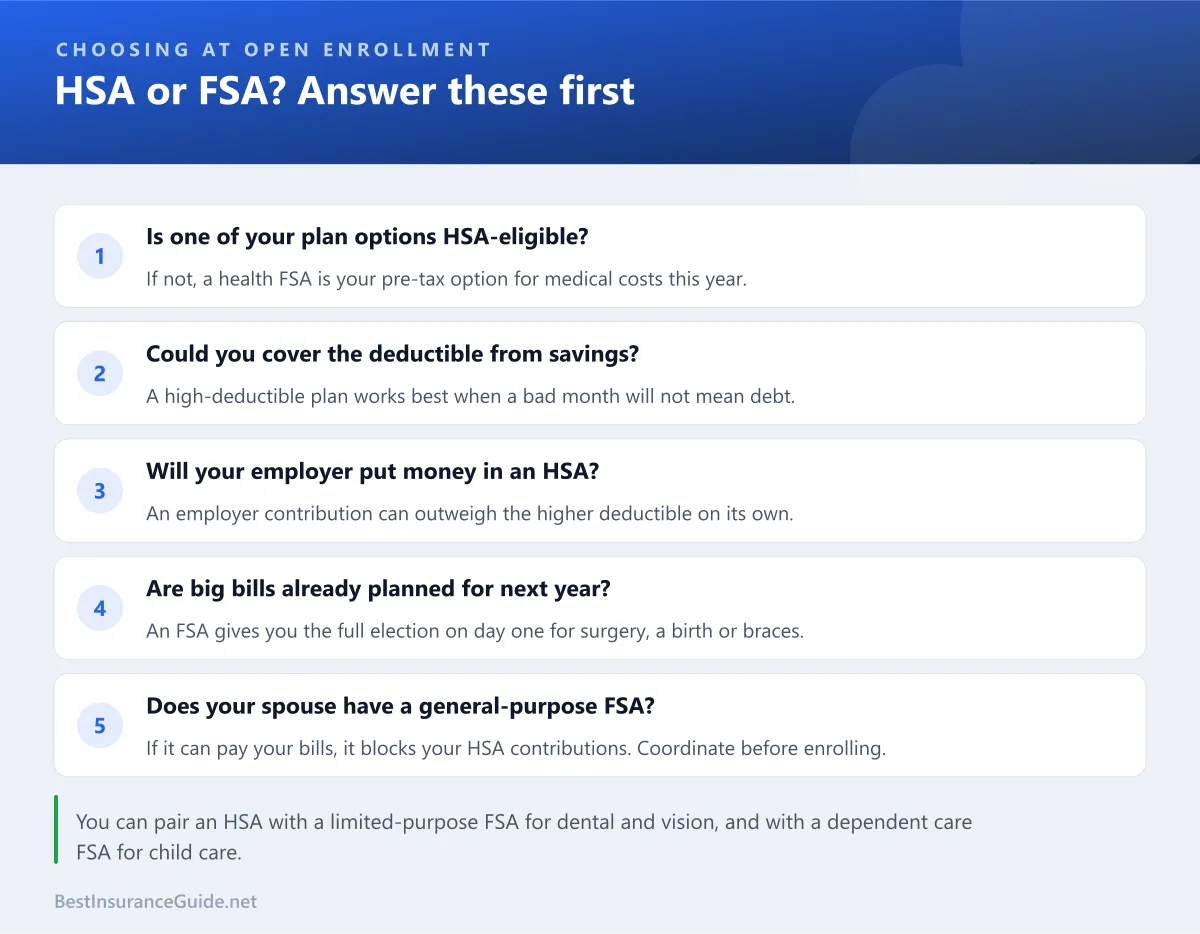
Yes, but not a general-purpose health FSA. If an FSA can reimburse your everyday medical costs, it counts as disqualifying coverage, and you can’t contribute to an HSA. That includes a spouse’s general-purpose FSA that can pay your bills, which catches many couples out.
You can combine an HSA with:
- A limited-purpose FSA. It covers dental and vision costs, and sometimes medical costs after the deductible. Many people use it for predictable dental and eyeglass bills so their HSA can stay invested.
- A dependent care FSA. It pays for child or adult day care, not medical costs, so it has no effect on HSA eligibility. Its limit is $7,500 per household.
If your spouse is enrolling in a general-purpose FSA at their job and you’re planning to use an HSA, check this before open enrollment closes. Switching mid-year usually isn’t possible.
HRA vs HSA vs FSA
A health reimbursement arrangement (HRA) is the third account you may see on a benefits portal. It differs from both:
| Feature | HRA | HSA | Health FSA |
|---|---|---|---|
| Who funds it | Employer only | You, your employer or both | Mostly you, through payroll |
| Who owns it | Employer | You | Employer |
| Health plan needed | Depends on the HRA type | HSA-eligible plan | Most plans |
| Unused money | Employer decides; often rolls over while you’re employed | Yours forever | Mostly forfeited |
| Leave your job | Usually lost | Keep it | Usually lost |
HRAs come in several types. An integrated HRA pairs with the group plan to help with deductibles. A CHOICE arrangement or ICHRA reimburses premiums for individual coverage. An excepted-benefit HRA can make up to $2,250 available for 2027 plan years. Because the employer sets the rules, read the plan summary to see what it pays for and whether it affects your HSA eligibility.
What both accounts can pay for
HSAs and health FSAs cover largely the same qualified medical expenses, listed in IRS Publication 502:
- deductibles, copays and coinsurance;
- prescription drugs, plus many over-the-counter medicines and menstrual care products;
- dental care, such as cleanings, fillings and orthodontics;
- vision care, such as eye exams, glasses, contact lenses and laser eye surgery;
- hearing aids, medical equipment and many supplies.
Health insurance premiums are generally not eligible. An HSA has exceptions: COBRA premiums, coverage while receiving unemployment, qualified long-term care insurance and, from 65, Medicare premiums other than Medigap. Our guide to whether COBRA payments are tax deductible covers that case.
Common mistakes to avoid
- Over-electing an FSA. Elect for the costs you can predict, not for the year you fear.
- Missing the FSA deadline. Learn whether your plan uses a carryover, a grace period or neither, and when its claims run-out period ends.
- Forgetting the spouse rule. A spouse’s general-purpose FSA can quietly disqualify your HSA.
- Contributing to an HSA after Medicare starts. Part A can be backdated up to six months when you enroll after 65, so stop HSA contributions in time. See our Medicare 2027 guide.
- Leaving HSA cash uninvested for decades. If you don’t need the money soon, check your provider’s investment options and fees.
- Not keeping receipts. You may need to prove an expense was qualified, for an FSA administrator or for the IRS.
How to choose at open enrollment
- Check which health plans make you HSA-eligible. If none do, a health FSA is your pre-tax option.
- Estimate next year’s predictable costs: prescriptions, therapy, dental, glasses, planned procedures.
- Compare total plan costs in a normal year and a bad year, including any employer HSA contribution.
- Coordinate with your spouse so a general-purpose FSA doesn’t block an HSA.
- Add a limited-purpose or dependent care FSA if you’ll have dental, vision or child care costs.
- Set your contribution amounts and note the deadlines, especially for the FSA.
Related reading
HSA contribution limits for 2027 covers the new eligibility rules and deadlines in full. FSA limits for 2027 explains carryovers, grace periods and the $7,500 dependent care limit. To understand the plans these accounts pair with, read HMO vs PPO, what a deductible is and health insurance terms explained.
Sources and notes
- IRS Revenue Procedure 2026-24: 2027 HSA contribution limits, HDHP minimum deductibles and out-of-pocket maximums, and the excepted-benefit HRA limit.
- IRS Revenue Procedure 2025-32: 2026 health FSA limit of $3,400 and carryover of $680.
- IRS Publication 969: HSA, FSA and HRA rules, including the rule on other coverage that blocks HSA eligibility.
- IRS Publication 502: qualified medical and dental expenses.
- The 2027 health FSA limit is a projection until the IRS publishes it, usually in October or November.
This article is general information, not tax, legal or financial advice. Plan rules vary by employer, and state tax treatment differs. Check your plan documents or ask a tax professional about your own situation.