Renters Insurance in Florida: Costs by City, Hurricane Rules and the Flood Gap
Renters insurance in Florida averages about $150 a year. Costs by city, hurricane deductibles, why flood needs a separate policy, and how to pay less.

Table of contents
Renters insurance in Florida costs about $150 a year on average, or roughly $13 a month, according to NerdWallet’s September 2026 analysis. That ranges from $129 in Sarasota to $232 in Hialeah. No state law requires it, but many landlords do. A standard policy covers hurricane wind damage to your belongings but not flood or storm surge, which is the gap that catches Florida renters most often.
This guide covers what renters pay across Florida, how hurricane deductibles work, what flood cover for renters costs and covers, Citizens as a fallback, and how to file a claim under Florida’s deadlines. This site is independent and is not affiliated with any insurer or with the State of Florida. Sources are listed at the end.
Florida renters insurance at a glance
| Average cost | About $150 a year ($13 a month) |
| Most expensive cities sampled | Hialeah $232, Homestead $220, Miami $215 |
| Cheapest cities sampled | Sarasota $129, Tallahassee $138, Gainesville $139 |
| Required by state law? | No, but a lease can require it |
| Hurricane wind | Usually covered, often with a separate hurricane deductible |
| Flood and storm surge | Not covered. Contents-only flood cover up to $100,000 through the NFIP |
| Claim deadline | Notice within 1 year of the loss (18 months for a supplemental claim) |
| Insurer of last resort | Citizens Property Insurance Corporation |
Figures are NerdWallet averages for $30,000 of personal property, $100,000 of liability and a $500 deductible. Your quote will differ.
What renters insurance costs in Florida
NerdWallet’s sample policy, a two-bedroom apartment with $30,000 of belongings cover, $100,000 of liability, $10,000 of additional living expenses and a $500 deductible, averaged $150 a year in Florida. Its national figure for the same profile was $165, so Florida renters pay slightly less than average despite the state’s storm exposure.
That surprises people who know what Florida homeowners pay. The reason is that a renters policy insures belongings and liability, not the building. A roof replacement after a hurricane is the landlord’s problem; a ruined sofa is yours.
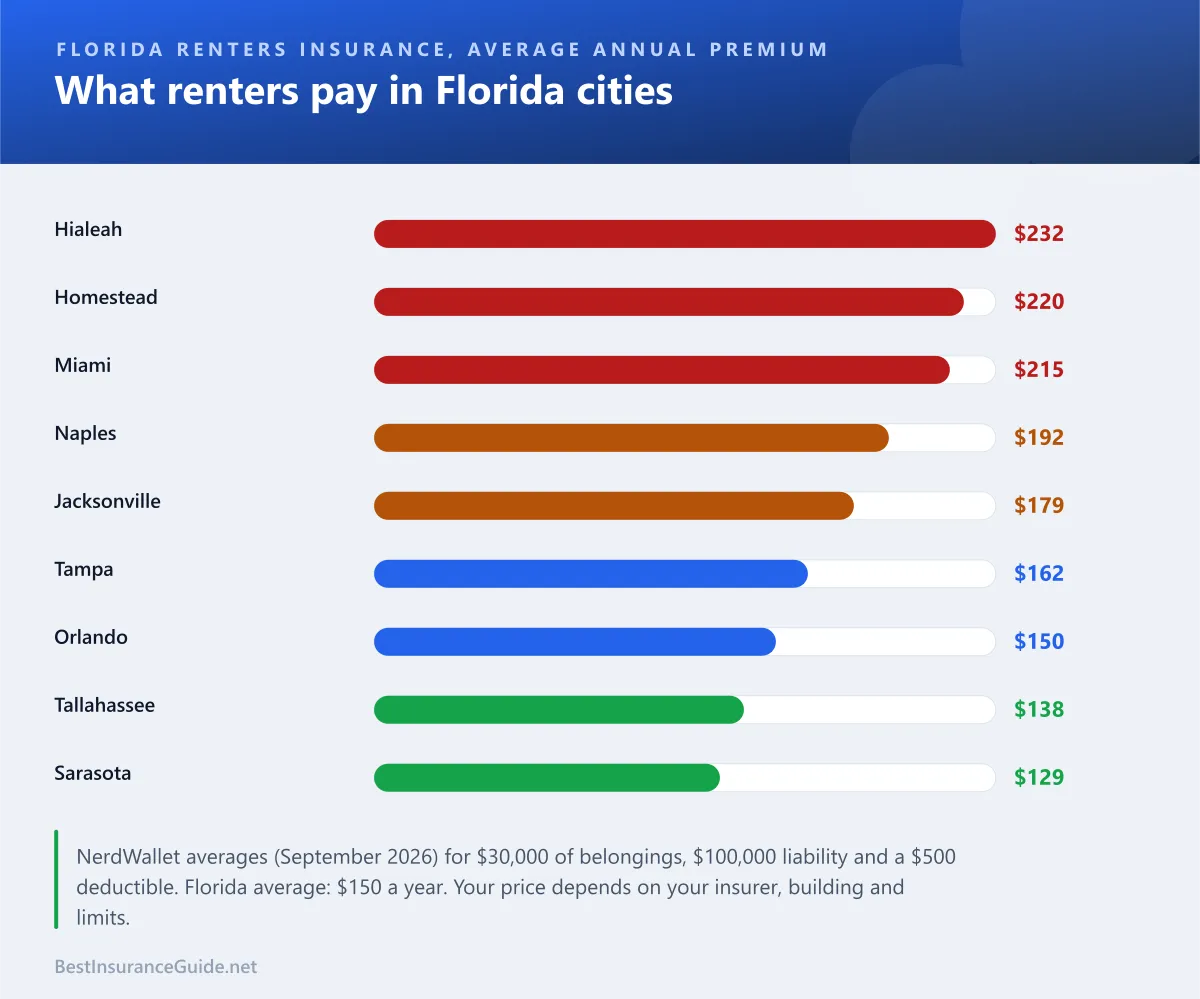
Location still matters. Miami-Dade cities top the list: Hialeah at $232, Homestead at $220 and Miami at $215. Inland and Gulf Coast cities such as Sarasota ($129), Tallahassee ($138) and Gainesville ($139) were cheapest. Within a city, insurers also price on theft rates, the age and construction of the building, the floor you live on and your claims history.
The cheapest companies in the sample were Citizens Property Insurance at $95 a year, Allstate at $115, Nationwide and State Farm at $125 each, and Universal Property at $155. Citizens is not open to everyone (see below), and rankings change from person to person, so treat these as a starting list for quotes rather than an answer.
Rates are also moving. In October 2026 Florida regulators approved an average 12.8% renters rate cut for about 122,000 American Modern Home policies. Our news report on the Florida renters insurance rate decrease covers who benefits.
Is renters insurance required in Florida?
No Florida law requires tenants to buy renters insurance. A landlord can make it a condition of the lease, and many apartment complexes require a minimum amount of liability cover and ask to be listed as an “interested party” so they are told if your policy lapses.
If your lease requires it, read the clause before you buy. It will usually set a minimum liability limit and say what proof the landlord needs. A policy that meets the clause on liability but carries a tiny contents limit satisfies the landlord while leaving you underinsured.
Your landlord’s insurance does not cover you. It pays to repair the building and protects the landlord against claims. It does not replace your belongings after a fire or a break-in, pay for a hotel while your unit is repaired, or defend you if a guest is hurt in your apartment. Our guide to whether you need renters insurance walks through the cases where it matters most.
What a Florida renters policy covers
A standard renters policy, called an HO-4, has four main parts:
- Personal property. Your furniture, clothes, electronics and other belongings, at home and usually away from home too.
- Loss of use (additional living expenses). Hotel bills, meals and other extra costs if a covered loss makes your home unlivable.
- Personal liability. Legal costs and damages if you injure someone or damage their property, including your landlord’s building.
- Medical payments. Small medical bills for guests hurt at your home, whoever was at fault.
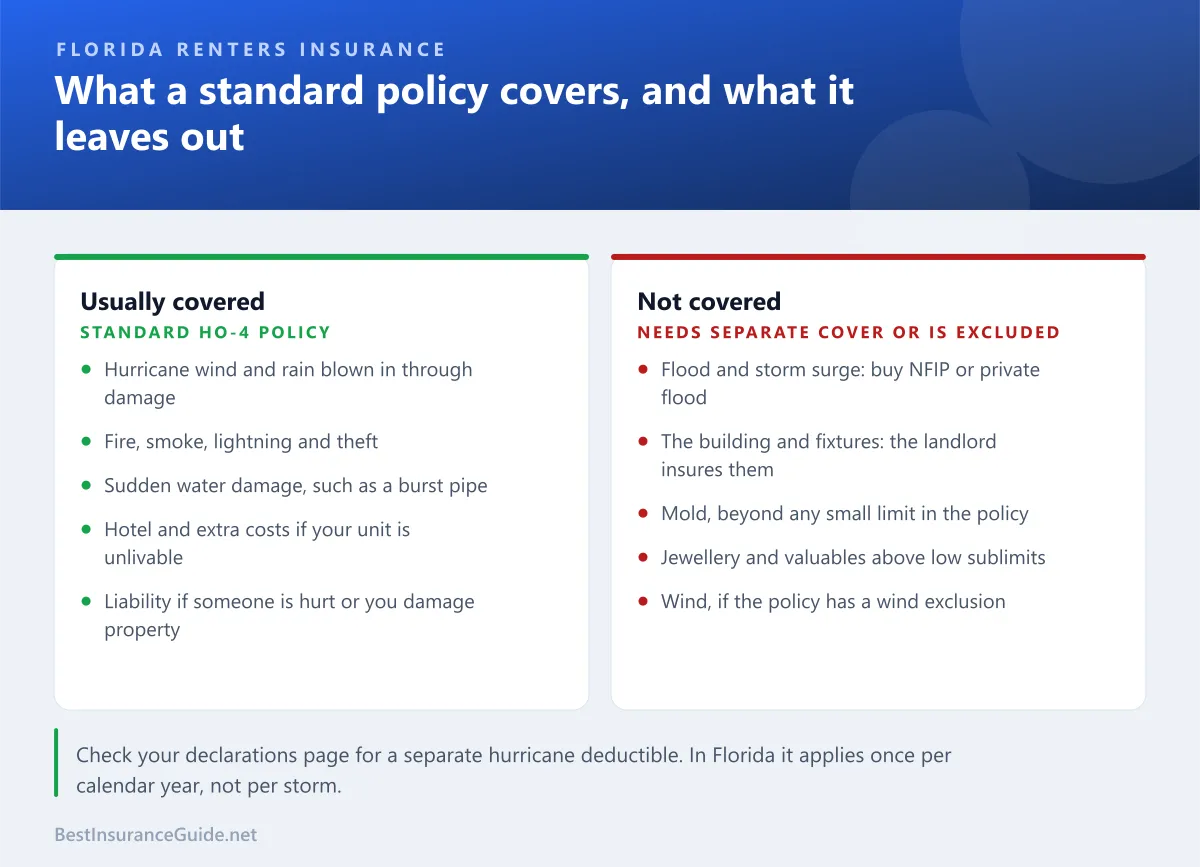
Covered causes of loss include fire, smoke, lightning, theft, vandalism, windstorm and sudden water damage such as a burst pipe. Our guide to renters insurance covered perils has the full list.
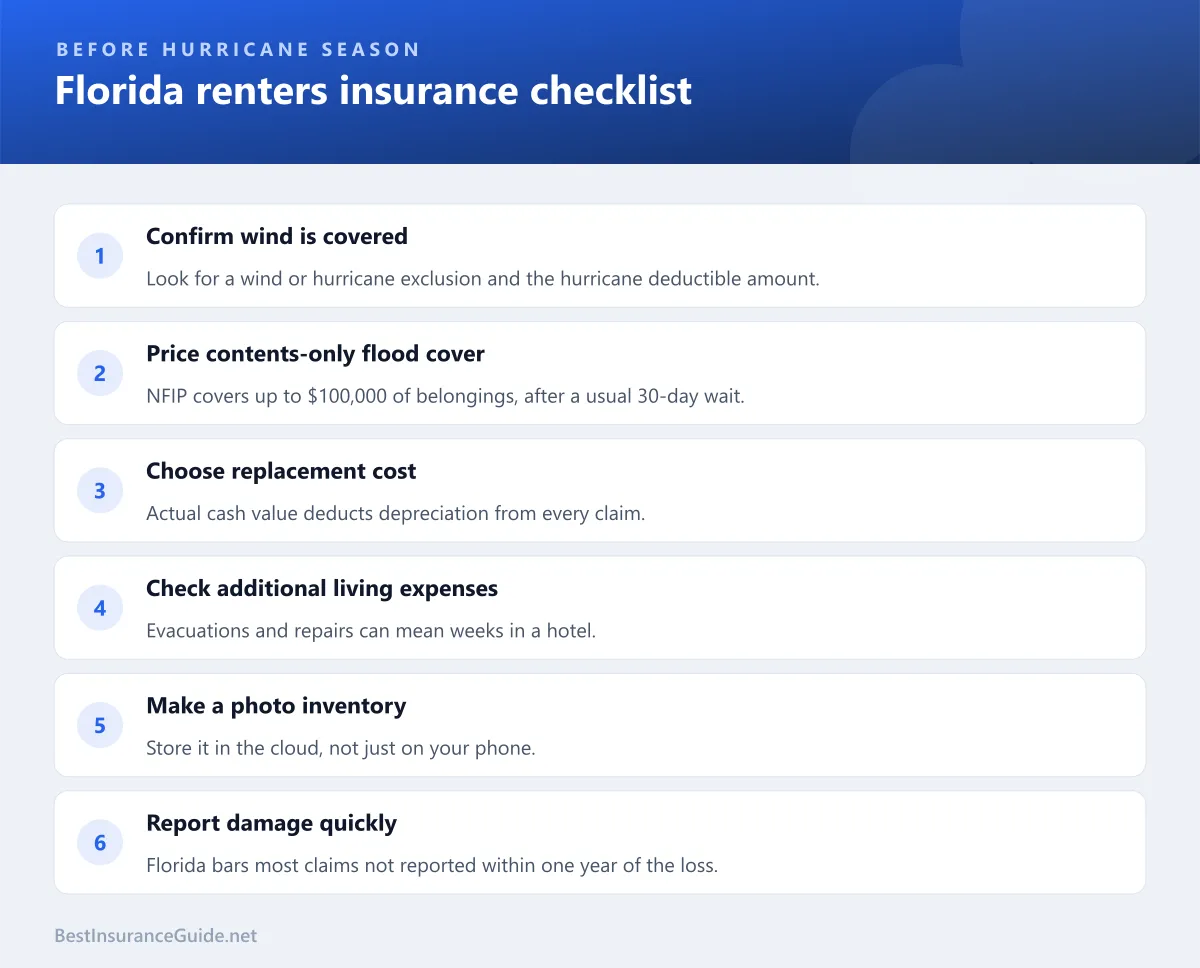
Choose replacement cost. An actual cash value policy deducts depreciation, so a five-year-old television pays out at a fraction of the cost of a new one. Replacement cost usually adds only a few dollars a month and makes a large difference after a storm, when you are replacing everything at once.
Hurricanes: what’s covered and the deductible
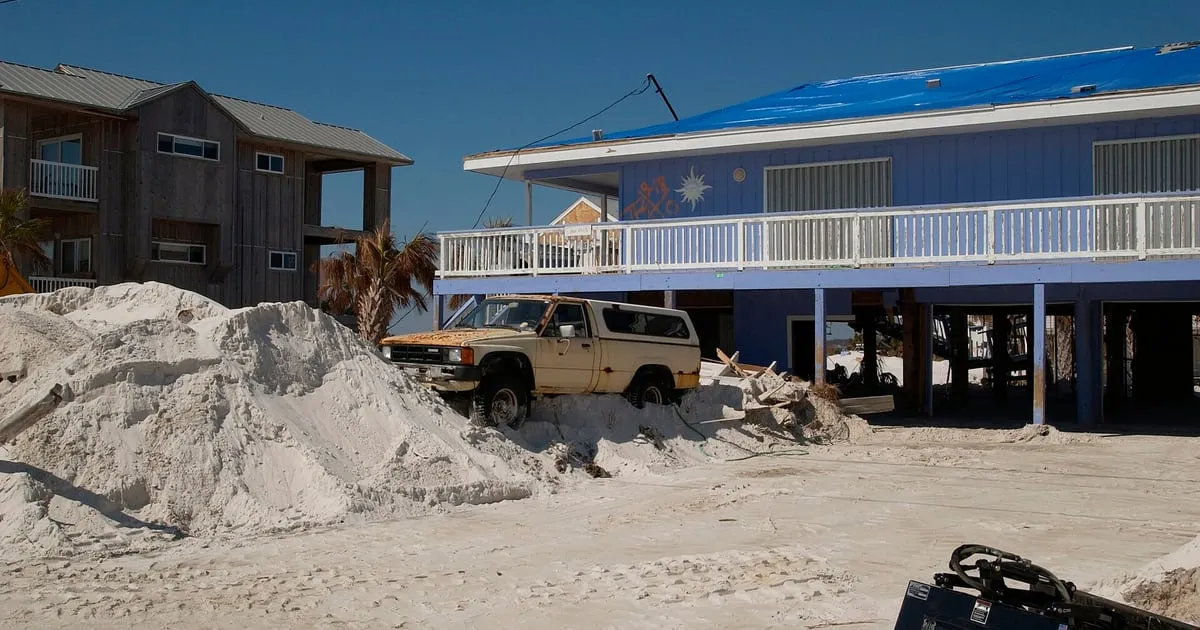
Wind damage to your belongings is normally covered, including rain that blows in through a window or roof damaged by the wind. So is additional living expense if your unit cannot be lived in while the building is repaired. A small number of policies, mostly in coastal areas, exclude wind entirely; check your declarations page for a wind or hurricane exclusion before the season starts.
Many Florida renters policies carry a separate hurricane deductible, either a flat amount or a percentage of your personal property limit. Florida law sets two rules worth knowing, according to the state’s Department of Financial Services:
- It applies once per calendar year, not per storm. If a second hurricane damages your belongings in the same year, you pay only what is left of the hurricane deductible, or your regular deductible if that is higher.
- It applies only during a defined window. That window opens when a hurricane warning is issued for any part of Florida and closes 72 hours after the last hurricane watch or warning ends. Wind damage outside that window falls under your normal deductible.
When the hurricane deductible applies, no other deductible on the policy can also be applied. Our news report on the Florida renters rate cut goes further into hurricane claims.
The flood gap
Renters insurance does not cover flood. That includes storm surge, overflowing rivers and canals, and heavy rain that rises from the ground. In a Florida hurricane, wind and water often arrive together, and the insurer will look at which one caused each item of damage.
Renters can buy contents-only flood insurance through FEMA’s National Flood Insurance Program (NFIP) or a private flood insurer. Under the NFIP:
- Contents cover goes up to $100,000 of tenant-owned belongings.
- A special limit of $2,500 applies to jewellery, artwork, furs and similar valuables.
- Belongings below the lowest elevated floor of an elevated building are covered only in a limited way, mostly a washer, dryer, freezer and the food in it.
- There is usually a 30-day waiting period before the policy starts, so you cannot buy it when a storm is already in the forecast.
Any renter in a community that takes part in the NFIP can buy a policy, whatever the flood zone. Ground-floor tenants, and anyone near the coast, a canal or a lake, should at least price it. Our guide to whether renters insurance covers flood damage explains the difference between flood and covered water damage, and do I need flood insurance? covers how to judge your risk.
Worked example: one storm, two kinds of damage
Illustrative example. Ana rents a ground-floor apartment in Fort Myers. Her renters policy has $30,000 of replacement-cost contents cover, a $500 standard deductible and a $1,000 hurricane deductible. She also has an NFIP contents policy with a $1,000 deductible.
A hurricane tears part of the roof off the building. Rain pours through her ceiling and ruins $6,000 of furniture and electronics. Then storm surge floods the ground floor, destroying another $9,000 of belongings.
| Damage | Covered by | Payout |
|---|---|---|
| $6,000 of wind-driven rain damage | Renters policy, minus $1,000 hurricane deductible | $5,000 |
| $9,000 of storm surge damage | NFIP contents policy, minus $1,000 deductible | $8,000 |
| Without the flood policy | Nothing | $0 of the $9,000 |
Her renters policy also pays reasonable hotel and meal costs while the building is unlivable after the wind damage. Without the flood policy, Ana would have been left with $10,000 of losses.
Sinkholes
Florida requires property insurers to cover catastrophic ground cover collapse, which is narrow. The ground must collapse suddenly, leave a visible depression, cause structural damage to the building, and lead to the building being condemned and ordered vacated. Ordinary settling or cracking does not count. Broader sinkhole coverage is optional and costs extra.
The statute was written with building owners in mind, so how it applies to a tenant’s belongings depends on the policy wording. If you live in a sinkhole-prone area, such as parts of west-central Florida, ask your insurer directly whether your contents are covered for either event.
Citizens: the insurer of last resort
Citizens Property Insurance Corporation is Florida’s state-created insurer of last resort. It sells a tenant policy (HO-4) covering belongings, additional living expenses and liability for renters of apartments, condo units and site-built homes. Renters of mobile or manufactured homes use a separate Citizens form. In some coastal areas it also sells a wind-only renters policy (HW-4) where private insurers will not write wind.
Citizens had the lowest average price in NerdWallet’s sample, at $95 a year. You generally qualify only if private insurers decline you, or if a comparable private policy would cost more than 20% above the Citizens premium. If you are offered a reasonable private policy, you will normally be expected to take it.
Filing a claim in Florida
Florida law sets firm deadlines. Notice of a new or reopened claim must be given within one year of the date of loss, and a supplemental claim within 18 months. A supplemental claim is for extra damage from the same event that turns up after your first claim, such as water damage found during repairs.
After a storm:
- Make sure you’re safe, then photograph and video all damage before moving anything.
- Prevent further damage if you safely can, for example by moving belongings away from a leak. Keep receipts.
- Report the claim to your renters insurer and, separately, your flood insurer if water came from outside.
- Keep receipts for hotels, meals and other extra costs.
- Don’t throw out damaged items until the adjuster has seen them or told you that photos are enough.
If you disagree with your insurer’s decision on a claim, the Florida Department of Financial Services runs a free mediation program for residential property claims where $500 or more is in dispute after the deductible. The insurer pays the mediator. It does not cover NFIP flood claims or liability claims. The Consumer Helpline is 1-877-693-5236.
How to pay less for renters insurance in Florida
- Bundle with your car insurance. Multi-policy discounts are usually the biggest single saving, and Florida car insurance is expensive enough that the discount on that policy can outweigh the renters premium.
- Choose your deductible on purpose. Raising it from $500 to $1,000 lowers the premium, but only makes sense if you could pay $1,000 after a storm.
- Ask about protective device discounts for deadbolts, monitored alarms, smoke detectors and sprinklers.
- Insure what you own, not a round number. A quick inventory often shows you need less than $50,000 of contents cover, or more than $20,000.
- Shop at renewal. Florida rates are changing in both directions, and some insurers have cut renters rates in 2026.
- Keep Citizens as a fallback. It is cheap on average but comes with eligibility rules.
How other states compare
Florida’s main risks are hurricanes, flood and storm surge. In Ohio and Indiana, water backup from sewers is the endorsement to add. Colorado shows how wildfire displacement can stretch a loss-of-use limit.
Related reading
- Florida renters insurance rates cut 12.8%, our news report on the 2026 rate decrease and hurricane cover.
- Renters insurance guide covers how policies work and how much cover to buy.
- Does renters insurance cover flood damage? explains where water damage stops and flood begins.
- Does renters insurance cover mold? covers a common problem in humid Florida apartments.
- Florida home insurance rates are falling explains why Florida property premiums are changing.
Sources and notes
- NerdWallet, “The Best and Cheapest Renters Insurance in Florida” (September 23, 2026): $150 Florida average and $165 national average, city averages and company averages, for $30,000 of personal property, $100,000 of liability, $10,000 of additional living expenses, $1,000 of medical payments and a $500 deductible.
- Florida Department of Financial Services, “Florida’s Hurricane Deductible”: calendar-year application, the hurricane deductible window and the rule that no other deductible applies.
- Florida Statutes, section 627.70132: one-year notice for new and reopened claims and 18 months for supplemental claims.
- Florida Statutes, section 627.706: catastrophic ground cover collapse and optional sinkhole coverage.
- Florida Department of Financial Services, mediation and neutral evaluation: residential property mediation eligibility and the Consumer Helpline.
- FEMA, NFIP flood insurance for renters brochure: $100,000 contents limit, $2,500 special limit, below-elevated-floor limits and the 30-day waiting period.
- Citizens Property Insurance Corporation, homeowners policy types: HO-4 tenant policies and HW-4 wind-only renters policies. The 20% eligibility rule is as described by NerdWallet.
- Ana’s example is illustrative. Deductibles, limits and payouts vary by policy.
This article is general information, not legal or insurance advice. Coverage depends on your policy wording, endorsements and exclusions. Read your declarations page and speak to a licensed Florida agent, or call the Department of Financial Services Consumer Helpline, about your own situation.