When Can I Apply for Medicare? Sign-Up Windows, Deadlines and Penalties Explained
Apply for Medicare 3 months before the month you turn 65. Initial, Special and General Enrollment Periods, automatic enrollment, and how to avoid the Part B penalty.

Table of contents

You can apply for Medicare three months before the month you turn 65. That opens a seven-month Initial Enrollment Period, and the earlier you act inside it, the better: sign up in the first three months and Part B starts the day your birthday month begins, with no gap. Miss the window entirely and you may wait until the following year and pay a late penalty of 10% a year for as long as you have Part B.
We are an independent site; every figure below is attributed to Medicare.gov, Social Security or CMS, and we will update it when CMS publishes the 2027 Part B premium, usually in November.
The timing question is more pressing than it used to be. The full Social Security retirement age is now 67 for anyone born in 1960 or later, so people turning 65 in 2027 were born in 1962. Unless they have already claimed Social Security early, Medicare will not sign them up automatically. They have to do it themselves.
When to sign up for Medicare at a glance
| Your situation | When to sign up | Penalty risk |
|---|---|---|
| Turning 65, already getting Social Security | Nothing to do: you are enrolled automatically | None |
| Turning 65, not getting Social Security | In your 7-month Initial Enrollment Period | None if you sign up inside it |
| Working past 65 with job coverage, employer 20+ employees | Can delay Part B; sign up within 8 months of the job or coverage ending | None if you use the Special Enrollment Period |
| Working past 65, employer under 20 employees | Usually at 65, because Medicare pays first | Yes, if you delay |
| On COBRA, retiree cover or a marketplace plan at 65 | In your Initial Enrollment Period | Yes, if you delay |
| Missed every window | January 1 to March 31 General Enrollment Period | 10% per full year late |
| Under 65 with disability benefits | Automatic after 24 months of benefits (immediately with ALS) | None |
Your Initial Enrollment Period: the seven-month window
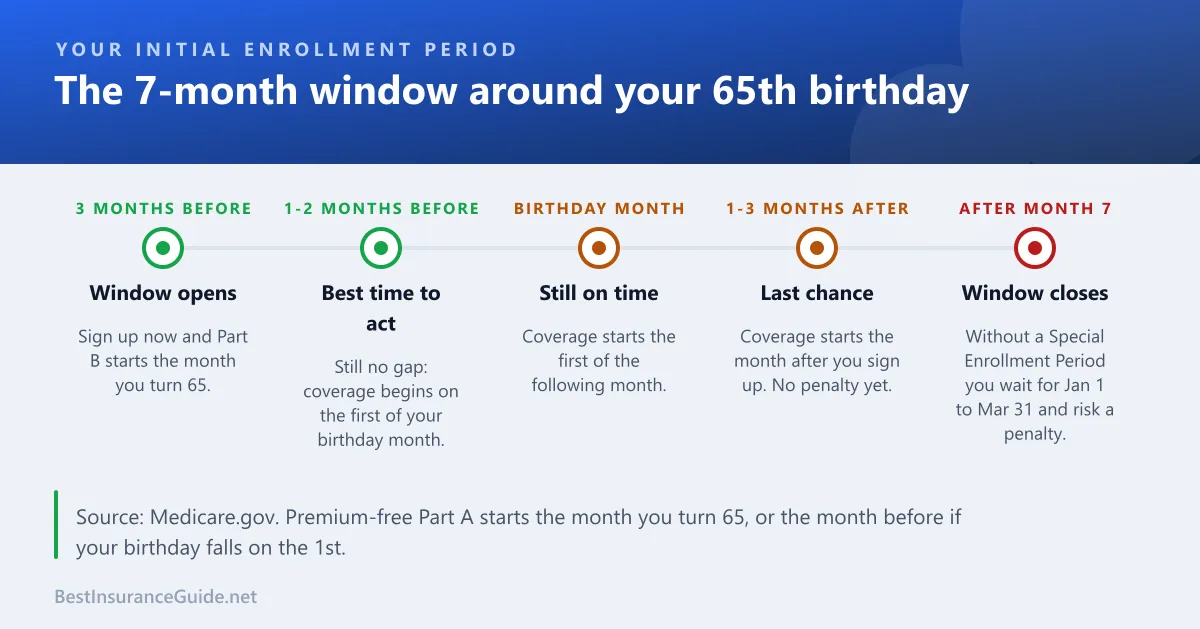
Medicare.gov describes the Initial Enrollment Period as a seven-month window starting three months before you turn 65 and ending three months after the month you turn 65. Coverage always starts on the first of a month.
When Part B starts depends on when you sign up:
- In the three months before your birthday month: coverage starts on the first day of the month you turn 65.
- In your birthday month or any of the three months after: coverage starts on the first day of the month after you sign up.
Before 2023, signing up late in the window could leave a gap of two or three months. That rule was changed, so the delay is now at most one month, but signing up early is still the only way to have no gap at all.
Premium-free Part A starts the month you turn 65 regardless. Medicare.gov notes one quirk: if your birthday falls on the 1st of the month, your coverage starts the month before, and your whole window shifts one month earlier.
Illustrative example
Illustrative. Maria turns 65 on June 18, 2027. Her Initial Enrollment Period runs from March 1 to September 30, 2027.
- If she signs up in March, April or May, Part A and Part B both start June 1.
- If she signs up in July, Part B starts August 1, leaving her without Part B for June and July unless she has other coverage.
- If she misses September 30 and has no job-based coverage, her next chance is January 1 to March 31, 2028, with Part B starting the month after she signs up and a penalty if she has gone 12 or more full months without it.
Who is enrolled automatically
According to Medicare.gov, you are enrolled in Parts A and B automatically when you turn 65 as long as you start getting Social Security or Railroad Retirement Board benefits at least four months before you turn 65. Your Medicare card arrives in the post about three months before your birthday.
People under 65 are also enrolled automatically after receiving Social Security disability benefits for 24 months, and immediately when disability benefits begin if they have ALS.
Everyone else has to apply. That now includes most people turning 65, because claiming Social Security before the full retirement age of 67 permanently reduces the monthly benefit and many people choose to wait.
If you are automatically enrolled and do not want Part B yet, for example because you are still working, the card comes with instructions for turning it down. Keep Part A: it is premium-free for about 99% of people, according to CMS.
How to sign up for Medicare
You apply through Social Security, not Medicare:
- Online at ssa.gov, using a my Social Security account. This is usually the quickest route.
- By phone at 1-800-772-1213 (TTY 1-800-325-0778).
- In person at a local Social Security office, ideally by appointment.
- Railroad workers apply through the Railroad Retirement Board at 1-877-772-5772.
Applying for Medicare does not force you to start Social Security retirement benefits. You can take Medicare at 65 and let your Social Security benefit keep growing until 67 or 70.
Drug coverage and Medigap have their own timing
Signing up for Parts A and B is only the first step.
- Part D drug coverage has the same seven-month Initial Enrollment Period. Join a plan then, or get Medicare Advantage with drug coverage, unless you have creditable drug coverage from a job or elsewhere. Going 63 days or more without creditable drug coverage triggers a lifelong penalty.
- Medigap (Medicare Supplement) has a separate six-month open enrollment period that begins the first month you have Part B and are 65 or older. During it, insurers must sell you any Medigap policy they offer without medical underwriting. After it ends, in most states they can refuse you or charge more based on your health. Our Medigap Plan G vs Plan N guide compares the two most popular plans.
If you delay Part B because you are still working, the Medigap clock does not start until Part B does, which is one more reason to delay only when the rules allow it.
Working past 65: when you can wait
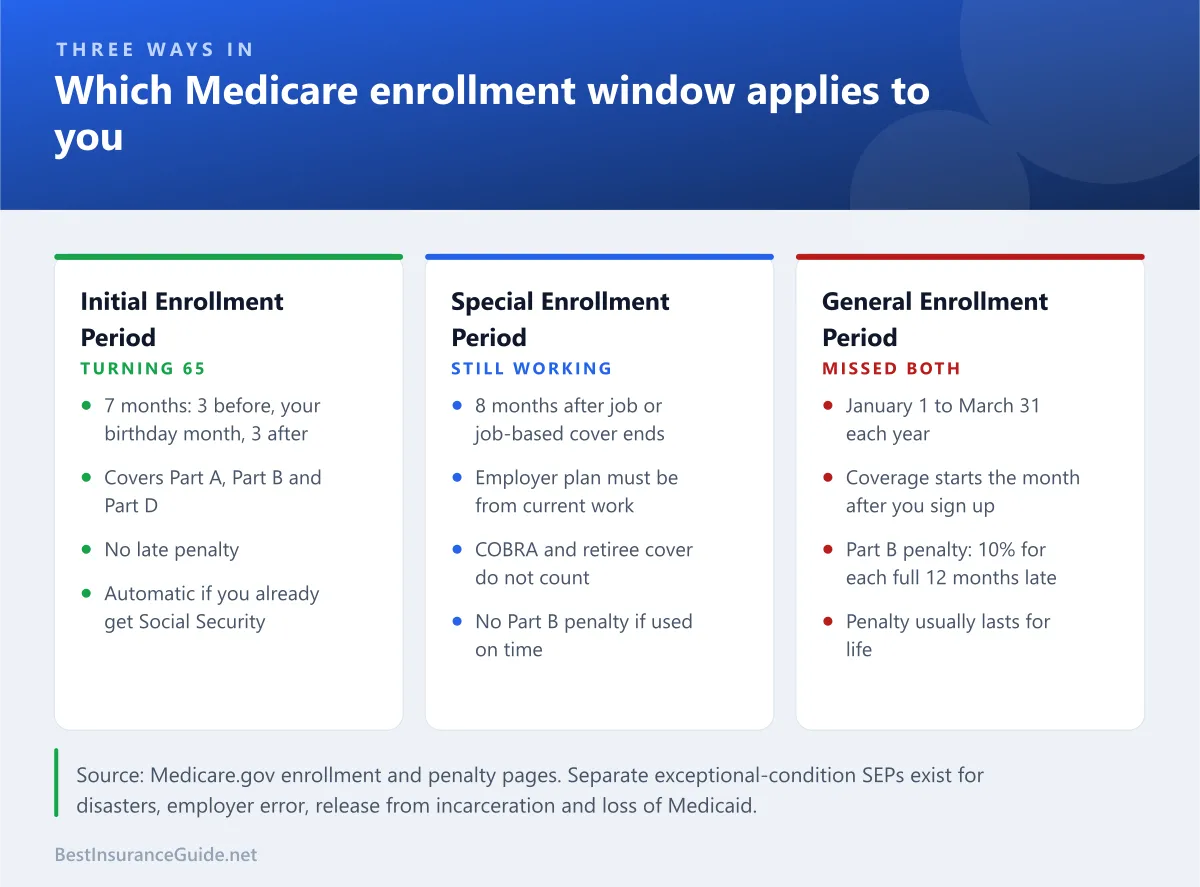
If you or your spouse are still working and covered by a group health plan from that current job, you may be able to delay Part B without a penalty.
The key test is employer size. Medicare.gov explains that at an employer with 20 or more employees, the job-based plan pays first, so delaying Part B can make sense. At an employer with fewer than 20 employees, Medicare generally pays first, and the job plan may not pay for services unless you have both Part A and Part B. In that case, sign up at 65.
The eight-month Special Enrollment Period. When the job or the job-based coverage ends, whichever happens first, you have eight months to sign up for Part B without a penalty. Medicare.gov’s advice is to sign up the month before your employer coverage ends so there is no gap.
What you will need. Social Security asks for proof that you had job-based coverage. That usually means Form CMS-40B (the Part B application) and Form CMS-L564, which your employer completes to confirm your coverage dates. Upload or send them together.
What does not count as job-based coverage
These are the traps that most often lead to a lifelong penalty:
- COBRA. It is not coverage from current work. Your eight-month Special Enrollment Period starts when the job ends, even if you take COBRA, and COBRA does not extend it. Our guide to how long COBRA coverage lasts explains the details.
- Retiree health coverage. Not based on current employment.
- Marketplace (Obamacare) plans. Having a marketplace plan does not give you a Special Enrollment Period, and Medicare.gov warns you may lose your marketplace premium tax credit once you are eligible for premium-free Part A.
- VA health care. It does not create a Special Enrollment Period, and VA care only covers you at VA facilities.
HSA owners: stop contributions early
You cannot contribute to a health savings account once you are enrolled in any part of Medicare. That catches people out because Part A is backdated up to six months when you sign up after 65, though not earlier than the month you turned 65. Contributions made during those backdated months can face a tax penalty.
The common approach is to stop HSA contributions about six months before you apply for Medicare, or before you start Social Security, which also triggers Part A. You can keep spending the HSA balance tax-free on qualified medical costs, including Medicare premiums. Our article on 2027 HSA contribution limits covers the prorated limit for the year you enroll.
Missed it? The General Enrollment Period and the penalty
If you miss your Initial Enrollment Period and do not qualify for a Special Enrollment Period, you can sign up during the General Enrollment Period, January 1 to March 31 each year. Medicare.gov says coverage then starts the month after you sign up.
The Part B late penalty
Medicare.gov is clear that the penalty is not a one-time fee. It is added to your monthly premium, and it usually lasts for as long as you have Part B.
- Part B: an extra 10% for each full 12-month period you could have had Part B but did not.
- Part D: 1% of the national base beneficiary premium for each month without creditable drug coverage. The base premium is $38.99 in 2026 and $41.33 in 2027, according to CMS.
- Part A: only applies if you have to buy Part A. The premium can rise 10% for twice the number of years you delayed.
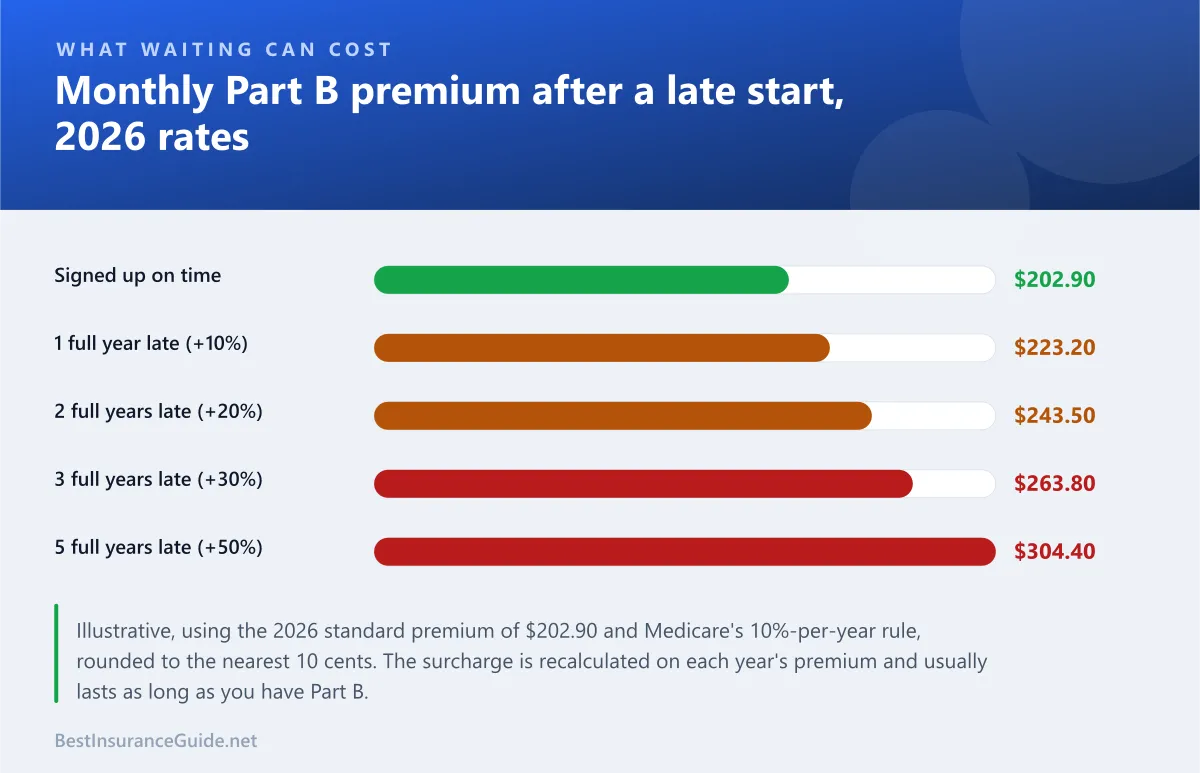
Medicare’s own example: someone who went 24 months without Part B and without a Special Enrollment Period pays a 20% penalty. On the 2026 standard premium of $202.90, that is $243.50 a month instead of $202.90.
Illustrative. Over 20 years, that $40.60 a month adds up to more than $9,700 at today’s rates, and more in practice because the 10% steps are applied to each year’s higher premium.
A Part D example, also illustrative: someone who went 14 months without creditable drug coverage pays 14% of the base premium. In 2027 that is 14% × $41.33 = $5.79, rounded to $5.80 a month, added to whatever their plan charges, for as long as they have Part D.
Exceptional-condition Special Enrollment Periods
Since 2023, Medicare has offered Special Enrollment Periods for people who missed a window for reasons outside their control. According to CMS’s application form (CMS-10797), qualifying situations include:
- living in an area hit by a declared emergency or disaster;
- getting incorrect information from an employer or health plan about Medicare;
- being released from incarceration;
- losing Medicaid coverage;
- other exceptional conditions, decided case by case.
You need written proof, and the timelines differ by situation, so contact Social Security as soon as you realise you have missed a window.
Is Medicare open enrollment the same thing?
No, and the confusion costs people money every autumn. The October 15 to December 7 open enrollment period, which is running now, is for people who already have Medicare to switch Medicare Advantage or Part D plans for the coming year. It is not a way to sign up for Part A or Part B for the first time.
If you are already on Medicare, our guide to Medicare 2027 changes covers this year’s premiums and plan choices.
Seven steps to a smooth Medicare start
- Diary the date. Your window opens three months before your 65th birthday month, or four months before if your birthday is on the 1st.
- Check whether you are being enrolled automatically. If you are not getting Social Security yet, you are not.
- If you are still working, ask HR how many employees the company has and whether your plan expects Medicare to pay first.
- Stop HSA contributions about six months before you plan to enroll.
- Apply online at ssa.gov in the first three months of your window to avoid any gap.
- Choose drug coverage: a Part D plan or a Medicare Advantage plan, unless you have creditable coverage.
- Decide on Medigap within six months of Part B starting if you plan to stay with Original Medicare.
If money is tight, check whether you qualify for a Medicare Savings Program, which can pay your Part B premium, and Extra Help with drug costs. Both can also remove late enrollment penalties.
Related reading
- Can you get Medicare at 62? covers options for bridging the years before 65.
- Medicare vs Medicaid explains how the two programmes differ and work together.
- Medicare 2027 changes lists premiums, Part D limits and open enrollment dates.
- Health insurance without a job looks at coverage if you retire before Medicare.
- Medicare Savings Program shows how your state can pay Part B premiums.
Sources and notes
- Medicare.gov, “When does Medicare coverage start?”: Initial, Special and General Enrollment Periods, coverage start dates and the 1st-of-the-month rule.
- Medicare.gov, “When can I sign up for Medicare?”: working past 65, the 20-employee rule, COBRA, VA and marketplace coverage.
- Medicare.gov, “How do I sign up for Medicare?”: automatic enrollment and Railroad Retirement Board contact.
- Medicare.gov, “Avoid late enrollment penalties”: Part A, B and D penalty rules and the 2026 examples.
- CMS, 2026 Medicare Parts A & B premiums and deductibles fact sheet (November 2025): $202.90 standard Part B premium; about 99% pay no Part A premium.
- CMS, CY 2027 Part D figures (July 2026): base beneficiary premium of $41.33.
- CMS, Form CMS-10797, application for exceptional-condition Special Enrollment Periods.
- Social Security full retirement age of 67 applies to people born in 1960 or later.
- HSA backdating rule summarised from Social Security guidance; consult a tax professional about your contributions.
This article is general information, not legal, tax or benefits advice. Medicare rules have exceptions for specific situations. Your State Health Insurance Assistance Program (SHIP) offers free, unbiased one-to-one Medicare counselling, and Social Security can confirm your own dates.