Employers Are Dropping GLP-1 Coverage for 2027: Will Your Insurance Still Cover Wegovy or Zepbound?
Employer GLP-1 coverage for weight loss fell from 72% to 60%. Does your insurance cover Wegovy or Zepbound in 2027, how to appeal, and cash prices.

Table of contents

If you take Wegovy, Zepbound or another GLP-1 for weight loss, read your 2027 open enrollment materials carefully this year. A growing number of employers are dropping coverage for these drugs when they are prescribed for weight loss, or putting tighter rules around them.
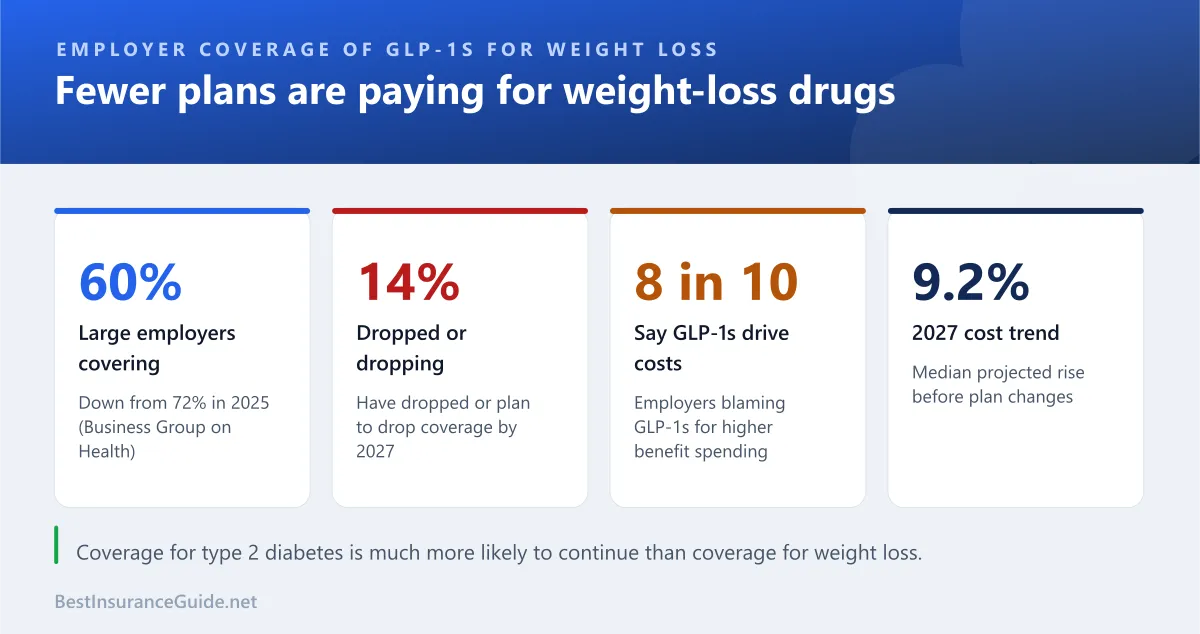
The clearest numbers come from the Business Group on Health’s 2027 Employer Healthcare Strategy Survey, published August 25, 2026. The share of large employers covering GLP-1s for obesity fell from 72% in 2025 to 60% in 2026, and 14% say they have dropped or plan to drop that coverage by 2027. Some well-known employers have already acted. Cigna ended weight-loss GLP-1 coverage for its own employees on July 1, 2026, and Starbucks stopped covering them for weight loss for benefits-eligible staff from October 2026.
This guide covers what is changing, how to check whether your insurance covers Wegovy or Zepbound for 2027, the most common reasons claims are denied, how to get coverage approved, and what you will pay if you have to pay cash. This site is independent and not affiliated with any insurer, employer or drug maker, and this article is not medical advice. Sources are listed at the end.
Why employers are pulling back
Employers give three main reasons.
- Cost. Nearly 8 in 10 employers in the Business Group on Health survey say GLP-1 coverage drives up their benefit costs. Overall, large employers expect health costs to rise by a median 9.2% in 2027 before plan changes. Brand-name injectable GLP-1s have list prices of roughly $1,000 to $1,500 a month, and employers typically pay most of that cost.
- More people using them, for longer. Utilization keeps climbing, more people qualify, and many patients stay on the drugs for years. KFF polling suggests about 1 in 8 adults are currently taking a GLP-1.
- Cheaper ways to buy them outside insurance. Manufacturers now sell several GLP-1s directly to patients at much lower cash prices. Some employers argue that this makes it reasonable to stop paying for weight-loss use through the health plan. Cigna told employees it made its decision because “new options have emerged”.
It is not a stampede. Mercer found that 44% of employers with 500 or more workers cover GLP-1s for obesity, that 6% dropped the coverage in 2026, and that another 5% plan to in 2027. Most employers are keeping coverage but tightening the rules: higher BMI thresholds, prior authorization, required lifestyle or coaching programs, and limits on which drugs are covered.
Weight loss vs diabetes: the distinction that matters
Almost every change covers GLP-1s prescribed for weight management, such as Wegovy, Zepbound and Saxenda. Coverage for type 2 diabetes drugs such as Ozempic and Mounjaro is far more likely to stay in place. Why a drug is prescribed matters as much as which drug it is.
Does my insurance cover Wegovy or Zepbound in 2027?
It depends on your plan, your diagnosis and your plan year. Here is where coverage stands by type of insurance.
| Type of coverage | Weight-loss GLP-1s in 2027 | What to check |
|---|---|---|
| Large employer plan | 60% covered them in 2026; more are dropping or restricting for 2027 | 2027 formulary, exclusions list, prior authorization criteria |
| Small employer plan | Less likely to cover; often depends on the insurer’s standard formulary | Summary of benefits and the insurer’s drug list |
| ACA marketplace plan | Varies by state and insurer; many exclude weight-loss drugs | The plan’s formulary on HealthCare.gov or your state exchange |
| Medicare Part D | Not covered for weight loss alone, but the GLP-1 Bridge offers a $50 copay to eligible people until December 31, 2027 | Eligibility through your prescriber, and Part D coverage for other uses |
| Medicaid | Varies by state | Your state Medicaid preferred drug list |
| Federal employees (FEHB) | Plans are changing their weight-loss drug rules for 2027 | Each plan’s 2027 brochure during Open Season, November 9 to December 14 |
How to check your own plan, step by step
- Read the 2027 open enrollment materials for any line about “weight loss drugs”, “anti-obesity medications” or “GLP-1”.
- Search your plan’s 2027 formulary for Wegovy, Zepbound, Foundayo and Saxenda. Note the tier and whether “PA” (prior authorization) or “ST” (step therapy) appears.
- Call the member services number on your card and ask four questions:
- Is this drug covered for my diagnosis in 2027?
- Is prior authorization required, and what are the criteria?
- What will my copay or coinsurance be?
- If I am already approved, does my approval carry over into 2027?
- Ask HR whether the plan is self-insured or fully insured. Self-insured plans set their own exclusions. Fully insured plans follow state insurance rules, which occasionally require coverage.
Why isn’t Zepbound (or Wegovy) covered by my insurance?
A denial letter has to tell you why. Most fall into one of five categories, and each calls for a different response.
| Reason on the denial | What it means | Best next step |
|---|---|---|
| Plan exclusion | The plan does not cover any drug for weight loss | Check coverage for another approved use; consider cash-pay options |
| No prior authorization | Your prescriber has not submitted paperwork | Ask the prescriber to submit PA with full documentation |
| Criteria not met | For example, BMI below the plan’s threshold or a missing condition | Get the criteria in writing; send any missing records; appeal |
| Step therapy | The plan wants you to try a preferred drug first | Try it, or ask for an exception if it is unsuitable |
| Non-preferred drug | Another GLP-1 is covered instead | Ask your prescriber whether the covered option suits you |
How to get Wegovy or Zepbound covered by insurance
Even with plans tightening, many people get coverage approved by getting the paperwork right.
1. Start with prior authorization done properly. Your prescriber should include your current BMI, your weight history, any weight-related conditions such as high blood pressure, prediabetes, high cholesterol or sleep apnea, and what you have already tried, such as diet, exercise or other medications.
2. Check other FDA-approved uses. Some plans that exclude weight-loss drugs still cover the same medicine for a different approved use:
- Zepbound is approved for moderate to severe obstructive sleep apnea in adults with obesity. Ask whether your plan covers it for sleep apnea, and whether you need a sleep study.
- Wegovy is approved to reduce the risk of heart attack and stroke in adults with established cardiovascular disease and obesity or overweight, and for MASH, a form of fatty liver disease, with moderate to advanced liver scarring.
This is not a loophole. If you have one of these conditions, it is a legitimate reason for coverage, and your prescriber should document it.
3. Appeal a denial. Under most employer plans you have 180 days from a denial to file an internal appeal. Include a letter of medical necessity from your prescriber, relevant records, and the plan’s own criteria showing how you meet them. If the internal appeal fails, you can usually request an external review by an independent reviewer. For urgent situations, ask for an expedited review.
4. Ask about the plan’s programs. Many employers now require enrollment in a coaching or lifestyle program before approving a GLP-1. Signing up early can save weeks.
 Photo: Rhoda Baer, National Cancer Institute (public domain).
What it costs if you pay without insurance
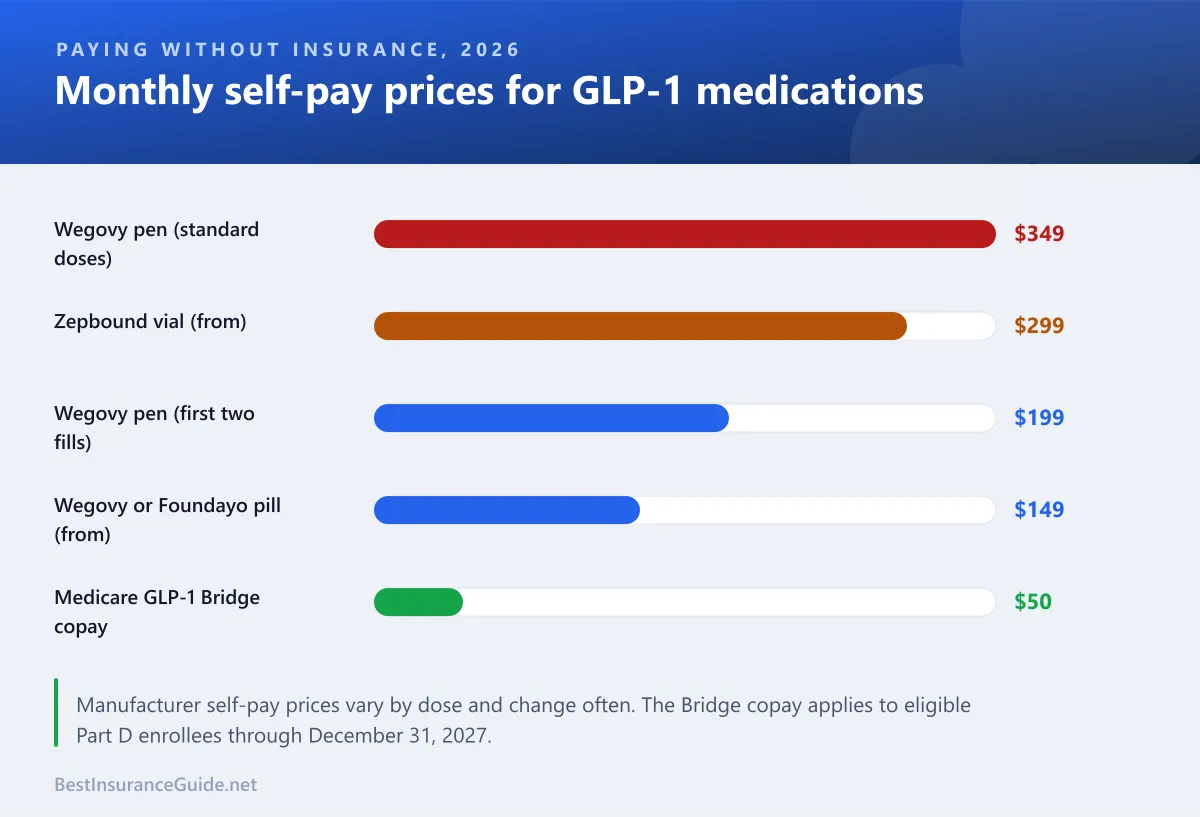
Prices have come down sharply since 2025, which is part of why some employers feel comfortable dropping coverage. These are the manufacturer self-pay prices reported for 2026. Prices vary by dose and form, and they change often.
| Drug | Self-pay price per month (2026) | Notes |
|---|---|---|
| Wegovy pill | From $149 | Starting doses; higher doses cost more |
| Foundayo pill (Lilly) | From $149 | Starting price |
| Wegovy pen | $199 for the first two fills, then $349 | Introductory price for new patients at the two lowest doses |
| Zepbound vial | From $299 | Single-dose vials; the KwikPen is priced differently |
| Medicare GLP-1 Bridge | $50 copay | Eligible Part D enrollees only, until December 31, 2027 |
Sources: TrumpRx.gov, NovoCare and LillyDirect pricing as reported by The RxIndex and Reuters in 2026; KFF for the Medicare GLP-1 Bridge. Check current prices before you buy.
Worked example: what losing coverage really costs
Suppose your 2026 plan charged a $75 monthly copay for Wegovy (an illustrative figure), and your employer drops weight-loss coverage for 2027.
| Detail | With coverage (2026) | Cash pay (2027) |
|---|---|---|
| Monthly cost | $75 | $349 (standard pen dose) |
| Annual cost | $900 | $4,188 |
| Extra cost per year | – | $3,288 |
Two things can soften that hit:
- Pay with an HSA or FSA. Prescription drugs for a diagnosed condition, including obesity, are generally a qualified medical expense, so paying with pre-tax money can cut the effective price by your tax rate. Keep your prescription and receipts.
- Ask about lower-cost forms. A pill or a vial can cost less than a pen at a similar strength. Your prescriber decides whether a switch is appropriate.
Cash purchases usually do not count toward your health plan’s deductible or out-of-pocket maximum. Factor that in if you expect other medical bills next year.
If you are on Medicare
Part D plans are generally barred from covering drugs used only for weight loss, but there are two routes to coverage:
- The Medicare GLP-1 Bridge. Running from July 1, 2026 through December 31, 2027, it lets eligible Part D enrollees get Wegovy, Foundayo or the Zepbound KwikPen for a $50 monthly copay. Eligibility depends on BMI thresholds combined with certain health conditions, and your prescriber has to attest that you qualify. The $50 copay does not count toward the Part D out-of-pocket cap, which is $2,400 in 2027.
- Other approved uses. Part D plans can cover Wegovy for cardiovascular risk reduction and Zepbound for obstructive sleep apnea, subject to the plan’s formulary.
CMS has delayed the Part D portion of its longer-term BALANCE model indefinitely, so the Bridge is the main Medicare route for weight-loss use through 2027. Medicare open enrollment runs October 15 to December 7, 2026, so check how each plan covers your drugs before you switch.
Your 2027 open enrollment checklist
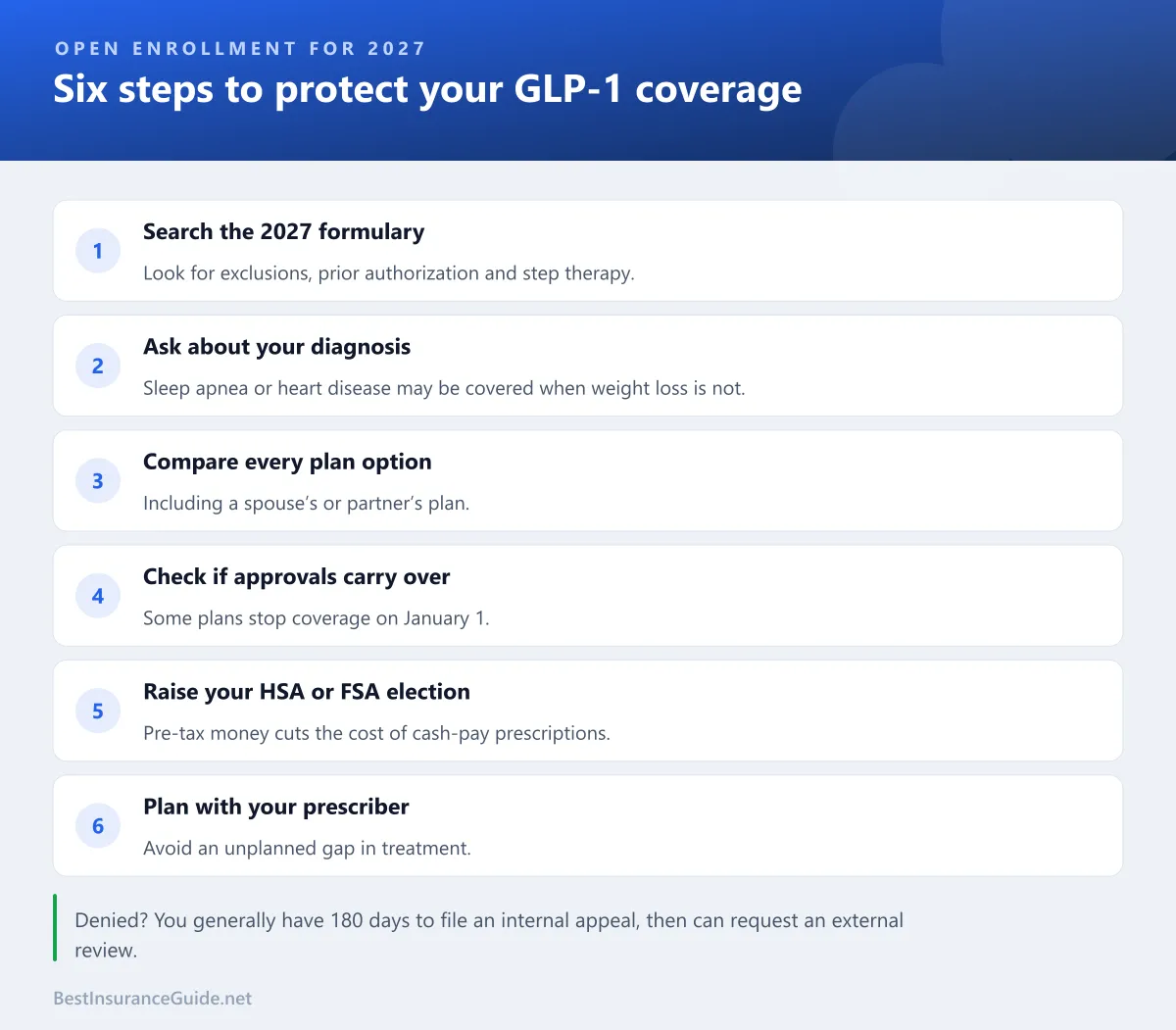
- Compare every plan option your employer offers. Sometimes one plan covers GLP-1s and another does not.
- Check a spouse’s or partner’s plan if you can switch to it at their open enrollment.
- Ask whether existing approvals carry over. Some plans phase people out gradually; others stop on January 1.
- Refill before coverage ends if your plan allows it. Cigna, for example, gave employees until June 30 to refill under the old benefit.
- Raise your HSA or FSA election if you expect to pay cash in 2027.
- Talk to your prescriber before any gap in treatment.
The bigger picture
GLP-1s are now one of the main reasons health premiums are rising. Consultants estimate they add about a full percentage point to employer cost growth for 2027. Employers are caught between employees who value these drugs and budgets that cannot absorb open-ended costs. Expect more restrictions rather than outright bans at most large employers, more plans steering members to direct-to-consumer cash prices, and continued pressure on pharmacy benefit managers over what plans actually pay. If prices keep falling, some employers that dropped coverage may revisit the decision for 2028.
Related reading
Do prescriptions count towards your deductible? explains how drug costs fit into your plan. Health insurance terms explained covers formularies, prior authorization and coinsurance. If you are appealing, insurance claim denied? What to do now walks through the process. Medicare 2027 changes covers this year’s Medicare open enrollment, and FSA limits 2027 and HSA contribution limits 2027 cover pre-tax ways to pay.
Sources and notes
- Business Group on Health, 2027 Employer Healthcare Strategy Survey, August 25, 2026 (via MedCity News, SHRM and U.S. News/Reuters): GLP-1 coverage 72% to 60%, 14% dropping by 2027, 9.2% median cost trend.
- Mercer 2026 survey of employers with 500 or more employees, as reported by Reuters and SHRM.
- Reports on Cigna’s employee plan change (Becker’s, June 2026) and Starbucks’ change (SHRM, August 2026).
- KFF, “What to Know About the BALANCE Model for GLP-1s in Medicare and Medicaid and the Medicare GLP-1 Bridge”; KFF polling on GLP-1 use.
- Manufacturer self-pay prices from TrumpRx.gov, NovoCare and LillyDirect, as summarised by The RxIndex and Reuters (2026).
- FDA-approved uses from the Wegovy and Zepbound prescribing information.
- Photos: Rhoda Baer, National Cancer Institute, public domain, via Wikimedia Commons.
This article is general information, not medical, legal or insurance advice. Coverage rules, prices and eligibility vary by plan and change often. Confirm details with your plan and your prescriber before making decisions.