ACA Open Enrollment 2027: Dates, Premium Increases and What Happened to Subsidies
ACA open enrollment 2027 runs Nov 1, 2026 to Jan 15, 2027. Premiums up a median 15%, enhanced subsidies still expired, insurers leaving.

Table of contents

Open enrollment for 2027 ACA marketplace coverage runs from November 1, 2026 to January 15, 2027. For millions of people who buy their own health insurance, it will be the second expensive year in a row.
Insurers have proposed a median premium increase of about 15% for 2027, on top of a roughly 20% increase for 2026, according to KFF’s analysis of rate filings. The enhanced premium tax credits that kept costs down from 2021 to 2025 are still expired, and some insurers are leaving the marketplace altogether.
This guide covers the key dates, what is driving premiums up, where the subsidy fight stands, other changes for 2027, and practical ways to pay less. This site is independent and not affiliated with HealthCare.gov or any insurer. Figures are attributed to their sources below.
Key dates for 2027 open enrollment
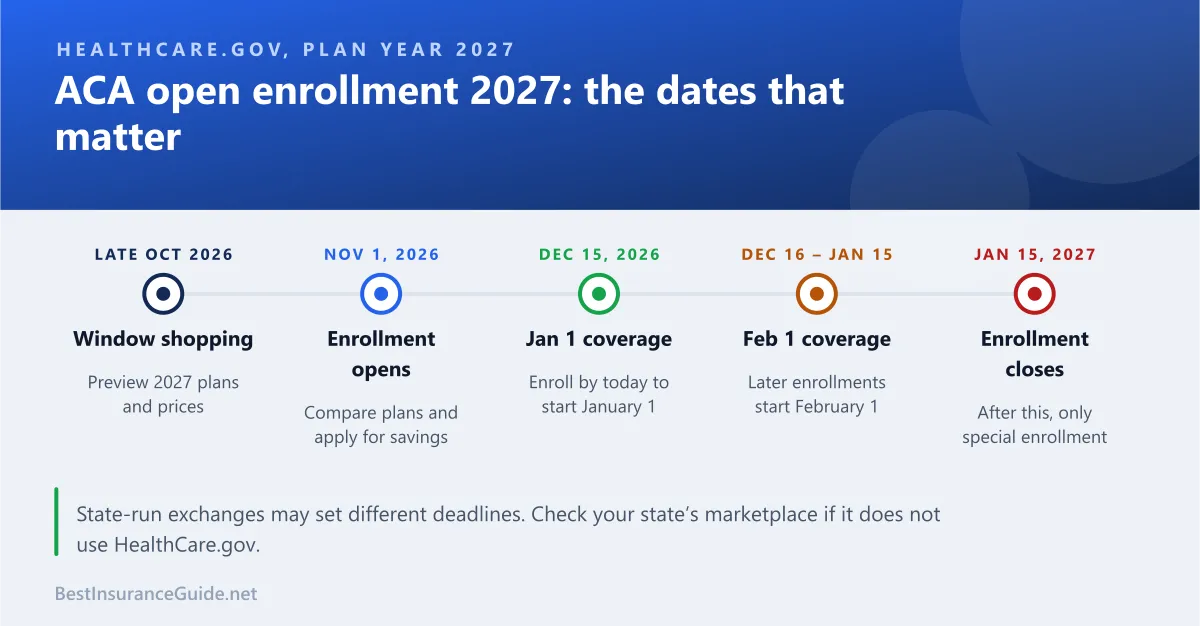
| Date | What happens |
|---|---|
| Late October 2026 | Window shopping: you can preview 2027 plans and prices on many exchanges |
| November 1, 2026 | Open enrollment opens on HealthCare.gov |
| December 15, 2026 | Last day to enroll for coverage starting January 1, 2027 |
| December 16 – January 15 | Enrollments start coverage on February 1, 2027 |
| January 15, 2027 | Open enrollment closes on HealthCare.gov |
A 2025 federal rule would have ended HealthCare.gov’s enrollment period on December 15. After a court challenge, federal regulators confirmed in August 2026 that the January 15 deadline stands for this enrollment season.
State-run exchanges set their own dates. Several states, including California, New Jersey and New York, have historically run longer windows. If your state runs its own marketplace, check its site.
The date that matters most for most people is December 15. Miss it, and you may have a month without coverage in January.
How much ACA premiums are rising in 2027
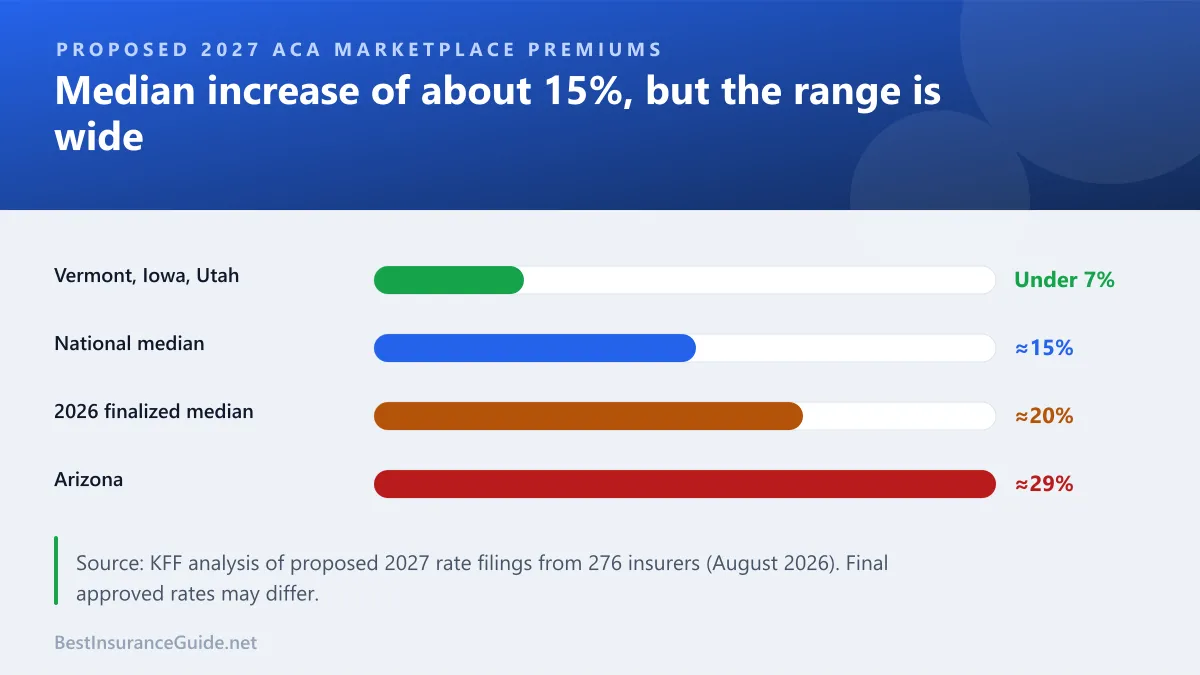
KFF reviewed proposed 2027 rates from 276 insurers across all 50 states and Washington, D.C. Its findings:
- Median proposed increase: about 15%.
- Lowest: under 7% in Vermont, Iowa and Utah.
- Highest: about 29% in Arizona.
- This follows a median finalized increase of about 20% for 2026. That means marketplace sticker prices have risen by more than a third in two years.
Proposed rates are not final. State regulators can approve, reduce or occasionally reject them, so the rates you see in November may differ.
Why premiums keep climbing
Insurers point to several pressures:
- Hospital and physician prices, the biggest single cost in health insurance.
- Prescription drugs, especially high-cost specialty medicines.
- Healthcare labor costs and general medical inflation.
- A smaller, sicker risk pool. When subsidies shrank, healthier people were the most likely to drop coverage. That leaves insurers covering a group with higher average costs, which pushes premiums up further.
What happened to the subsidies

The U.S. Capitol. Photo: Architect of the Capitol, public domain, via Wikimedia Commons.
From 2021 to 2025, enhanced premium tax credits made marketplace coverage much cheaper. They increased subsidies at every income level and removed the cap that cut off help above 400% of the federal poverty level.
They expired at the end of 2025. Here is how the fight has played out since:
- January 8, 2026: the House passed a three-year extension, 230–196, with 17 Republicans joining Democrats.
- January 2026: the Senate rejected both a Democratic extension and a Republican alternative built around health savings accounts.
- September 2026: subsidies returned to the centre of the government funding fight, without a resolution.
As of early October 2026, the enhanced subsidies have not been restored. Congress could still act, so check HealthCare.gov’s prices when you shop rather than relying on last year’s figures.
What the expiration did in 2026
KFF’s analysis shows how large the effect has been:
- Enrollees who kept the same plan faced an average 114% increase in what they paid for premiums once the enhanced credits ended.
- Marketplace enrollment was projected to fall from 22.3 million in 2025 to about 17.5 million in 2026, a drop of roughly 21%.
- People shifted to cheaper plans with higher deductibles. Silver plans fell from 57% to 43% of enrollments, while bronze rose from 30% to 40%.
The subsidy cliff is back
With the enhanced credits gone, the original ACA rule applies again: premium tax credits generally stop at 400% of the federal poverty level. Earn even slightly more, and you pay the full price. For people in their 50s and early 60s, whose premiums are highest because of age, that cliff can mean paying many hundreds of dollars more a month.
How your subsidy actually works, and why it absorbs some of the increase
The premium tax credit is pegged to the benchmark plan, the second-lowest-cost silver plan in your area. You are expected to pay a set share of your income toward it, and the credit covers the rest.
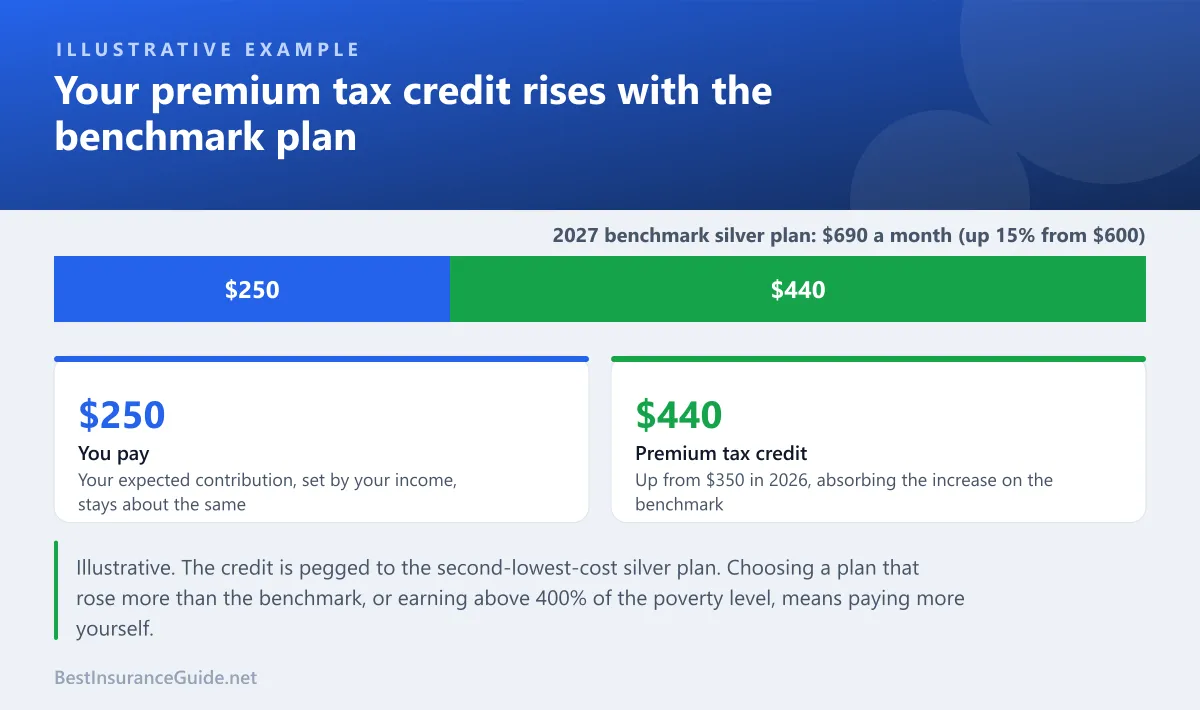
Worked example
Illustrative figures only.
Suppose your expected contribution, based on your income, is $250 a month.
- 2026: the benchmark silver plan costs $600, so your subsidy is $350.
- 2027: the benchmark rises 15% to $690. Your contribution stays at about $250, so your subsidy rises to $440.
If you buy the benchmark plan, your net cost barely changes. The risk is for people who do not shop. If your current plan rose 25% while the benchmark rose only 15%, auto-renewing into your old plan means paying the whole difference yourself. And if your income is above 400% of the poverty level, there is no subsidy to absorb anything.
Other changes for 2027
- Higher out-of-pocket maximum. The maximum out-of-pocket limit for marketplace plans rises to $12,000 for an individual in 2027, from $10,600 in 2026. Our guide to deductibles vs out-of-pocket maximums explains how the two work together.
- Insurer exits. More insurers are leaving marketplaces than entering for 2027, affecting hundreds of thousands of enrollees. If your insurer leaves, you will get a notice.
- Narrower eligibility for some immigrants. Federal changes limit subsidy eligibility for many lawfully present immigrants, keeping it for groups such as lawful permanent residents.
- State programs. Some states use their own money to replace part of the lost federal help. New Mexico did so for 2026, and Virginia and Rhode Island are introducing programs. Check whether your state offers one.
Which insurers are leaving the ACA marketplace in 2027?
KFF’s tracker, last updated October 7, 2026, counts Cigna plus 10 other carriers exiting some or all of their marketplace states for 2027, against six carriers entering new states.
| Insurer | What’s happening for 2027 |
|---|---|
| Cigna | Leaving the marketplace in all 11 of its states: Arizona, Colorado, Florida, Georgia, Illinois, Indiana, Mississippi, North Carolina, Tennessee, Texas and Virginia, affecting more than 350,000 enrollees |
| Mending (formerly Taro Health) | Leaving the health insurance business, including the Maine and Oklahoma marketplaces |
| Other carriers | Exiting selected states or counties; check KFF’s tracker or your exchange for your area |
Aetna CVS Health had already left the exchanges at the end of 2025, so some enrollees are now facing a second forced switch in two years.
If your insurer is leaving, you’ll get a discontinuation notice. The exchange may automatically move you to a similar plan from another insurer, but that plan may have a different network and price. Shop actively during open enrollment instead of accepting the default, and pick a plan by December 15 for coverage starting January 1.
How to pay less for 2027 coverage
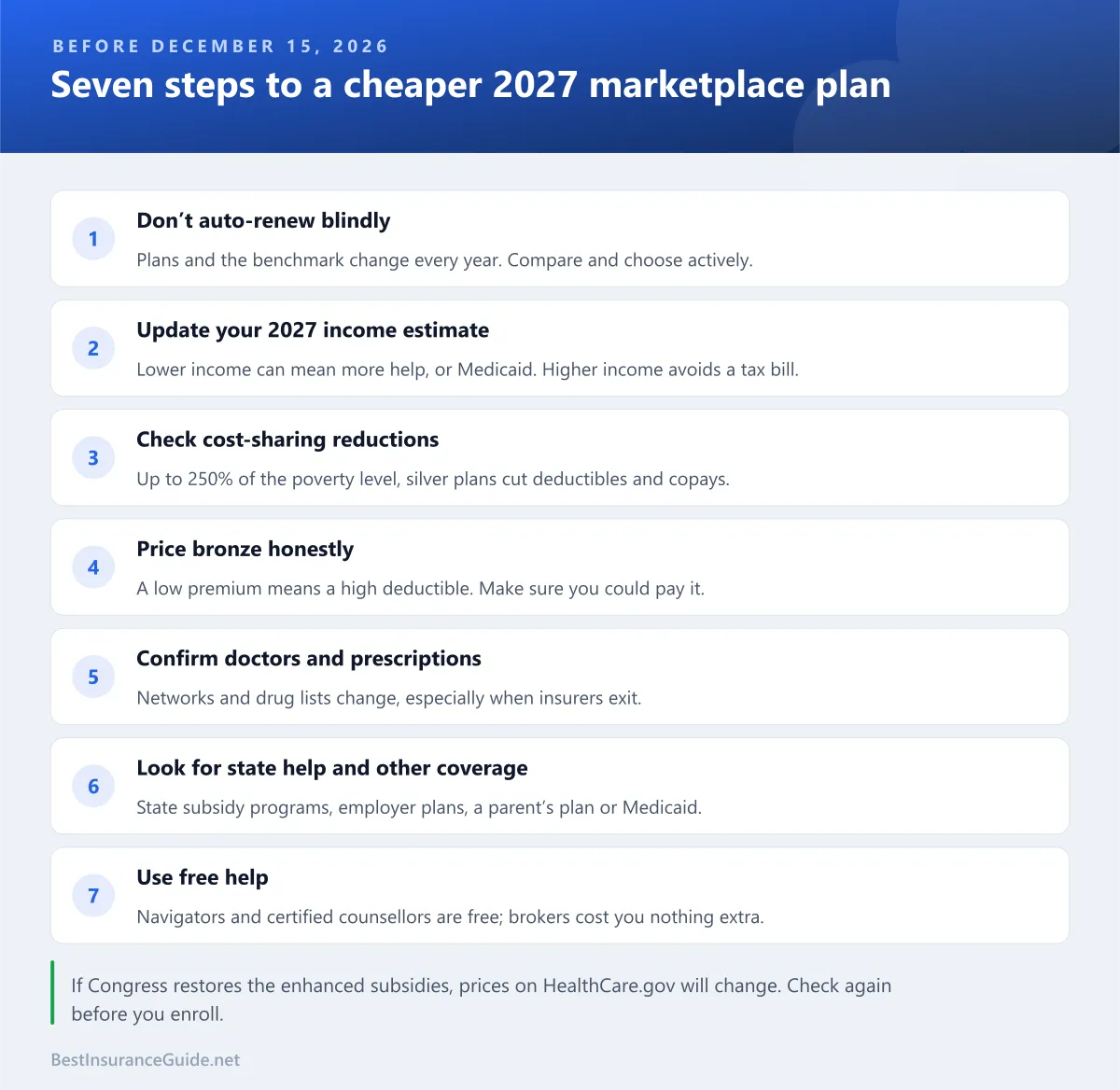
1. Don’t auto-renew without looking
Auto-renewal keeps you covered, but it rarely keeps you in the best deal. Plans and the benchmark change every year. Log in, compare, and choose actively.
2. Update your income estimate
Your subsidy depends on your projected 2027 income. If your income has dropped, report it. You may qualify for more help, or for Medicaid. If it has risen, update it to avoid owing money when you file taxes.
3. Look hard at silver if your income is lower
If your income is up to 250% of the poverty level, silver plans come with cost-sharing reductions that lower deductibles and copays. A bronze plan can look cheaper but cost far more if you actually need care.
4. Understand what a bronze plan really costs
Bronze plans have the lowest premiums and the highest deductibles. They can make sense if you are healthy and have savings. Make sure you could pay the deductible, and check that your doctors and prescriptions are covered. Our guide to what a deductible is walks through the maths.
5. Check the network and drug list
Insurer exits and plan redesigns often change networks. Confirm your doctors, hospital and prescriptions before you choose. HMO vs PPO explains how network types differ.
6. Check other options
- Employer coverage, through your job or a spouse’s.
- Staying on a parent’s plan until 26. See staying on your parents’ health insurance.
- Medicaid, if your income qualifies in your state.
- COBRA, usually expensive but sometimes worth it for a short gap. See how much COBRA costs.
7. Get free, unbiased help
Navigators and certified application counsellors help for free, and HealthCare.gov lists local help. Licensed brokers can also enrol you at no extra cost, since they are paid by insurers.
Who is hit hardest
- People earning just over 400% of the poverty level, who lost all subsidy help.
- Older enrollees not yet on Medicare, whose full-price premiums are highest. Our guide can you get Medicare at 62? covers the gap before 65.
- Self-employed people and early retirees who rely on the marketplace.
- People in high-increase states such as Arizona.
If you are between jobs, our guide to getting health insurance without a job covers every route to coverage.
Three common situations, and what to do
A 61-year-old couple, retired early, income just above 400% of the poverty level. This is the group the expired credits hurt most. With no subsidy, they pay the full price, and age-rated premiums are steep in their early 60s. Their options: check whether a modest change in reportable income, such as how retirement withdrawals are timed, would bring them under the cliff, compare bronze and silver at full price, and price coverage until Medicare at 65. A tax adviser is worth the fee here.
A single 30-year-old earning about twice the poverty level. Subsidies still apply, and a silver plan with cost-sharing reductions may have a much lower deductible than its price suggests. The mistake to avoid is auto-renewing into last year’s plan if it rose faster than the benchmark. Five minutes of comparison can save hundreds of dollars over the year.
A self-employed family whose insurer is leaving the marketplace. They will get a discontinuation notice and may be automatically placed in a similar plan. They should instead compare networks first, so their children’s doctors are still covered, then compare premiums and deductibles. Self-employed people can also generally deduct health premiums they pay, which softens the cost. Check the rules with a tax professional.
In all three cases, the habit that saves the most money is the same: log in, update your income, and compare before December 15.
What to watch before December 15
- Final 2027 rates as states finish approving filings.
- Any congressional deal on subsidies. If Congress restores the enhanced credits, subsidy amounts would change, and HealthCare.gov would update its prices.
- Insurer exit notices in your mailbox or email.
We will update this article if subsidies change or final rate figures differ significantly from the proposals.
Sources and notes
- KFF, “How Much and Why ACA Marketplace Premiums Are Going Up in 2027” and related analysis, August 2026.
- KFF analysis of 2026 marketplace enrollment, premiums and plan selection after the enhanced tax credits expired, 2026.
- Healthinsurance.org, “2027 ACA open enrollment: What’s changing,” September 2026, for dates, out-of-pocket limits and insurer exits.
- KFF, “Tracking Insurer Participation Changes in the ACA Marketplaces in 2027”, updated October 7, 2026; STAT News, “Cigna to exit ACA individual market in 2027”, April 30, 2026.
- Congressional actions on the enhanced premium tax credits as reported by AJMC, Health Affairs and the AHA, January to September 2026.
- Featured photo: National Cancer Institute / Rhoda Baer, public domain, via Wikimedia Commons. Capitol photo: Architect of the Capitol, public domain.
This article is general information, not tax, legal or financial advice. Subsidy amounts depend on your household income, size and location. This site is independent and not affiliated with HealthCare.gov, CMS or any insurer.