ICHRA Is Now a CHOICE Arrangement: Pros and Cons, ICHRA vs QSEHRA, and the 2027 Rules
ICHRA is now a CHOICE Arrangement: same rules, new name. ICHRA pros and cons, ICHRA vs QSEHRA, and the 2027 10.22% affordability test.

Table of contents

The individual coverage HRA has a new name. On September 3, 2026, the Small Business Administration (SBA) and the Centers for Medicare & Medicaid Services (CMS) announced that ICHRAs will now be called CHOICE Arrangements. The name stands for Custom Health Option and Individual Care Expense Arrangement. SBA Administrator Kelly Loeffler and CMS Administrator Dr. Mehmet Oz unveiled it at an event in Indiana, pitching it as a way for small businesses to offer health benefits on a fixed budget.
What the rename did not do is change the rules. Benefits advisers and compliance firms have been clear that CHOICE is “a name change, not a rule change”. The 2019 federal regulations that created the ICHRA still govern how it works. Congress considered writing the CHOICE name and several rule changes into law in 2025, but those provisions were dropped before the bill was enacted.
So why does it matter now? Because 2027 renewal season is here, group health costs are projected to rise at the fastest pace in years, and the ICHRA affordability test is changing for 2027. This guide explains how a CHOICE Arrangement works, the real pros and cons of an ICHRA, how it compares with a QSEHRA, and what the new 10.22% affordability percentage means, with worked examples.
This site is independent and is not affiliated with the SBA, CMS, the IRS or any HRA administrator. Figures are attributed to their sources at the end.
What happened: ICHRA to CHOICE Arrangement
| Detail | Before September 3, 2026 | After |
|---|---|---|
| Official name | Individual coverage HRA (ICHRA) | CHOICE Arrangement (ICHRA still widely used) |
| Governing rules | 2019 Treasury / DOL / HHS final regulations | Same 2019 regulations |
| Who can offer one | Employers with at least one W-2 employee | Same |
| Allowance cap | None | None |
| Tax treatment | Tax-free to employees, deductible for employers | Same |
| What employers must do | Nothing new | Nothing new. Existing plans keep running |
If you already offer an ICHRA, you do not need to amend anything because of the rename. If you are an employee, your allowance works exactly as before. The practical effect is that you will start to see “CHOICE” on government websites, in broker proposals and in administrator portals, often alongside “ICHRA” for a while.
How a CHOICE Arrangement (ICHRA) works
A CHOICE Arrangement turns the usual employer health plan inside out. Instead of the employer picking one group policy for everyone, the employer sets a monthly allowance, and each employee buys their own individual health insurance, on the ACA marketplace or directly from an insurer. The employee then gets reimbursed, tax-free, up to the allowance.
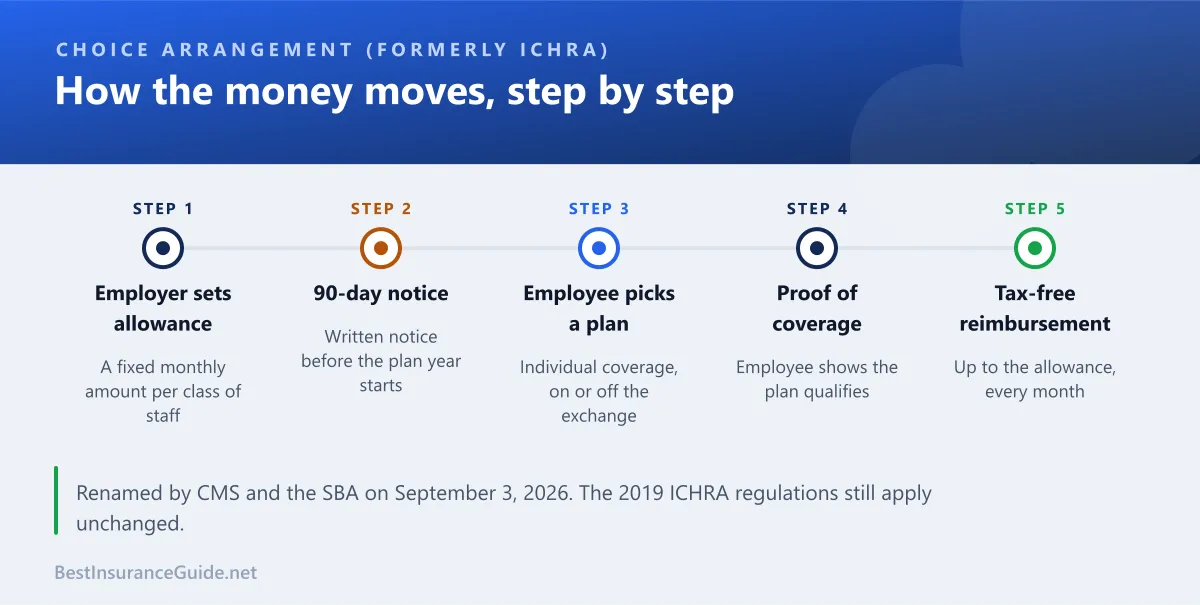
The core rules, all unchanged by the rename:
- Any size employer can offer one, as long as it has at least one W-2 employee. Sole owners with no employees cannot.
- Employees must have individual coverage. That means ACA-compliant individual health insurance, or Medicare Parts A and B or Part C. Short-term plans and dental-only or vision-only plans do not qualify. Employees must provide proof of coverage.
- Allowances can vary by class. Employers can treat up to 11 classes differently, including full-time, part-time, seasonal, salaried, hourly, employees in different rating areas, and new hires in a waiting period.
- Within a class, the offer must be the same. The only allowed differences are by age and family size. An older employee’s allowance can be no more than three times a younger employee’s in the same class.
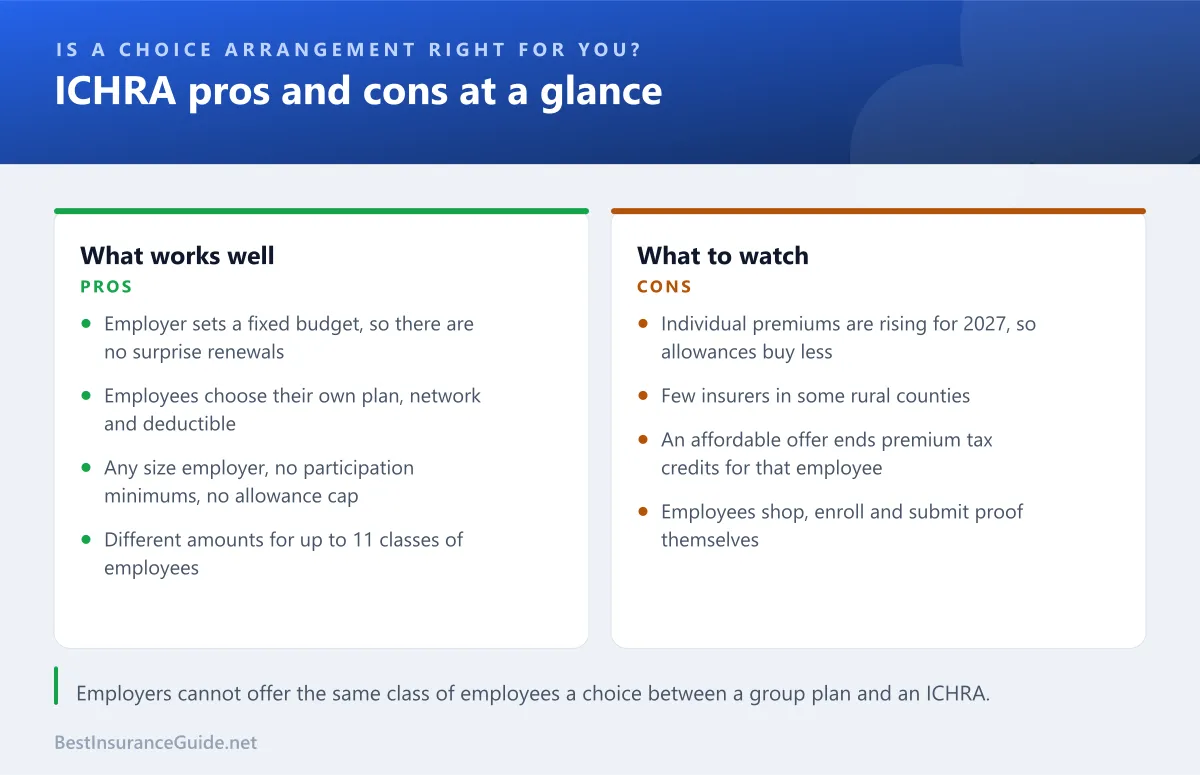
- No group plan and ICHRA for the same class. An employer can offer a group plan to salaried staff and a CHOICE Arrangement to hourly staff, but it cannot let one class pick between the two.
- Minimum class sizes apply in some split designs, for example when full-time and part-time staff are treated differently and one class gets a group plan. The minimum is 10 employees for employers with fewer than 100 workers, 10% of the workforce for those with 100 to 200, and 20 for larger employers.
- Notice. Employers must give eligible employees written notice at least 90 days before the plan year starts. For a January 1, 2027 start date, that deadline was around October 3, 2026. Newly eligible employees must get notice by the day they become eligible.
- Special enrollment. Being newly offered an ICHRA opens a special enrollment period, so employees can buy individual coverage outside open enrollment.
A useful way to think about it: the employer decides how much, the employee decides which plan.
ICHRA pros and cons
The rename is part of a federal push to promote the model, so it helps to set out both sides plainly.
Pros for employers
- Predictable cost. You set the allowance, so you know your maximum spend for the year. Group renewals, by contrast, can jump. The Business Group on Health projects that large employers’ health costs will rise by a median 9.2% in 2027 before plan changes.
- No participation or contribution minimums. Small-group insurers often require a set share of employees to enroll. An ICHRA has no such requirement.
- Flexibility by class. You can spend more on full-time staff, adjust for expensive rating areas, or keep a group plan for one class while moving another to an allowance.
- Large employers can satisfy the employer mandate if the arrangement is affordable and the coverage meets minimum value.
- Less plan administration. You are not choosing networks or negotiating renewals, although you do need to handle reimbursement and substantiation, usually through an administrator.
Pros for employees
- You choose the plan. That includes a network that fits your doctors, an HSA-eligible bronze plan, or a richer gold plan.
- The plan is yours. Individual coverage does not end because you change jobs, although the allowance does.
- Tax-free money. Reimbursements are not taxable income.
- Older employees can get larger allowances, within the 3:1 limit, which helps offset age-rated premiums.
Cons and trade-offs
- The individual market is getting more expensive. Insurers proposed a median increase of about 15% for 2027 marketplace premiums, according to KFF’s analysis of rate filings, and the enhanced premium tax credits are still expired. An allowance that looked generous in 2025 may cover less in 2027.
- Choice depends on where you live. In some rural counties only one or two insurers sell individual plans, often with narrow networks.
- Lower-income employees can lose subsidies. If the allowance makes the arrangement “affordable”, employees cannot claim premium tax credits, even when the subsidy would have been worth more than the allowance.
- Paperwork shifts to employees. They shop, enroll and submit proof. Some will need help, especially the first year.
- Payroll pre-tax gaps. Employees can pay their share of off-exchange premiums pre-tax through a cafeteria plan, but not marketplace premiums.
- Administration is not zero. Notices, classes, substantiation and affordability checks are where most compliance mistakes happen.
ICHRA vs QSEHRA: which fits?
ICHRA and QSEHRA are often mixed up. Both reimburse individual health insurance tax-free, but they are built for different employers.
| Detail | ICHRA / CHOICE Arrangement | QSEHRA |
|---|---|---|
| Who can offer it | Any employer with at least one W-2 employee | Employers with fewer than 50 full-time equivalents only |
| Group plan allowed? | Yes, for a different class of employees | No group plan for anyone |
| Allowance cap | None | 2026: $6,450 self-only, $13,100 family (2027 limits due from the IRS) |
| Different amounts by class | Yes, up to 11 classes | No. Same terms for all eligible employees, except by age and family size |
| Employee must have | Individual coverage or Medicare | Minimum essential coverage, which can include a spouse’s group plan |
| Premium tax credits | Lost if the employee accepts, or if the arrangement is affordable | Credit reduced by the allowance |
| Satisfies the ACA employer mandate | Yes, if affordable and minimum value | Not relevant (small employers only) |
| Notice deadline | 90 days before the plan year | 90 days before the plan year |
Rule of thumb: a business with a handful of staff, a tight budget and no interest in classes often finds a QSEHRA simpler. A growing business, one approaching 50 employees, one with distinct groups of staff, or one that wants to spend more than the QSEHRA cap will usually prefer a CHOICE Arrangement.
 Photo: Rhoda Baer, National Cancer Institute (public domain).
The 2027 affordability test: 10.22%
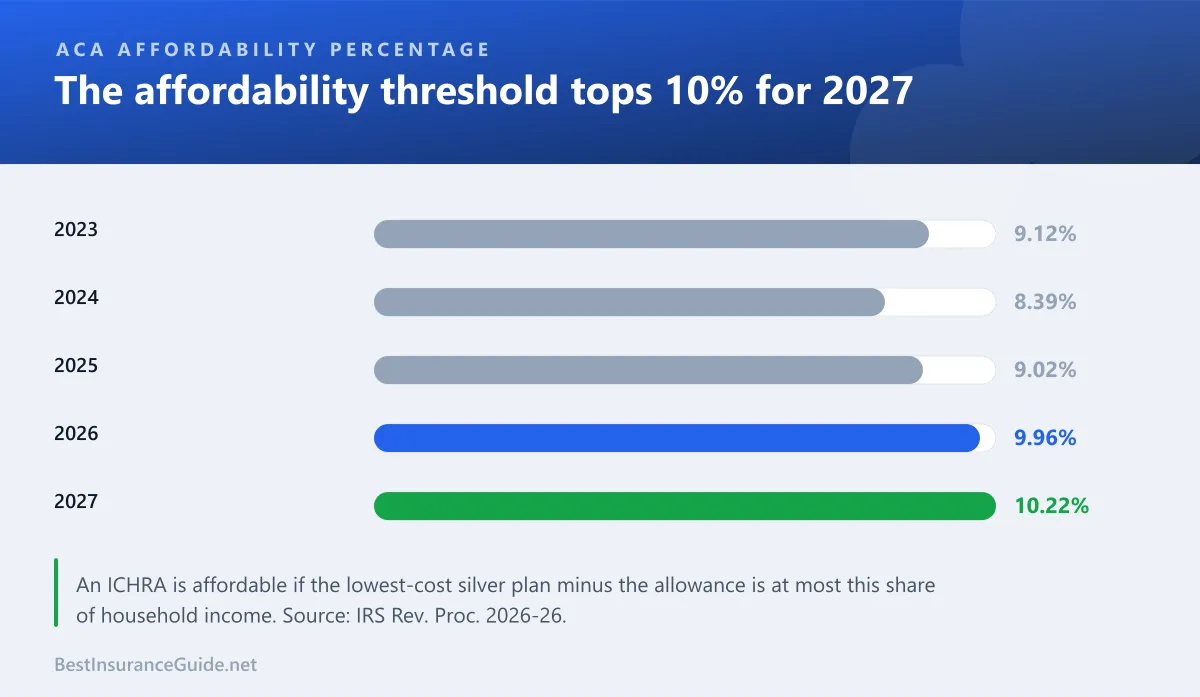
Affordability is the number that matters most for both employers and employees, and it changes every year. For plan years starting in 2027, the IRS set the affordability percentage at 10.22% of household income in Revenue Procedure 2026-26, issued July 21, 2026. That is up from 9.96% in 2026 and is the first time the figure has topped 10%.
For an ICHRA, the test works like this:
Monthly cost of the lowest-cost silver plan for the employee (self-only, in their rating area) − monthly allowance ≤ 10.22% × household income ÷ 12
If the left side is smaller, the arrangement is affordable: the employee cannot claim a premium tax credit, and a large employer is protected from the affordability penalty for that employee. If the left side is larger, it is unaffordable, and the employee may opt out and claim premium tax credits instead.
Because employers do not know household income, large employers usually rely on safe harbors based on W-2 wages, the rate of pay or the federal poverty line. The federal poverty line safe harbor works out to a maximum employee cost of about $135.93 a month for 2027 in the mainland U.S., according to Mercer.
Worked example: same allowance, two employees
The premium and income figures below are illustrative, not quotes. The method is the IRS test above.
| Detail | Employee A | Employee B |
|---|---|---|
| Lowest-cost silver plan, self-only | $520 / month | $520 / month |
| Household income | $48,000 | $30,000 |
| 10.22% of income, monthly | $408.80 | $255.50 |
| Allowance needed to be affordable | $520 − $408.80 = $111.20 | $520 − $255.50 = $264.50 |
| Employer’s allowance | $250 | $250 |
| Result | Affordable. No premium tax credit | Unaffordable. May opt out and claim a premium tax credit |
Two takeaways. First, the higher percentage makes it slightly easier for an allowance to count as affordable in 2027. Second, the same allowance can be affordable for one employee and not another, which is why employees with lower household incomes should run the numbers before accepting.
What employers should do now
- Check your timeline. For a January 1, 2027 start, the 90-day notice date has passed. If you have not sent notices, a later start date, such as April 1 or July 1, is the usual fix.
- Re-price the allowance against 2027 premiums. Individual market rates for 2027 appear on HealthCare.gov and state exchanges from late October. Use your employees’ actual rating areas and ages.
- Re-run affordability at 10.22% if you are an applicable large employer, using a safe harbor.
- Review your classes. Make sure any split between group plan and ICHRA classes meets the minimum class size rules.
- Plan employee support. Budget for a broker, navigator or administrator to help staff choose plans. This is the biggest factor in whether employees are happy with the switch.
- Update your materials. You may want to use the CHOICE name in communications, but keep “ICHRA” too, because that is what employees will find when they search.
What employees should do if offered one
- Read the notice. It tells you your allowance, whether the employer says it is affordable, and how premium tax credits are affected.
- Run the affordability test yourself using the lowest-cost silver plan for your age and ZIP code on HealthCare.gov or your state exchange.
- Compare total cost, not just premium. Look at deductibles, out-of-pocket maximums and whether your doctors are in network.
- Use the special enrollment period. Being offered an ICHRA opens a 60-day window to buy individual coverage, generally in the 60 days before the arrangement starts, so your plan and your allowance begin on the same day.
- Keep your proof of coverage. You will need it to get reimbursed.
What to watch next
- 2027 QSEHRA limits are expected from the IRS later this fall.
- 2027 marketplace premiums will be visible during open enrollment, which runs November 1, 2026 to January 15, 2027 on HealthCare.gov.
- New legislation. The rename was administrative. Any rule changes that have been floated, such as removing the 3:1 age limit or allowing one class to choose between a group plan and an ICHRA, would need new regulations or an act of Congress. None has been enacted as of early October 2026.
Related reading
For background on how employer plans are funded, see fully insured vs self-insured health plans. If you are between jobs, how to get health insurance without a job covers your options, and ACA open enrollment 2027 explains this year’s marketplace dates and premiums. Small employers may also find the business insurance checklist useful. For pre-tax health accounts, see HSA contribution limits 2027.
Sources and notes
- U.S. Small Business Administration, “SBA Recognizes Innovative CHOICE Arrangements as Major Win for Small Businesses”, September 3, 2026.
- OneDigital and TASC summaries of the CHOICE Arrangement announcement (a name change, not a rule change, and the removal of CHOICE provisions from 2025 legislation).
- IRS Revenue Procedure 2026-26, July 21, 2026: 2027 affordability percentage of 10.22%, as summarised by Mercer and Marsh McLennan Agency.
- Treasury, Labor and HHS final regulations on HRAs and other account-based group health plans (2019): classes, minimum class sizes, notice, substantiation and age variation rules.
- PeopleKeep’s ICHRA guide for class lists and the 2026 affordability percentage; IRS 2026 QSEHRA limits.
- Business Group on Health, 2027 Employer Healthcare Strategy Survey, August 25, 2026; KFF analysis of proposed 2027 marketplace premiums.
- Featured photo: Redd Angelo via Unsplash, CC0, via Wikimedia Commons. In-body photo: Rhoda Baer, National Cancer Institute, public domain, via Wikimedia Commons.
This article is general information, not tax, legal or benefits advice. ICHRA and QSEHRA rules have exceptions, and state rules on individual coverage vary. Employers should consult a benefits adviser or attorney before setting up or changing an arrangement.