Small Business Health Insurance for 2027: Costs, Options and the December Window
Small business health insurance for 2027: group plans vs QSEHRA vs ICHRA, average costs, the 50% SHOP tax credit and the Nov 15–Dec 15 window.

Table of contents

Small business health insurance is getting more expensive in 2027, but small employers have more ways to offer it than ever. A traditional group plan is still the default. Tax-free allowances such as a QSEHRA or an ICHRA, recently renamed the CHOICE Arrangement, give owners a fixed budget instead.
Searches for small business health insurance have climbed through the second half of 2026 as renewal notices land. The Business Group on Health projects that employer health costs will rise by a median 9.2% in 2027, and ACA marketplace insurers have proposed a median increase of about 15%, with the enhanced premium tax credits still expired.
This guide compares the main options, explains what coverage costs, covers the SHOP tax credit, and highlights the November 15 to December 15 window, when insurers must sell you a group plan even if not enough employees sign up. This site is independent and not affiliated with any insurer, broker or government agency.
Small business health insurance options at a glance
| Option | Who can use it | What the business pays | Employees get | Best for |
|---|---|---|---|---|
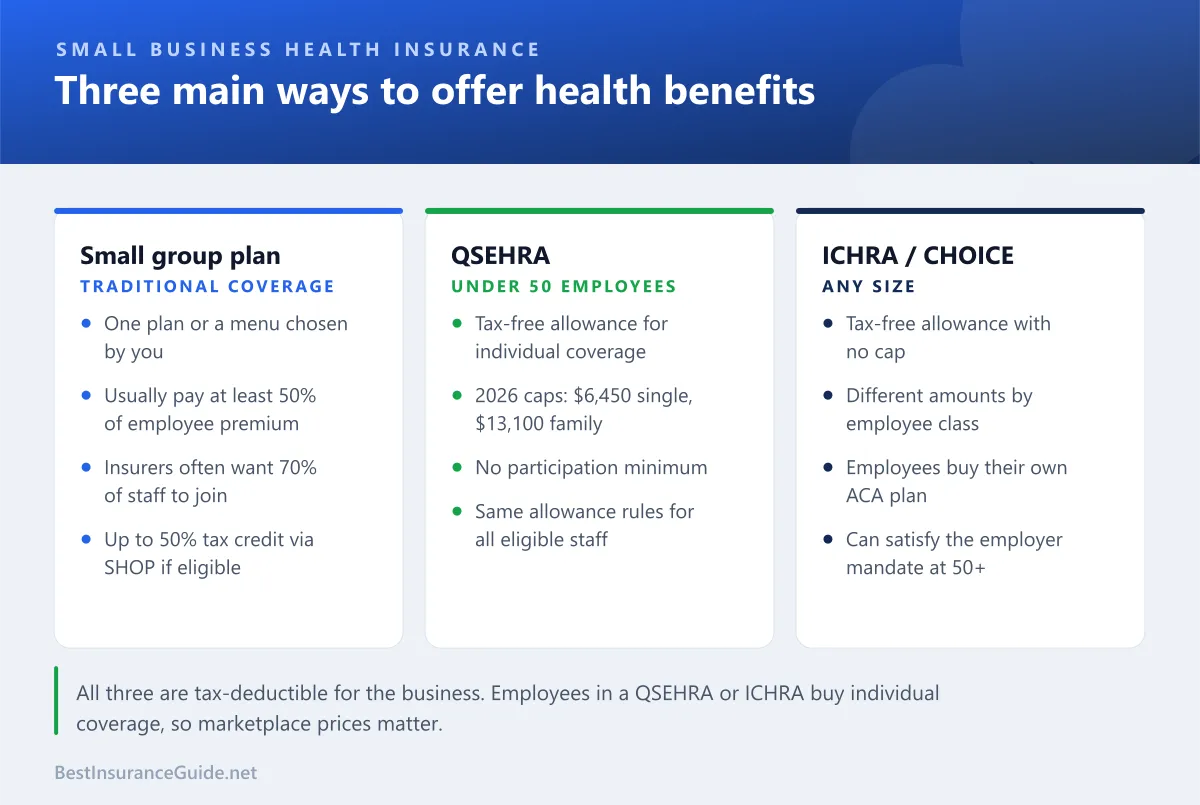
| Small group plan | Usually 1 to 50 employees (1 to 100 in CA, CO, NY, VT) | Typically at least 50% of employee-only premium | One shared plan, or a choice of plans | A traditional benefit with predictable coverage |
| SHOP plan | Up to 50 employees (100 in some states) | At least 50% of employee-only premium to get the tax credit | Group coverage bought through the ACA’s small business marketplace | Businesses that qualify for the tax credit |
| QSEHRA | Fewer than 50 full-time equivalents, no group plan | A fixed allowance up to $6,450 single or $13,100 family (2026) | Tax-free reimbursement for individual coverage and medical costs | Very small businesses on a tight budget |
| ICHRA / CHOICE Arrangement | Any size | Any allowance you choose, by employee class | Tax-free reimbursement for individual coverage | Growing businesses and staff in different states |
| Taxable stipend | Any size | Any amount | Extra pay, taxed as wages | Simplicity, though it is the least tax-efficient |
Do small businesses have to offer health insurance?
No, not under federal law, if you have fewer than 50 full-time equivalent employees. The ACA’s employer mandate, the employer shared responsibility rule, applies only to employers with 50 or more full-time equivalents.
Hawaii requires most employers to provide coverage for employees working 20 hours or more a week, and San Francisco has its own health spending requirement. Check local rules if you operate there.
Most small employers that offer coverage do so to hire and keep staff. KFF’s 2025 survey found that 61% of firms offer health benefits to at least some workers, with offer rates much lower among the smallest firms than among large ones.
What small business health insurance costs
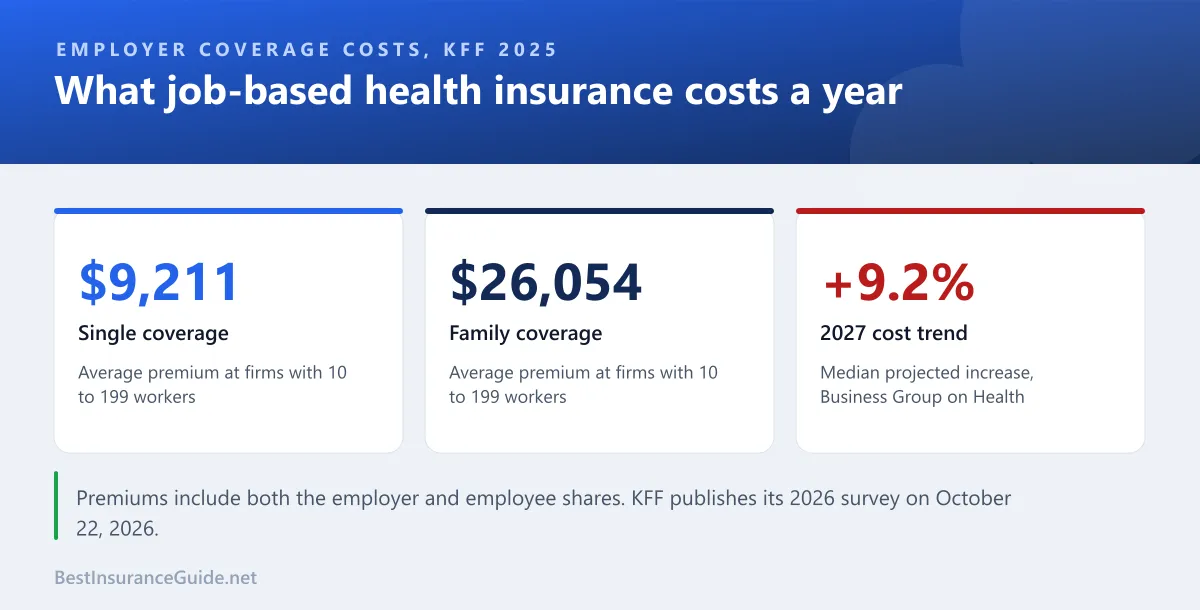
The best national benchmark is KFF’s annual Employer Health Benefits Survey. For 2025, KFF found:
| Coverage | Firms with 10–199 workers | Larger firms | All firms |
|---|---|---|---|
| Single, average annual premium | $9,211 | $9,361 | $9,325 |
| Family, average annual premium | $26,054 | $27,280 | $26,993 |
Source: KFF 2025 Employer Health Benefits Survey. Premiums include both the employer and employee shares.
Single premiums rose 5% and family premiums 6% in 2025. KFF is due to publish its 2026 survey on October 22, 2026, and we will update these figures when it does.
What drives your quote
Small group premiums are set under ACA rules, so insurers cannot charge more for health conditions. Your price depends on:
- Employee ages. Older staff cost more, up to three times as much for a 64-year-old as for a 21-year-old.
- Location. Prices vary sharply by state and county.
- Plan design. Deductible, network type and out-of-pocket limits.
- How many people enrol, including spouses and children.
- Tobacco use, where state rules allow a surcharge.
Worked example: a 10-person business
Illustrative. A business with 10 employees, all on single coverage, at the 2025 small-firm average of $9,211 a year:
- Total premium: about $92,110 a year.
- Employer pays 50%, the common minimum: about $46,055 a year, or $384 per employee a month.
- Employer pays 80%: about $73,690 a year.
- With a 9.2% increase for 2027: the 50% share rises to about $50,300.
Premiums are a deductible business expense, and employees’ shares can usually be paid pre-tax through a Section 125 premium-only plan, which saves payroll taxes for both sides.
Option 1: a small group health plan
A small group plan is what most people mean by “company health insurance.” You choose one plan or several from an insurer, pay part of the premium, and employees join.
Requirements to know:
- At least one employee who is not the owner or the owner’s spouse, in most states. A sole proprietor with no staff buys individual coverage instead and can usually take the self-employed health insurance deduction.
- Minimum participation. Many insurers want around 70% of eligible employees to enrol. Employees who decline because they have other coverage, such as a spouse’s plan, often do not count against you.
- Minimum contribution. Insurers commonly require you to pay at least 50% of the employee-only premium.
Pros: one shared plan, simple for staff, strong recruiting signal, premiums can’t vary by health status.
Cons: renewals can jump, you carry the risk of rising costs, and participation rules can block very small businesses.
Level-funded plans
Many insurers and brokers now offer level-funded plans, a form of self-funding with a fixed monthly cost and stop-loss protection. They can cost less for a young, healthy group, and some refund a surplus. But renewals depend on your group’s claims, so one large claim can raise your price. Read the stop-loss terms carefully. Our guide to fully insured vs self-insured plans explains the trade-offs.
The November 15 to December 15 window
This is the most useful rule most small business owners have never heard of.
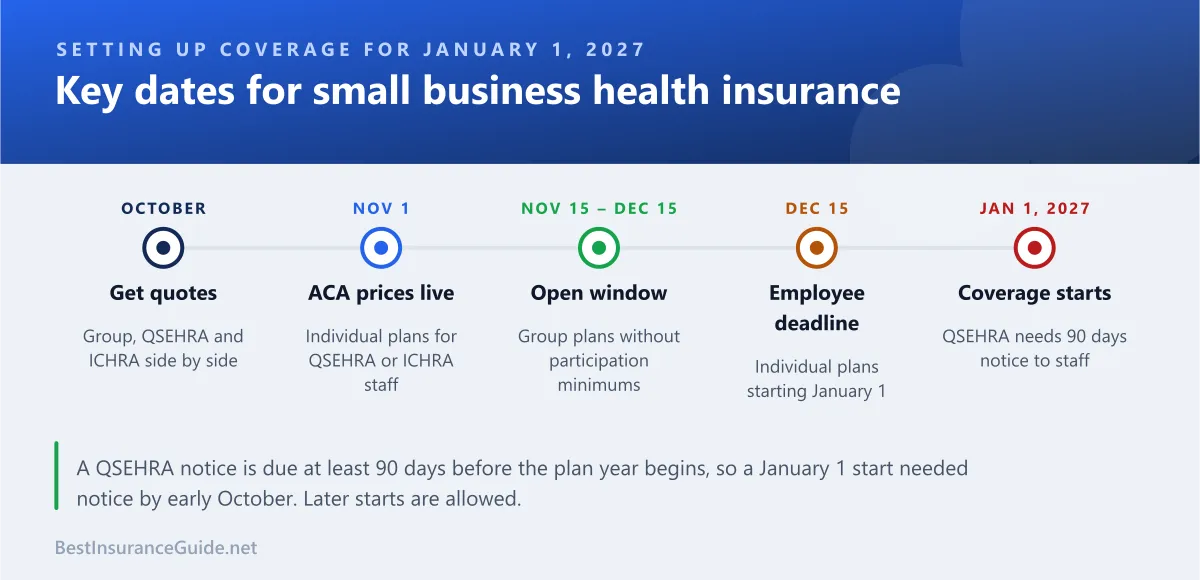
Under the ACA’s guaranteed availability rules, an insurer that normally imposes minimum participation or contribution requirements must still sell you small group coverage if you apply between November 15 and December 15. Coverage bought in this window usually starts January 1.
Who it helps:
- Businesses where too few employees want to join to meet a 70% participation rule
- Owners who cannot afford to pay 50% of premiums
- Very small teams that have been turned down before
The trade-off: outside this window, the insurer can enforce its rules at renewal. But for many small businesses, it is the easiest way to get a group plan in place for 2027.
Option 2: SHOP and the small business tax credit
SHOP, the Small Business Health Options Program, is the ACA’s marketplace for small group coverage. You usually buy SHOP plans through a SHOP-registered broker or directly from an insurer, rather than on HealthCare.gov itself.
The main reason to use SHOP is the Small Business Health Care Tax Credit:
- Worth up to 50% of the premiums you pay (35% for tax-exempt employers).
- Available to employers with fewer than 25 full-time equivalent employees.
- Average annual wages must be below an inflation-adjusted limit, about $67,000 for 2026 according to the IRS’s draft Form 8941 instructions. The credit phases out as headcount and average wages rise.
- You must pay at least 50% of employee-only premiums under a uniform policy.
- You can claim it for two consecutive tax years, on IRS Form 8941.
The full credit goes to businesses with 10 or fewer full-time equivalents and lower average wages. Owners and their family members do not count as employees for the credit. Ask your accountant to run the numbers before you choose a plan, because the credit only applies to SHOP coverage.
Option 3: QSEHRA
A Qualified Small Employer Health Reimbursement Arrangement lets you give employees a tax-free monthly allowance to buy their own individual health insurance and pay medical costs.
| QSEHRA detail | 2026 |
|---|---|
| Who can offer it | Fewer than 50 full-time equivalents, and no group health plan |
| Maximum allowance, self-only | $6,450 a year ($537.50 a month) |
| Maximum allowance, family | $13,100 a year (about $1,091 a month) |
| Participation minimum | None |
| Notice to employees | At least 90 days before the plan year begins |
Source: IRS Revenue Procedure 2025-32. The IRS usually publishes the next year’s limits in the fall.
Pros: a fixed budget, no participation rules, and employees choose their own plan.
Cons: the allowance is capped. And because staff buy on the individual market, marketplace price rises hit them directly. A QSEHRA allowance also reduces any premium tax credit an employee would otherwise get, and can make them ineligible if the allowance counts as affordable.
Option 4: ICHRA, now the CHOICE Arrangement
An individual coverage HRA works like a QSEHRA with fewer limits: no cap on the allowance, available to any size of employer, and allowances can vary by class of employee, such as full-time and part-time, or by state. In September 2026, CMS and the SBA renamed it the CHOICE Arrangement. The rules did not change.
For 2027, an ICHRA is “affordable” for an employee if the cost of the lowest-cost silver plan, minus the allowance, is no more than 10.22% of household income. Our full guide to the ICHRA / CHOICE Arrangement explains how to set allowances and how it compares with a QSEHRA.
How to choose: four quick tests
- Do most of your employees want coverage? If yes, and you can pay at least half, a group plan is simplest. If not, consider the December window or an allowance.
- Do you have fewer than 25 employees and modest wages? Price a SHOP plan and check the tax credit. It can halve your cost for two years.
- Do you need a fixed, predictable budget? A QSEHRA or ICHRA caps your spend. Group renewals can rise 9% or more.
- Are your employees spread across states, or very different in age? An ICHRA handles this better than one group plan.
Before choosing an allowance, check marketplace prices where your employees live. With ACA premiums rising and the enhanced subsidies expired, a $400 allowance may buy much less than it did two years ago. Our guide to ACA open enrollment 2027 covers what individual plans will cost.
Common mistakes to avoid
- Waiting until December 16. Miss the November 15 to December 15 window, and participation rules apply again.
- Offering a group plan and an ICHRA to the same class. You cannot offer both to the same employees.
- Paying premiums as a taxable stipend by accident. Reimbursing individual premiums without a formal QSEHRA or ICHRA can trigger IRS penalties.
- Forgetting the 90-day QSEHRA notice. Employees need written notice before the plan year.
- Ignoring the employees’ side. A cheap plan with a high deductible may not help you hire. Our guide to HDHP vs PPO explains how plan design changes what staff pay.
Related reading
Health insurance is only one part of protecting a small business. Our business insurance checklist covers the policies most small businesses need, and startup business insurance costs shows what to budget in your first year.
Sources and notes
- KFF, 2025 Employer Health Benefits Survey: average premiums by firm size, premium growth and offer rates. The 2026 survey is scheduled for October 22, 2026.
- Business Group on Health, 2027 Employer Healthcare Strategy Survey, August 2026: projected median 9.2% cost increase before plan changes.
- KFF analysis of proposed 2027 ACA marketplace premiums: median proposed increase of about 15%.
- 45 CFR 147.104(b)(1)(i)(B): guaranteed availability of small group coverage from November 15 to December 15 regardless of participation or contribution rules.
- IRS Revenue Procedure 2025-32: 2026 QSEHRA limits of $6,450 and $13,100, as summarised by Mayer Brown.
- IRS Form 8941 and instructions: Small Business Health Care Tax Credit rules; 2026 wage threshold from the IRS draft instructions.
- IRS Revenue Procedure 2026-26: 2027 affordability percentage of 10.22%.
- Featured photo: Serge Esteve, CC0 public domain dedication, via Unsplash and Wikimedia Commons.
This article is general information, not tax, legal or benefits advice. Rules vary by state, and tax credit eligibility depends on your circumstances. Consult a licensed broker, accountant or benefits adviser before choosing a plan.