How to Get Health Insurance Without a Job (and the Age 26 Rule)
How to get health insurance with no employer plan: marketplace subsidies, Medicaid, COBRA and a parent's plan until 26. Plus Medicaid approval timelines.

Table of contents

Losing employer coverage, or never having had it, feels like a wall. It usually is not. There are six routes, and for most people without an income one of them is dramatically cheaper than expected.
The age 26 rule, stated properly
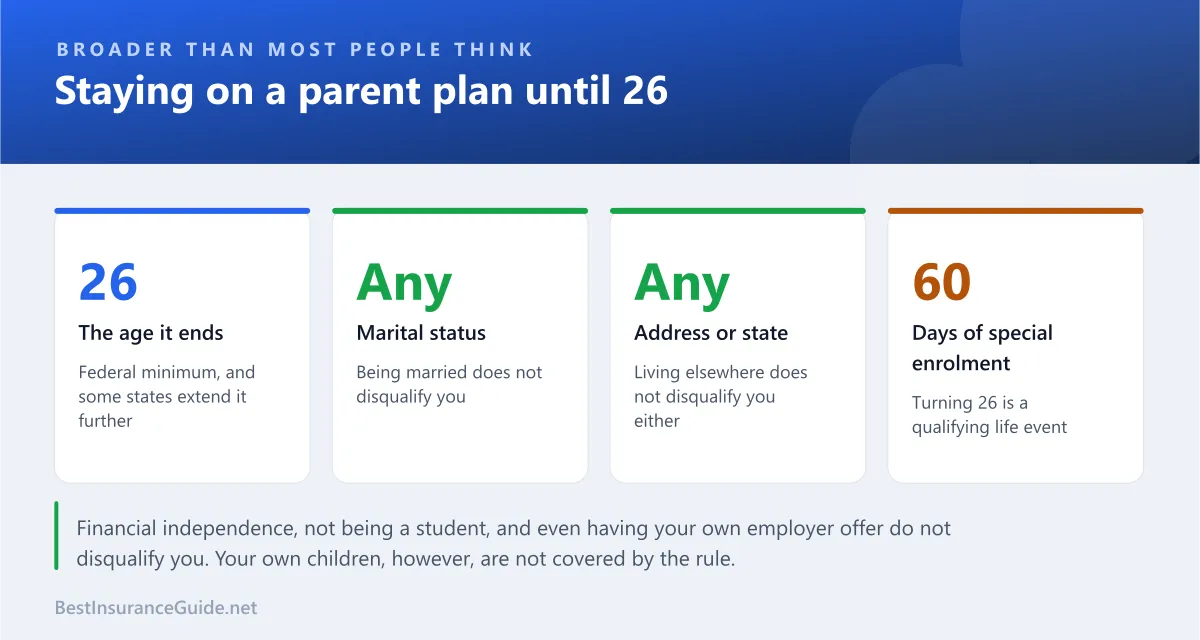
If you are under 26, this is almost certainly your answer, and the rule is broader than most people believe.
You can stay on a parent’s health plan until your 26th birthday, and none of the following disqualify you:
- Being married
- Living at a different address, in a different state
- Being financially independent
- Not being a student
- Being eligible for a plan through your own employer
- Having a child of your own
That last set matters because the old rules were much narrower and the folk memory persists. A married 25-year-old with a job and their own apartment can still be on a parent’s plan.
Two practical notes.
The end date varies. Some plans run cover to the end of the birthday month, some to the end of the plan year, some to the birthday itself. Ask, because planning the handover depends on it.
Your children are not covered. The rule extends to you, not to your own dependants. A grandchild is not automatically on the grandparent’s plan.
Several states extend coverage past 26 under specific conditions, often for unmarried dependants or with a financial dependence test. Check your state insurance department if you are approaching the cliff.
Turning 26 is a qualifying life event
Losing that coverage opens a special enrolment period, normally 60 days, to buy a marketplace plan or join an employer plan.
Apply before the birthday. Most marketplaces let you apply up to 60 days in advance and set the start date so there is no gap. Waiting until after creates a window where you are uninsured for no reason.
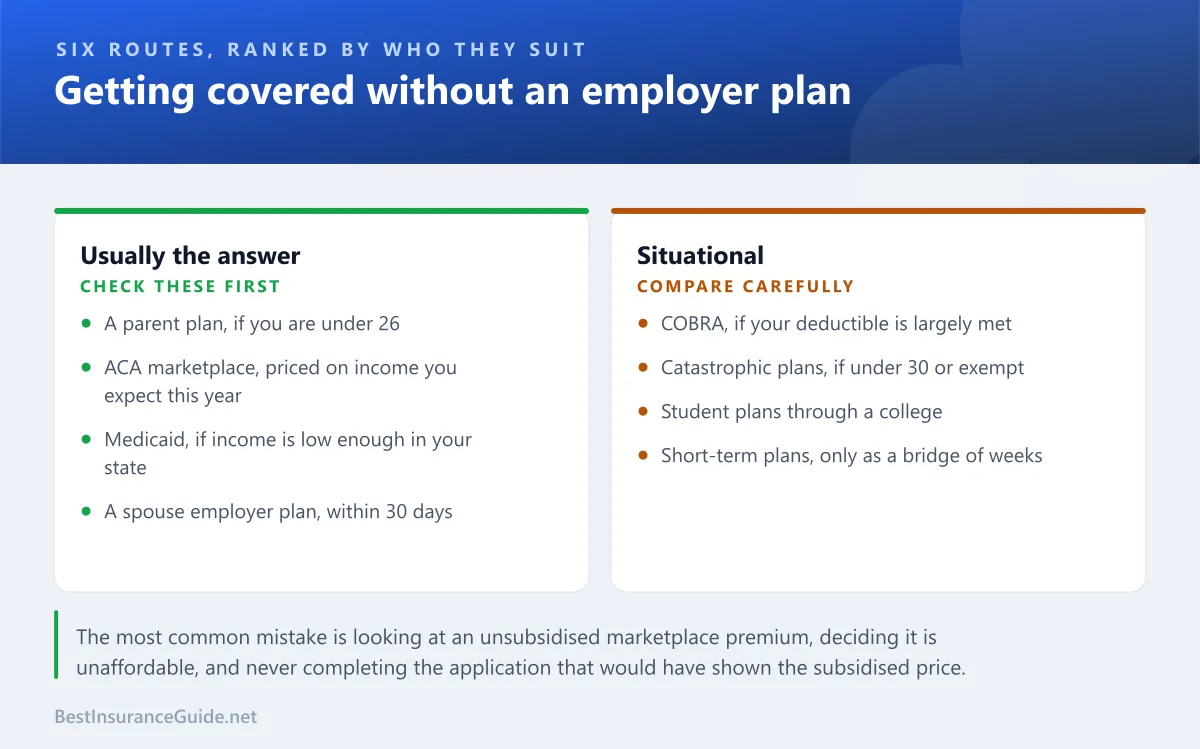
The six routes
1. The ACA marketplace
For most people without a job, this is the answer, and the reason is the subsidy.
Premium tax credits are calculated on the income you expect this year, not last year’s salary. Someone whose income has just dropped often qualifies for substantial help, and the resulting premium can be a small fraction of the sticker price.
This is the single most common mistake people make when they lose a job: they look at the unsubsidised premium, decide they cannot afford it, and never complete the application that would have shown them the real number.
Cost-sharing reductions are a second, less known benefit. At lower incomes, choosing a silver plan unlocks reduced deductibles and out-of-pocket maximums that can be dramatically better than the standard version. This only applies to silver plans, which is why picking bronze on price alone can be a mistake at low incomes.
Estimating income for the year is genuinely hard when you are between jobs. Estimate honestly, and update the marketplace when things change, because the credit is reconciled on your tax return and a large underestimate creates a bill.
2. Medicaid
If your income is low, Medicaid is likely better than any marketplace plan: little or no premium, minimal cost-sharing, and comprehensive benefits.
Eligibility depends on your state. In states that expanded Medicaid, adults under a threshold based on the federal poverty level generally qualify on income alone. In states that did not expand, eligibility for adults without children is much narrower, which creates a coverage gap for people earning too much for Medicaid and too little for subsidies.
Two features make Medicaid unusually forgiving:
There is no enrolment period. You can apply any day of the year. This alone makes it worth applying if you are anywhere near the threshold.
Coverage can be backdated. Most states allow retroactive coverage up to three months before the application for bills incurred while eligible. If you have unpaid medical bills from recent months, apply anyway.
How long does approval take? States are generally required to decide within 45 days of a complete application, or around 90 days where a disability determination is required. Many decisions come far faster. Incomplete documentation is the main cause of delay, so send income verification, identity documents and residency proof with the application rather than waiting to be asked.
Apply through your state Medicaid agency or through the marketplace, which screens for Medicaid automatically and refers you.
3. A spouse or partner’s plan
Losing your coverage is a qualifying life event for their plan too. Their employer must allow you to join outside open enrolment, typically within 30 days.
This is often the cheapest good option, because employer plans are subsidised. Ask their HR department promptly, since the 30-day window is shorter than the marketplace’s 60.
4. COBRA
Continuing your former employer’s plan keeps the same network, the same doctors, and the deductible you have already partly met.
It costs 102% of the full group premium, which is usually three to five times the payroll deduction you were used to. Our guide to how much COBRA costs works through the numbers and the deadlines, including the election window that quietly functions as a decision period rather than a hard cutoff.
The short version: COBRA usually wins if you have already met most of your deductible or are mid-treatment. Otherwise the marketplace is usually far cheaper.
5. Catastrophic and student plans
Catastrophic plans are available on the marketplace to people under 30, and to anyone with a hardship or affordability exemption. Low premium, very high deductible, and full coverage after the out-of-pocket maximum. They are ACA-compliant and cover preventive care and three primary visits before the deductible. Premium tax credits cannot be applied to them, so at low incomes a subsidised silver plan is usually better.
Student health plans through a college are often good value and worth comparing if you are enrolled.
6. Short-term plans, with caution
Short-term limited-duration plans are cheap for a reason: they are not ACA-compliant.
They can exclude pre-existing conditions, decline applicants on health grounds, cap annual and lifetime benefits, and omit essential health benefits such as maternity, mental health and prescription cover. Availability and maximum duration vary by state, and several states restrict or ban them.
They are defensible as a genuine bridge of a few weeks when nothing else fits. They are a poor substitute for real coverage, and buying one when a subsidised marketplace plan was available is a common and expensive error.
Can I cancel my health insurance at any time?
The answer differs by plan type, and the asymmetry catches people.
Marketplace plans: yes. You can cancel at any time, usually with around 14 days notice. If you are cancelling because you got a job with coverage, set the end date to align with the new plan’s start date.
Employer plans: generally no. You must wait for open enrolment or have a qualifying life event. Getting married, having a child, or a spouse gaining coverage will do it; simply changing your mind will not.
Medicaid: yes, any time, and you can reapply any time.
One warning. Voluntarily cancelling marketplace coverage does not create a special enrolment period. If you drop a plan in March because money is tight, you generally cannot buy another until the next open enrolment unless something else qualifies you. Losing coverage involuntarily qualifies; walking away from it does not.
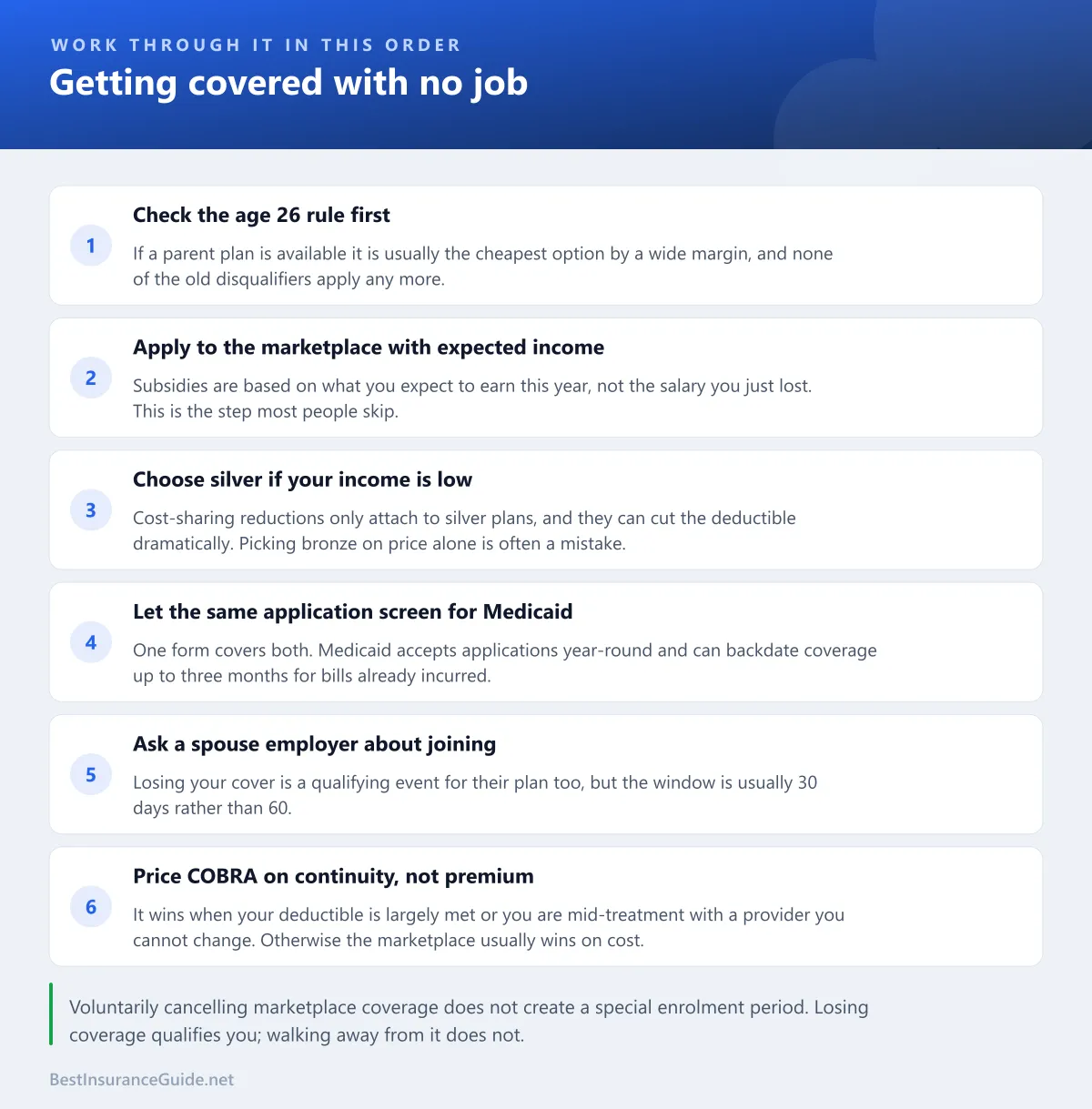
The order to work through it
If you are under 26, check whether a parent’s plan is available. It is usually the cheapest option by a wide margin.
Apply through the marketplace using your expected income for this year. The application screens for Medicaid at the same time, so one form covers both routes. Do this even if you think the premiums are unaffordable, because the unsubsidised price is not the price you will pay.
Ask a spouse’s employer about joining their plan, and mind the shorter 30-day window.
Price COBRA against the marketplace result, and weigh it on deductible progress and provider continuity rather than premium alone.
Only then consider short-term cover, and only as a bridge of weeks.
Throughout, avoid a gap if you can. Continuous coverage matters for pre-existing condition protections in some contexts, and an uninsured month is when the expensive thing happens.
Estimating income when you have no idea
The marketplace application asks for expected annual income, and for someone between jobs that number is a genuine guess. It is also the number that sets your subsidy, so it is worth doing deliberately.
Count everything that is taxable. Wages already earned this year, severance, freelance income, investment income, and taxable retirement withdrawals. Unemployment compensation counts as income for this purpose.
Estimate the rest of the year honestly. If you expect work in three months, include it. Deliberately understating income to secure a larger subsidy creates a reconciliation bill at tax time, because premium tax credits are trued up against actual income on your return.
Update the marketplace when things change. This is the step almost nobody takes. Report a new job, a raise, or a longer gap than expected, and the credit adjusts going forward rather than arriving as a surprise in April.
Overestimating is safer than underestimating. If you earn less than projected, the difference typically comes back to you as a refundable credit. Underestimate and you may owe.
One further note: if your income turns out low enough to qualify for Medicaid mid-year, you can switch. Medicaid accepts applications year-round, and moving to it is generally better than staying on a subsidised marketplace plan you cannot afford the cost-sharing on.
Keeping care affordable while uninsured
If there is a genuine gap before coverage starts, a few things reduce the damage.
Community health centres offer primary and often dental care on a sliding scale based on income. They are federally supported, they exist in most areas, and they will see uninsured patients.
Ask for the cash price. Providers frequently have a self-pay rate substantially below their billed charge, and hospitals are required to publish standard charges. Asking before treatment is normal and expected.
Request financial assistance. Non-profit hospitals are required to have charity care policies, and many people who qualify never apply because they do not know it exists. Ask for the financial assistance application specifically.
Negotiate after the fact. Hospital bills are routinely reduced for uninsured patients who ask, and interest-free payment plans are widely available.
Use prescription discount programmes and generic equivalents. The gap between a discounted generic and a branded drug is often enormous.
Do not ignore bills. Unpaid medical debt is handled far more sympathetically when you engage early, and most providers prefer a payment plan to a collections referral.
None of this substitutes for coverage. It reduces the harm of a gap that should be as short as you can make it.
Two related situations
Losing a job is one route to needing cover. Two others come up frequently and have their own rules.
Ageing off a parent’s plan. Coverage runs until 26 under federal rules, and almost nothing disqualifies you before then: not marriage, not a job with its own benefits, not living independently, not having a child. What causes problems is the exact end date, which varies by plan from the birthday itself to the end of the plan year, and the network, which may not reach where you actually live. Our guide to staying on a parent’s health insurance covers both, along with the 60-day special enrolment window that opens when it ends.
Deciding to cancel coverage. Cancelling is usually straightforward and getting back in is not, because enrolment is restricted to open enrolment and qualifying life events, and voluntarily cancelling is not itself a qualifying event. A cancellation early in the year can leave somebody uninsured until January. Our guide to whether you can cancel health insurance at any time sets out the asymmetry and the alternatives worth trying first when cost is the problem.
Related reading
If a new employer offers an allowance to buy your own plan instead of group coverage, read ICHRA and CHOICE Arrangements.
The short version
You can stay on a parent’s plan until your 26th birthday regardless of marriage, address, income or job offers, and turning 26 opens a 60-day special enrolment period you should use before the birthday rather than after.
Without a job, apply to the marketplace using the income you expect this year, not the salary you lost. The subsidy calculation is the single biggest factor and it is the step most people skip. The same application screens you for Medicaid, which accepts applications year-round, typically decides within 45 days, and can backdate coverage up to three months.
For understanding what the plans actually mean once you are choosing between them, deductible vs out-of-pocket maximum and health insurance terms explained cover the mechanics.