FSA Limits 2027: Health FSA, Carryover and the New $7,500 Dependent Care Limit
2027 FSA limits: health FSA projected at about $3,500 (IRS due this fall), carryover about $700, dependent care FSA $7,500. Rules, deadlines and tax savings.

Table of contents

Open enrollment for 2027 workplace benefits is under way, and flexible spending accounts (FSAs) are one of the easiest ways to cut your tax bill. This year there is good news and a missing number.
- The good news: the dependent care FSA limit is now $7,500, up from $5,000 before 2026. That is the biggest increase in decades, and it stays at $7,500 for 2027.
- The missing number: the 2027 health FSA limit. The IRS hasn’t announced it yet. It usually does in October or November, and it is projected to rise to about $3,500 from $3,400.
This guide covers both limits, the carryover and grace-period rules, who can use which account, and how much an FSA can save. We will update this article with the official 2027 health FSA and carryover figures as soon as the IRS publishes them.
This site is independent and not affiliated with the IRS or any benefits provider.
2027 FSA limits at a glance
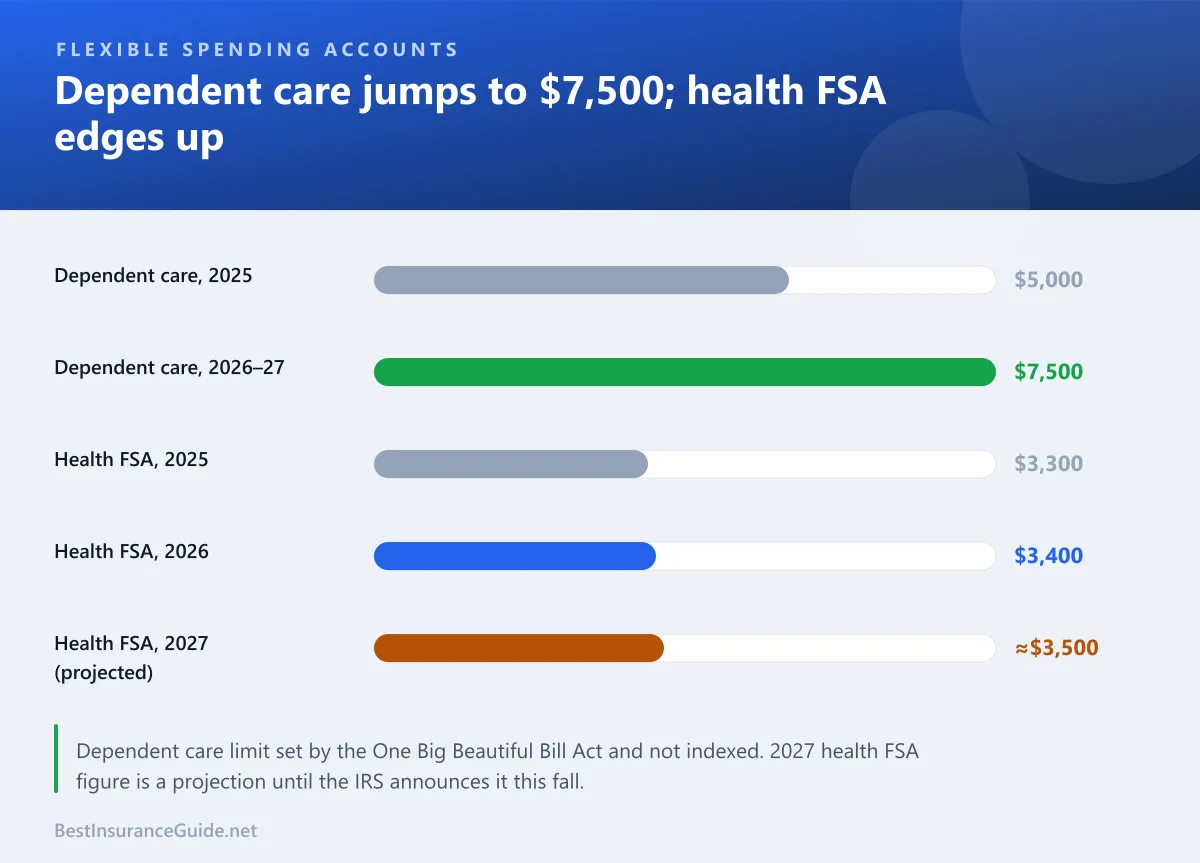
| Detail | 2025 | 2026 | 2027 |
|---|---|---|---|
| Health FSA contribution limit | $3,300 | $3,400 | ≈$3,500 (projected, IRS fall 2026) |
| Health FSA carryover limit | $660 | $680 | ≈$700 (projected) |
| Dependent care FSA limit, per household | $5,000 | $7,500 | $7,500 (set in law) |
| Dependent care FSA, married filing separately | $2,500 | $3,750 | $3,750 |
Sources: IRS Revenue Procedure 2025-32 for 2026 health FSA figures; One Big Beautiful Bill Act for dependent care limits. 2027 health FSA figures are projections until the IRS confirms them.
The big change: dependent care FSA rises to $7,500

Photo: U.S. Army / Lisa R. Rhodes, public domain, via Wikimedia Commons.
For decades, the dependent care FSA (also called a dependent care assistance program, or DCAP) was capped at $5,000 per household, an amount that hadn’t changed since 1986 while child care costs soared. The One Big Beautiful Bill Act raised it to $7,500 starting January 1, 2026, or $3,750 for married people filing separately.
Two points to know:
- It is not indexed for inflation. The $7,500 limit stays the same in 2027 and beyond unless Congress changes it.
- Your employer must update its plan. Some employers may not offer the full amount, so check your enrollment materials.
What dependent care FSA money covers
Eligible expenses are care costs that let you, and your spouse if married, work or look for work, for:
- Children under 13, or
- A spouse or dependent who is physically or mentally unable to care for themselves and lives with you for more than half the year.
Common eligible costs include daycare, preschool, before- and after-school care, summer day camp and in-home caregivers. Overnight camp, kindergarten and private school tuition generally do not qualify.
You can’t use the same expenses for both the dependent care FSA and the Child and Dependent Care Tax Credit. Money run through the FSA reduces the expenses you can claim for the credit.
The health FSA: what’s expected for 2027
A health FSA lets you set aside pre-tax pay for medical, dental and vision costs not covered by insurance. The limit is adjusted for inflation each year:
- 2026: $3,400 per employee, with a $680 maximum carryover (IRS Revenue Procedure 2025-32).
- 2027: projected around $3,500, with a carryover around $700. The IRS announces the official figures in its annual inflation-adjustment release, typically in October or November. For 2026, it came out on October 9, 2025.
If your open enrollment closes before the IRS announces the figure, your employer’s plan may let you elect up to the new maximum once it is published, or it may use the 2026 limit. Check your plan materials.
What a health FSA covers
- Deductibles, copays and coinsurance
- Prescriptions, and many over-the-counter medicines and menstrual products
- Dental work, glasses, contacts and eye exams
- Medical supplies, such as bandages, blood sugar test kits and some devices
The uniform coverage rule
With a health FSA, your full annual election is available from the first day of the plan year, even though you pay it in through payroll over the year. If you elect $3,400 and need surgery in January, you can be reimbursed the full $3,400 straight away.
Health FSA vs dependent care FSA
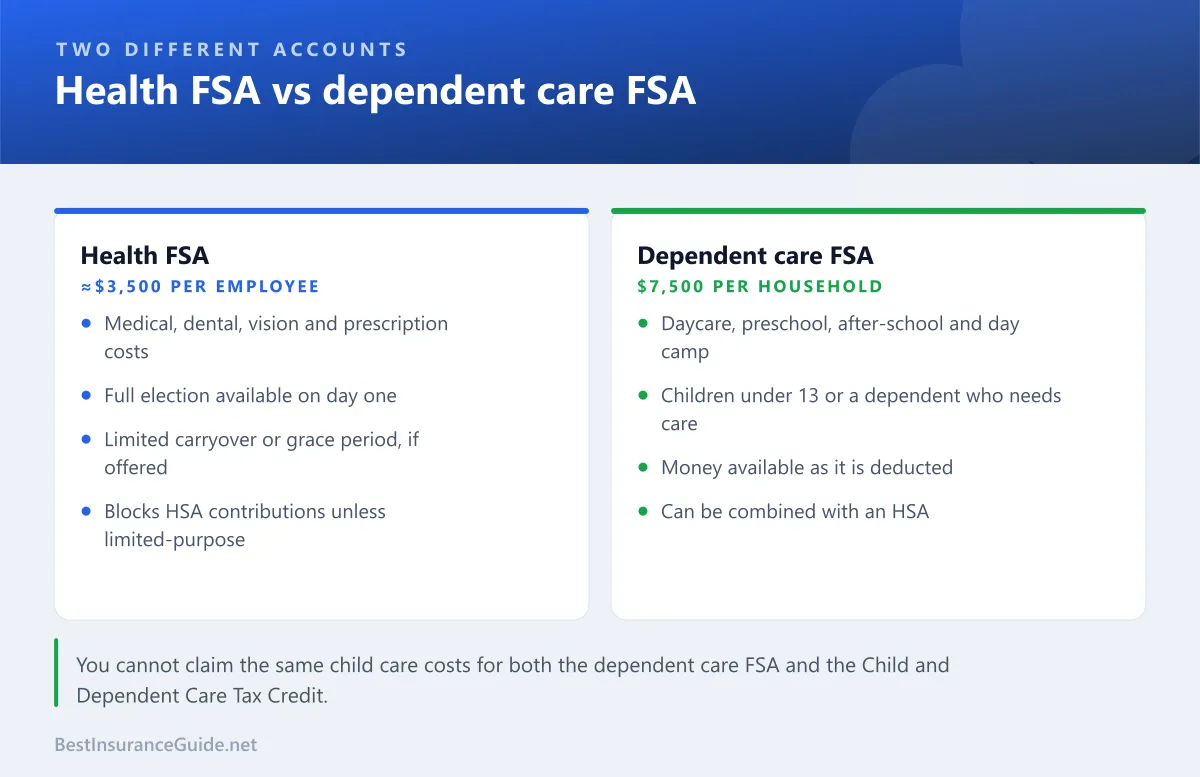
| Detail | Health FSA | Dependent care FSA |
|---|---|---|
| 2027 limit | ≈$3,500 per employee (projected) | $7,500 per household |
| Covers | Medical, dental, vision costs | Child and dependent care so you can work |
| Money available | Full election from day one | As it is deducted from your pay |
| Unused money | Lost, unless carryover or grace period | Lost, unless grace period |
| Works with an HSA? | Only a limited-purpose version | Yes |
Use it or lose it: carryover vs grace period
FSAs are generally use-it-or-lose-it. Employers can soften that with one of these options, but not both:
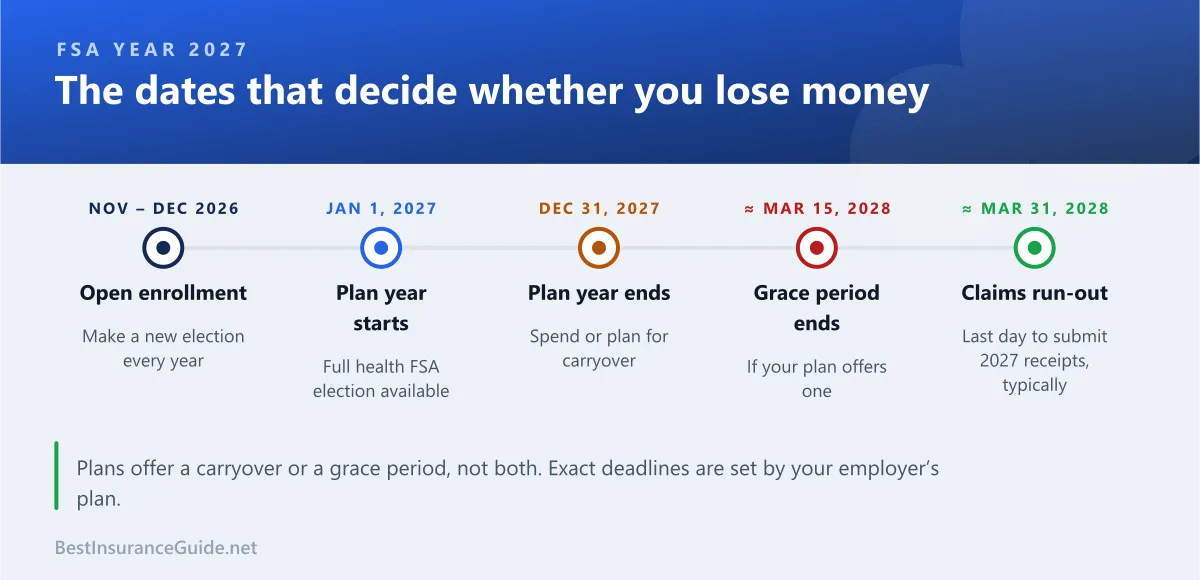
- Carryover: roll a limited amount into next year, $680 from 2026 into 2027, with the 2027 figure to be announced.
- Grace period: up to two and a half months after the plan year ends to spend remaining funds, typically until March 15.
Many plans also have a run-out period, often until about March 31, to submit claims for expenses incurred during the plan year. Know which options your plan uses so you don’t forfeit money.
FSA calendar for 2027
How much an FSA can save you
Illustrative, simplified. Assumes a 22% federal tax bracket and contributions through payroll, which also avoid 7.65% Social Security and Medicare tax.
| Account | Contribution | Approximate federal tax saved |
|---|---|---|
| Dependent care FSA | $7,500 | ≈ $2,224 ($1,650 income tax + $574 payroll tax) |
| Health FSA (2026 limit) | $3,400 | ≈ $1,008 ($748 + $260) |
| Both together | $10,900 | ≈ $3,232 |
Most states also exempt FSA contributions from state income tax, which adds to the savings.
Can you have an FSA and an HSA?
Not a general-purpose health FSA. It disqualifies you from HSA contributions. But you can combine an HSA with:
- A limited-purpose FSA for dental and vision only, and
- A dependent care FSA.
That combination lets you use the HSA for long-term savings and the limited-purpose FSA for predictable dental and vision costs. See our guide to HSA contribution limits for 2027.
Limited-purpose FSA: the HSA owner’s add-on
A limited-purpose FSA (LPFSA) is a health FSA that pays only for dental and vision expenses, and sometimes for medical costs after you’ve met your plan’s deductible. Because it doesn’t cover general medical care, it doesn’t block HSA contributions.
- Limit: it shares the health FSA limit, $3,400 in 2026 and a projected ≈$3,500 in 2027.
- Typical uses: cleanings and fillings, orthodontics, glasses, contact lenses, LASIK.
- Why use one: spend LPFSA dollars on predictable dental and vision bills, and let your HSA balance stay invested for the long term.
If your employer offers a high-deductible plan with an HSA, ask whether a limited-purpose FSA is available. Many people don’t realise they can have both.
FSA vs HSA in one table
| Detail | Health FSA | HSA |
|---|---|---|
| Who owns it | Your employer’s plan | You, and it stays with you |
| 2027 limit | ≈$3,500 (projected) | $4,500 self-only / $9,000 family |
| Needs a high-deductible plan? | No | Yes |
| Unused money | Mostly forfeited | Rolls over forever |
| Change contributions mid-year? | Only after a qualifying event | Yes, at any time |
| Money available | Full amount on day one | Only what you’ve deposited |
2027 HSA limits are from IRS Revenue Procedure 2026-24; see our HSA limits guide for details. For a fuller side-by-side, including HRAs and how to choose at open enrollment, read HSA vs FSA.
What happens if you leave your job?
A health FSA belongs to your employer’s plan, so leaving your job usually ends your ability to use it for new expenses.
- Expenses incurred before your last day can usually still be claimed during the run-out period.
- Unused health FSA money is generally forfeited when you leave, unless you elect COBRA continuation for the FSA, which some plans allow for the rest of the year.
- The uniform coverage rule works in your favour here. If you spent your full annual election early in the year and then left, you generally don’t have to pay back the difference.
- Dependent care FSA balances can usually still be used for eligible care expenses through the end of the plan year, depending on your plan’s terms.
Can you change your FSA election mid-year?
Generally only after a qualifying life event, and only in a way that is consistent with that event. Common examples:
- Marriage, divorce, birth or adoption
- A change in employment for you or your spouse
- A change in child care costs or provider, which applies to dependent care FSAs only. For example, your child moves from daycare to free public kindergarten.
You can’t simply lower your health FSA election because you’ve had fewer medical bills than expected. That is why getting the open enrollment number right matters.
Common FSA mistakes to avoid
- Overestimating health costs in a plan with no carryover or grace period.
- Forgetting the claims deadline. Unsubmitted receipts are as good as unspent money.
- Missing out on over-the-counter items. Since the 2020 CARES Act, many OTC medicines and menstrual products are eligible without a prescription.
- Using a general-purpose health FSA while contributing to an HSA, which can create a tax problem.
- Claiming the same child care costs twice, once through the dependent care FSA and again for the tax credit.
- Not keeping receipts. Your administrator can ask you to substantiate any claim.
How to choose your 2027 FSA amount
- Add up predictable costs. Glasses, contacts, dental work, ongoing prescriptions, copays you know you’ll have.
- Be conservative with health FSA elections if your plan has no carryover or grace period. Unused money is lost.
- Max out the dependent care FSA if you pay for child care. At $7,500, it is one of the largest tax breaks available to working parents.
- Coordinate with your spouse. Each of you can have a health FSA, but the dependent care limit is per household.
- Re-elect every year. FSA elections don’t roll over automatically.
Related reading
Health insurance terms explained covers premiums, deductibles and copays. Do prescriptions count towards your deductible? explains how drug costs work, and dental insurance for kids covers another cost families often plan for.
Federal employees enroll in FSAFEDS during Open Season. FEHB premiums 2027 covers the dates and the new FSAFEDS debit card.
Sources and notes
- IRS Revenue Procedure 2025-32, October 9, 2025: 2026 health FSA limit of $3,400 and carryover of $680, as summarised by NFP and EPIC.
- One Big Beautiful Bill Act: dependent care assistance limit raised to $7,500 ($3,750 married filing separately) from 2026, not indexed.
- 2027 health FSA and carryover figures are projections based on the IRS inflation formula, pending the IRS’s fall 2026 announcement.
- Featured photo: U.S. Air Force / Senior Airman Alexxis Pons Abascal, public domain, via Wikimedia Commons.
This article is general information, not tax or legal advice. Plan rules vary by employer. This site is independent and not affiliated with the IRS or any benefits provider.