Medicaid Eligibility in 2027: Income Limits, Work Requirements and How To Apply
Medicaid eligibility explained: 138% FPL limits ($22,025 single in 2026), who qualifies in non-expansion states, the 80-hour work requirement from Jan 1, 2027, and how to apply.

Table of contents

You can qualify for Medicaid on income alone in 41 states, including D.C., if you are 19 to 64 and earn up to 138% of the federal poverty level: about $22,025 a year for one person or $45,540 for a family of four in 2026. Children, pregnant women, older adults and people with disabilities qualify through separate groups, often at higher limits.
We are an independent site; figures below are from HHS, KFF, CMS and the text of the 2025 budget law as summarised by KFF and the Center for Health Care Strategies.
The rules change on January 1, 2027. Under the 2025 federal budget reconciliation law, most adults in the expansion group must show 80 hours a month of work, school or volunteering to keep their coverage, renew it every six months instead of every year, and get less backdated coverage when they apply. Here is how eligibility works now, what changes, and how to apply.
Medicaid eligibility at a glance
| Group | Who | Typical income rule |
|---|---|---|
| Children | Under 19 | Every state covers children well above the poverty line through Medicaid or CHIP |
| Pregnant women | Pregnancy plus postpartum | At least 138% FPL; many states go higher; postpartum cover lasts 12 months in nearly every state |
| Parents and caretakers | Adults caring for a child | 138% FPL in expansion states; often far below poverty in non-expansion states |
| Expansion adults | 19-64, no other group | Up to 138% FPL in the 41 expansion states; work requirement from 2027 |
| Older adults and people with disabilities | 65+, blind or disabled | Income and asset tests; SSI recipients usually qualify automatically |
| Medically needy | High medical bills | “Spend-down” programmes in many states |
The 2026 Medicaid income limits
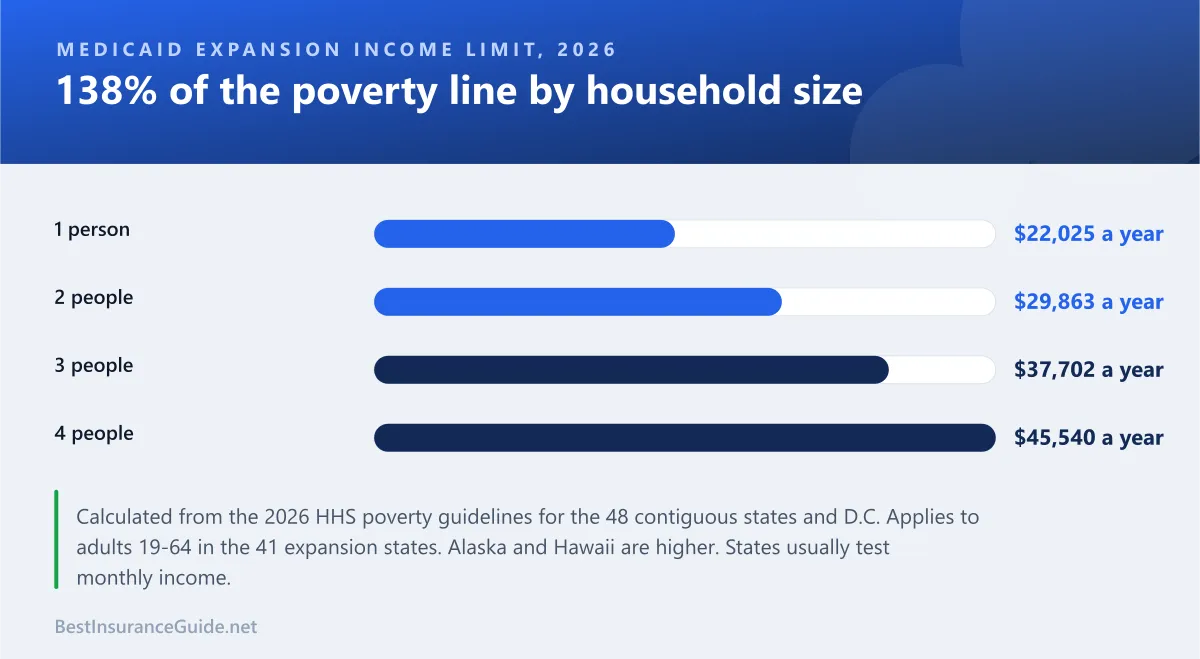
The 2026 HHS poverty guidelines for the 48 contiguous states and D.C. are $15,960 for one person, $21,640 for two, $27,320 for three and $33,000 for four. Medicaid expansion covers adults up to 138% of those amounts:
| Household size | 100% FPL | 138% FPL (expansion limit) | Approx. monthly |
|---|---|---|---|
| 1 | $15,960 | $22,025 | $1,835 |
| 2 | $21,640 | $29,863 | $2,489 |
| 3 | $27,320 | $37,702 | $3,142 |
| 4 | $33,000 | $45,540 | $3,795 |
A few points that trip people up:
- States usually look at your current monthly income, not last year’s tax return. If your hours were cut or you lost a job this month, you may qualify now even if last year’s income was too high.
- Income means modified adjusted gross income (MAGI) for most groups: broadly, taxable income plus untaxed Social Security, tax-exempt interest and foreign income. Child support received and SSI do not count.
- Household size follows tax rules: usually you, your spouse and the people you claim as dependants.
- Alaska and Hawaii have higher guidelines. The 2027 guidelines are published in January.
Illustrative example
Illustrative. Dana, 52, lives alone in Ohio, an expansion state, and works part time earning $1,700 a month. That is below the $1,835 monthly limit, so Dana qualifies. Because Dana works more than 80 hours a month, the 2027 work requirement is met through payroll data the state can check, but Dana should still keep pay stubs in case the state asks.
Expansion and non-expansion states
According to KFF’s tracker, updated October 16, 2026, 41 states including D.C. have expanded Medicaid and 10 have not: Alabama, Florida, Georgia, Kansas, Mississippi, South Carolina, Tennessee, Texas, Wisconsin and Wyoming.
In the 10 non-expansion states:
- Adults without children generally cannot get Medicaid at any income, unless they are pregnant, disabled or 65 and older. Wisconsin covers adults up to 100% of poverty through a waiver, and Georgia Pathways covers some adults up to 100% of poverty with its own work requirement.
- Parents’ limits are often far below the poverty line.
- People below 100% of poverty can fall into the coverage gap: too poor for marketplace subsidies, which generally start at 100% FPL, but not eligible for Medicaid.
If you are in that gap, check every other route: pregnancy, disability, caring for a child, and community health centres, which charge on a sliding scale. If your income is at or above 100% of poverty, a subsidised marketplace plan may cost little; our guide to ACA open enrollment for 2027 explains the dates and premiums.
Other ways to qualify
Pregnancy. States must cover pregnant women up to at least 138% of poverty, and many go much higher. Nearly every state now provides 12 months of postpartum coverage. Pregnancy Medicaid is one of the most searched topics for good reason: it can start quickly, and some states offer presumptive eligibility so a clinic can enroll you on the spot.
Children. Through Medicaid and the Children’s Health Insurance Program (CHIP), every state covers children in families with incomes well above the poverty line. Children can be eligible even when their parents are not.
Age 65 and over, blind or disabled. These groups have income and often asset limits, frequently around $2,000 for an individual, though states vary. People who receive SSI usually qualify for Medicaid automatically. If you have Medicare and a low income, Medicaid or a Medicare Savings Program can pay your premiums; our Medicare vs Medicaid guide explains how they fit together.
Medically needy. Many states let people with high medical bills “spend down” their income to the Medicaid limit, which matters most for nursing home and long-term care.
Immigration status. Most lawful permanent residents must wait five years before qualifying for full Medicaid, with exceptions such as refugees and, in many states, children and pregnant women. The 2025 law also narrows which lawfully present immigrants can get Medicaid, starting in October 2026. Emergency Medicaid remains available regardless of status for people who otherwise qualify.
Medicaid work requirements from January 1, 2027
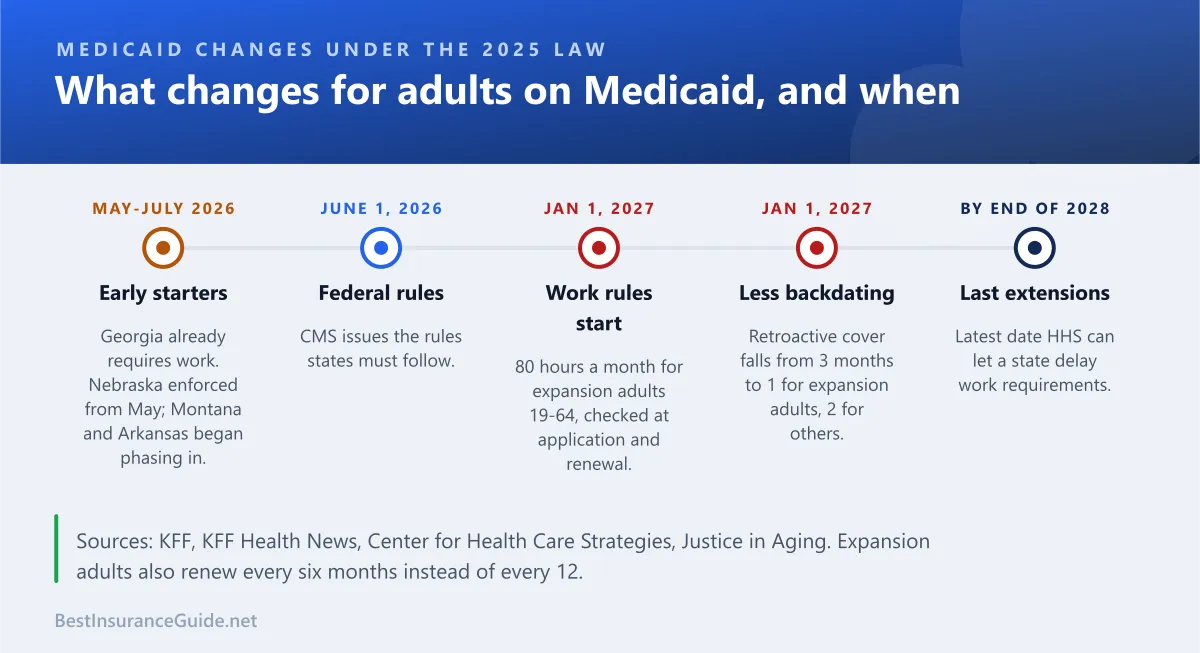
This is the biggest change to Medicaid eligibility since the Affordable Care Act. Here is what the law and CMS’s June 1, 2026 rules say, based on KFF’s analysis.
Who it applies to
Adults aged 19 to 64 in the Medicaid expansion group, plus similar groups covered under waivers in Georgia and Wisconsin. KFF Health News, citing the Congressional Budget Office, put the number subject to the rules at about 18.5 million people.
It does not apply to children, people 65 and older, or people who qualify through pregnancy, disability, SSI or the parent and caretaker group.
What you have to show
Each month, one of the following:
- 80 hours of work, community service, a work programme or a combination;
- enrollment in school at least half time;
- monthly income of at least $580, equal to 80 hours at the federal minimum wage. Seasonal workers can average income over six months in states that allow it.
Who is exempt
Under the law, you do not have to meet the requirement if you are, among others:
- a parent or caretaker of a child aged 13 or under, or of a disabled person;
- pregnant or postpartum;
- medically frail, which includes people who are blind or disabled, have a substance use disorder, a disabling mental disorder, or a serious or complex medical condition;
- meeting SNAP or TANF work requirements;
- a veteran with a total disability rating;
- an American Indian or Alaska Native eligible for Indian Health Service care;
- a former foster youth under 26;
- recently released from incarceration (within the past three months);
- entitled to Medicare.
States can also grant short-term hardship exceptions, for example after a hospital stay or in a county with very high unemployment.
How it is checked
- At application: states check that you met the requirement for one to three consecutive months before you apply, so someone with no recent work cannot simply start the day they apply.
- At renewal: expansion adults are renewed every six months, and compliance is checked each time. States can check more often.
- States must use existing data first, such as payroll and education records. According to KFF Health News, in 2027 you may be able to self-attest your hours, or that you are too sick to work, if the data cannot confirm it. That flexibility narrows from 2028.
What happens if the state cannot verify you
You get a notice of noncompliance and 30 days to show you meet the requirement or qualify for an exemption. Coverage continues during those 30 days. If you cannot show it, you are disenrolled by the end of the following month. You can reapply.
One consequence is easy to miss: people denied or removed from Medicaid for not meeting the work requirement are also barred from marketplace premium tax credits, according to KFF. Losing Medicaid this way does not open the door to a subsidised ACA plan.
States that started early
Georgia already runs a work requirement through Pathways. Nebraska began enforcing in May 2026. Montana started in July with no disenrollments before October, and Arkansas began a “soft” launch in July without penalties until 2027. If you live in one of those states, check your notices now.
Less backdated coverage from 2027
Medicaid has long paid medical bills from up to three months before the month you apply, as long as you were eligible then. Under Section 71112 of the 2025 law, from January 1, 2027 that falls to:
- one month for expansion adults;
- two months for other groups, including older adults and people with disabilities.
Illustrative. Sam has an emergency hospital stay in October 2027 and applies in December 2027. Under the old rules, Medicaid could have covered October. Under the new rules, as an expansion adult, Sam can only get coverage back to November. The lesson: apply as soon as you think you might qualify, ideally before or during a hospital stay. Many hospitals have staff who will help you apply.
How to apply for Medicaid
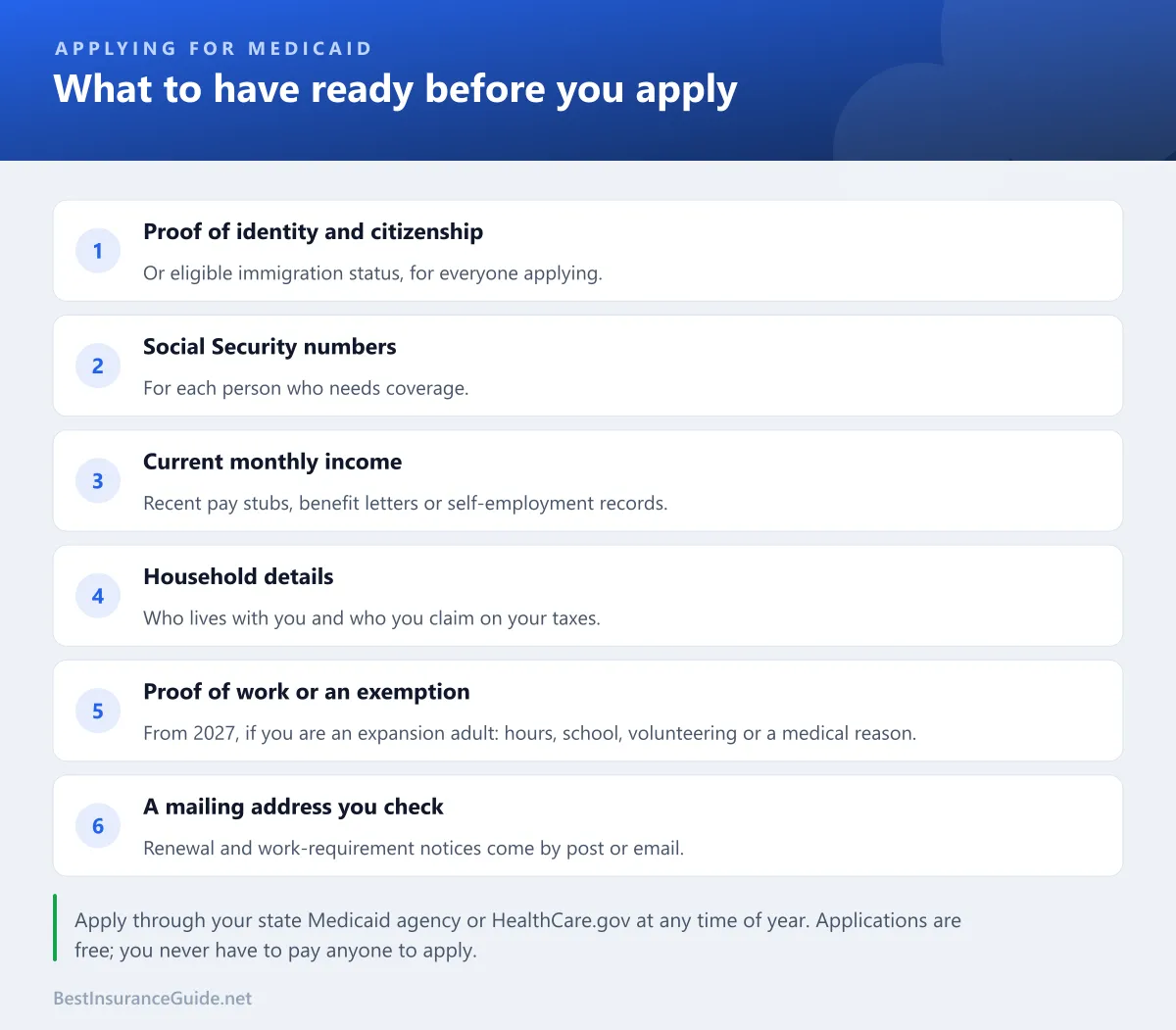
You can apply any time of year, and applying is always free.
- Choose a route. Apply through your state Medicaid agency online, by phone, by mail or in person, or through HealthCare.gov or your state’s marketplace, which will pass your application to the state if you look eligible.
- Gather documents. Proof of identity and citizenship or immigration status, Social Security numbers, recent pay stubs or benefit letters, and details of everyone in your tax household.
- From 2027, add proof of work or an exemption if you are applying as an expansion adult: pay stubs, a school enrollment letter, a volunteering letter or a medical statement.
- Answer requests quickly. States must generally decide within 45 days, or 90 days if your eligibility depends on a disability. Our guide to how long Medicaid approval takes explains the timeline and how to chase a delayed application.
- Keep your address current. Renewal and work-requirement notices come by post or email, plus at least one other method such as a text. A missed letter is one of the most common reasons people lose coverage.
How to keep your coverage
- Update your state agency when your income, address or household changes.
- Open every letter from Medicaid, and respond before the deadline.
- Keep a simple monthly record of hours worked, classes or volunteering if you are an expansion adult.
- If you get a noncompliance notice, act within the 30 days. Ask whether you qualify for an exemption, especially for caregiving or a health condition.
- If you lose coverage, check whether you can reapply, whether another family member still qualifies, or whether a marketplace plan or a job-based plan is available. Our article on health insurance without a job lists the options.
Related reading
- How long Medicaid approval takes covers the timeline and what to do if it stalls.
- Medicare vs Medicaid explains the differences and how dual eligibility works.
- Medicare Savings Program shows how states pay Medicare premiums for people with low incomes.
- ACA open enrollment 2027 covers marketplace dates and subsidies.
- Does Medicaid cover wisdom teeth removal? is a look at adult dental benefits.
Sources and notes
- HHS ASPE, 2026 poverty guidelines: $15,960 for one person, $33,000 for four (48 contiguous states and D.C.). The 138% figures are our calculation.
- KFF, “Status of State Medicaid Expansion Decisions” (October 16, 2026): 41 expansion states including D.C., 10 non-expansion states.
- KFF, “A Closer Look at the Work Requirement Provisions in the 2025 Federal Budget Reconciliation Law”: who is covered, exemptions, look-back, six-month renewals, noncompliance process, marketplace subsidy bar and the 2028 extension limit.
- KFF Health News, coverage of CMS’s June 1, 2026 final rules: early-start states, self-attestation in 2027, 18.5 million people affected (CBO).
- Center for Health Care Strategies, summary of federal Medicaid work requirements: $580 income alternative, seasonal workers and specified excluded groups.
- Justice in Aging and state Medicaid agency notices: Section 71112 retroactive coverage limits from January 1, 2027.
- Federal regulations set the 45-day and 90-day application decision standards.
This article is general information, not legal or benefits advice. Medicaid rules vary by state and are changing as states implement the 2025 law. Contact your state Medicaid agency, or a local legal aid or navigator organisation, for help with your own situation.