Medicare Advantage Dental Coverage: What Plans Really Cover for 2027
How dental benefits in Medicare Advantage plans work: preventive vs comprehensive cover, annual maximums, 50% coinsurance, networks, exclusions and how to compare plans for 2027.

Table of contents
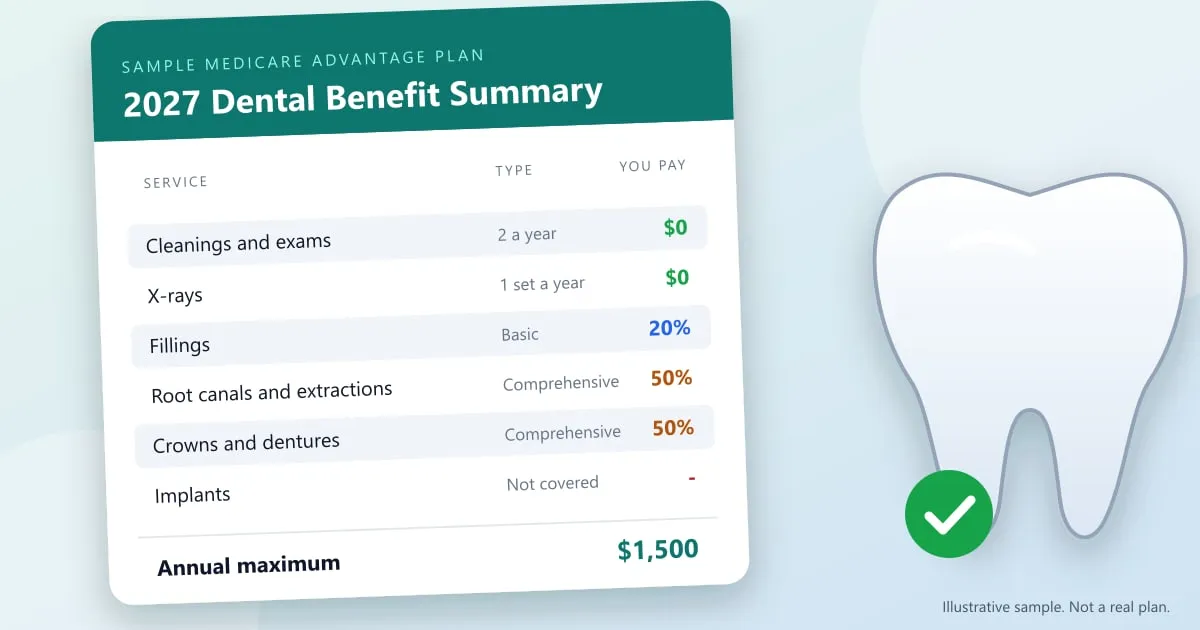
Almost every Medicare Advantage plan includes dental benefits, but “includes dental” can mean very different things. Most plans cover exams, cleanings and X-rays at little or no cost. Bigger work such as root canals, crowns and dentures usually comes with around 50% coinsurance and an annual dollar limit, often $1,500 or less, after which you pay the full bill.
We are an independent site and are not affiliated with Medicare, CMS or any insurer, and we do not sell plans. Figures below are attributed to KFF and CMS, and examples are labelled illustrative.
Medicare open enrollment runs from October 15 to December 7, 2026, and dental benefits are one of the main reasons people switch plans. Here is how to tell a strong dental benefit from a thin one before you choose.
Medicare Advantage dental at a glance
| Question | Short answer |
|---|---|
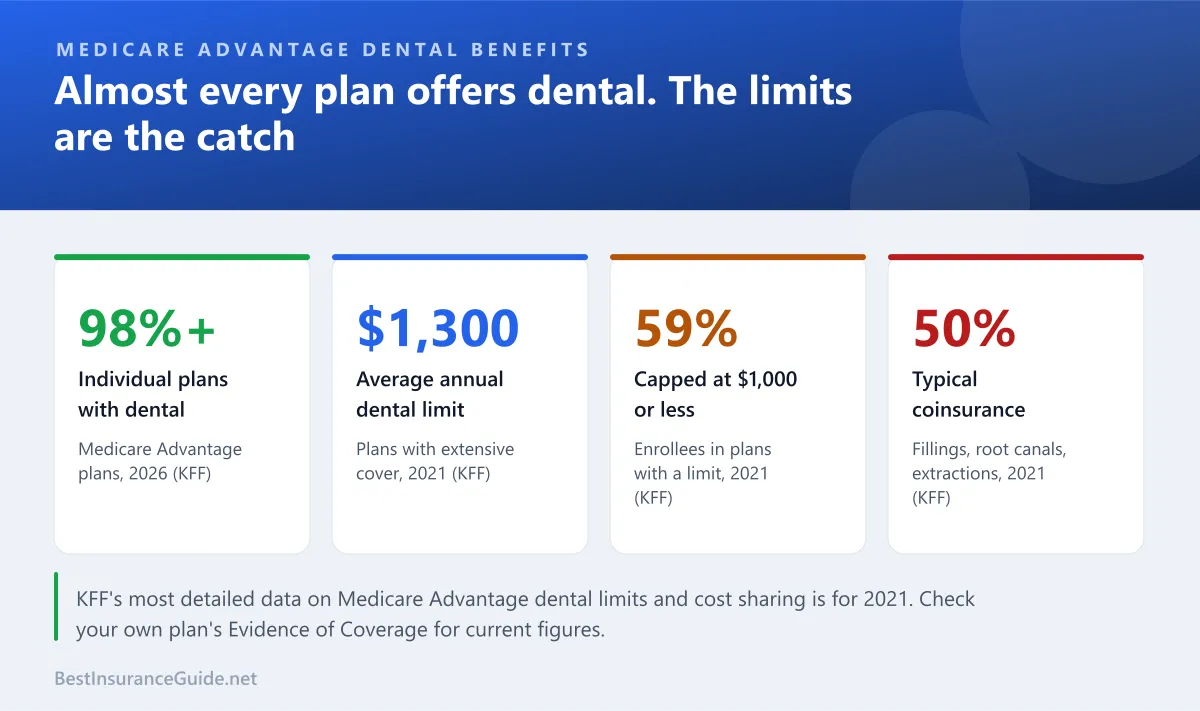
| Do Medicare Advantage plans cover dental? | 98% or more of individual plans offer some dental (KFF, 2026) |
| Does Original Medicare cover dental? | Only when tied to certain covered medical treatment |
| What is usually free? | Exams, cleanings and X-rays, often twice a year |
| What costs more? | Fillings, root canals, extractions, crowns and dentures, often at 50% |
| Is there a yearly limit? | Usually. KFF found an average of about $1,300 (2021 data) |
| Can I use any dentist? | Usually only in-network dentists |
| Do unused benefits roll over? | Generally no; they reset on January 1 |
| When can I switch plans? | October 15 to December 7, and January 1 to March 31 if you are already in Medicare Advantage |
Does Original Medicare cover dental?
Mostly no. Original Medicare (Parts A and B) does not cover routine dental care, such as cleanings, fillings, extractions or dentures.
Since 2023, CMS rules have allowed Medicare to pay for dental services only when they are closely tied to the success of a covered medical treatment. Examples include dental exams and treatment to clear infection before an organ transplant or heart valve surgery, and dental care connected with certain cancer treatments. CMS did not add new examples for 2026.
That gap is why dental benefits are one of the main selling points of Medicare Advantage. For other ways to get cover, our guide to dental insurance for seniors on Medicare compares stand-alone and discount plans.
How Medicare Advantage dental benefits work
Dental cover in Medicare Advantage is a supplemental benefit. Medicare does not require it, so each insurer decides what to offer and the details change every year.
Preventive vs comprehensive cover
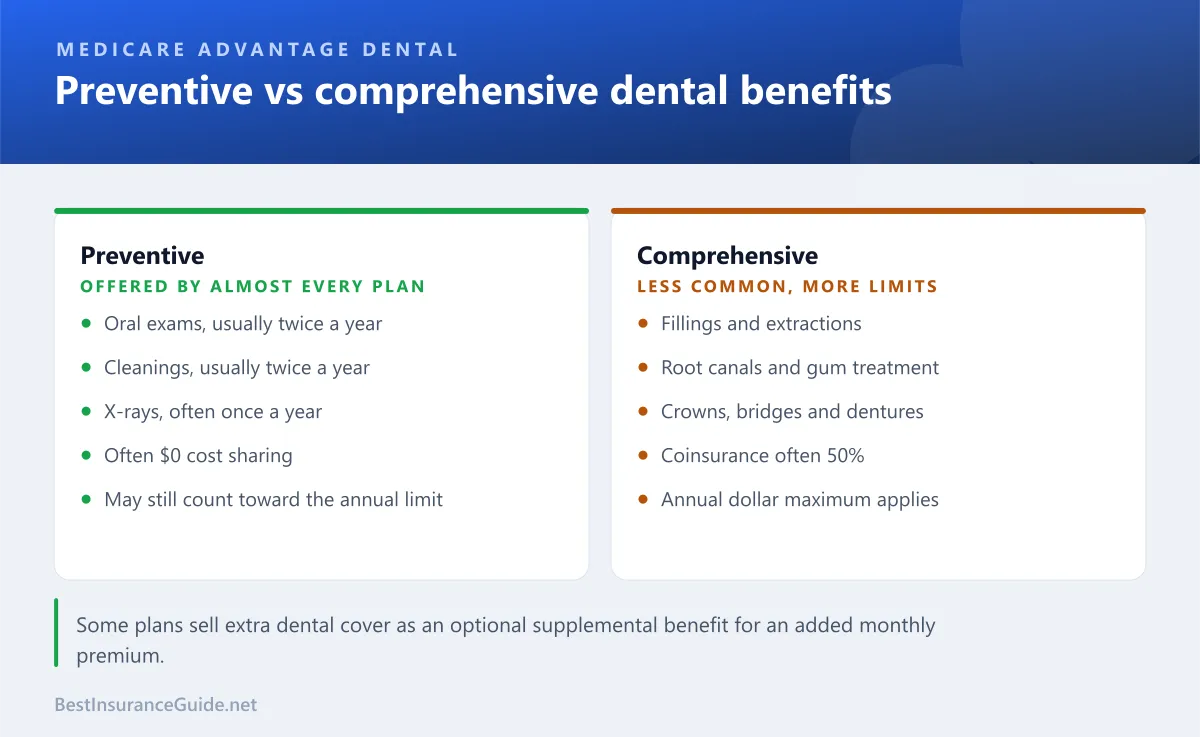
Plans usually split dental care into two groups:
- Preventive: oral exams, cleanings and X-rays. KFF found that 64% of enrollees with access to preventive dental benefits paid no cost sharing for them in 2021.
- Comprehensive: fillings, extractions, root canals, gum treatment, crowns, bridges and dentures. KFF found 50% coinsurance was the most common cost sharing for these services.
According to KFF, 98% or more of individual Medicare Advantage plans offered vision, dental and hearing benefits in 2026. The actuarial firm Milliman reports that almost all plans include preventive dental cover, but the share offering comprehensive dental has fallen since 2024. A “dental” tick on a plan summary may therefore mean cleanings only.
The annual maximum
Most plans cap what they will pay for dental care each calendar year. KFF’s most detailed study of Medicare Advantage dental benefits, for 2021, found:
- 78% of enrollees offered more extensive dental cover were in plans with an annual dollar limit.
- The average limit was about $1,300.
- 59% of enrollees in plans with a limit had a maximum of $1,000 or less.
A single crown commonly costs more than $1,000 before insurance, so a low limit can be used up by one procedure. Some plans now offer higher limits, but always check the number.
Does preventive care count against the limit? In some plans it does, in others it does not. If it does, two cleanings and an X-ray could use several hundred dollars of your annual maximum before any other treatment.
Mandatory vs optional dental benefits
- Built-in (mandatory supplemental) dental is included in the plan for every member at no extra premium.
- Optional supplemental dental is an add-on you can choose for an extra monthly premium, usually with a higher annual limit or richer comprehensive cover. KFF found that about 10% of Medicare Advantage enrollees had to pay a separate premium to get any dental benefit at all in 2021, averaging $270 a year.
An add-on is worth buying when the extra benefit you expect to use is clearly more than the extra premium. If an option costs $30 a month ($360 a year) and raises the annual maximum by $1,000, it only pays off if you will actually need that extra treatment.
Networks and dental ID cards
Many plans run their dental benefit through a separate dental company, with its own network and sometimes its own ID card. Before you enrol:
- ask your dentist whether they accept the exact plan for 2027, not just the insurer’s name;
- check whether out-of-network care is covered at all, and at what rate;
- ask whether major work needs a pre-treatment estimate or prior approval.
What Medicare Advantage dental usually doesn’t cover
Common exclusions and limits include:
- Implants, which many plans exclude or cover only up to the annual maximum.
- Cosmetic work, such as whitening and veneers.
- Frequency limits, such as two cleanings a year or one set of dentures every five years.
- Orthodontics for adults.
- Care after the annual maximum is used up.
- Out-of-network dentists, in many HMO-style plans.
Some optional dental add-ons also have waiting periods for major work. Check the plan’s Evidence of Coverage, not just the marketing summary, for the full list.
What a dental benefit pays: an illustrative example
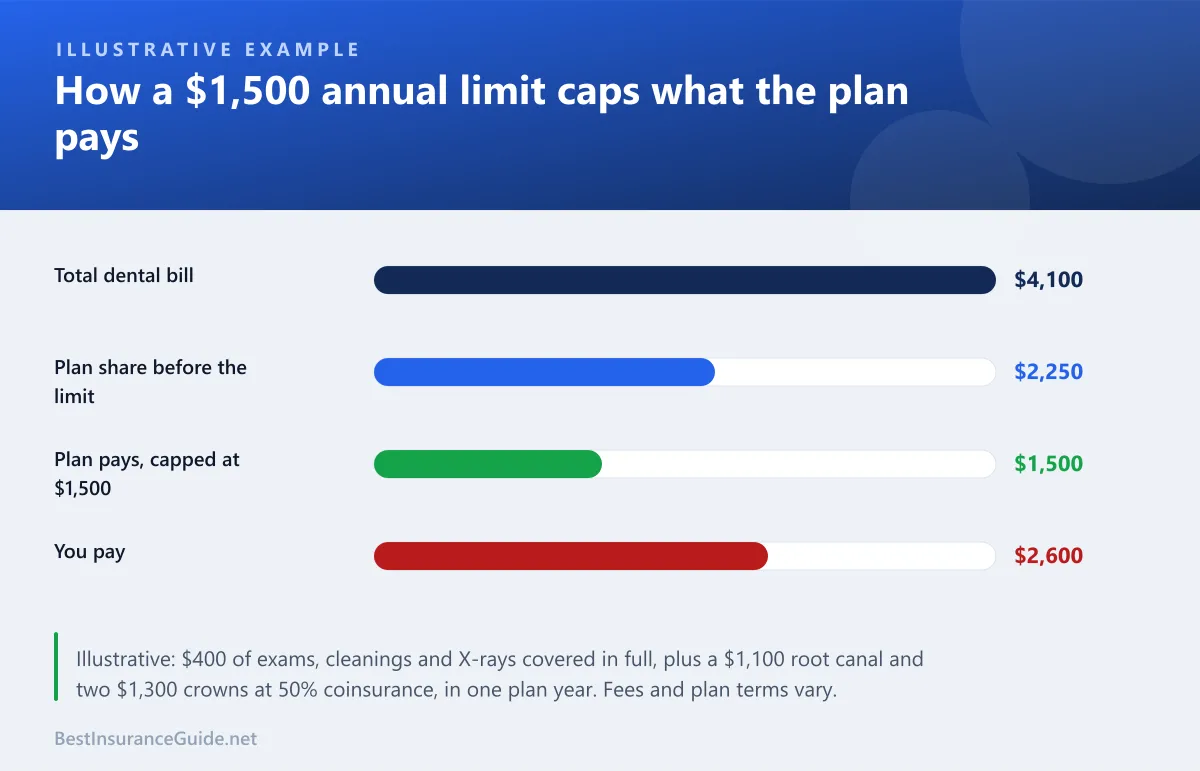
Illustrative. Rosa’s Medicare Advantage plan covers preventive care in full, charges 50% for comprehensive work and has a $1,500 annual maximum. In one year she has:
- two exams, two cleanings and X-rays costing $400, which the plan pays in full;
- a root canal costing $1,100;
- two crowns costing $1,300 each, or $2,600.
Without the limit, the plan would pay $2,250: $400 for preventive care plus half of the $3,700 comprehensive work. But it stops at $1,500, so Rosa pays $2,600 of the $4,100 total.
What could help her:
- Timing. If her dentist agrees the second crown can safely wait until January, part of the treatment falls under the next year’s limit.
- A higher-limit plan or add-on during open enrollment, if she knows the work is coming.
- A stand-alone dental plan, which may have a higher annual maximum but usually has waiting periods for major work.
How to compare dental benefits during open enrollment
- Find the annual maximum and whether preventive care counts toward it.
- Check the coinsurance for fillings, root canals, crowns and dentures.
- Look for exclusions, especially implants and denture replacement limits.
- Confirm your dentist is in the plan’s dental network for 2027.
- Ask about optional dental add-ons, their premiums and what they add.
- Plan big treatment around the January 1 reset.
- Weigh dental against everything else. A better dental benefit is not worth a plan that drops your doctors or covers your drugs poorly. Our guide to Original Medicare vs Medicare Advantage covers the wider trade-offs.
You can see each plan’s dental benefits in the Plan Finder on Medicare.gov under plan details, and your State Health Insurance Assistance Program (SHIP) can help you compare them for free.
When you can switch
You can change Medicare Advantage plans during open enrollment, October 15 to December 7, with the new plan starting January 1. If you are already in Medicare Advantage, you get one more change between January 1 and March 31. Our guide to Medicare open enrollment covers both windows and the Special Enrollment Periods.
Switching in the middle of treatment can be costly. If you start a crown or dentures in December, find out whether your new plan will cover the rest of the work in January, and ask your dentist to finish the treatment before your old plan ends where possible.
Other ways to get dental care on Medicare
- Stand-alone dental insurance can be bought at any time and works alongside Original Medicare or Medicare Advantage.
- Medicaid covers adult dental care in many states, and dual-eligible special needs plans (D-SNPs) often have richer dental benefits for people with both Medicare and Medicaid.
- Dental schools and community health centres often offer lower-cost care.
- Dental discount plans reduce fees at participating dentists but are not insurance.
If money is tight, check whether you qualify for a Medicare Savings Program, which can free up your budget by paying your Part B premium.
Related reading
- Best dental insurance for seniors on Medicare compares Medicare Advantage, stand-alone and discount plans.
- Original Medicare vs Medicare Advantage explains networks, costs and prior authorization.
- When is Medicare open enrollment? covers dates and what you can change.
- Medicare Advantage star ratings explains how plan quality is measured.
- Medicare Advantage plans leaving in 2027 covers what to do if your plan is ending.
Sources and notes
- KFF, “Medicare and Dental Coverage: A Closer Look” (July 2021): Medicare Advantage dental access, an average annual limit of about $1,300, 59% with limits of $1,000 or less, 50% typical coinsurance, 64% with no preventive cost sharing and about 10% paying a separate dental premium averaging $270 a year. These are 2021 figures; plan terms have changed since.
- KFF, “Medicare Advantage 2026 Spotlight: A First Look at Plan Premiums and Benefits” (December 2025): 98% or more of individual plans offering vision, dental and hearing benefits.
- Milliman, “Shaping senior care trends: Medicare Advantage benefits 2026”: near-universal preventive dental cover and a decline in comprehensive dental since 2024.
- CMS, physician fee schedule rules for 2023 to 2026 and 42 CFR 411.15(i): Medicare payment for dental services linked to covered medical treatment.
- Medicare.gov, Open Enrollment: open enrollment dates and the Medicare Advantage Open Enrollment Period.
- Rosa’s example and the sample benefit summary in our featured image are illustrative. Dental fees and plan terms vary.
This article is general information, not legal, dental or benefits advice. Plan benefits vary by plan, county and year. Check the plan’s Evidence of Coverage, and contact your State Health Insurance Assistance Program (SHIP) for free, unbiased Medicare counselling.