HSA Contribution Limits 2027: $4,500 and $9,000, Plus the New Rules on Who Qualifies
2027 HSA limits: $4,500 self-only, $9,000 family, $1,000 catch-up at 55. 2027 HDHP deductibles and out-of-pocket limits, new eligibility rules and deadlines.

Table of contents

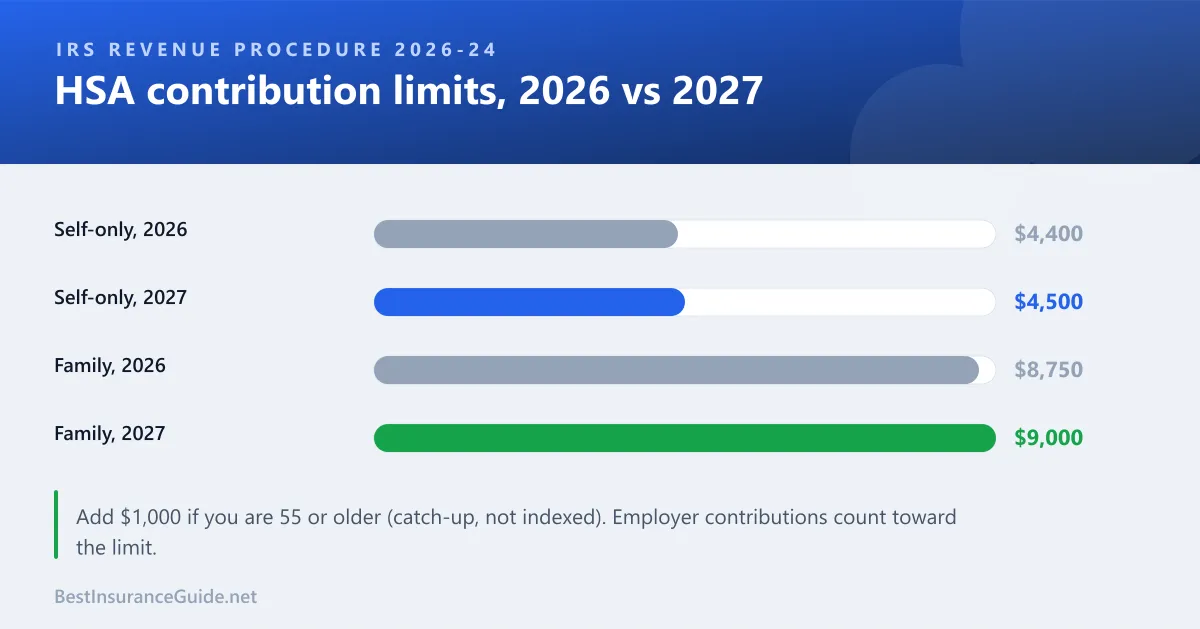
The IRS has confirmed the 2027 HSA contribution limits: $4,500 for self-only coverage and $9,000 for family coverage, plus a $1,000 catch-up contribution if you are 55 or older. The figures were published in Revenue Procedure 2026-24 on May 29, 2026, and take effect on January 1, 2027.
Those increases are modest: $100 for self-only and $250 for family. The bigger story for many people is who can now contribute. Since January 2026, people with bronze and catastrophic marketplace plans can open and fund an HSA, and direct primary care members can too.
This guide covers the 2027 limits, the 2027 high-deductible health plan (HDHP) rules, eligibility, deadlines, how HSAs interact with Medicare, and how to get the most from the account. This site is independent and not affiliated with the IRS or any HSA provider. Figures are attributed below.
2027 HSA and HDHP limits at a glance
| Detail | 2026 | 2027 | Change |
|---|---|---|---|
| HSA limit, self-only coverage | $4,400 | $4,500 | +$100 |
| HSA limit, family coverage | $8,750 | $9,000 | +$250 |
| Catch-up contribution (age 55+) | $1,000 | $1,000 | none (not indexed) |
| HDHP minimum deductible, self-only | $1,700 | $1,750 | +$50 |
| HDHP minimum deductible, family | $3,400 | $3,500 | +$100 |
| HDHP out-of-pocket maximum, self-only | $8,500 | $8,700 | +$200 |
| HDHP out-of-pocket maximum, family | $17,000 | $17,400 | +$400 |
| Excepted benefit HRA limit | $2,200 | $2,250 | +$50 |
Source: IRS Revenue Procedure 2026-24, as summarised by SHRM and Mercer.
HSA limits over the years
| Year | Self-only | Family |
|---|---|---|
| 2021 | $3,600 | $7,200 |
| 2022 | $3,650 | $7,300 |
| 2023 | $3,850 | $7,750 |
| 2024 | $4,150 | $8,300 |
| 2025 | $4,300 | $8,550 |
| 2026 | $4,400 | $8,750 |
| 2027 | $4,500 | $9,000 |
IRS annual inflation adjustments. Catch-up contributions of $1,000 at 55+ are in addition and unchanged.
The limits rose sharply in 2023 and 2024 with high inflation, and more slowly since.
What is an HSA, and why do the limits matter?
A health savings account (HSA) is a tax-advantaged account for medical costs that you can open if you have a qualifying high-deductible health plan. It is often called the most tax-efficient account in the U.S. because of its triple tax advantage:
- Contributions are tax-deductible, or pre-tax if made through payroll.
- Growth is tax-free. You can invest the balance.
- Withdrawals are tax-free when used for qualified medical expenses.
Unlike a flexible spending account, an HSA has no “use it or lose it” rule. The money stays yours year after year, even if you change jobs or plans. The annual limit caps how much you can put in, so each year’s limit is worth knowing before you set your payroll election.

Photo: National Cancer Institute / Rhoda Baer, public domain, via Wikimedia Commons.
Who can contribute to an HSA in 2027
To contribute for a given month, you generally must:
- Be covered by an HSA-qualified HDHP on the first day of the month.
- Have no other disqualifying health coverage, such as a general-purpose FSA or a non-HDHP plan through a spouse. Some exceptions apply, such as dental, vision and certain limited-purpose accounts.
- Not be enrolled in Medicare.
- Not be claimed as a dependent on someone else’s tax return.
New in 2026: who else qualifies
Under changes made by the One Big Beautiful Bill Act and explained in IRS guidance (Notice 2026-05):
- Bronze and catastrophic marketplace plans: starting January 1, 2026, bronze and catastrophic plans available through an ACA Exchange are treated as HSA-compatible, even if they don’t meet the usual HDHP definition. This matters for the millions of people choosing bronze plans as marketplace premiums rise. See our ACA open enrollment 2027 guide.
- Direct primary care (DPC): from January 1, 2026, enrolling in a qualifying direct primary care arrangement no longer blocks HSA eligibility, and periodic DPC fees can be paid tax-free from your HSA, within monthly limits set in the law.
- Telehealth: HDHPs can permanently cover telehealth and other remote care before the deductible without breaking HSA eligibility, for plan years beginning on or after January 1, 2025.
The 2027 HDHP rules
For your plan to qualify for HSA contributions in 2027, unless it is a bronze or catastrophic Exchange plan:
- Minimum deductible: $1,750 self-only, $3,500 family.
- Maximum out-of-pocket, including deductibles, copays and coinsurance but not premiums: $8,700 self-only, $17,400 family.
Your employer or insurer will usually tell you whether a plan is HSA-eligible. If you’re unsure, ask before contributing, because contributions while not eligible must be corrected. Our guide to deductibles vs out-of-pocket maximums explains how the two limits work.
Key HSA deadlines
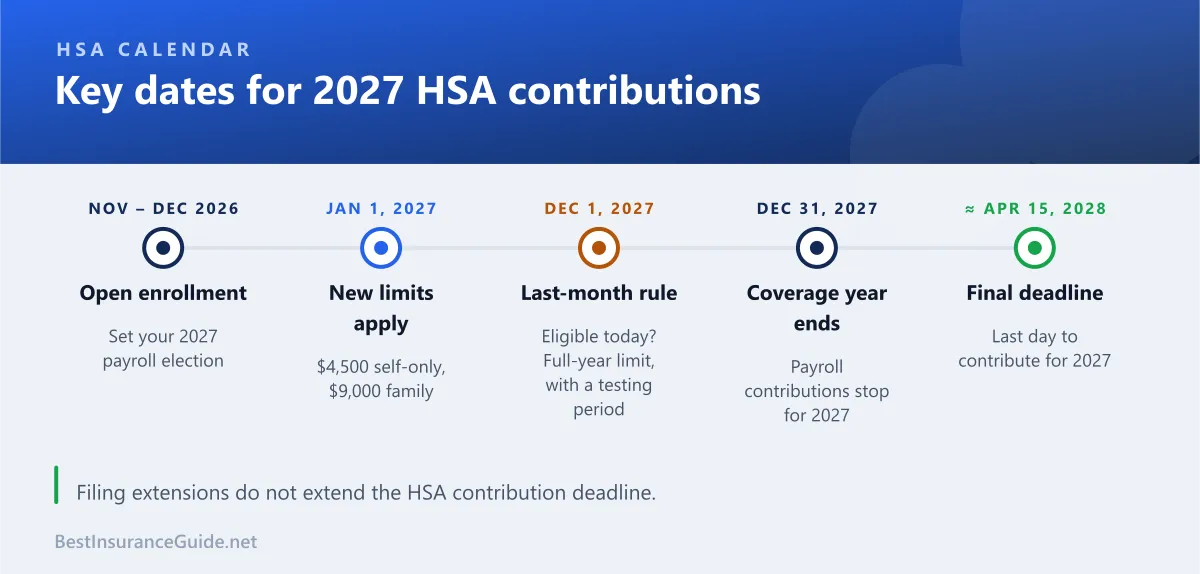
- January 1, 2027: the new limits apply.
- During open enrollment, usually November–December 2026: set your 2027 payroll contribution.
- December 31, 2027: last day of the 2027 coverage year.
- About April 15, 2028: the deadline to contribute for 2027, the tax filing deadline without extensions.
Rules that trip people up
Employer money counts toward your limit
If your employer puts $1,000 into your HSA, a self-only account holder can only add $3,500 more in 2027 to stay at the $4,500 limit.
Families share one limit
The $9,000 family limit is shared between spouses, though it can be split between two HSAs. The $1,000 catch-up belongs to each spouse who is 55 or older, and must go into that spouse’s own HSA.
Partial years are prorated, unless you use the last-month rule
If you are only HSA-eligible for part of the year, your limit is generally prorated by month. The last-month rule lets you contribute the full annual amount if you are eligible on December 1, but you must then stay eligible through a testing period until the end of the following year, or the excess becomes taxable and penalised.
Medicare ends contributions
Once you enroll in any part of Medicare, you can’t contribute. If you sign up after 65, Part A can be backdated up to six months, so stop contributing six months before you apply to avoid excess contributions. You can still spend your HSA tax-free on qualified costs, including Medicare premiums, except Medigap premiums. See our Medicare 2027 guide.
Non-medical withdrawals are costly before 65
Money taken out for non-qualified expenses is taxed as income plus a 20% penalty before age 65. From 65, the penalty no longer applies, though non-medical withdrawals are still taxed.
What you can spend HSA money on
Qualified medical expenses are broadly defined. Common ones include:
- Deductibles, copays and coinsurance for doctor visits, hospital care and tests.
- Prescription drugs, plus many over-the-counter medicines and menstrual care products.
- Dental and vision care: cleanings, fillings, glasses, contact lenses and eye exams.
- Hearing aids and many medical devices and supplies.
- Certain insurance premiums: COBRA continuation coverage, coverage while receiving unemployment benefits, qualified long-term care insurance within limits, and from 65, Medicare premiums except Medigap.
General health items such as gym memberships and most cosmetic procedures usually don’t qualify. IRS Publication 502 lists qualified medical expenses in detail. When in doubt, check before you spend, and keep the receipt.
Should you choose an HDHP for 2027 to get an HSA?
An HSA is only available with a qualifying plan, so the real question is whether a high-deductible plan suits you.
It often makes sense if you are generally healthy, have savings that could cover the deductible, and value the long-term tax advantages, especially if your employer contributes to your HSA. Our HDHP vs PPO guide works through the cost of each in a low-use, moderate and high-use year.
Think twice if you expect high medical costs next year, take expensive ongoing medication, or could not comfortably pay the deductible after a hospital visit. A lower-deductible plan may cost less overall.
A practical test: add the HDHP’s premium and deductible, subtract any employer HSA contribution and your tax savings, then compare the total with a traditional plan’s premium and deductible.
Worked example: what maxing out a family HSA can save
Illustrative, simplified. Your tax situation will differ.
A married couple with family HDHP coverage contributes the full $9,000 through payroll in 2027. Assume a 22% federal income tax bracket:
| Detail | Amount |
|---|---|
| Contribution through payroll | $9,000 |
| Federal income tax avoided (22%) | ≈ $1,980 |
| Social Security and Medicare tax avoided on payroll contributions (7.65%) | ≈ $689 |
| Approximate federal tax saved in one year | ≈ $2,669 |
Many states also exempt HSA contributions from state income tax, though a few do not. If the money is invested and grows over the years, the tax-free growth can matter even more.
How to make the most of your HSA in 2027
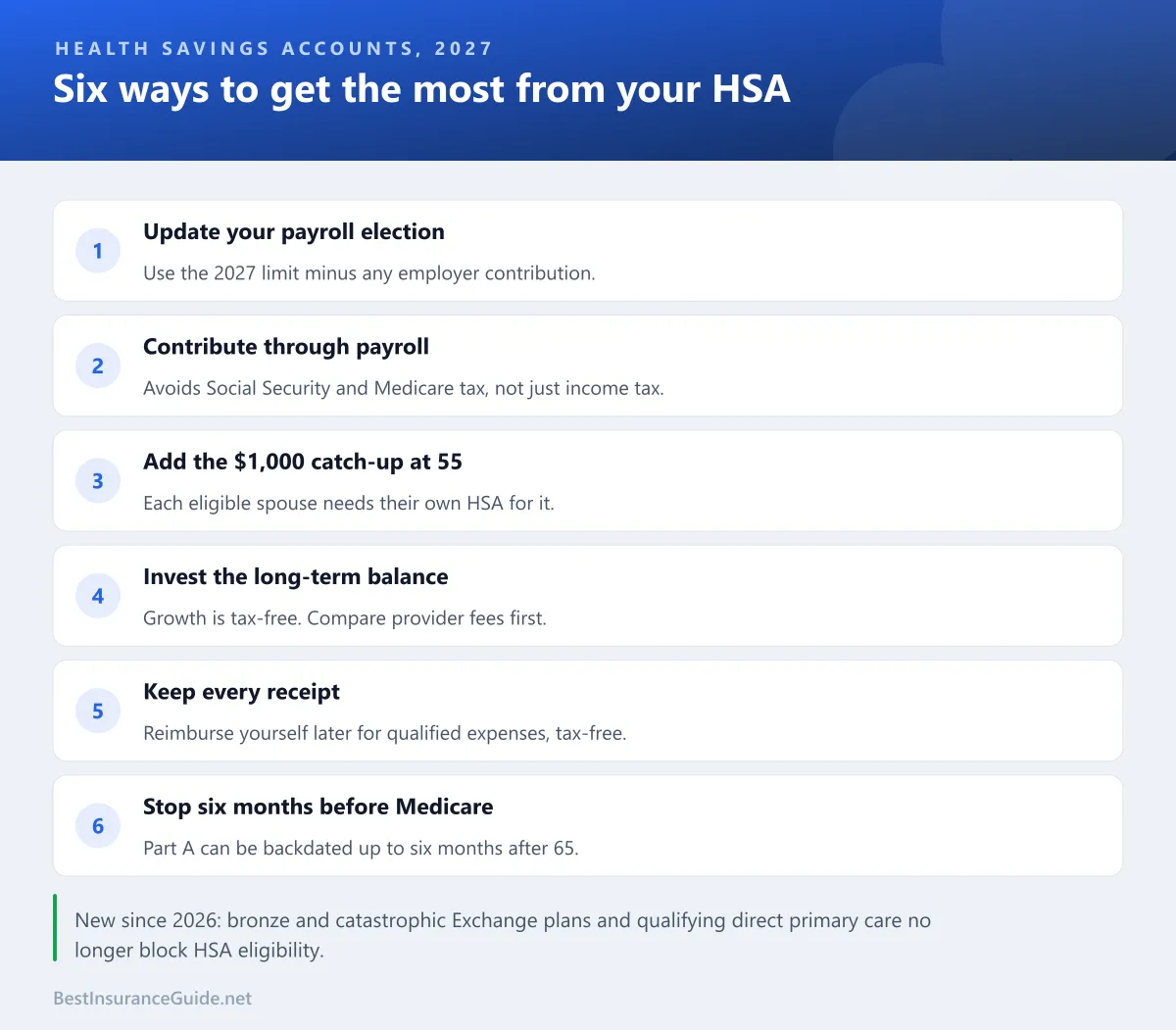
- Update your payroll election at open enrollment to the new 2027 limit, after subtracting any employer contribution.
- Contribute through payroll if you can. It avoids Social Security and Medicare tax as well as income tax.
- Add the catch-up at 55. That’s $1,000 more a year, and each eligible spouse needs their own HSA.
- Invest what you don’t need soon. Many HSA providers let you invest once a cash threshold is met. Compare fees.
- Keep receipts. You can reimburse yourself later for qualified expenses incurred after the HSA was opened, as long as you keep records.
- Plan around Medicare. Stop contributions six months before applying for Medicare after 65.
HSA vs FSA: which is better?
| Detail | HSA | Health FSA |
|---|---|---|
| Who can have one | People with an HSA-qualified HDHP, bronze or catastrophic Exchange plan | Employees offered one by their employer |
| 2027 limit | $4,500 / $9,000 | Announced by the IRS in fall 2026 |
| Rollover | Unlimited. You keep it all | Limited carryover or grace period, otherwise lost |
| Portability | Yours if you change jobs | Usually tied to your employer |
| Investing | Often allowed | No |
If you are eligible for both, an HSA is usually more valuable for long-term savings. Our full HSA vs FSA comparison walks through which one fits you, and when you can have both. Note that a general-purpose health FSA makes you ineligible for an HSA, while a limited-purpose FSA for dental and vision does not.
Related reading
What is a deductible for health insurance? explains how high-deductible plans work in practice. Health insurance terms explained covers premiums, copays and coinsurance, and do prescriptions count towards your deductible? explains how drug costs fit in.
Employers can also fund individual coverage tax-free through an ICHRA, now called a CHOICE Arrangement.
Sources and notes
- IRS Revenue Procedure 2026-24, May 29, 2026: 2027 HSA, HDHP and excepted benefit HRA amounts, as summarised by SHRM and Mercer.
- IRS news release IR-2025-119 and Notice 2026-05: HSA changes under the One Big Beautiful Bill Act (telehealth, bronze and catastrophic plans, direct primary care).
- Featured photo: National Cancer Institute / Bill Branson, public domain, via Wikimedia Commons.
This article is general information, not tax or legal advice. HSA rules have exceptions, and state tax treatment varies. Consult a tax professional about your situation. This site is independent and not affiliated with the IRS or any HSA provider.