Medicare Savings Programs 2026: Income Limits, State Rules and How to Apply
2026 Medicare Savings Program limits: QMB $1,350, SLMB $1,616, QI $1,816 a month for one person. State rules, Idaho, Oklahoma and how to apply.

Table of contents

A Medicare Savings Program can pay your Part B premium, which is $202.90 a month in 2026, worth $2,434.80 a year, and the most generous version also pays your Medicare deductibles and coinsurance. Yet these state-run programmes are among the most underused benefits in Medicare.
With Medicare open enrollment running from October 15 to December 7, 2026, and the Part B premium projected to rise again in 2027, now is a good time to check whether you qualify. Searches for Medicare Savings Programs have climbed steadily through 2026, especially for state rules in places like Idaho and Oklahoma.
This guide covers the 2026 income and asset limits, what each programme pays, the states with more generous rules, and how to apply. This site is independent and not affiliated with Medicare, CMS or any state agency. Figures are attributed to their sources below.
Medicare Savings Programs 2026 at a glance
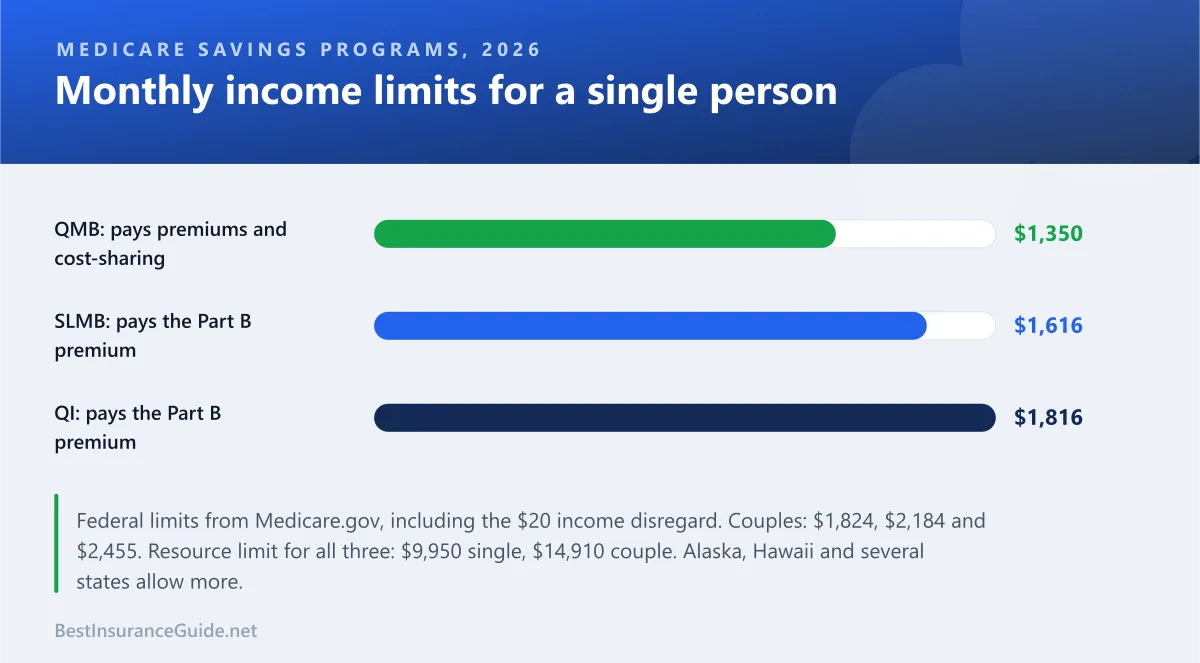
| Program | Monthly income, single | Monthly income, couple | Resources, single / couple | What it pays |
|---|---|---|---|---|
| QMB (Qualified Medicare Beneficiary) | $1,350 | $1,824 | $9,950 / $14,910 | Part A and B premiums, deductibles, coinsurance and copays |
| SLMB (Specified Low-Income Medicare Beneficiary) | $1,616 | $2,184 | $9,950 / $14,910 | Part B premium |
| QI (Qualifying Individual) | $1,816 | $2,455 | $9,950 / $14,910 | Part B premium |
| QDWI (Qualified Disabled and Working Individual) | $5,405 | $7,299 | $4,000 / $6,000 | Part A premium for some working people with disabilities |
Federal limits for 2026 from Medicare.gov (QMB, SLMB, QI) and NCOA (QDWI). Income limits include the standard $20 income disregard. Alaska, Hawaii and several states use higher limits.
What is a Medicare Savings Program?
Medicare Savings Programs, often shortened to MSPs, are help programmes run by each state’s Medicaid agency and funded jointly with the federal government. They pay some or all of what you owe Medicare, so more of your Social Security check stays in your pocket.
You do not need to qualify for full Medicaid to get one. The income limits for SLMB and QI sit well above most states’ Medicaid limits for older adults, which is why many people who were turned down for Medicaid still qualify for an MSP.
There are four programmes. Most people will only ever deal with the first three.
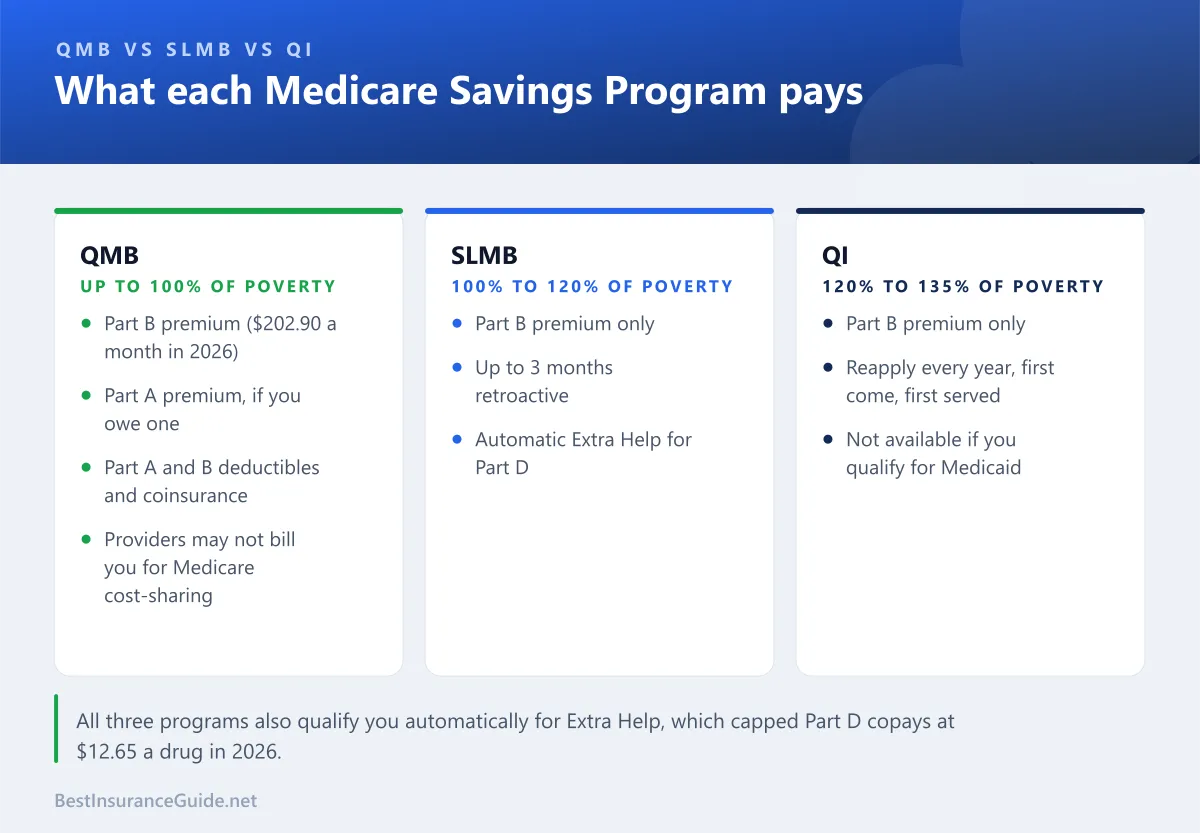
QMB: the most complete help
QMB is for people with income up to 100% of the federal poverty level. It pays:
- The Part B premium: $202.90 a month in 2026
- The Part A premium, if you do not get premium-free Part A: up to $565 a month in 2026
- The Part B deductible: $283 in 2026
- The Part A hospital deductible: $1,736 per benefit period in 2026
- Coinsurance and copays for Medicare-covered services, such as the usual 20% for doctor visits
QMB also comes with an important protection. Doctors, hospitals and other Medicare providers are not allowed to bill you for Medicare deductibles, coinsurance or copays. If you get a bill for Medicare cost-sharing while on QMB, show your QMB card or notice and call 1-800-MEDICARE.
QMB coverage starts the first month after your state confirms you are eligible. It does not pay retroactively, so apply as soon as you think you might qualify.
SLMB: the Part B premium
SLMB is for people with income between 100% and 120% of the poverty level. It pays the Part B premium only, and you must have both Part A and Part B. SLMB can pay up to three months retroactively if you were eligible in those months.
QI: the Part B premium, renewed each year
QI is for people with income between 120% and 135% of the poverty level. Like SLMB, it pays the Part B premium. But QI has three extra rules:
- You must reapply every year.
- States approve applications first come, first served, with priority for people who had QI the previous year.
- You cannot get QI if you qualify for Medicaid.
QDWI: Part A for working people with disabilities
QDWI pays the Part A premium for people under 65 who have a disability, returned to work and lost premium-free Part A. Income can be up to 400% of the poverty level, but resources are limited to $4,000 for one person.
The bonus: automatic Extra Help for prescriptions
Everyone who qualifies for QMB, SLMB or QI automatically qualifies for Extra Help, the federal Low-Income Subsidy for Part D drug coverage. You do not need a separate application.
According to Medicare.gov, people in these programmes pay no more than $12.65 for each covered drug in 2026. Extra Help also lowers or removes your Part D premium and deductible, depending on the plan you choose.
That matters more in 2027. CMS has confirmed that the standard Part D deductible rises to $700 and the out-of-pocket cap to $2,400 next year. Extra Help shields you from most of that, with 2027 copays of up to $5.80 for generics and $14.40 for brand-name drugs. Our guide to Extra Help in 2027 covers the new copays, and Medicare 2027 changes explains the wider Part D numbers.
How much a Medicare Savings Program is worth
Illustrative. Consider a single person on Medicare with $1,300 a month in Social Security, a few thousand dollars in savings, and Original Medicare.
| Cost | Without QMB, 2026 | With QMB, 2026 |
|---|---|---|
| Part B premium | $2,434.80 a year | $0 |
| Part B deductible | $283 | $0 |
| 20% coinsurance on $5,000 of outpatient care | $1,000 | $0 |
| Part D drug copays | Plan’s usual copays | Up to $12.65 a drug (Extra Help) |
| Total, before drugs | $3,717.80 | $0 |
For the same person on SLMB or QI, the saving is the Part B premium, $2,434.80 a year, plus Extra Help on prescriptions.
Because Social Security deducts the Part B premium from your monthly benefit, the saving usually shows up as a bigger Social Security deposit. If the 2027 Part B premium lands at the Trustees’ projection of $209.50, the yearly value of the Part B help rises to about $2,514.
How income and resources are counted
The headline limits are not as strict as they look, because several things are left out.
Income
- States start from your gross income, before the Part B premium is taken out of your Social Security.
- The first $20 a month of most income is disregarded. The limits above already include it.
- Only about half of earned income counts. If you still work, after a small fixed deduction, roughly half of your wages are disregarded.
- Some states disregard more. Illinois disregards $25 and Mississippi $50, according to NCOA.
Resources
Countable resources include cash, bank accounts, stocks, bonds and mutual funds. These generally do not count:
- Your home
- One car
- Burial funds up to $1,500 per person, and burial plots
- Household goods and personal belongings
- Life insurance with a small cash value, under rules that vary by state
States with higher limits or no asset test
States can be more generous than the federal rules, and many are. According to NCOA’s 2026 state guide:
No asset limit for MSPs: Alabama, Arizona, Connecticut, Delaware, District of Columbia, Louisiana, Maine, Massachusetts, Mississippi, New Mexico, New York, Oregon, Vermont and Washington.
Higher income limits (QMB, single person, a month):
| State | QMB income limit, single | Notes |
|---|---|---|
| District of Columbia | $4,010 | QMB is the only programme, with expanded eligibility |
| Connecticut | $2,752 | No asset limit |
| Maine | $2,481 | No asset limit |
| Massachusetts | $2,385 | No asset limit |
| Indiana | $2,015 | Federal asset limit |
| New York | $1,856 | No asset limit |
| Alaska | $1,683 | Federal asset limit |
| Hawaii | $1,550 | Federal asset limit |
| Washington | $1,454 | No asset limit |
California reinstated an asset limit on January 1, 2026, of $130,000 for one person and $195,000 for a couple, still far above the federal $9,950. Minnesota uses $10,000 and $18,000.
Some states also use different names. North Carolina calls its programmes MQB, MQB-B and MQB-E, and Oregon calls SLMB and QI “SMB” and “SMF”. New York eliminated SLMB in 2023 by folding it into broader QMB eligibility.
State rules change. Confirm current limits with your state Medicaid agency before you apply.
Medicare Savings Program in Idaho
Idaho uses the federal limits for 2026, according to NCOA:
- QMB: $1,350 single, $1,824 couple
- SLMB: $1,616 single, $2,184 couple
- QI: $1,816 single, $2,455 couple
- Resources: $9,950 single, $14,910 couple
You apply through the Idaho Department of Health and Welfare, online, by phone or at a local office. Idaho’s free SHIP counselling service, SHIBA, can help you check eligibility and fill in the forms.
Be careful with charts you find online. Limits change every year when new poverty guidelines come out, and older 2024 and 2025 tables are still widely shared. Use 2026 figures for a 2026 application.
Medicare Savings Program in Oklahoma
Oklahoma also uses the federal limits and the federal resource limits for 2026, according to NCOA. You apply through the Oklahoma Department of Human Services (OKDHS), which handles eligibility for older adults and people with disabilities. OKDHS publishes its current figures in Appendix C-1 of its policy manual.
Oklahoma’s free SHIP counsellors, through the Oklahoma Insurance Department’s Medicare Assistance Program, can help you apply.
How to apply, step by step
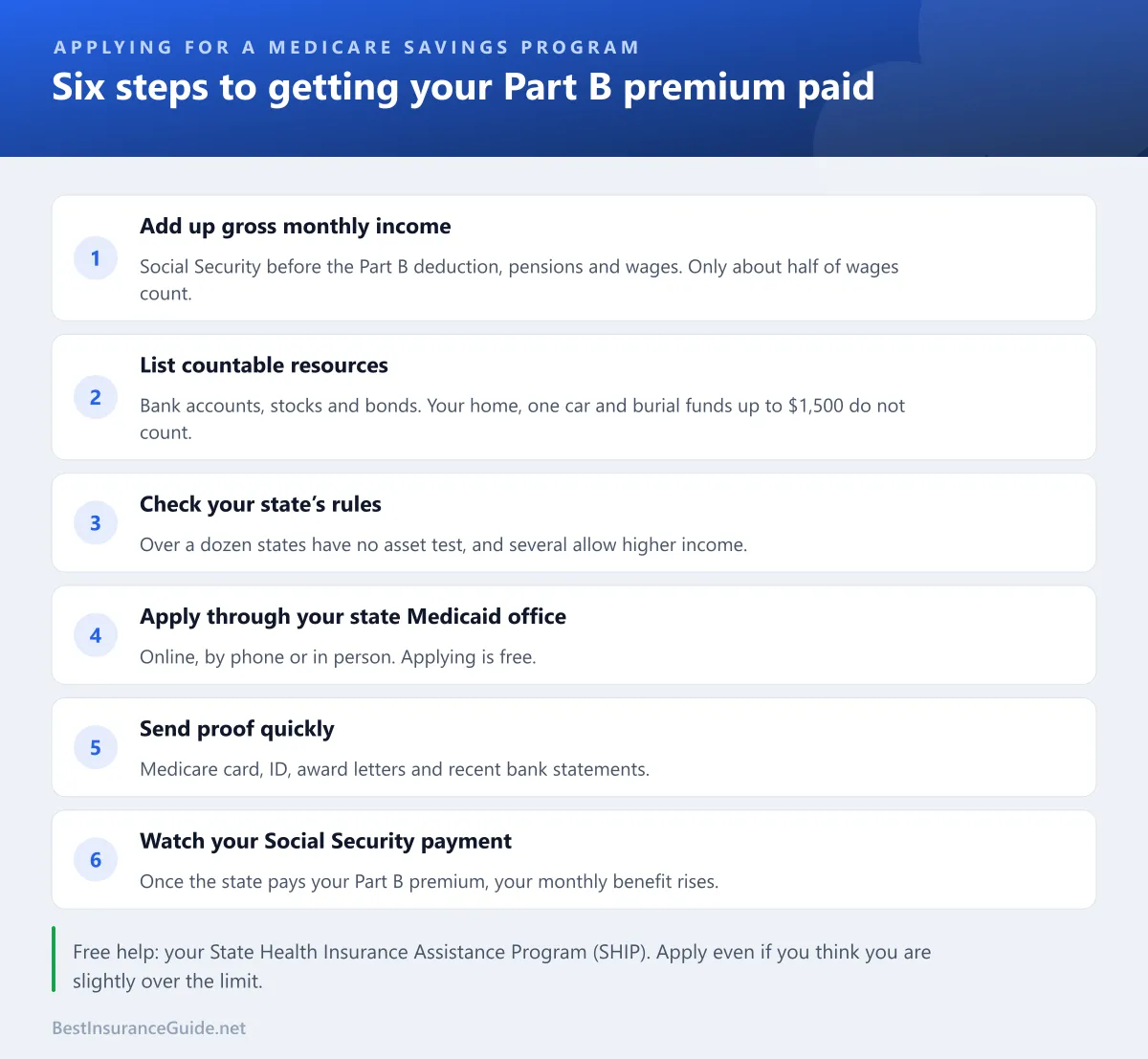
1. Add up your monthly income
Use your gross Social Security benefit, before the Part B premium is deducted, plus pensions, annuities and wages. If you are married and live together, add your spouse’s income.
2. List your countable resources
Check balances in bank accounts and investments. Leave out your home, one car and up to $1,500 each in burial funds.
3. Compare against your state’s limits
Use the federal limits as a starting point, then check your state’s rules. If you are close to a limit, apply anyway. Medicare.gov’s own advice is: even if you don’t think you qualify, you should still apply.
4. Apply through your state Medicaid office
Find your state’s office on Medicaid.gov or by calling 1-800-MEDICARE. Many states let you apply online. Applying is free. Be wary of anyone who charges a fee to “enroll” you.
5. Send your documents promptly
Have these ready: your Medicare card, photo ID, proof of address, Social Security award letter, pension statements and recent bank statements. Missing paperwork is the most common reason for delays.
6. Check your Social Security payment
Once you are approved, the state begins paying your Part B premium. It can take a couple of months for the change to reach your Social Security payment, and you may receive a refund for months already deducted.
Do it now, not after December 7
You can apply for a Medicare Savings Program at any time of year. But there are three reasons to do it during open enrollment:
- Extra Help changes your Part D choices. With Extra Help, some Part D plans cost you little or nothing. Knowing your status before December 7 lets you pick the right plan for 2027.
- The 2027 Part B premium is about to be set. CMS usually announces it in November, and it is projected to rise.
- Enrollment is not getting easier. The 2025 budget law paused parts of a 2023 federal rule meant to simplify MSP enrollment until September 30, 2034. Paperwork requirements in many states will stay as they are, so starting early helps.
Common questions people get wrong
- “I own my home, so I won’t qualify.” Your home does not count as a resource.
- “My Social Security is over $1,350, so QMB is out.” You may still get SLMB or QI. And if you work, only about half of your wages count.
- “The state will take my house.” Federal law has exempted MSP benefits from Medicaid estate recovery since 2010.
- “I have Medicare Advantage, so this doesn’t apply.” MSPs work with Medicare Advantage too.
- “I was turned down for Medicaid.” MSP limits are higher than most states’ Medicaid limits for older adults.
Related reading
For the full picture of next year’s costs, read Medicare 2027 changes and how the 2027 Social Security COLA interacts with Medicare premiums. If your Medicare Advantage plan is ending, see Medicare Advantage plans leaving in 2027. For the difference between the two programmes, see Medicare vs Medicaid.
Sources and notes
- Medicare.gov, “Medicare Savings Programs”: 2026 QMB, SLMB and QI income and resource limits, QI renewal rules, and the $12.65 Extra Help drug copay.
- NCOA, “2026 Medicare Savings Programs Eligibility and Coverage”, updated March 2026: QDWI limits, Alaska and Hawaii limits, 2026 Medicare cost-sharing amounts, and state-specific income and asset rules.
- CMS, “2026 Medicare Parts A & B Premiums and Deductibles,” November 2025: Part B premium $202.90 and deductible $283.
- 2026 Medicare Trustees Report: projected 2027 Part B premium of $209.50.
- One Big Beautiful Bill Act (Public Law 119-21), section 71101: moratorium on parts of the 2023 Medicare Savings Program streamlining rule through September 30, 2034.
- Oklahoma Department of Human Services, health help programmes.
- Featured photo: Rhoda Baer, National Cancer Institute, public domain, via Wikimedia Commons.
This article is general information, not legal, financial or medical advice. Limits and rules vary by state and change each year. This site is independent and not affiliated with Medicare, CMS or any state agency.