Extra Help 2027: New Copays, Income Limits and How to Get Help With Part D Costs
Extra Help 2027 copays: up to $5.80 generic, $14.40 brand, $0 deductible. 2026 limits: $23,940 income, $18,090 resources. How to apply.

Table of contents

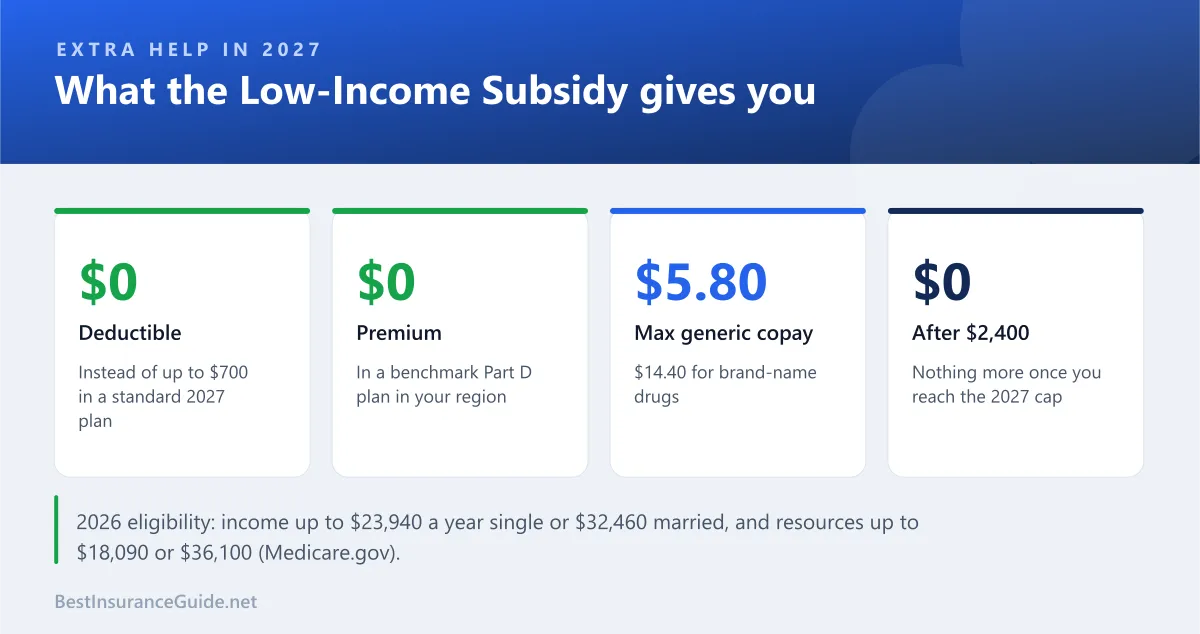
Medicare’s Extra Help program will cap 2027 prescription copays at $5.80 for a generic drug and $14.40 for a brand-name drug, with no deductible and, in many plans, no premium. For people on a tight budget, it is the single biggest way to cut Part D costs. Yet many people who qualify have never applied.
The timing matters. Medicare open enrollment runs from October 15 to December 7, 2026, and the standard Part D deductible rises to $700 in 2027. With Extra Help, you pay none of it. Searches for “Extra Help” have risen through 2026 as people prepare for those changes.
This guide covers the confirmed 2027 copays, the current income and resource limits, who qualifies automatically and how to apply. This site is independent and not affiliated with Medicare, CMS or the Social Security Administration. Figures are attributed to their sources below.
Extra Help 2027 at a glance
| Detail | Standard Part D, 2027 | With Extra Help, 2027 |
|---|---|---|
| Deductible | Up to $700 | $0 |
| Monthly premium | Average about $36 for a standalone plan | $0 in a benchmark plan |
| Generic drug | Plan’s copay or coinsurance | Up to $5.80 |
| Brand-name drug | Plan’s copay or coinsurance | Up to $14.40 |
| After the out-of-pocket cap | $0 after $2,400 | $0 after $2,400 |
| Late enrollment penalty | Applies if you delayed coverage | Waived |
Sources: CMS CY 2027 Rate Announcement (deductible, cap, copays), CMS July 2026 Part D premium projections, Medicare.gov.
What is Extra Help?
Extra Help, officially the Part D Low-Income Subsidy (LIS), is a federal program that pays most of the cost of Medicare prescription drug coverage for people with limited income and savings. It is run by Medicare, and the Social Security Administration handles most applications.
It works with either:
- A standalone Part D plan alongside Original Medicare, or
- A Medicare Advantage plan that includes drug coverage
Extra Help is not available in Puerto Rico or the U.S. territories, which have their own programs.
2027 Extra Help copays: confirmed
CMS published the 2027 copays in its CY 2027 Rate Announcement in April 2026. Medicare.gov now lists them too. The amounts rise each year with Part D drug costs.
| Who you are | Generic, 2026 | Generic, 2027 | Brand-name, 2026 | Brand-name, 2027 |
|---|---|---|---|---|
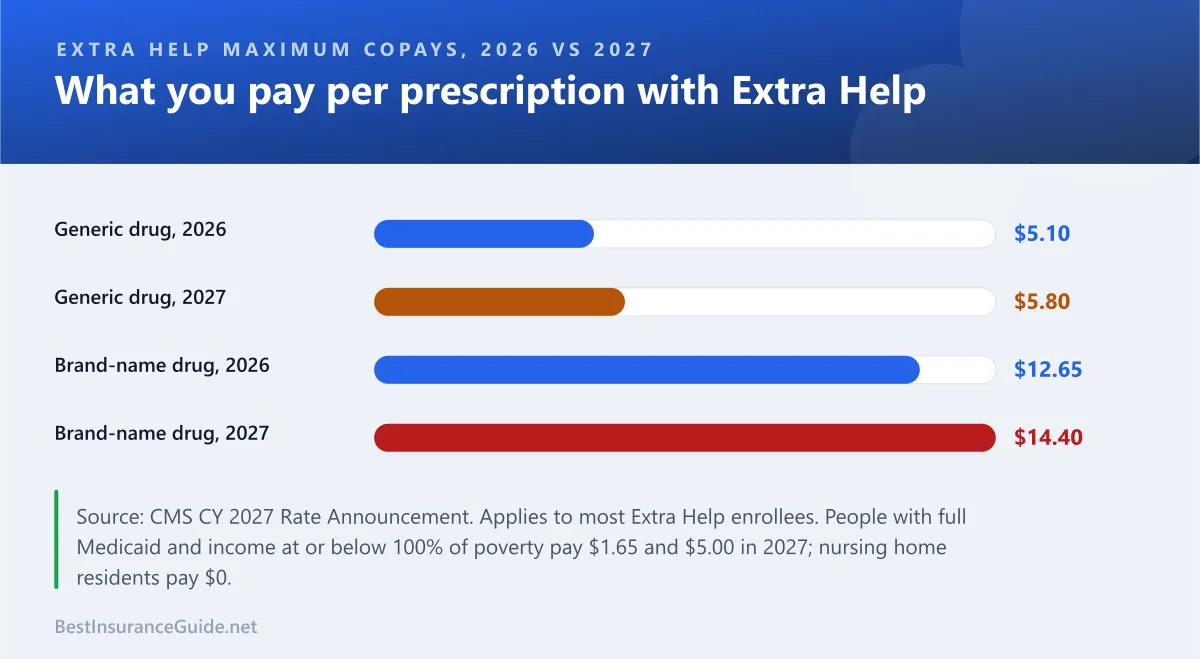
| Most Extra Help enrollees (including Medicare Savings Program and SSI) | $5.10 | $5.80 | $12.65 | $14.40 |
| Full Medicaid, income at or below 100% of poverty | $1.60 | $1.65 | $4.90 | $5.00 |
| Nursing home or home and community-based services, with full Medicaid | $0 | $0 | $0 | $0 |
Source: CMS, Announcement of Calendar Year 2027 Medicare Advantage capitation rates and Part C and Part D payment policies, April 6, 2026.
These are maximums. Some plans charge less, and many charge $0 for preferred generics. Once your total out-of-pocket drug spending reaches the $2,400 cap in 2027, you pay nothing more for covered drugs for the rest of the year.
Who qualifies for Extra Help
Income and resource limits
Medicare.gov lists these limits, labelled for 2026:
| Household | Yearly income limit | Resource limit |
|---|---|---|
| Single | $23,940 | $18,090 |
| Married, living together | $32,460 | $36,100 |
The income limit is 150% of the federal poverty level. Limits are higher in Alaska and Hawaii, and they are updated early each year when new poverty guidelines are published. Medicare.gov notes that you may qualify even if your income is somewhat higher, because some income is not counted.
What counts as a resource
Counted: cash, bank accounts, stocks, bonds, mutual funds, IRAs and other savings you could turn into cash.
Not counted:
- Your home and the land it sits on
- Your car
- Personal belongings and household goods
- Life insurance policies
- Burial plots, and up to $1,500 per person set aside for burial, if you say you plan to use it that way. The limits above already include this allowance.
What counts as income
Social Security, pensions, wages, annuities and similar income count. Some things do not, including SNAP food benefits, housing help and home energy assistance. If you are married and live together, your spouse’s income and resources count too, even if only one of you has Medicare.
You may already have Extra Help
You qualify automatically, with no separate application, if you have:
- Full Medicaid
- Supplemental Security Income (SSI)
- A Medicare Savings Program that pays your Part B premium: QMB, SLMB or QI
If you qualify automatically, Medicare usually sends a purple letter confirming it. If you lose automatic eligibility for the next year, you get a grey letter explaining that you will need to apply.
Not sure? Your Part D plan can tell you, and the plan’s Low-Income Subsidy rider shows your copays. Our guide to Medicare Savings Programs explains how to get your Part B premium paid, which brings Extra Help with it.
How much Extra Help saves in 2027
Illustrative. Consider someone who takes one brand-name drug and two generics every month, in a plan with a $36 monthly premium and the full $700 deductible.
| Cost, 2027 | Without Extra Help | With Extra Help |
|---|---|---|
| Premium (benchmark plan) | $432 | $0 |
| Deductible | $700 | $0 |
| Brand-name drug, 12 fills | Often $40 to $100+ each after the deductible | Up to $172.80 total |
| Two generics, 24 fills | Often $5 to $20 each | Up to $139.20 total |
| Rough yearly total | Often $1,500 or more | Up to about $312 |
The exact saving depends on your drugs and plan, but savings of well over $1,000 a year are common. For someone on expensive brand-name drugs, Extra Help can also mean reaching the $2,400 cap with far less paid out of pocket.
How to apply for Extra Help
1. Check whether you already qualify
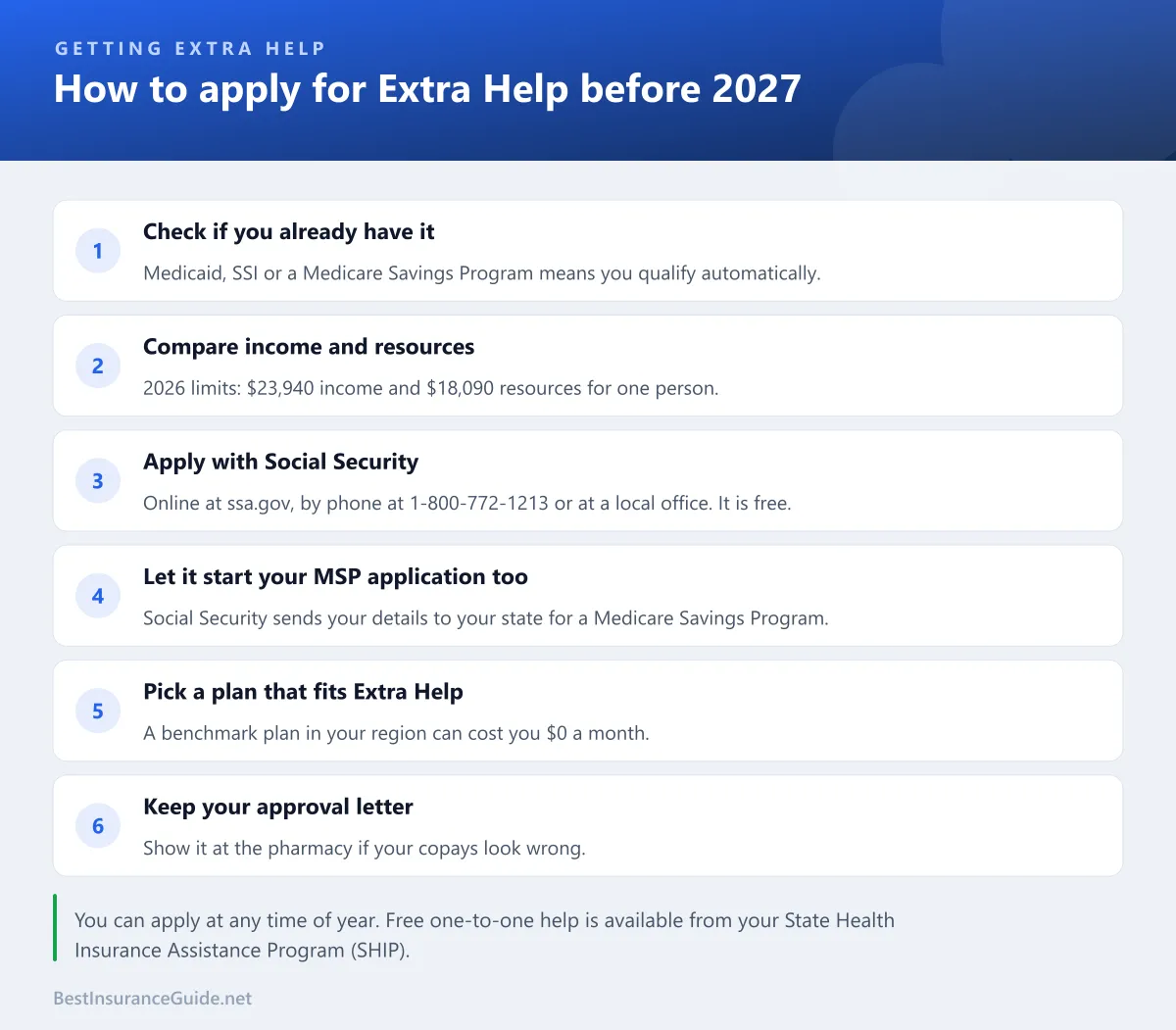
If you have Medicaid, SSI or a Medicare Savings Program, you do not need to apply. Look for your purple letter or ask your plan.
2. Gather your numbers
Have recent bank and investment statements, your Social Security and pension amounts, and your spouse’s details if you are married.
3. Apply with Social Security
You can apply:
- Online at ssa.gov/medicare/part-d-extra-help
- By phone at 1-800-772-1213 (TTY 1-800-325-0778)
- In person at a local Social Security office
The application asks about income and resources but does not require you to send bank statements up front. Social Security may follow up to check.
4. Let it start your Medicare Savings Program application too
When you apply for Extra Help, Social Security sends your information to your state Medicaid agency, which counts as an application for a Medicare Savings Program unless you ask it not to. That could get your $202.90 Part B premium paid as well.
5. Choose a plan that works with Extra Help
Once approved, compare plans on Medicare.gov’s Plan Finder and enter your drugs. Look for benchmark plans, which cost you $0 a month with Extra Help. If you do not choose a plan, Medicare may enroll you in one automatically.
6. Keep your approval letter
If a pharmacy charges you more than the Extra Help copays, show your letter. Medicare’s Best Available Evidence policy requires plans to correct your copays when you have proof you qualify.
Do it before December 7
You can apply for Extra Help at any time of year, and you can reapply if your income or savings drop. But there are three reasons to apply now:
- Your plan choice depends on it. Extra Help changes which plans cost the least. Knowing your status before December 7 helps you choose the right plan for 2027.
- The 2027 deductible jumps to $700. Without Extra Help, that comes out of your pocket in January.
- You get more chances to switch. People with Extra Help can use a monthly special enrollment period to switch into Original Medicare with a standalone Part D plan, so you are not locked in for the year.
Common Extra Help mistakes
- Assuming your savings are too high. Your home, car and life insurance do not count, and the resource limit is $18,090 for one person in 2026.
- Choosing a plan above the benchmark. You pay the difference. A benchmark plan often costs $0.
- Ignoring a grey letter. If you lose automatic eligibility, you need to apply yourself to keep the help.
- Not reapplying after a change. If your income falls, a spouse dies, or your savings drop, you can apply again.
- Paying someone to apply. Applying is free. Be wary of anyone who charges a fee.
Related reading
For every Medicare number changing next year, see Medicare 2027 changes. For help with Part B premiums and Medicare cost-sharing, see Medicare Savings Programs. If you take weight-loss or diabetes drugs, GLP-1 coverage in 2027 explains what Part D will pay.
Sources and notes
- CMS, Announcement of Calendar Year 2027 Medicare Advantage capitation rates and Part C and Part D payment policies, April 6, 2026: Part D deductible $700, out-of-pocket threshold $2,400, and 2026 and 2027 low-income subsidy copays.
- Medicare.gov, “Help with drug costs”: Extra Help income and resource limits, 2027 copays, automatic eligibility and how to apply.
- CMS press release, “Medicare Advantage and Medicare Prescription Drug Programs Expected to Remain Stable in 2027,” July 2026: projected average standalone Part D premium of about $36.
- Inflation Reduction Act of 2022, section 11404: full Extra Help for people with income up to 150% of the poverty level, effective 2024.
- Featured photo: Rhoda Baer, National Cancer Institute, public domain, via Wikimedia Commons.
This article is general information, not legal, financial or medical advice. Plan costs and drug coverage vary. This site is independent and not affiliated with Medicare, CMS or the Social Security Administration.