Burial Insurance: No Waiting Period Options, Costs, and Burial vs Life Insurance
Burial insurance explained: how it differs from life insurance, no-waiting-period policies, graded benefits, costs, and whether it's worth buying.

Table of contents

Nobody likes thinking about their own funeral, but a lot of people think about who’ll pay for it. That’s what burial insurance is for: a small, simple life insurance policy that makes sure a funeral or cremation doesn’t land on your children’s credit cards.
This guide explains what burial insurance is, how it differs from regular life insurance, how to get coverage with no waiting period, what the fine print about “graded” and “modified” benefits means, and the simple math that tells you whether it’s worth it. This site is independent and doesn’t sell insurance or take commissions from insurers.
What is burial insurance?
Burial insurance is a small whole life insurance policy meant to cover end-of-life costs. You’ll also see it sold as final expense insurance or funeral insurance. They’re different names for essentially the same product.
The typical features:
- Small death benefit, often a few thousand dollars up to about $25,000
- Level premiums for life. Your price doesn’t go up as you age.
- Lifetime coverage. It doesn’t expire as long as you keep paying.
- Easy underwriting. A short health questionnaire, or no questions at all, and usually no medical exam.
- Fast payouts, because the amounts are small and claims are simple
It’s aimed mostly at people in their 50s to 80s. The goal is simple: cover a funeral, a burial plot or cremation, and a few final bills. In the NFDA’s 2023 study, the median funeral with viewing and burial cost $8,300, and $6,280 with cremation. Our guide to how much cremation costs has the line-by-line breakdown.
Burial insurance vs life insurance
This is one of the most common questions, and the honest answer is that burial insurance is life insurance. It’s just a smaller, simpler version designed for one job.
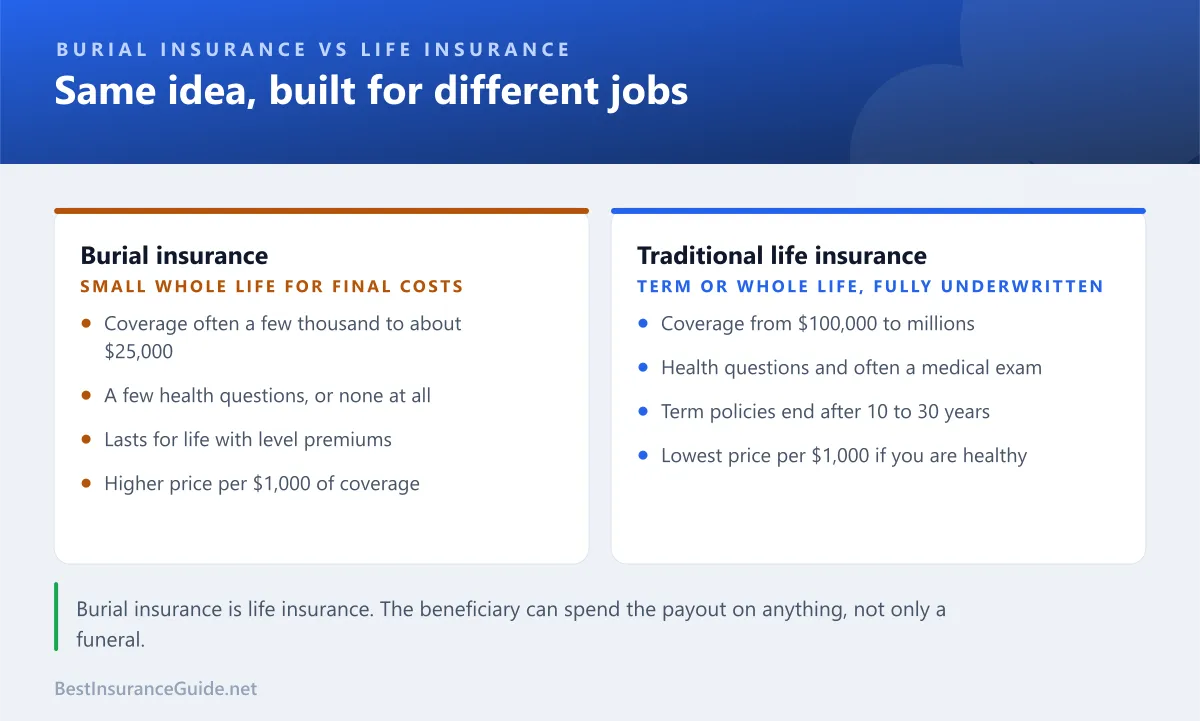
| Detail | Burial insurance | Traditional term or whole life |
|---|---|---|
| Typical coverage | A few thousand to about $25,000 | $100,000 to millions |
| Health questions | A few, or none | Detailed, often with a medical exam |
| How long it lasts | For life | Term: 10 to 30 years. Whole life: for life |
| Price per $1,000 of coverage | Higher | Lower, if you’re healthy |
| Main purpose | Funeral and final costs | Replacing income, paying off debts, supporting family |
| Who gets the money | Your beneficiary | Your beneficiary |
A point people often miss: the beneficiary isn’t required to spend the money on a funeral. Burial insurance pays your named beneficiary in cash. They can pay the funeral home, a medical bill or anything else. That’s flexible, but it also means you should choose a beneficiary you trust to follow your wishes.
If you’re healthy enough to qualify for a regular term or whole life policy, compare that too. You’ll often get more coverage for the same money. Burial insurance makes most sense when you only need a small amount, or your health makes traditional coverage expensive or unavailable.
Burial insurance with no waiting period
“No waiting period” is the most searched phrase around burial insurance, and it comes down to one thing: the type of death benefit in the policy.
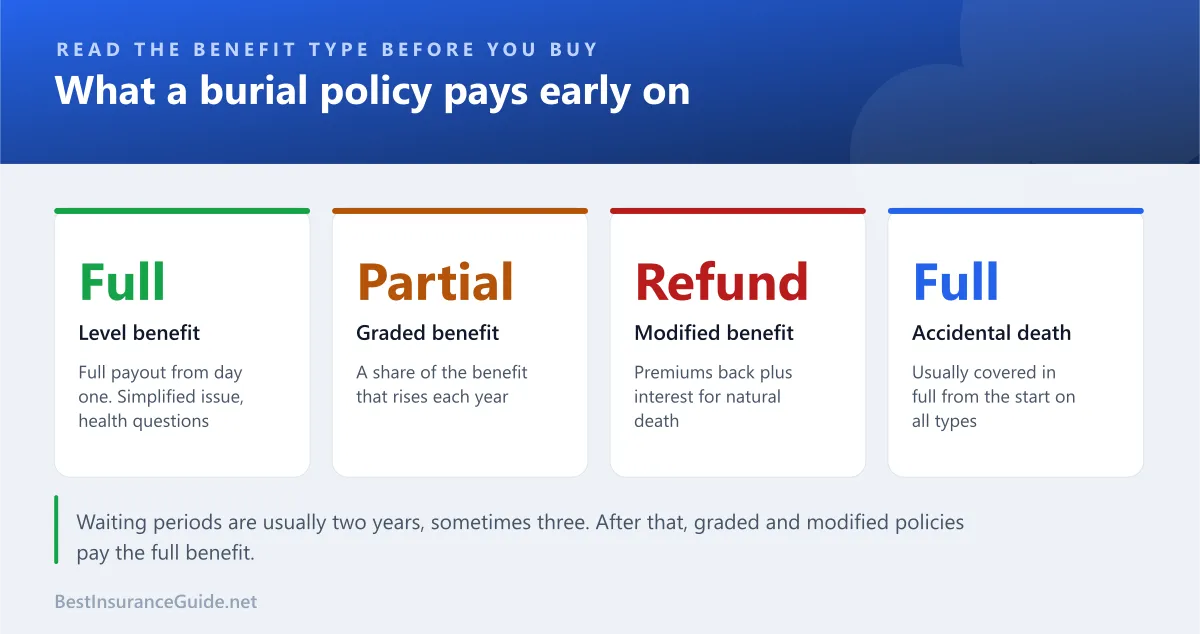
There are three main types:
- Level benefit (no waiting period). The full death benefit is paid from the first day the policy is in force. These are simplified issue policies. You answer a short list of health questions, and the insurer decides whether you qualify.
- Graded benefit. If you die of natural causes in the first two or three years, the policy pays only part of the benefit, a share that rises each year. After the graded period, it pays in full. These are for people with some health issues.
- Modified benefit, or return of premium. If you die of natural causes in the first two or three years, your beneficiary gets the premiums you paid, usually plus interest, rather than the death benefit. Most guaranteed issue policies work this way.
On nearly all of these, accidental death is covered in full from day one.
How to qualify for no waiting period
The health questions on simplified issue applications usually ask about serious conditions within a certain look-back period. Common examples include recent cancer treatment, heart attack or stroke, kidney failure, use of oxygen, and being in a nursing home or hospice. The exact questions differ by insurer, which is why one company may decline you while another approves you for a level benefit.
A few tips:
- Answer honestly. Life insurance has a two-year contestability period. If the insurer finds a misstatement after a death, it can deny the claim.
- Try simplified issue before guaranteed issue. If one insurer turns you down, another with different questions might not.
- Use an independent agent who can compare several final expense insurers. Matching your health history to the right insurer’s questions is most of the job.
How much does burial insurance cost?
Burial insurance is priced on your age, sex, tobacco use, health and coverage amount, and on whether the policy is simplified or guaranteed issue. Prices rise steeply with age. Guaranteed issue costs noticeably more than simplified issue for the same coverage, because the insurer knows nothing about your health.
We don’t publish sample premiums for named insurers, because the right comparison is a real quote for your age and health. When you get quotes, compare them on the same coverage amount and benefit type. A cheap-looking guaranteed issue policy and a simplified issue policy aren’t the same product.
How much coverage do you need?
Start with what you actually want:
- Direct cremation usually needs the least coverage.
- Cremation with a memorial or funeral needs more. The NFDA median for a funeral with cremation was $6,280.
- A traditional funeral and burial needs the most. The median was $8,300, or $9,995 with a vault, before a cemetery plot, opening and closing, and a headstone.
Then add a cushion for final medical bills, small debts and inflation, because prices will rise between now and when the policy pays.
Is burial insurance worth it?
It depends on one simple calculation: how long would it take for your premiums to add up to more than the death benefit?
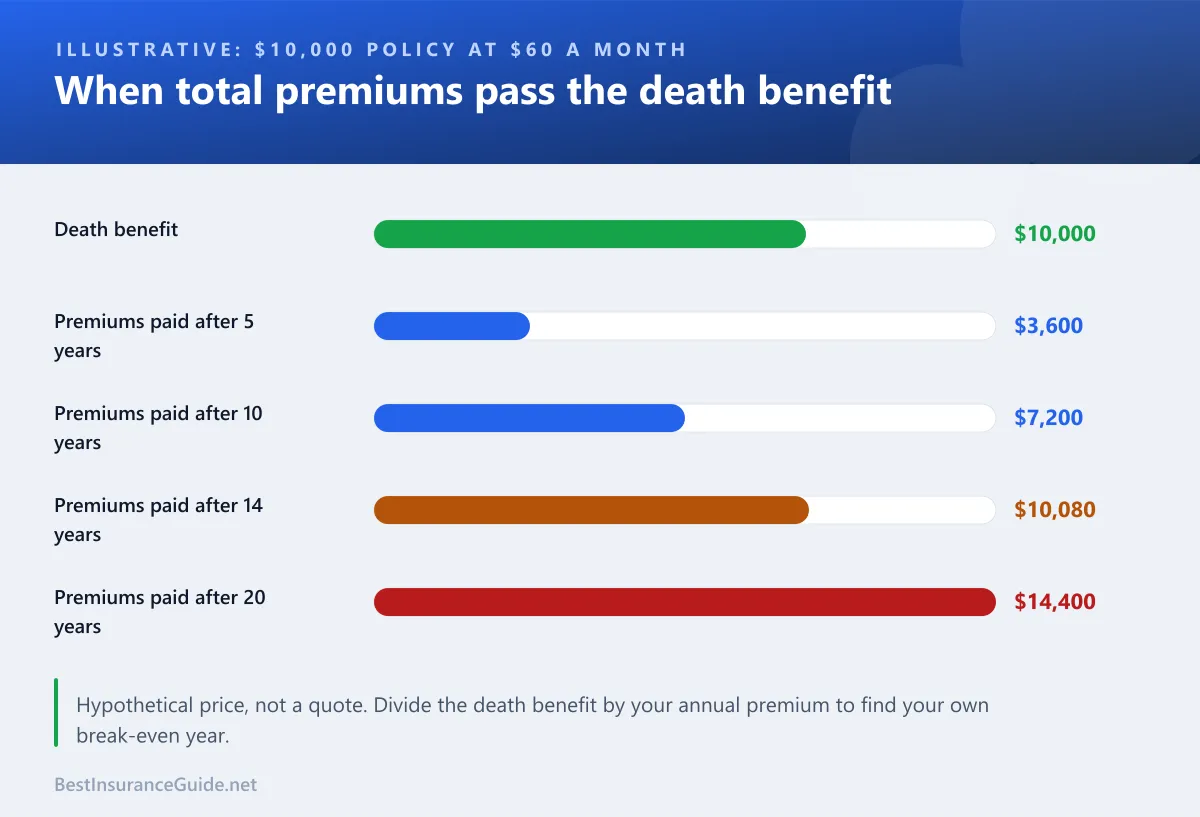
Take a hypothetical $10,000 policy that costs $60 a month, or $720 a year. Divide $10,000 by $720 and you get about 14 years. If you live longer than that, you’ll have paid in more than your family gets back. If you die sooner, the policy comes out ahead.
That’s not automatically a reason to skip it. You’re buying certainty that the money will be there whenever you die, without relying on savings you might need for something else. But it does help you decide:
Burial insurance is often worth it if:
- you don’t have savings set aside for a funeral, and your family couldn’t easily cover one
- your health rules out cheaper term or whole life coverage
- you want a fixed, predictable cost and a guaranteed payout
It may not be worth it if:
- you already have enough savings, or a payable-on-death account set aside for funeral costs
- you’re healthy enough for a regular policy that’s cheaper per dollar
- you’re very likely to outlive the break-even point and could save the premiums instead
- only a guaranteed issue policy is available and the premiums are high relative to the benefit
Burial insurance for seniors over 70, 85 and 90
- Over 70: most final expense insurers still offer simplified and guaranteed issue policies, and this is a common age to buy.
- Over 80: coverage is still available from many insurers, but the price per $1,000 is high. Many products stop accepting new applicants at 80 or 85.
- Over 85 and over 90: only a few insurers issue new policies, and coverage amounts are small. Look at savings, old policies and prepaid funeral options first.
Our guide to life insurance for seniors covers all the options by age.
Burial insurance for cancer patients
A cancer diagnosis doesn’t automatically rule out burial insurance:
- During active treatment, or with a recent diagnosis, most people are limited to guaranteed issue policies with a graded or modified benefit.
- After treatment, some simplified issue insurers will offer a level benefit once enough time has passed. The look-back period varies, often a few years, and some cancers are treated differently from others.
Our guide to life insurance with cancer explains what insurers look at.
Burial insurance for parents
If you’re an adult child worried about a parent’s funeral, you can buy burial insurance on your parent’s life, with their consent and an insurable interest. You can be the owner, the payer and the beneficiary. Our guide to life insurance for parents explains how to set it up properly.
Burial insurance vs a prepaid funeral plan
These two are often confused.
| Detail | Burial insurance | Prepaid (preneed) funeral plan |
|---|---|---|
| Who it pays | Your beneficiary | A specific funeral home |
| What it pays for | Anything the beneficiary chooses | The goods and services you selected |
| Locks in funeral prices? | No | Often, for the items covered |
| If you move away | No problem, the money goes anywhere | May be hard to transfer or cancel |
| Health questions | Simplified or none | Usually none |
A preneed plan is good if you know exactly what you want and where, and you want to spare your family the decisions. Burial insurance is more flexible. Before signing a preneed contract, ask what happens if the funeral home closes, changes owners, or you need to cancel.
Is there free burial insurance?
No. You’ll see ads promising “free burial insurance for seniors”, but insurers don’t give policies away, and those ads typically lead to a sales call. Real sources of help with funeral costs include:
- Social Security’s $255 lump-sum death payment to an eligible surviving spouse or child
- VA burial benefits for eligible veterans, including burial in a national cemetery
- County or state indigent burial programs for families who can’t afford a funeral
- Whole-body donation programs, which often cover cremation afterward
How to buy burial insurance the smart way
- Decide what you want covered: cremation, funeral, burial plot, or a cushion for bills.
- Check what you already have, including old life insurance, retiree group coverage or a prepaid plan.
- Get simplified issue quotes first. Use guaranteed issue only if you’re declined.
- Compare several insurers through an independent agent, on the same coverage and benefit type.
- Check the benefit type: level, graded or modified.
- Do the break-even math on the premium.
- Name a beneficiary and a contingent beneficiary, and tell them the policy exists.
- Set up automatic payments. If the policy lapses, the coverage and what you paid can be lost.
Sources and notes
- NFDA 2023 General Price List Study median funeral costs, as reported by the Arizona Funeral, Cemetery & Cremation Association.
- Federal Trade Commission, The FTC Funeral Rule, on funeral pricing and preneed considerations.
- Social Security Administration, survivors benefits, including the lump-sum death payment.
- Coverage ranges, issue ages, look-back periods and graded benefit periods reflect common market practice and vary by insurer, product and state. The cost example is hypothetical. Your quote and policy contract are authoritative.
This article is general information, not financial or insurance advice. Compare quotes and read the benefit provisions before you buy.