What Does Medicare Part D Cover in 2027? Costs, Changes and How To Pick the Best Plan
What Medicare Part D covers and excludes, 2027 costs ($700 deductible, $2,400 cap), fewer stand-alone plans, negotiated drug prices from Jan 2027, and how to choose the best plan.
Table of contents

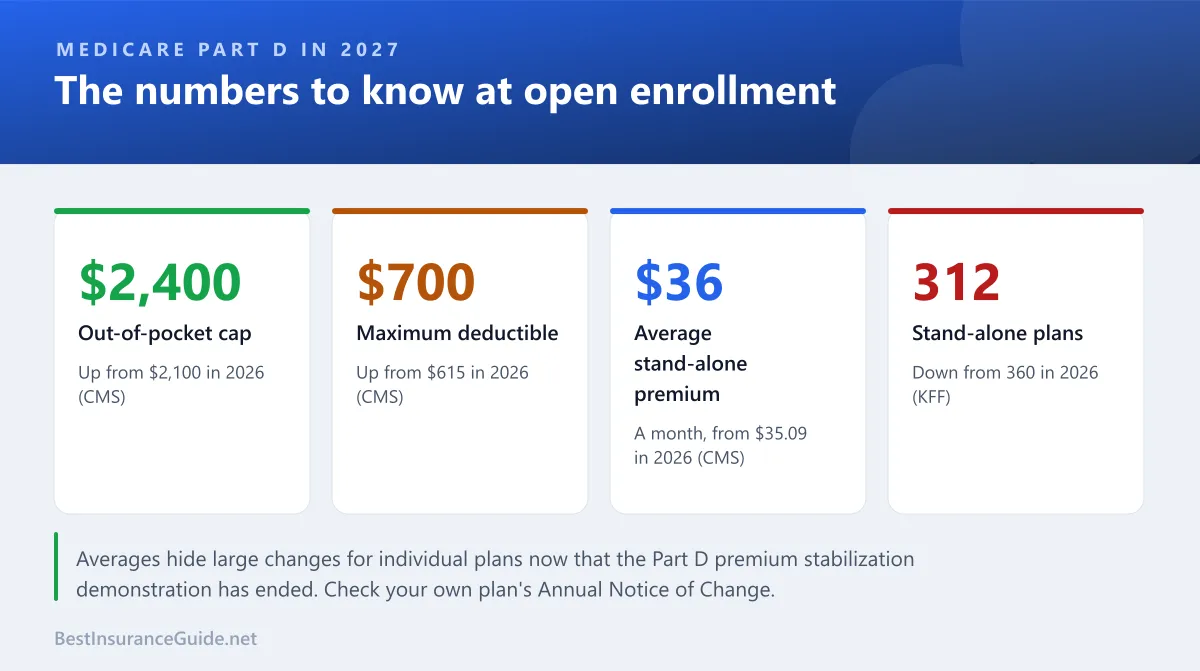
Medicare Part D covers the prescription drugs you take at home, as long as they are on your plan’s list of covered drugs, called a formulary. In 2027, the most you will pay out of pocket for covered drugs is $2,400, up from $2,100, and the maximum deductible rises to $700, according to CMS.
We are an independent site; figures below are from CMS, KFF and Medicare.gov, and examples are labelled illustrative.
Open enrollment runs until December 7, and this year it matters more than usual. The temporary Part D premium stabilization demonstration has ended, KFF reports that the number of stand-alone drug plans will fall from 360 to 312, and 15 more drugs, including Ozempic and Wegovy, get Medicare-negotiated prices from January 1. Here is what Part D covers, what it will cost in 2027, and how to find the plan that is cheapest for your drugs.
Medicare Part D at a glance for 2027
| Item | 2026 | 2027 |
|---|---|---|
| Maximum deductible | $615 | $700 |
| Out-of-pocket cap | $2,100 | $2,400 |
| Average stand-alone plan premium (CMS) | $35.09 | About $36 |
| Average drug premium in Medicare Advantage (CMS) | $11.32 | About $7 |
| Stand-alone plans nationally (KFF) | 360 | 312 |
| Base beneficiary premium (for penalties) | $38.99 | $41.33 |
| Insulin | $35 a month cap | $35 a month cap |
| Drugs with negotiated prices | 10 | 25 |
What does Medicare Part D cover?
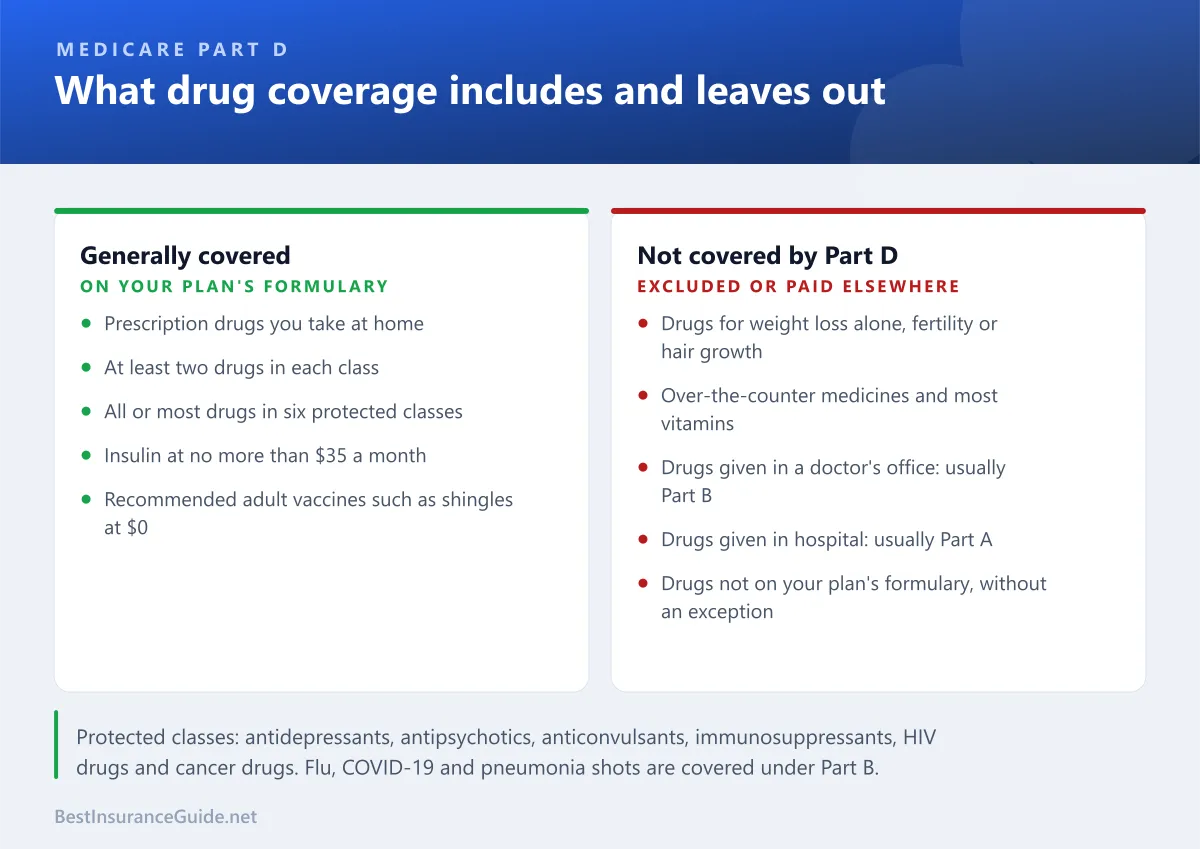
Part D is offered by private insurers approved by Medicare, either as a stand-alone prescription drug plan (PDP) alongside Original Medicare, or built into a Medicare Advantage plan with drug coverage (MA-PD). Every plan must:
- cover prescription drugs you fill at a retail or mail-order pharmacy and take at home;
- include at least two drugs in each drug category and class;
- cover all or substantially all drugs in six protected classes: antidepressants, antipsychotics, anticonvulsants, immunosuppressants for transplants, HIV drugs and cancer drugs;
- limit insulin to $35 a month for each covered insulin product;
- cover recommended adult vaccines, such as the shingles and Tdap vaccines, at no cost.
How formularies work. Plans put drugs on tiers, usually from preferred generics at the lowest cost to specialty drugs at the highest. They can also use prior authorisation, step therapy (trying a cheaper drug first) and quantity limits. If you join a new plan and a drug you already take is not covered, the plan must usually give you a temporary transition supply while you ask your doctor about alternatives or request an exception.
What Part D does not cover
By law, Part D plans cannot cover:
- drugs used only for weight loss or weight gain;
- fertility drugs;
- drugs for cosmetic purposes or hair growth;
- cough and cold medicines for symptom relief;
- most prescription vitamins and minerals, apart from prenatal vitamins and fluoride;
- most over-the-counter medicines;
- drugs for erectile dysfunction, unless used for another approved condition.
Other drugs are covered by another part of Medicare:
- drugs given in a doctor’s office or outpatient clinic, such as many infusions and injections, are usually covered by Part B;
- drugs given during a hospital stay are covered by Part A;
- flu, COVID-19 and pneumonia vaccines are covered by Part B.
GLP-1 drugs. Wegovy and Zepbound can be covered when prescribed for an approved condition other than weight loss alone, such as reducing cardiovascular risk or treating sleep apnoea. Separately, the Medicare GLP-1 Bridge lets eligible Part D enrollees get certain GLP-1 drugs for weight loss for a $50 monthly copay until December 31, 2027. Our article on GLP-1 coverage in 2027 explains who qualifies.
What Part D costs in 2027
Premiums
CMS projects the average stand-alone Part D premium at about $36 a month in 2027, up less than $1 from $35.09, and the average drug premium in Medicare Advantage plans about $7, down from $11.32.
Averages can mislead this year. The Part D Premium Stabilization Demonstration, which gave stand-alone plans extra federal support in 2025 and 2026, has ended. KFF’s analysis warns that stand-alone coverage will be harder to find and more expensive for millions of people, even though the national average barely moves, and KFF’s Juliette Cubanski has said some stand-alone enrollees could face larger premium increases than in recent years. Your plan’s Annual Notice of Change, sent by September 30, shows your own 2027 premium.
Higher earners also pay an income-related monthly adjustment amount (IRMAA) on top of their plan premium. The 2027 brackets are usually announced in November.
The 2027 standard benefit
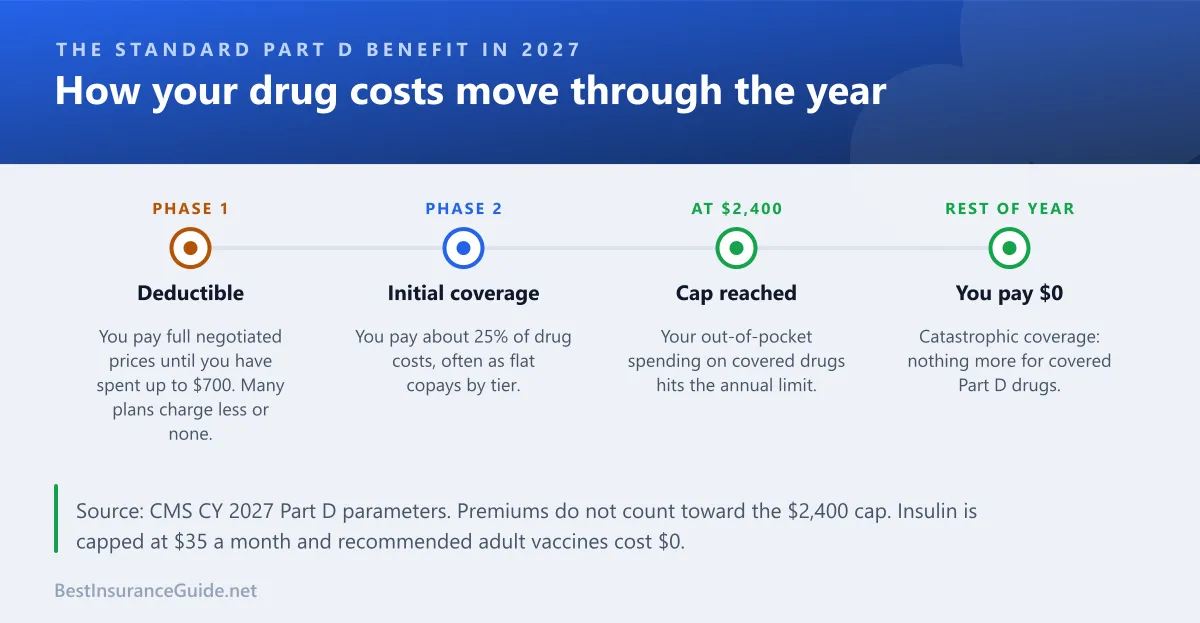
Since 2025, Part D has had a simple structure with a hard annual cap:
- Deductible: you pay full negotiated prices up to $700. Many plans charge less, or exempt cheaper tiers.
- Initial coverage: you pay about 25% of drug costs, often as flat copays by tier.
- Cap: once your out-of-pocket spending reaches $2,400, you pay $0 for covered drugs for the rest of 2027.
The old “donut hole” no longer exists.
Illustrative. Ray takes a brand-name drug with a negotiated price of $800 a month in a plan with the full $700 deductible and 25% coinsurance.
- January: Ray pays the $700 deductible plus 25% of the remaining $100, so $725.
- February onward: Ray pays 25% of $800, so $200 a month.
- By the end of September, Ray has paid $2,325: $725 plus $200 a month for February to September. In October, Ray pays only the final $75 and hits the $2,400 cap.
- From then on, Ray pays nothing for covered drugs until January.
Ray’s total for the year, before premiums, is $2,400, compared with $9,600 for the drug at full price.
Spreading the cost: the Medicare Prescription Payment Plan
If a big January bill is a problem, every Part D plan must offer the Medicare Prescription Payment Plan, which spreads your out-of-pocket drug costs over monthly instalments across the year at no interest. It does not lower your total cost, but it can turn Ray’s $725 January bill into smaller monthly payments. You can opt in through your plan before or during the year.
Negotiated drug prices from January 2027
Under the Inflation Reduction Act’s drug price negotiation programme, CMS announced negotiated prices for 15 more drugs in November 2025, effective January 1, 2027. They include:
- Ozempic, Wegovy and Rybelsus (semaglutide), with a negotiated price of $274 for a 30-day supply, against a 2024 list price of $959, according to Becker’s Hospital Review;
- Trelegy Ellipta and Breo Ellipta for lung disease;
- Xtandi, Ibrance, Calquence and Pomalyst for cancer;
- Ofev, Linzess, Austedo, Xifaxan, Vraylar, Janumet, Tradjenta and Otezla.
Discounts range from about 38% to 85% off list prices. The first 10 negotiated drugs, including Eliquis, Jardiance, Xarelto and Januvia, have had lower prices since January 1, 2026.
What it means for you: if you pay coinsurance as a percentage, a lower negotiated price means a lower bill. If you pay a flat copay, the savings may show up mainly in premiums and in reaching the cap more slowly. Either way, check how each plan places these drugs on its tiers for 2027.
How to pick the best Part D plan for 2027
There is no single best Part D plan. The best plan is the one that covers all your drugs at the lowest total yearly cost, at a pharmacy you use.
- Make a full list of your drugs, with doses and how often you take them.
- Use Medicare’s Plan Finder at Medicare.gov. Enter your drugs and pharmacies, and sort by lowest drug and premium cost, not lowest premium.
- Check every drug is on the formulary, and note any prior authorisation, step therapy or quantity limits.
- Compare preferred pharmacies and mail order. The same plan can cost far more at a non-preferred pharmacy.
- Look at star ratings, from one to five, as a guide to service and quality. Our article on Medicare Advantage star ratings for 2027 explains how they work.
- Decide between stand-alone and Medicare Advantage. If you have Original Medicare and a Medigap plan, you need a stand-alone PDP. Medicare Advantage plans usually include drug coverage.
- Enrol by December 7 for coverage starting January 1. If you do nothing, most people stay in their current plan, whatever it now costs.
If your plan is leaving. Some stand-alone plans and Medicare Advantage plans are not returning for 2027. You will get a notice and a special enrollment period; our guide to Medicare Advantage plans leaving in 2027 explains your deadlines.
Help with costs and penalties
- Extra Help (the Low-Income Subsidy) can reduce your premium and deductible to $0 and cap 2027 copays at $5.80 for generics and $14.40 for brand-name drugs. People with Extra Help can also change plans once a month. See our Extra Help 2027 guide.
- Medicare Savings Programs can pay your Part B premium and qualify you for Extra Help automatically; see our Medicare Savings Program guide.
- The late enrollment penalty is 1% of the base beneficiary premium, $41.33 in 2027, for each month you went without Part D or other creditable drug coverage after first becoming eligible. It lasts as long as you have Part D. Our guide to when to sign up for Medicare explains how to avoid it.
Related reading
- Medicare 2027 changes covers Part B, Medicare Advantage and open enrollment.
- Extra Help 2027 explains how to cut Part D costs on a low income.
- Medigap Plan G vs Plan N compares supplement plans to pair with a stand-alone PDP.
- GLP-1 coverage in 2027 covers Wegovy, Zepbound and the Medicare GLP-1 Bridge.
- Do prescriptions count towards your deductible? explains how drug spending is counted.
Sources and notes
- CMS, CY 2027 Part D rate announcement and parameters: $700 deductible, $2,400 out-of-pocket threshold, $41.33 base beneficiary premium.
- CMS, “Medicare Advantage and Medicare Prescription Drug Programs Expected to Remain Stable in 2027” (September 28, 2026): $36 average stand-alone premium, $7 average Medicare Advantage drug premium, end of the premium stabilization demonstration.
- KFF, analysis of 2027 Part D plans, as reported by AARP: stand-alone plans falling from 360 to 312, and warnings about higher premiums for some enrollees.
- CMS, negotiated prices for 15 Part D drugs effective January 1, 2027 (announced November 2025), with drug-level figures as reported by Becker’s Hospital Review and Managed Healthcare Executive.
- Medicare.gov: Part D coverage rules, exclusions, vaccines, insulin cap, the Medicare Prescription Payment Plan and late enrollment penalty.
- The worked example uses a hypothetical drug price and standard benefit design; real plans use copays and tiers.
This article is general information, not personalised advice. Plan premiums, formularies and pharmacy networks change every year. Your State Health Insurance Assistance Program (SHIP) offers free, unbiased help comparing Part D plans.