Medicare vs Medicaid: Two Programmes, One Confusing Letter Apart
Is Medicare and Medicaid the same? No. One is age-based and federal, one is income-based and state-run. Eligibility, costs, and whether you can have both.

Table of contents

Medicare and Medicaid are separate programmes that sound almost identical, were created at the same time, and do genuinely different jobs. The confusion is entirely understandable and it causes real problems, because people assume they are covered by one when they qualify for the other.
The one-line difference
Medicare is about age. Federal, uniform across the country, for people 65 and over plus certain younger people with disabilities. Your income is irrelevant.
Medicaid is about income. Jointly funded by federal and state government, administered by your state, with rules and names that vary. Your income and circumstances determine everything.
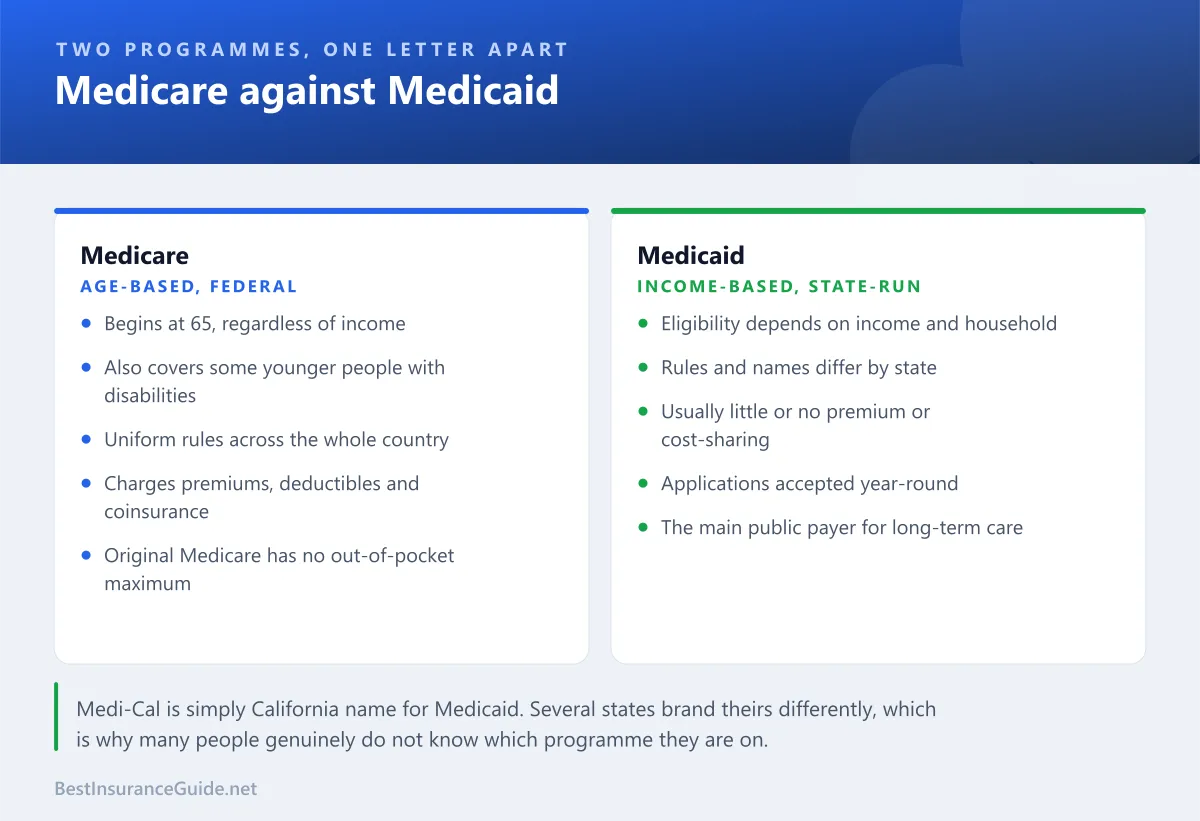
That is the whole distinction. Everything else follows from it.
Medicare in practice
Medicare comes in parts, and the alphabet is the confusing bit.
Part A, hospital insurance. Inpatient stays, limited skilled nursing, hospice, some home health. Usually premium-free if you or a spouse paid Medicare taxes for about ten years. It has a deductible per benefit period, not per year, which trips people up.
Part B, medical insurance. Doctor visits, outpatient care, preventive services, durable medical equipment. Charges a monthly premium, which is higher for higher incomes, plus an annual deductible and generally 20% coinsurance with no out-of-pocket maximum.
Part C, Medicare Advantage. A private plan that replaces Parts A and B, usually bundling Part D and often extras like dental or vision. It works like an HMO or PPO with a network, and unlike original Medicare it does have an out-of-pocket maximum.
Part D, prescription drugs. A separate private plan, or included in Advantage.
Medigap. Supplemental private policies that cover the gaps in original Medicare’s cost-sharing. You cannot hold Medigap alongside Medicare Advantage; it is one route or the other.
The critical thing people underestimate: original Medicare has no cap on your out-of-pocket costs. That 20% coinsurance on Part B applies to everything, including expensive ongoing treatment. This is why most beneficiaries add either Medigap or Medicare Advantage rather than relying on original Medicare alone.
Can you get Medicare at 62?
No, not on age. This is one of the most persistent misunderstandings in the whole system.
You can claim Social Security retirement benefits from 62 at a reduced rate. Medicare eligibility still begins at 65. Claiming Social Security early does not accelerate Medicare, and the three-year gap between the two catches people who retire at 62 assuming health coverage comes with it.
If you retire before 65, you need coverage for the gap: a marketplace plan, COBRA, a spouse’s plan or retiree coverage. Our guide to health insurance without a job covers those routes, and marketplace subsidies are often generous for someone living on early Social Security.
Three exceptions grant Medicare before 65:
Social Security Disability Insurance for 24 months. Coverage begins in month 25.
End-stage renal disease. Eligibility regardless of age, with its own timing rules.
ALS. Eligibility begins with SSDI benefits, without the 24-month wait.
Enrolment timing matters more than almost anything
Your initial enrolment period runs seven months: three before the month you turn 65, the birthday month, and three after.
Miss it without qualifying coverage and you can face lifelong late enrolment penalties on Part B and Part D. The Part B penalty in particular is permanent and increases with each year of delay.
The main exception is having creditable coverage through active employment, yours or a spouse’s, which lets you delay without penalty and gives you a special enrolment period when that employment ends. Note the word active: retiree coverage and COBRA generally do not count for this purpose, which is a genuinely expensive trap.
Medicaid in practice
Medicaid covers a much broader population than most people realise: children, pregnant women, parents, adults under an income threshold in expansion states, people with disabilities, and older adults needing long-term care.
Cost. Usually no premium or a very small one, and minimal cost-sharing. For those who qualify, it is the most comprehensive coverage available at the lowest cost.
Scope. Federally required benefits plus optional ones each state may add. Coverage of dental, vision and some therapies varies considerably by state.
Long-term care. This is the part Medicare does not do, and it is why Medicaid matters to families who never expected to encounter it. Medicaid is the largest public payer for nursing home care in the country.
Applications run year-round. There is no open enrolment. Apply whenever your circumstances change, and coverage can typically be backdated up to three months for bills already incurred.
Approval times. States are generally required to decide within about 45 days, or around 90 days where a disability determination is involved. Incomplete documentation is the usual cause of delay.
The naming problem
Medi-Cal is California’s Medicaid programme. Same thing, different name.
Several states brand theirs distinctly, which is why people genuinely do not know whether they have Medicaid. If you are on a state health programme for low-income residents, it is almost certainly Medicaid under a local name.
This also explains a persistent search confusion: people asking whether “medical” and Medicaid are the same are usually asking about Medi-Cal, and the answer is yes.
Having both: dual eligibility
Around one in ten Medicare beneficiaries also qualifies for Medicaid. These are described as dual eligible, and the combination is powerful.
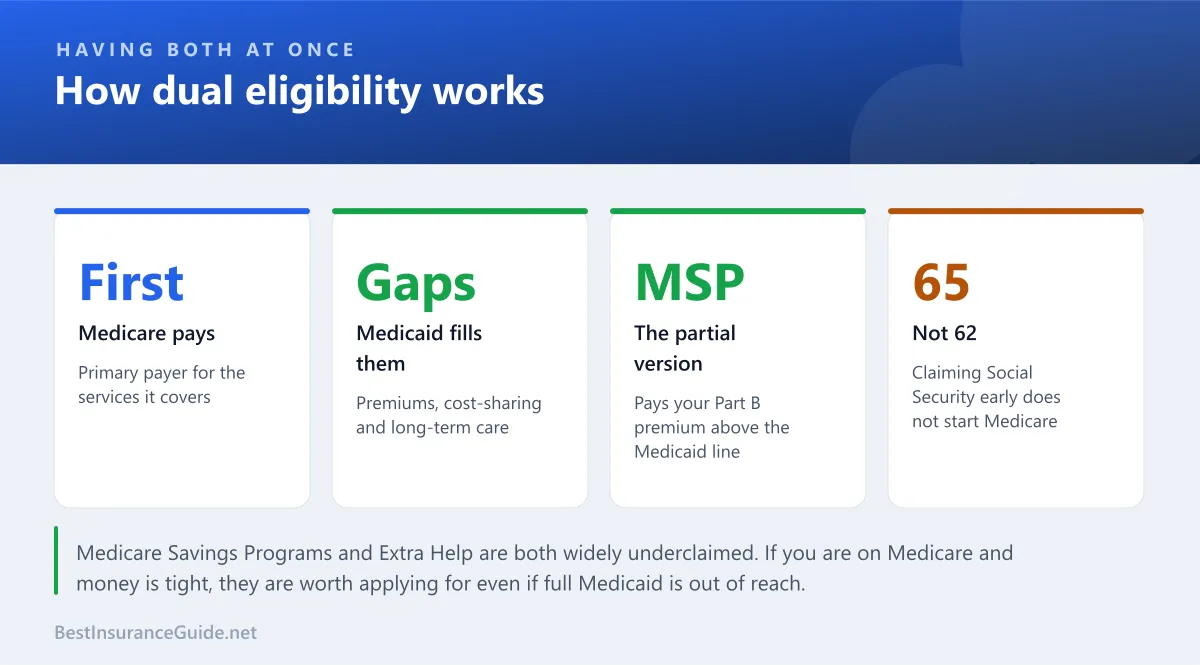
Medicare pays first as the primary payer for services it covers.
Medicaid fills the gaps: Part B premiums, deductibles, coinsurance, and services Medicare does not cover at all, most importantly long-term custodial care.
Medicare Savings Programs are the partial version, and they are widely underclaimed. Even where full Medicaid is out of reach, these programmes can pay your Part B premium and sometimes your cost-sharing, for people whose income sits modestly above the Medicaid line. If you are on Medicare and money is tight, this is worth applying for.
Extra Help, the low-income subsidy for Part D, similarly reduces prescription costs and is separately worth checking.
Which one applies to you
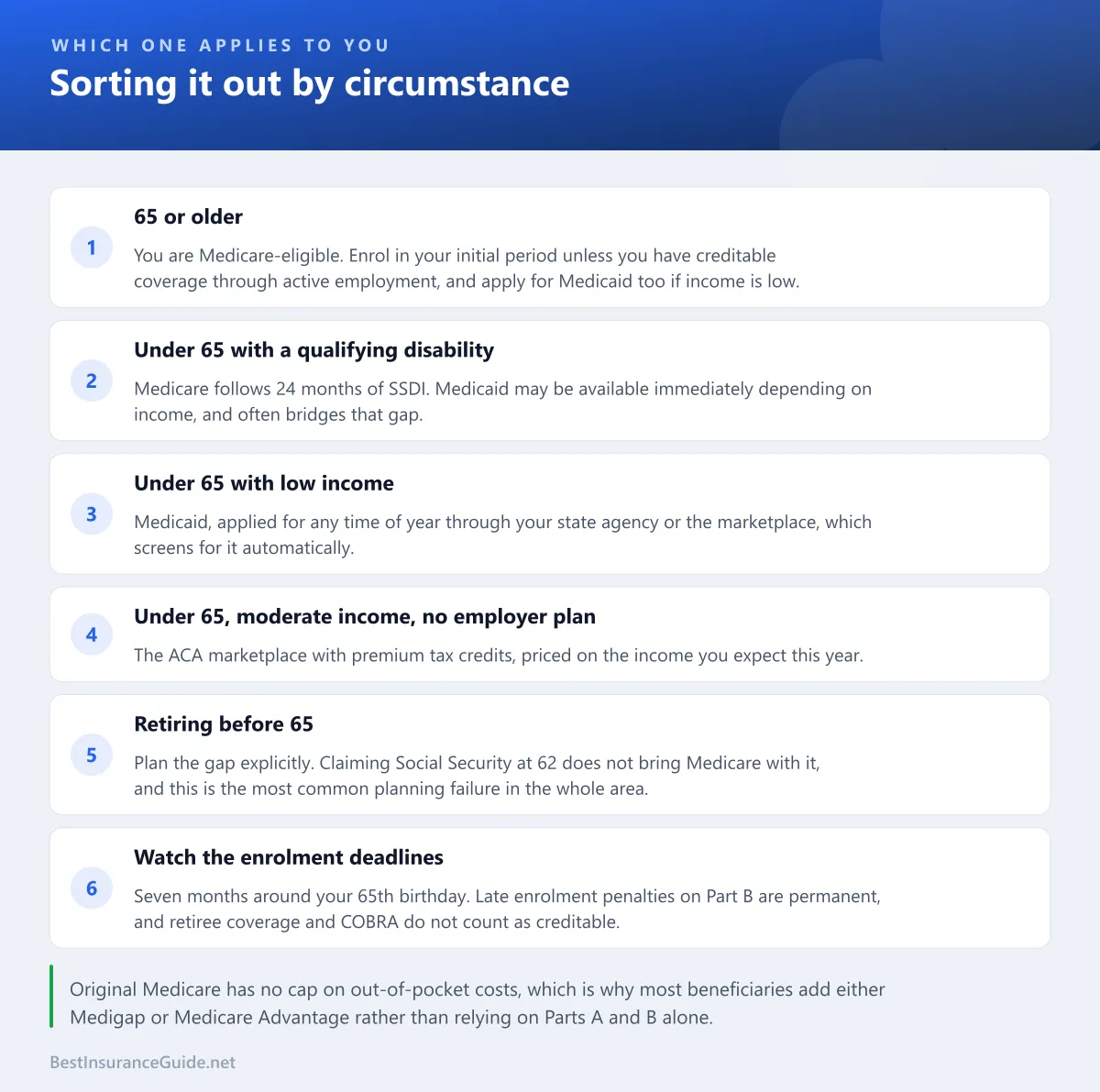
The practical sorting:
65 or older, you are Medicare-eligible. Enrol during your initial enrolment period unless you have creditable coverage through active employment. If your income is low, apply for Medicaid or a Medicare Savings Program as well.
Under 65 with a qualifying disability, Medicare follows 24 months of SSDI. Medicaid may be available immediately depending on income and state, and often bridges that 24-month gap.
Under 65, low income, Medicaid is the route, applied for at any time of year through your state agency or the marketplace, which screens for it automatically.
Under 65, moderate income, no employer plan, the ACA marketplace with premium tax credits is usually the answer.
Retiring before 65, plan for the gap explicitly. It is the single most common planning failure in this area.
The enrolment mistakes that cost the most
Medicare’s rules are unforgiving in a few specific places, and the penalties are permanent rather than one-off.
Assuming retiree coverage lets you delay Part B. It does not. Only coverage through active employment, yours or a spouse’s, allows a penalty-free delay. Retiree plans and COBRA do not count, and people discover this years later when the penalty is already permanent.
Missing the initial enrolment period. Seven months around your 65th birthday. The Part B late enrolment penalty is added to your premium for life and increases with each full year of delay.
Forgetting Part D. The drug plan carries its own late enrolment penalty, also permanent. Even someone taking no medication should usually enrol in an inexpensive plan to start the clock.
Missing the Medigap open enrolment window. This is the one nobody warns about. For six months from when Part B starts, you can buy any Medigap policy sold in your state regardless of health. After that window, in most states insurers can underwrite you and decline. A decision made at 65 can therefore close off Medigap permanently.
Not reviewing Medicare Advantage annually. Networks, formularies and extra benefits change every year, and the plan that suited you last year may not cover your current medications.
Worked example: a delayed Part B enrolment
| Detail | Amount |
|---|---|
| Years Part B delayed without creditable coverage | 3 |
| Penalty added to the standard premium | 30% |
| Applied for | The rest of their life |
The penalty is calculated as a percentage of the standard premium for every twelve-month period of delay, and it does not stop.
If you are approaching 65, the single most useful thing you can do is confirm in writing whether your current coverage is creditable. Ask the plan administrator, not a colleague.
Where to get help deciding
This is one of the few areas of insurance with genuinely good free, unbiased advice available, and almost nobody uses it.
SHIP counsellors. Every state runs a State Health Insurance Assistance Program offering free one-to-one counselling on Medicare. The counsellors are trained, they do not sell anything, and they will go through your specific medications and doctors against the plans available in your county. This is the single best resource in the entire Medicare landscape and it costs nothing.
Medicare’s own plan finder compares Part D and Advantage plans against your actual drug list and pharmacy. Entering your real medications rather than browsing plans generically changes the answer substantially.
Your state Medicaid agency for eligibility, and note again that applications are accepted year-round.
Area Agencies on Aging for help with Medicare Savings Programs and Extra Help, both of which are widely underclaimed.
Be careful with commercial sources. Many websites that appear to compare Medicare plans are lead generators for insurance agents, and an agent is paid differently depending on what you buy. That does not make their advice wrong, but it is not neutral, and a SHIP counsellor is.
One practical note: do these comparisons annually rather than once. Advantage and Part D plans change their networks, formularies and extra benefits every year, and the plan that was right last year frequently is not.
A note on scope and timing
Medicare and Medicaid rules change, and several of the figures that matter most are adjusted annually: the Part B standard premium, the income thresholds for higher premiums, Part D cost-sharing, and the federal poverty level percentages that set Medicaid eligibility.
Medicaid rules additionally differ by state, sometimes substantially, and states continue to change their expansion status and eligibility criteria.
This article describes how the two programmes relate rather than the current year’s numbers. For those, Medicare’s own materials, your state Medicaid agency and a free SHIP counsellor are the authoritative sources, and all three are available at no cost.
Three questions that come up constantly
The distinction above answers which programme applies. Three follow-on questions account for most of what people actually need to know.
Can I get Medicare before 65? Only in narrow circumstances: long-term disability benefits, end-stage renal disease, or ALS. Claiming Social Security early at 62 does not accelerate it, because the two programmes have separate eligibility ages. For an early retiree the practical question is how to bridge the gap, and the answer is usually a marketplace plan whose subsidy is calculated on realised income, which makes the withdrawal strategy for those years genuinely consequential. Our guide to getting Medicare at 62 works through the five bridging options and the enrolment deadlines that carry permanent penalties.
How long does a Medicaid application take? Federal standards require a decision within 45 days, or 90 where a disability determination is involved, and many straightforward applications are decided far faster through automated verification. Almost all delay comes from outstanding documents. Our guide to Medicaid approval timelines covers what to gather before applying, the retroactive coverage provision most people do not know about, and what to do while a decision is pending.
Does Medicaid cover dental work? For anyone under 21, medically necessary dental care is covered under a federal requirement regardless of what the state does for adults. For adults it depends entirely on the state, because adult dental cover is optional and ranges from comprehensive to emergency-only. Our guide to whether Medicaid covers wisdom teeth removal sets out how medical necessity is assessed and what to do if a claim is denied.
Related reading
If your Medicare Advantage plan is closing, read Medicare Advantage plans leaving in 2027 for your deadlines and guaranteed rights.
The short version
Medicare is federal and age-based, starting at 65 regardless of income, with parts covering hospital, medical, drugs and private alternatives. It has no out-of-pocket cap in its original form, which is why most people add Medigap or Medicare Advantage.
Medicaid is state-administered and income-based, accepts applications year-round, usually costs little or nothing, and is the main public payer for long-term care. Medi-Cal is simply California’s version.
You cannot get Medicare at 62 by claiming Social Security early. You can have both programmes at once, and if your income is modest you should check Medicare Savings Programs and Extra Help, both of which are widely underclaimed.
For the terminology that applies once you are choosing between plan designs, HMO vs PPO and your insurance card and health insurance terms explained cover the mechanics.