2027 Medicare Advantage Star Ratings: 15 Five-Star Plans, What the Stars Mean, and How to Use Them
2027 Medicare Advantage star ratings are out: 15 five-star plans, a 3.99 average, 71% of members in 4+ star plans. What star ratings mean, how they are calculated, and the 5-star SEP.

Table of contents

Every October, the Centers for Medicare & Medicaid Services (CMS) grades every Medicare Advantage and Part D plan in the country, and every October the results quietly shape what millions of people pick for the following year. The 2027 Medicare Advantage star ratings came out on October 8, 2026, a week before open enrollment starts on October 15.
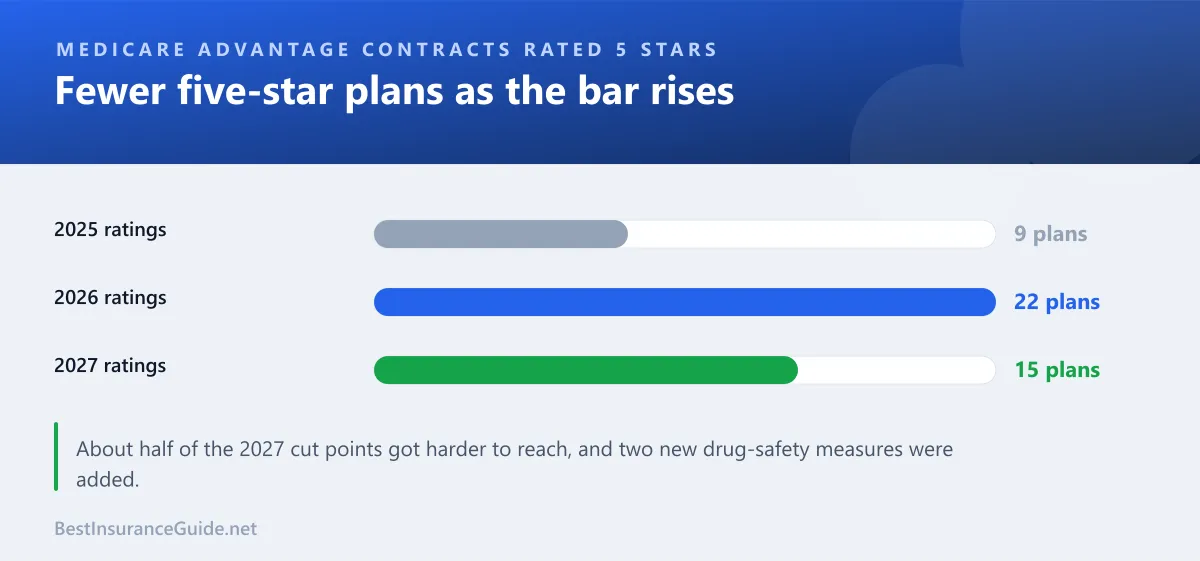
The headline: 15 Medicare Advantage plans earned the top 5-star rating for 2027, down from 22 last year. The average rating slipped slightly from 4.01 to 3.99 stars. Even so, 71% of people in Medicare Advantage plans with drug coverage are in plans rated 4 stars or higher.
If you’re comparing plans for yourself or a parent this fall, here is what changed, what Medicare star ratings actually measure, how they’re calculated, and how to use them, including the little-known 5-star special enrollment period that lets you switch plans almost any time of year.
This site is independent and not affiliated with CMS, Medicare or any insurer. All figures are from CMS’s 2027 star ratings fact sheet unless stated otherwise.
2027 Medicare star ratings at a glance
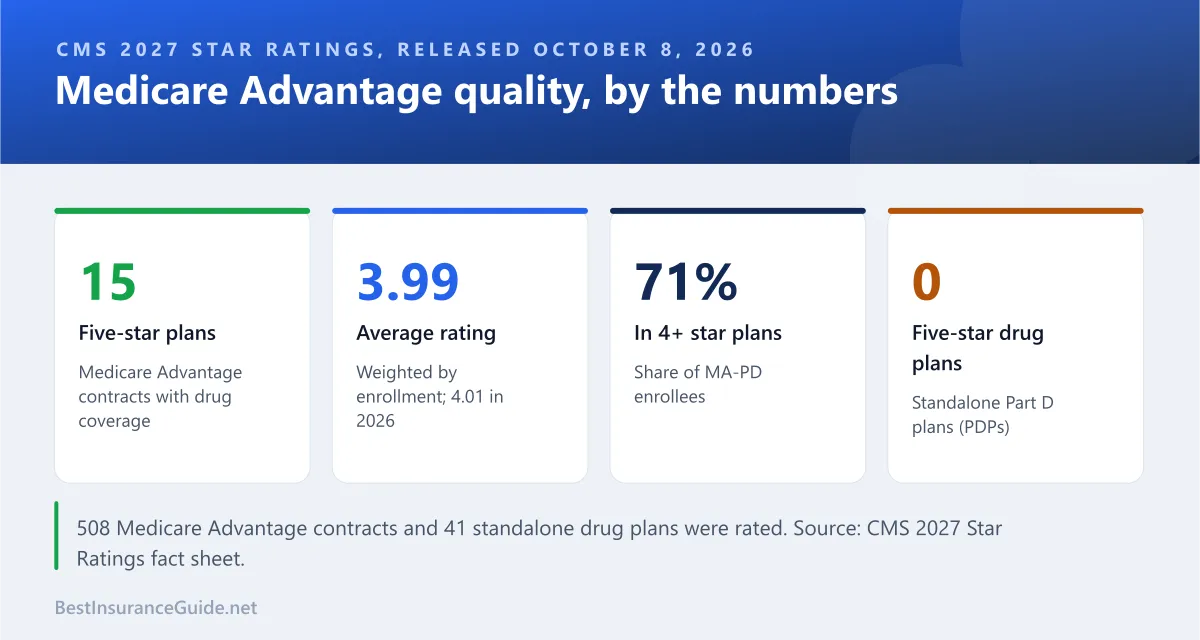
| Medicare Advantage with drug coverage (MA-PD) | Standalone Part D plans (PDP) | |
|---|---|---|
| Contracts rated | 508 | 41 |
| Average rating (weighted by enrollment) | 3.99 (2026: 4.01) | 3.22 (2026: 3.01) |
| Contracts at 4 stars or higher | 188 (37%) | 11 (27%) |
| Contracts with 5 stars | 15 | 0 |
| Enrollees in 4+ star plans | 71% | 22% |
| Contracts with a low-performing icon | 4 (MA and Part D combined, same as 2026) |
Source: CMS, 2027 Medicare Advantage and Part D Star Ratings fact sheet, October 8, 2026.
Who got 5 stars?
The 15 five-star contracts for 2027 include five Longevity Health plans and three UnitedHealthcare contracts, according to Healthcare Finance News’s analysis of the CMS data. Clover Health announced that its PPO plans earned 5 stars. At the other end, just one plan, Verda Health Plan of Texas, received the lowest score, 2 stars.
Among the large national carriers, Aetna said more than 69% of its Medicare Advantage members are in 2027 plans rated 4 stars or higher, based on September 2026 enrollment. Other carriers’ figures vary widely, and a carrier-wide percentage tells you little about your plan, because ratings are given contract by contract. Look up the exact plan you’re considering in Medicare Plan Finder.
Why fewer 5-star plans this year?
Mostly because the bar went up. CMS sets “cut points”, the score a plan needs on each measure to earn a given number of stars, and those move every year with industry performance. Industry analysts reported that roughly half of the 2027 cut points became harder to reach, and CMS added two new drug-safety measures: concurrent use of opioids and benzodiazepines, and use of multiple anticholinergic medications in older adults. When everyone improves, staying at 5 stars is harder.
For you, the practical point is that a plan that drops from 5 to 4.5 stars hasn’t necessarily got worse. It may have stood still while the grading got tougher.
What are Medicare star ratings?
Medicare star ratings are CMS’s report card for Medicare Advantage and Part D plans, on a scale of 1 to 5 stars:
| Stars | What CMS calls it |
|---|---|
| ★★★★★ 5 | Excellent |
| ★★★★ 4 | Above average |
| ★★★ 3 | Average |
| ★★ 2 | Below average |
| ★ 1 | Poor |
Ratings are given to each plan contract, which can include several plans sold under different names in different areas. Medicare Advantage plans with drug coverage get an overall rating that combines health and drug measures, plus separate Part C (health) and Part D (drug) summary ratings.
What do the ratings measure?
For health plans (Part C), five areas:
- Staying healthy: screenings, tests and vaccines.
- Managing chronic conditions: diabetes care, blood pressure control, medication reviews, follow-up after hospital stays.
- Member experience: how members rate the plan, its doctors and getting care quickly.
- Complaints and changes: complaints to Medicare, members leaving the plan, and improvement over time.
- Customer service: how the plan handles appeals, and call center access, including interpreter availability.
For drug plans (Part D), four areas: drug plan customer service; complaints and changes; member experience with the drug plan; and drug safety and accuracy of drug pricing.
 Blood pressure control is one of the chronic-condition measures in the Medicare star ratings. Photo: Bill Branson, National Cancer Institute (public domain).
How are Medicare star ratings calculated?
In plain terms:
- Data comes in from several sources: medical records and claims (for example, whether diabetic members got eye exams), the CAHPS member survey, the Health Outcomes Survey, plan administrative data, and CMS’s own monitoring of appeals and call centers.
- Each measure gets a star score from 1 to 5, based on the year’s cut points.
- Measures are weighted. Outcome measures, such as whether blood pressure or blood sugar is actually controlled, and patient experience and access measures count more than simple process measures, such as whether a test was done.
- The weighted average becomes the overall rating, with adjustments for consistent high performance and for plans serving many low-income or disabled members, rounded to the nearest half star.
Because most of the data describes care delivered a year or two earlier, star ratings are a look in the rear-view mirror. They are a good guide to how a plan is run, but not a guarantee of next year.
Why plans care so much about stars
Plans rated 4 stars or higher receive quality bonus payments from Medicare, typically a 5% increase in their benchmark. Plans use that money to fund extra benefits, such as dental, vision, hearing aids and over-the-counter allowances, or lower premiums. A plan that drops below 4 stars can lose that bonus, which is one reason benefits sometimes shrink the year after a ratings fall.
What star ratings don’t tell you
Star ratings are useful, but they have blind spots:
- They don’t measure your network. A 5-star plan can still leave out your doctor, your preferred hospital or the specialist you see every month.
- They don’t measure price. Premiums, deductibles, drug tiers and the out-of-pocket maximum are separate from the rating.
- They lag. Much of the data covers care from one or two years ago. A plan that has just changed its network or pharmacy benefit manager may perform differently in 2027.
- They are contract-wide. One contract can cover several plans across many counties. Your local experience may be better or worse than the average.
- New plans often have no rating. A plan that’s too new or too small shows “Plan too new to be measured”. That’s not a red flag in itself, just an unknown.
The best use of stars is as a tie-breaker and a warning light: pick between plans that already fit your doctors, drugs and budget, and avoid anything with a low-performing icon.
The 5-star special enrollment period
This is the most useful, least known part of the ratings.
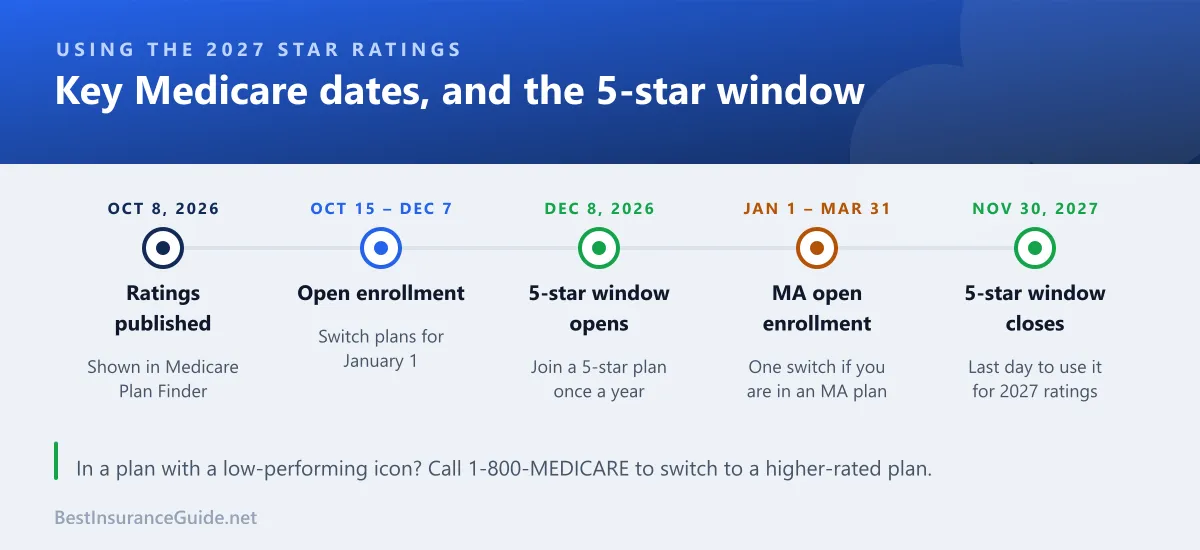
If a 5-star Medicare Advantage plan, Part D plan or cost plan is available where you live, you can switch into it once between December 8 and November 30 of the following year. That means you are not limited to the October–December open enrollment.
- The 2027 ratings apply to this special enrollment period starting December 8, 2026.
- You can use it once in that window.
- Coverage starts on the first day of the month after you enroll.
- No standalone Part D plan earned 5 stars for 2027, so for 2027 the 5-star route applies to Medicare Advantage and cost plans only.
One trap to avoid. If you leave a plan with drug coverage for a 5-star plan without drug coverage, you could lose drug coverage altogether. You might then be unable to add a Part D plan until the next open enrollment, and you could face a late enrollment penalty. Check that the 5-star plan includes drugs before you switch.
If your plan is a low performer
CMS puts a low-performing icon on plans that scored below 3 stars for three years in a row. Four contracts carry that warning for 2027. If you are in one of them, you can switch to a higher-rated plan using a special enrollment period by calling 1-800-MEDICARE. Don’t wait for open enrollment.
How to use star ratings during open enrollment
Medicare open enrollment runs October 15 to December 7, 2026, for coverage starting January 1, 2027. Star ratings are useful, but use them in the right order:
- Start with your doctors and hospitals. Narrow to plans whose 2027 network includes them.
- Enter every prescription in Medicare Plan Finder and compare total yearly drug costs, not just premiums.
- Compare total costs: premium, deductibles, copays and the out-of-pocket maximum.
- Then use the stars to choose between the finalists. Between two plans that both fit, the higher-rated one is usually the safer bet on service, appeals and care coordination.
- Click into the details. A plan with 4 stars overall might score poorly on the things you care about most, such as “getting needed care” or “plan makes timely decisions about appeals”.
- Check for changes. Some 2027 plans are leaving the market entirely. See Medicare Advantage plans leaving in 2027.
Worked example: when the 5-star plan isn’t the best choice
Maria, 71, takes three brand-name drugs and sees a cardiologist at a hospital system near her home.
| Plan A (5 stars) | Plan B (4 stars) | |
|---|---|---|
| Premium | $0 | $25/month |
| Her cardiologist in network? | No | Yes |
| Estimated 2027 drug costs (Plan Finder) | $2,400 (the Part D cap) | $1,450 |
| Out-of-pocket maximum | $5,900 | $4,800 |
| Likely total yearly cost | Higher, plus a new cardiologist | Lower, same doctor |
Illustrative example. For Maria, the 4-star plan is the better choice. The stars broke no ties here, because the plans weren’t close on what matters to her.
Free help choosing a plan
- SHIP counselors. Every state has a State Health Insurance Assistance Program with free, unbiased one-on-one help.
- 1-800-MEDICARE (1-800-633-4227), available 24/7.
- Medicare Plan Finder at Medicare.gov shows star ratings next to each plan, and you can click through to the individual measure scores.
Related reading
Medicare 2027: Part B premium, open enrollment dates and every major change covers this year’s bigger picture. Social Security COLA 2027 shows how premiums affect your raise, and Medicare vs Medicaid explains who qualifies for what. On a weight-loss drug? GLP-1 coverage in 2027 covers the Medicare GLP-1 Bridge.
Sources and notes
- Centers for Medicare & Medicaid Services, “2027 Medicare Advantage and Part D Star Ratings” fact sheet, October 8, 2026: contract counts, averages, 4+ and 5-star counts, enrollment shares, low-performing icons and new measures.
- Healthcare Finance News, analysis of 2027 star ratings (five-star contract list and lowest-rated plan), October 2026; Clover Health press release, October 2026.
- Aetna / CVS Health, “Aetna 2027 Star Ratings Reflect Strong Clinical Quality and Member Experience”, October 8, 2026.
- Healthcare Dive and industry analyses of 2027 cut point changes.
- Medicare.gov guidance on the 5-star special enrollment period and low-performing plans.
- Photos: Rhoda Baer and Bill Branson, National Cancer Institute, public domain, via Wikimedia Commons.
This article is general information, not personal Medicare advice. Plan availability, costs and ratings vary by county. Confirm details in Medicare Plan Finder or with your State Health Insurance Assistance Program before enrolling.