Best Dental Insurance for Seniors on Medicare: How to Choose
What Medicare does and does not cover for dental, how Medicare Advantage dental benefits compare with stand-alone senior dental plans, and how to choose.

Table of contents

Most people approaching 65 assume Medicare will take over their dental care the way an employer plan did. It will not. Original Medicare covers almost no routine dental care, and the gap arrives at exactly the age when crowns, dentures and implants become more likely.
This guide explains what Medicare does and does not cover, how the three realistic options for dental coverage compare, and how to decide which one fits the dental work you actually expect.
What Medicare covers, and what it does not
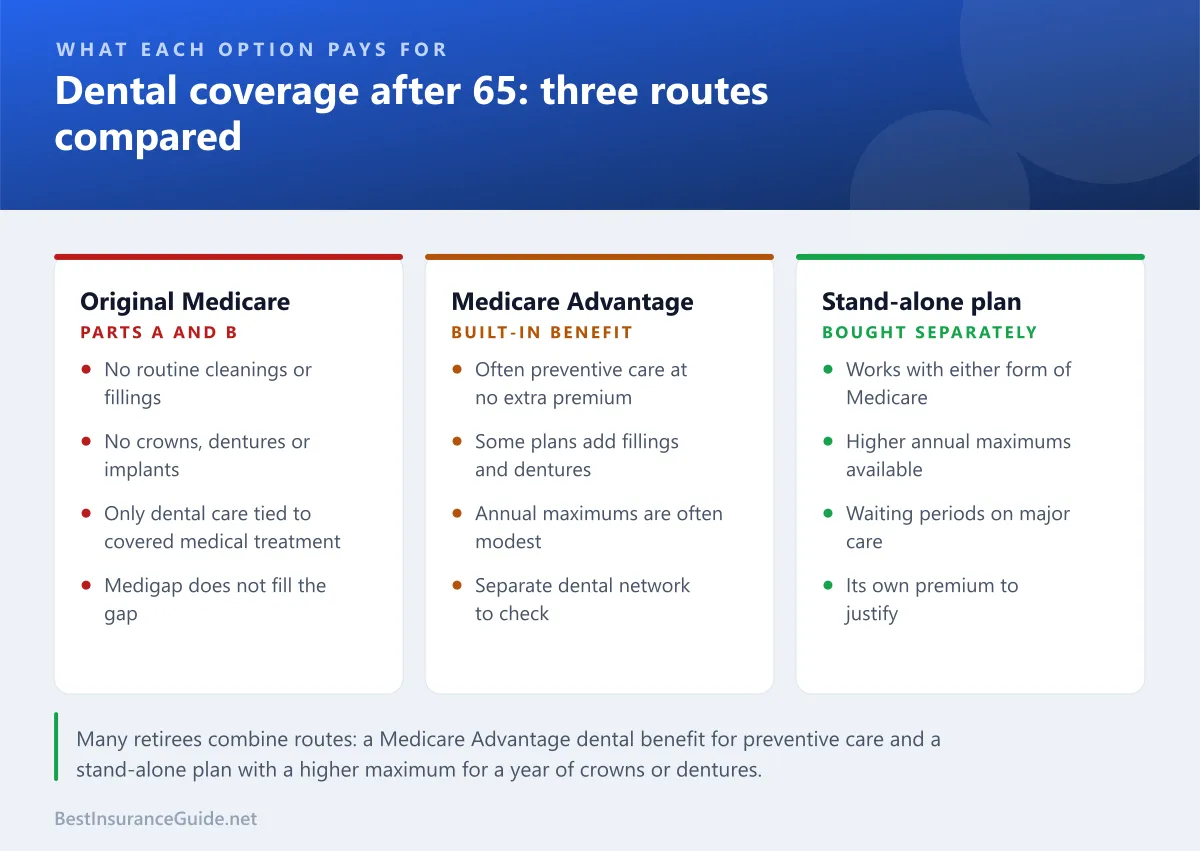
Original Medicare — Part A and Part B — does not cover most dental care. That includes cleanings, exams, fillings, extractions, root canals, crowns, bridges, dentures and implants.
There is a narrow exception. Medicare pays for certain dental services that are inextricably linked to a covered medical treatment. The Centers for Medicare and Medicaid Services has clarified and expanded this category in recent years to include, for example, dental exams and necessary treatment before an organ transplant, before a heart valve replacement, and before or during treatment for certain head and neck cancers. Hospital care related to a complicated dental procedure may also be covered under Part A, even when the dental work itself is not.
Those exceptions matter a great deal to the people they apply to. For everyone else, routine dental care is outside Original Medicare altogether.
Medigap does not fill the gap. Medicare Supplement plans pay toward cost sharing for services that Original Medicare covers. Because routine dental is not one of them, Medigap does not pay for it either.
Option 1: Medicare Advantage with dental benefits
Most Medicare Advantage plans include some dental coverage as a supplemental benefit. The range is enormous.
Some cover preventive care only — exams, cleanings and X-rays.
Some include comprehensive dental — fillings, extractions, root canals, crowns and dentures — usually with an annual maximum.
Some offer an optional supplemental dental package for an additional monthly premium.
The recurring weakness is the annual maximum. Built-in dental benefits on Medicare Advantage plans frequently carry annual maximums in the range of a few hundred to a couple of thousand dollars, and some limit which services count toward it. A single crown can use a large share of a modest maximum, and a set of dentures can exceed it.
The other constraint is the network. Many Medicare Advantage plans deliver dental benefits through a separate dental network, which may not include your current dentist.
The advantage is simplicity and cost: the dental benefit is often included without an extra premium.
Option 2: A stand-alone dental plan for seniors
You can buy an individual dental plan from a dental insurer whether you are on Original Medicare or Medicare Advantage. Several insurers market plans specifically to people over 65.
Annual maximums are often higher than on a Medicare Advantage plan’s built-in benefit, and some plans increase the maximum in the second and third year of coverage.
Waiting periods usually apply to basic and major work, often six to twelve months for major services such as crowns and dentures, unless you can show recent prior coverage.
Premiums are separate, and a plan with a higher maximum and shorter waiting periods costs more.
A stand-alone plan suits someone on Original Medicare plus Medigap, who has no dental benefit at all, and someone on Medicare Advantage whose built-in benefit is too thin for the work they expect.
Option 3: A dental discount plan
A discount plan is a membership that gives you reduced fees at participating dentists. It pays nothing toward the bill itself.
There are no waiting periods, no annual maximum and no claim forms, which makes discount plans useful for someone who needs work immediately. The savings are only as good as the discount and the number of participating dentists near you, and they are not insurance.
A worked example: a crown and a partial denture
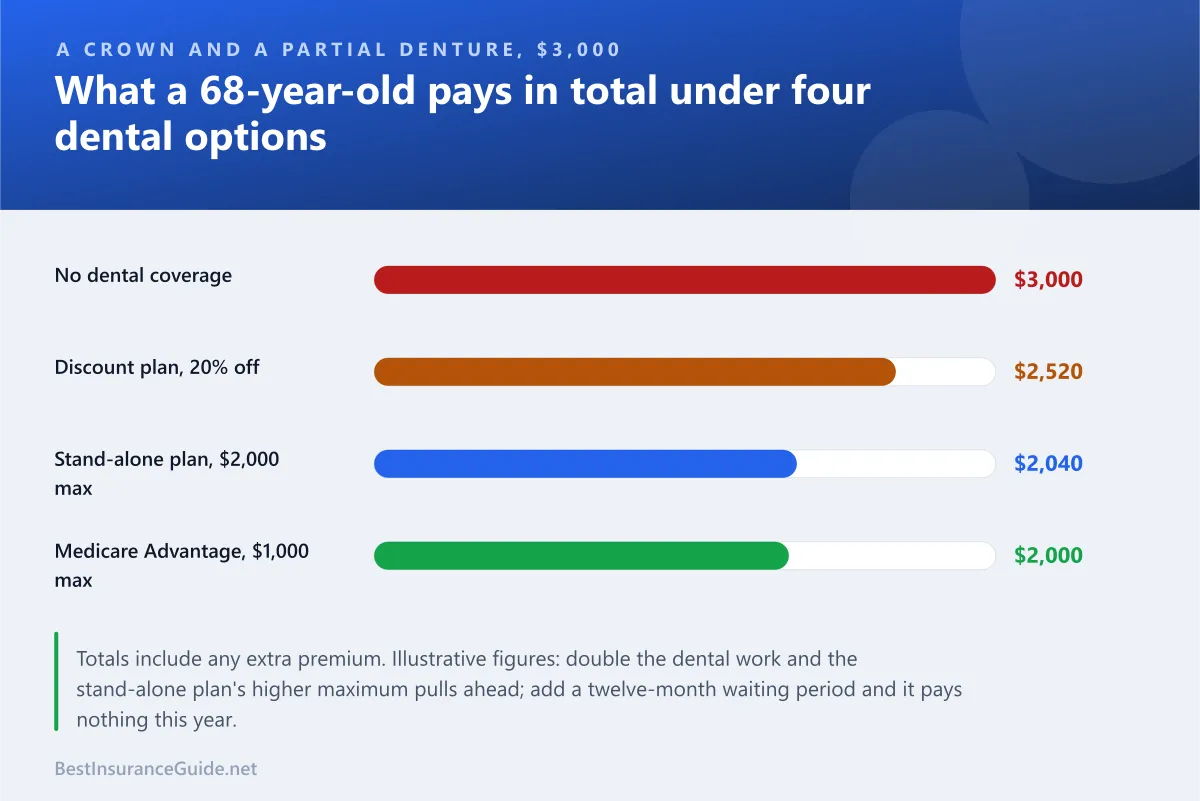
Take a 68-year-old who needs one crown and a partial denture in the same year. Use illustrative fees of $1,200 for the crown and $1,800 for the partial denture — $3,000 in total — and a plan that pays 50% for major work after any waiting period.
| Detail | No dental coverage | MA plan, $1,000 max | Stand-alone plan, $2,000 max | Discount plan (20% off) |
|---|---|---|---|---|
| Extra premium for the year | $0 | $0 | $540 | $120 |
| Plan pays | $0 | $1,000 | $1,500 | $0 |
| You pay the dentist | $3,000 | $2,000 | $1,500 | $2,400 |
| Total cost to you | $3,000 | $2,000 | $2,040 | $2,520 |
In this example, the Medicare Advantage plan’s built-in benefit is as good as the stand-alone plan, because it costs nothing extra and the $1,000 cap is only $500 short of what the stand-alone plan pays. Double the amount of work and the stand-alone plan’s higher maximum pulls ahead. Add a twelve-month waiting period on the stand-alone plan and it pays nothing this year.
The figures are illustrative; your own fees and plan terms decide the real answer. The pattern, though, holds widely: the annual maximum and the waiting period decide the result more than the premium does.
Dentures, implants and the missing tooth clause
Seniors are more likely to need tooth replacement, which is exactly where dental plans are most restrictive.
Dentures are usually covered as major services at around 50%, subject to the annual maximum, and usually limited to one replacement every five years or so.
Implants are covered by some plans and excluded by many. Where they are covered, the benefit is commonly limited, and some plans pay only the amount they would have paid for a less expensive alternative, such as a bridge or denture. See our guide to dental insurance for implants for the full picture.
The missing tooth clause excludes replacing a tooth that was lost before coverage began. Many senior plans include it, and it catches people who buy a plan specifically to fund a replacement for a tooth that is already missing.
How to choose
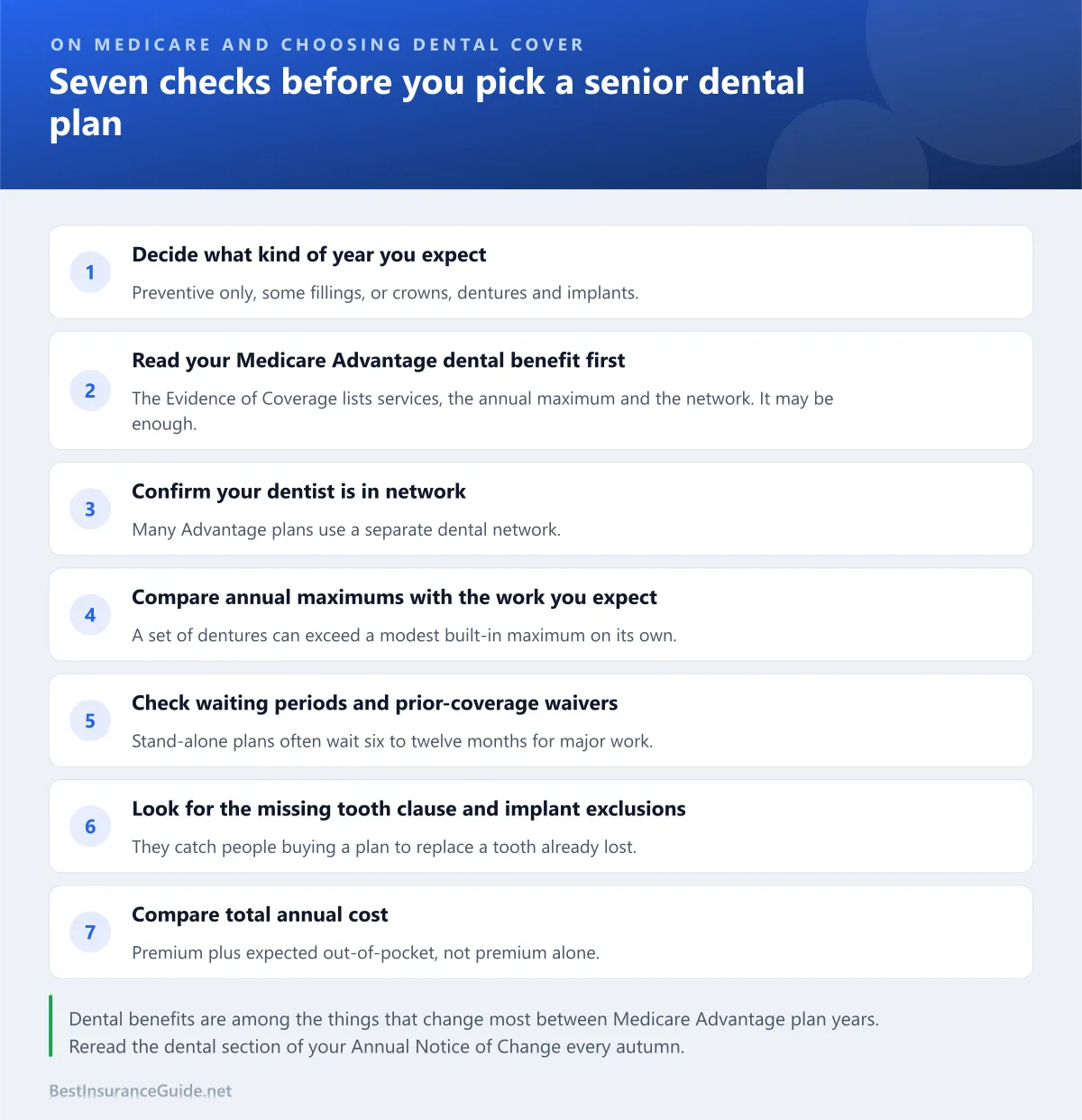
1. Decide which kind of year you expect. Check-ups only, some fillings, or major work such as crowns, dentures or implants.
2. If you are on Medicare Advantage, read your plan’s dental benefit first. The Evidence of Coverage lists the covered services, the annual maximum and the network. It may be enough on its own.
3. Check whether your dentist is in network for any plan you are considering.
4. Compare annual maximums against the work you expect.
5. Check waiting periods and whether they are waived for prior coverage.
6. Check for the missing tooth clause and the implant exclusion if you need replacements.
7. Compare total annual cost, premium plus expected out-of-pocket, rather than premium alone.
When you can change
Medicare Advantage plans can be changed during the annual Medicare open enrolment period each autumn and, for people already in Medicare Advantage, during the Medicare Advantage open enrolment period early in the year. Dental benefits are one of the things that change most between plan years, so reread the dental section of your plan’s Annual Notice of Change every autumn.
Stand-alone dental plans can generally be bought at any time of year, which makes them a useful fallback if you discover mid-year that your Medicare Advantage dental benefit is not enough.
Questions to ask about a Medicare Advantage dental benefit
A Medicare Advantage plan’s summary rarely tells you everything about its dental benefit. The Evidence of Coverage, or a call to the plan, should answer these:
Which services are covered? Preventive only, or also fillings, extractions, root canals, crowns, dentures and implants?
What is the annual maximum, and does it apply to all dental services or only some? Some plans have one maximum for preventive care and a separate one for comprehensive care.
Is the dental benefit built in, or an optional supplemental benefit with its own premium?
Which dental network does it use, and is my dentist in it?
What coinsurance or copays apply to the services I expect?
Are there frequency limits on cleanings, X-rays, dentures or crowns?
Does the plan use an allowance or card for dental spending rather than traditional coverage? Some plans provide a spending allowance that can be used for dental services; check what it covers and whether unused amounts carry over.
Gum disease and periodontal maintenance
Gum disease becomes more common with age, and it changes what a senior dental plan needs to cover.
Scaling and root planing — a deep cleaning below the gum line — is usually covered as a basic service at around 80% on PPO plans, subject to the deductible and annual maximum.
Periodontal maintenance — cleanings every three or four months after treatment for gum disease — is sometimes treated differently from a routine cleaning. Some plans count it against the two cleanings a year allowed; others cover it separately at a basic rate.
For anyone with a history of gum disease, how a plan treats periodontal maintenance can matter as much as the crown benefit.
Dry mouth and medications
Many common medications reduce saliva, and dry mouth increases the risk of decay, particularly around the roots of teeth and existing fillings. That is one reason seniors often need more fillings than they did in middle age. A plan with good basic coverage and a reasonable deductible can matter more than a high major-service benefit for someone in this situation. Mention any medications to your dentist, who may recommend fluoride treatments; check whether the plan covers fluoride for adults, since some limit it to children.
Relines, repairs and replacement dentures
Dentures need maintenance: relines as the gums change shape, repairs when they crack, and eventually replacement. Most plans cover relines and repairs as basic or major services with frequency limits, commonly one reline every few years, and replacement dentures typically once every five years or so. If you already wear dentures, check these limits as closely as the headline benefit.
If money is tight
Medicaid, for seniors who qualify on income and assets, may include adult dental benefits depending on the state. People eligible for both Medicare and Medicaid should check their state’s adult dental benefit and any dual-eligible special needs plan in their area. Our guide to Medicare versus Medicaid explains the difference.
Dental schools offer supervised treatment at reduced cost.
Community health centres often offer dental care on a sliding fee scale.
Related reading
Veterans have extra options, including VA dental care and VADIP. See dental insurance for veterans.
The short version
Original Medicare and Medigap do not cover routine dental care. Seniors have three realistic routes: a Medicare Advantage plan’s built-in dental benefit, a stand-alone dental plan, or a discount plan, and some combine two of them.
For preventive care and occasional fillings, a built-in Medicare Advantage benefit is often enough. For crowns, dentures and implants, the annual maximum and the waiting period decide which option is best, and a stand-alone plan with a higher maximum usually wins in a heavy treatment year.
If you are just approaching eligibility, see can you get Medicare at 62 for the timing rules.
A note on scope
This guide is general information rather than advice about any specific plan. Medicare Advantage dental benefits, stand-alone plan terms, premiums and networks vary by plan and location and change each year. Medicare’s official site and your plan’s Evidence of Coverage are the authoritative sources, and your State Health Insurance Assistance Program offers free, unbiased Medicare counselling. This site is independent and not affiliated with any insurer or with Medicare.