California Home Insurance in High Fire Risk Areas: Allstate and State Farm Move to Reopen, and Your Options Today
How to get California home insurance in a high fire risk area: Allstate and State Farm reopening filings, the FAIR Plan and DIC, surplus lines, wildfire discounts, and nonrenewal protections.

Table of contents
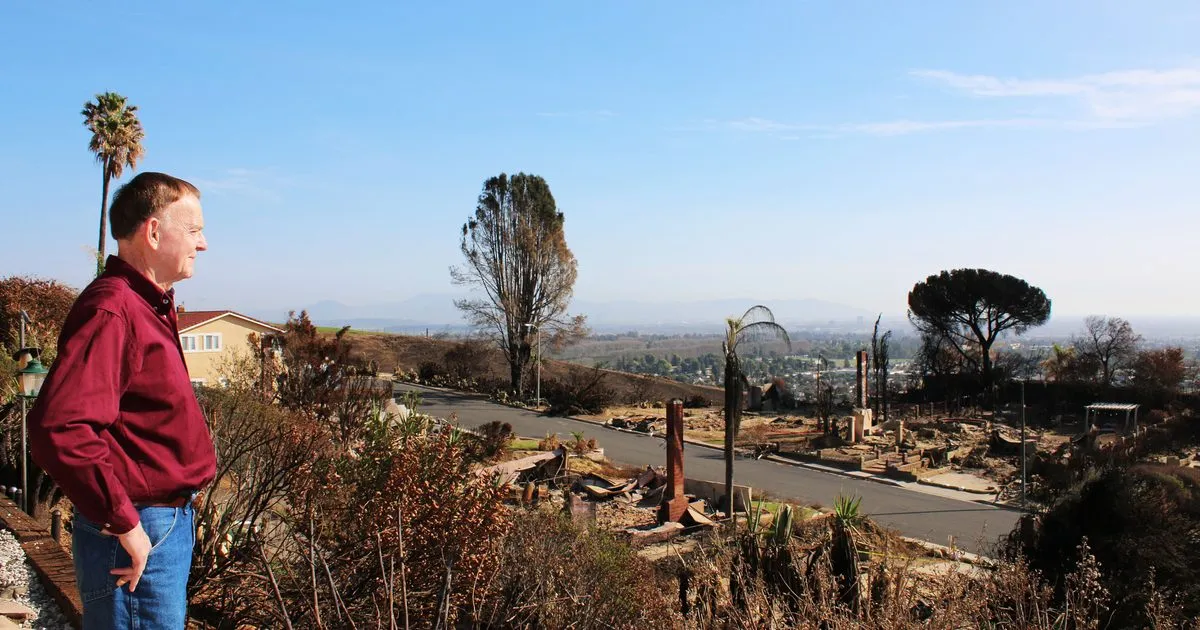
For four years, California homeowners in wildfire country have heard the same answer from the biggest insurers: we’re not writing new policies. That may finally be starting to change.
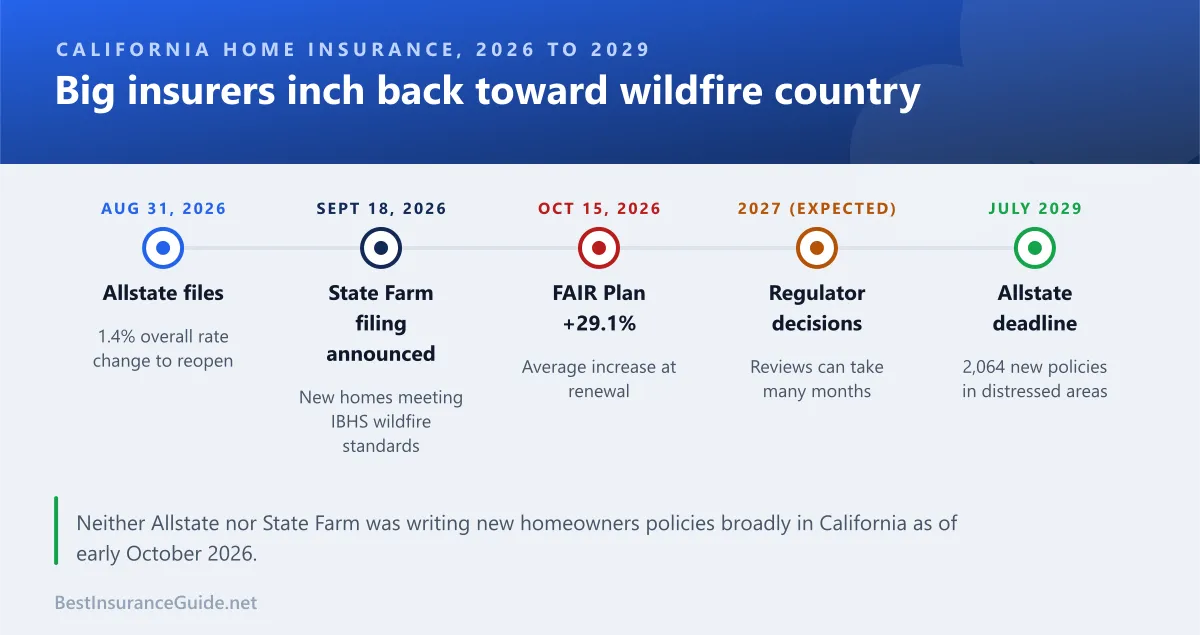
Allstate, which stopped writing new homeowners policies in California in 2022, filed a plan on August 31, 2026 to come back. State Farm, the state’s largest home insurer, which closed to new homeowners business in May 2023, has filed to resume too. The California Department of Insurance (CDI) announced both on September 18. Insurance Commissioner Ricardo Lara called them “a starting point, not a finish line”.
Neither company is writing yet. Meanwhile the California FAIR Plan’s 29.1% average rate increase takes effect on October 15. So if you own a home in a high fire risk area in California, the practical question is still: how do I get covered, at a price I can live with, right now?
This guide answers that. It covers what the new filings actually promise, every route to coverage available today, the wildfire discounts insurers must offer, and the protections you have if your insurer drops you. This site is independent and not affiliated with the CDI, the FAIR Plan or any insurer.
What Allstate and State Farm actually filed
| Allstate | State Farm | |
|---|---|---|
| Closed to new homeowners business | 2022 | May 2023 |
| Filing | Sustainable Insurance Strategy plan, filed Aug. 31, 2026 | Rule application to resume new homeowners policies |
| What it asks for | Approval of an overall 1.4% rate increase; about two-thirds of current policyholders would see premiums fall | Rules defining which homes it will accept |
| What it promises | At least 2,064 new homeowners policies in CDI-designated distressed areas by July 2029 | New policies for homes meeting IBHS Wildfire Prepared Home “Enhanced” standards statewide, and “Essential” standards in low and moderate wildfire zones |
| Status | Under CDI review | Under CDI review |
Sources: California Department of Insurance, September 18, 2026; Insurance Business, September 2026.
What this means for you, honestly
- Not tomorrow. Rate and rule filings in California can take many months to review. Industry observers expect Allstate’s approval to take the better part of a year.
- Not for everyone. 2,064 policies over almost three years is a small number next to the roughly 697,000 policies the FAIR Plan held in mid-2026. State Farm’s plan is limited to homes that meet demanding IBHS wildfire standards, which most existing homes don’t yet meet without upgrades.
- But it’s a real signal. Twelve insurance groups have now filed or won approval under the state’s Sustainable Insurance Strategy. If more large carriers return, competition should slowly improve in high-risk areas.
If you’ve been turned down before, ask again in 2027, and in the meantime make your home look like the kind of risk these filings say insurers want.
Why California home insurance is so hard to get in fire areas
Three things collided:
- Huge wildfire losses, culminating in the January 2025 Los Angeles fires.
- Pricing rules that, until the Sustainable Insurance Strategy reforms, made insurers price wildfire mostly from past losses rather than forward-looking models, and didn’t let them pass on reinsurance costs.
- Rising rebuild costs for labor, materials and code upgrades.
The Sustainable Insurance Strategy changes the deal. Insurers can now use CDI-reviewed wildfire catastrophe models and the net cost of reinsurance in their rates. In return, they must commit to writing at least 85% of their statewide market share in wildfire-distressed areas. The catastrophe models can also account for mitigation, so a hardened home can, in principle, be priced better than an identical unprotected one next door.
Your options for California home insurance in a high fire risk area today
1. Admitted insurers still writing, or writing again
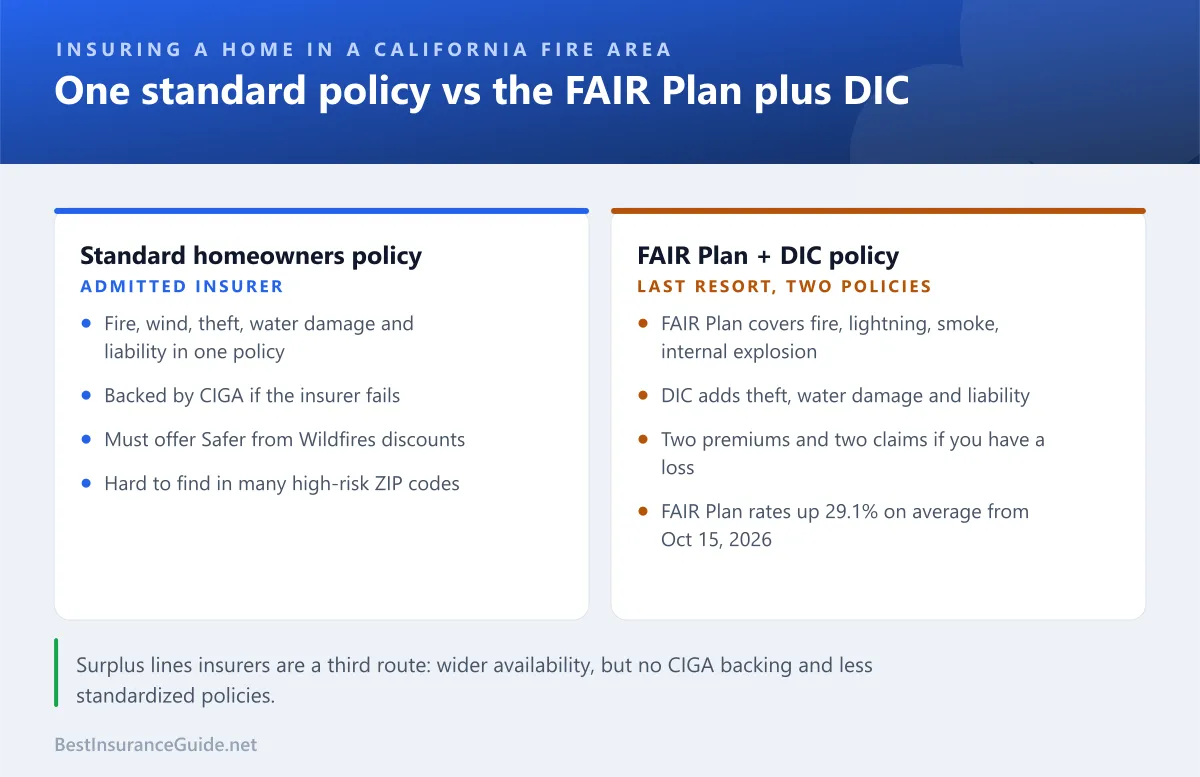
Some admitted insurers, those licensed by the state and backed by the California Insurance Guarantee Association (CIGA) if they fail, are still writing in fire-prone areas, or have reopened under Sustainable Insurance Strategy commitments. Availability changes month to month and by ZIP code.
How to find them: use an independent agent or broker who places business with many companies. Captive agents can only offer one company’s products. Ask specifically: “Which of your carriers are writing new homeowners policies in my ZIP code this month?”
2. Surplus lines insurers
Surplus lines (non-admitted) insurers can cover homes the standard market won’t. They can be a good option for higher-value or harder-to-place homes, but:
- They are not backed by CIGA if the insurer becomes insolvent.
- Their rates and forms aren’t approved by the CDI in the same way, so read the policy carefully for exclusions and sub-limits.
- They must be placed through a licensed surplus lines broker.
3. The California FAIR Plan, plus a DIC policy
The FAIR Plan is the insurer of last resort, available when you can’t find coverage elsewhere. Its dwelling policy is basic, covering fire, lightning, smoke and internal explosion, with some add-ons. Most owners pair it with a difference in conditions (DIC) policy from a private insurer that fills the gaps: water damage, theft, liability and more.
From October 15, 2026, the FAIR Plan’s rates rise 29.1% on average, with some high-risk homes facing increases around 50% and some lower-risk homes seeing decreases. See California FAIR Plan rate increase for the details.
Compare fairly. A FAIR Plan premium plus a DIC premium is the real price. If that combined number is close to a standard policy quote, the single policy usually gives broader, simpler coverage.
How much is home insurance in California?
There’s no meaningful single average, because wildfire risk dominates the price. Two similar houses can have premiums several times apart depending on:
- Fire hazard severity zone and the insurer’s own wildfire score for your address.
- Rebuild cost, which drives your dwelling coverage limit.
- Roof, vents, eaves, windows and siding: how ember-resistant the home is.
- Defensible space and the surrounding vegetation.
- Community mitigation, such as Firewise USA sites.
- Your deductible and claims history.
To see real numbers for your address, get several quotes and use the CDI’s homeowners premium comparison resources. If you’re quoted only by the FAIR Plan, also price a DIC policy so you know the full cost.
Wildfire discounts: the Safer from Wildfires rules
California’s Safer from Wildfires regulation, in effect since October 2022, requires admitted insurers that use wildfire risk in their pricing to offer discounts for qualifying mitigation, and to tell you which ones apply. Measures recognized include:
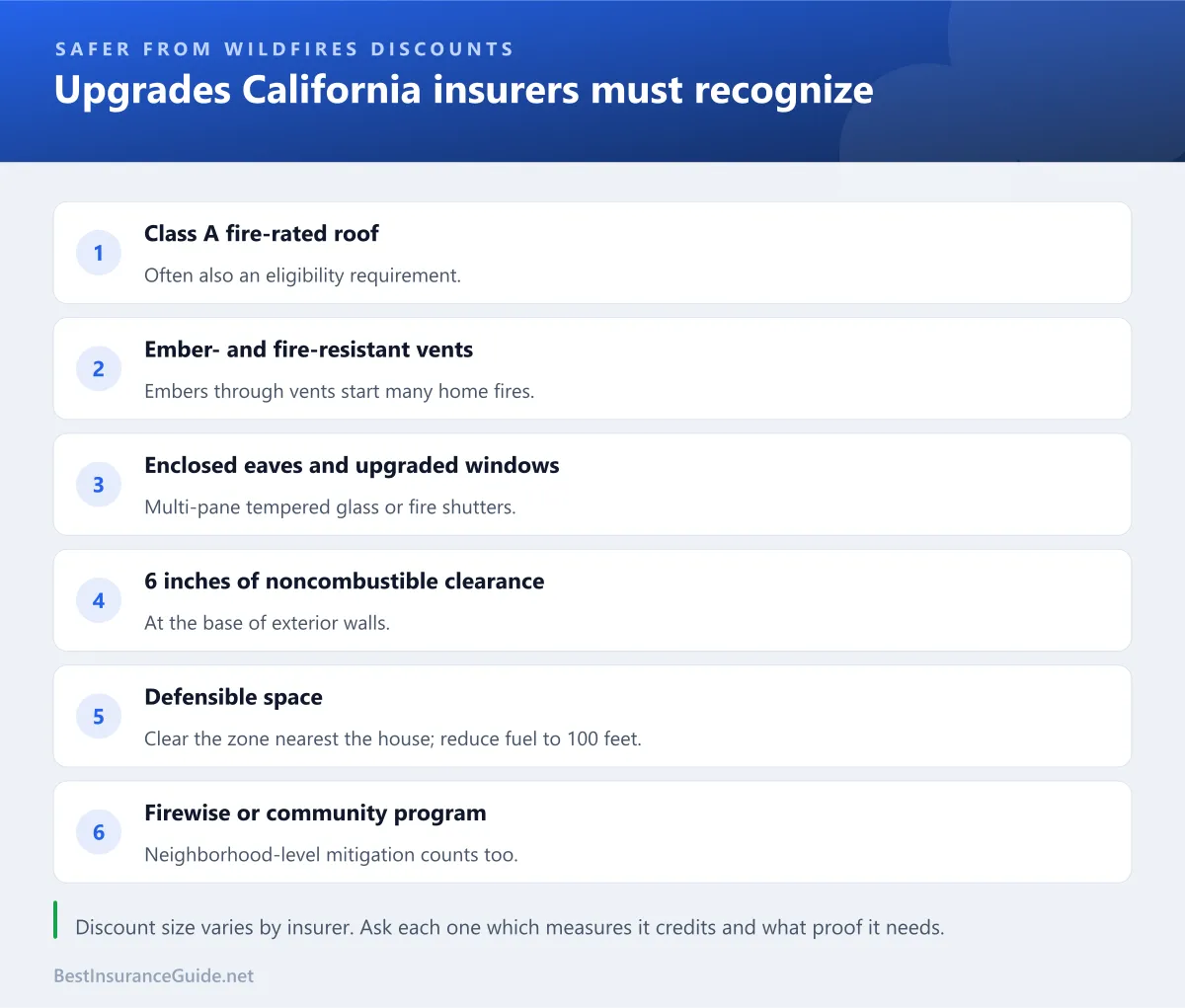
- Class A fire-rated roof
- Ember- and fire-resistant vents
- Enclosed eaves
- Upgraded windows (multi-pane, tempered glass) or fire shutters
- At least 6 inches of noncombustible vertical clearance at the base of exterior walls
- Defensible space that meets state and local rules, including clearing the area closest to the house
- Removing combustible sheds and structures near the home
- Community programs, such as a Firewise USA site or a designated Fire Risk Reduction Community
Discounts vary a lot by insurer, from very small to meaningful. The bigger benefit is often eligibility: State Farm’s filing, for example, ties new business to IBHS Wildfire Prepared Home certification, which bundles many of these measures.
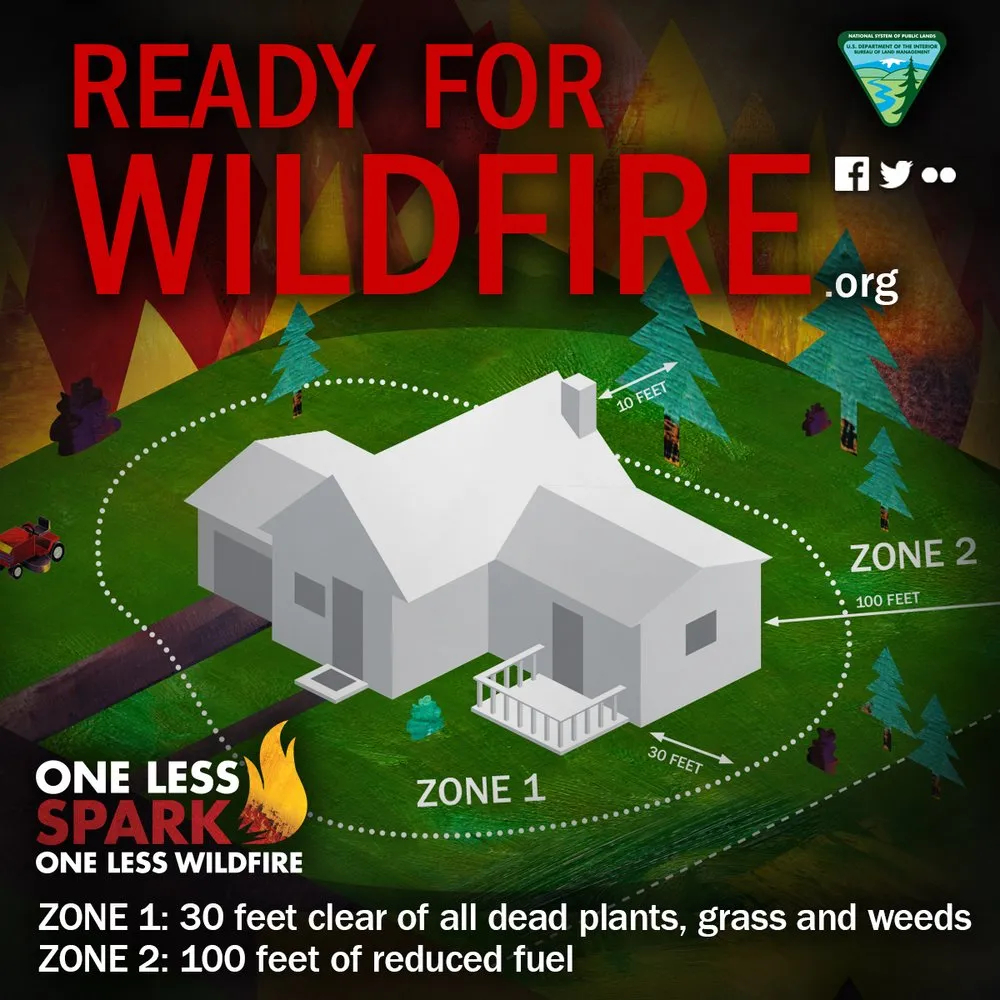 Defensible space zones around a home. Graphic: Bureau of Land Management, California (public domain).
Worked example: what hardening can do
Imagine a 1990s home in a very high fire hazard zone, currently on the FAIR Plan plus DIC.
| Step | Approximate cost | Insurance effect |
|---|---|---|
| Replace vents with ember-resistant vents | Hundreds to low thousands of dollars | Qualifies for a Safer from Wildfires discount with admitted insurers |
| Clear a 5-foot noncombustible zone around the house; maintain 30–100 ft defensible space | Mostly labor and landscaping | Discount, and better risk scores |
| Class A roof at the next replacement | Part of a normal reroof | Discount; often an eligibility requirement |
| IBHS Wildfire Prepared Home certification | Inspection fee plus any upgrades | May open the door to insurers such as State Farm under its new filing |
Illustrative. Costs vary widely, and discounts depend on the insurer. The point: these steps lower your risk and improve your options when insurers start writing again.
Questions to ask an agent or broker
Shopping in a fire area is different from shopping anywhere else. These questions save time and avoid surprises:
- “Which of your carriers are writing new homeowners policies in my ZIP code right now?” Availability changes month to month.
- “Is this an admitted or a surplus lines policy?” That decides whether CIGA protects you if the insurer fails, and how much the policy wording is regulated.
- “What wildfire mitigation do you credit, and what proof do you need?” Photos, receipts, a defensible space inspection or IBHS certification.
- “Is my dwelling limit enough to rebuild today?” Rebuilding after a wildfire often costs more than people expect, because of code upgrades and demand for contractors. Ask about extended replacement cost and building code upgrade coverage.
- “What is the wildfire deductible, if any?” Some policies use special deductibles or sub-limits for wildfire or smoke damage.
- “If I’m on the FAIR Plan, will you re-shop me every year?” A good broker will keep looking for a way off the FAIR Plan as insurers return.
If your insurer non-renews you
California gives homeowners some protections:
- 75 days’ written notice. Insurers must give at least 75 days’ notice before non-renewing a homeowners policy, with the reason.
- Wildfire moratoriums. After a declared wildfire emergency, the Insurance Commissioner can order a one-year moratorium on non-renewals in ZIP codes in or next to the fire area.
- Help line. The CDI’s consumer hotline, 1-800-927-4357, can help with non-renewals and complaints.
Start shopping as soon as you get a notice. Don’t wait for the last week.
Manufactured and mobile homes in fire areas
Manufactured and mobile homes are often in rural, fire-exposed areas, and they face the same squeeze. Look for insurers that specialize in manufactured homes, ask whether your home’s installation and location meet the FAIR Plan’s or other insurers’ eligibility rules, and focus on ember-resistant skirting and vents and defensible space, which help both safety and eligibility.
Related reading
California FAIR Plan rate increase explains the October 15 increase. What home insurance covers lists the gaps a FAIR Plan policy leaves, replacement cost vs actual cash value explains how total-loss claims are paid, and how to compare insurance quotes helps you compare like for like.
Sources and notes
- California Department of Insurance, “Major California home insurers move to reopen for new business, including state’s largest insurer”, September 18, 2026.
- Insurance Business, “Allstate moves to reopen California home insurance market for first time in four years”, September 2026 (1.4% rate change, 2,064-policy commitment, July 2029 deadline).
- California Department of Insurance, Sustainable Insurance Strategy materials (catastrophe models, reinsurance costs, 85% commitment).
- California Code of Regulations, title 10, §2644.9 (Safer from Wildfires mitigation discounts); California Insurance Code §675.1 and §678 (non-renewal moratoriums and notice).
- California FAIR Plan policy count, June 2026, as reported in our FAIR Plan coverage.
- Photos: U.S. Fish and Wildlife Service, Pacific Southwest Region (featured); Bureau of Land Management, California (graphic). Both public domain, via Wikimedia Commons.
This article is general information, not legal or insurance advice. Availability, rates and eligibility change frequently and vary by address. Check with a licensed agent or broker and the California Department of Insurance for your situation.