Liability-Only Car Insurance: What It Covers, What It Costs and When It Makes Sense
What liability-only car insurance covers and excludes, average cost vs full coverage ($820 vs $2,697 a year), how to pick limits, and the 10% rule for dropping collision.

Table of contents
Liability-only car insurance pays for the damage and injuries you cause to other people, and nothing for your own car. It is the cheapest legal way to drive in almost every state: about $820 a year on average for minimum coverage, against about $2,697 for full coverage, according to Bankrate’s 2026 analysis. For an older, paid-off car, that saving can be worth more than the car itself.
We are an independent site; figures below are attributed to Bankrate, the Insurance Research Council and state law, and worked examples are labelled illustrative.
The trade-off is risk. If your car is totalled, stolen or flooded, you pay. And if you buy only the state minimum, a serious crash can cost more than your limits, leaving you personally responsible for the rest. Here is how to get the saving without the worst of the risk.
Liability-only car insurance at a glance
| Question | Liability only | Full coverage |
|---|---|---|
| Other people’s injuries | Yes, up to your limits | Yes |
| Damage to other cars and property | Yes, up to your limits | Yes |
| Repairs to your own car after a crash | No | Yes, minus deductible |
| Theft, hail, flood, fire, deer | No | Yes, minus deductible |
| Legal defence if sued | Yes | Yes |
| Allowed with a car loan or lease | Usually not | Yes |
| National average cost (Bankrate, 2026) | ~$820/yr for minimum cover | ~$2,697/yr |
What liability car insurance covers
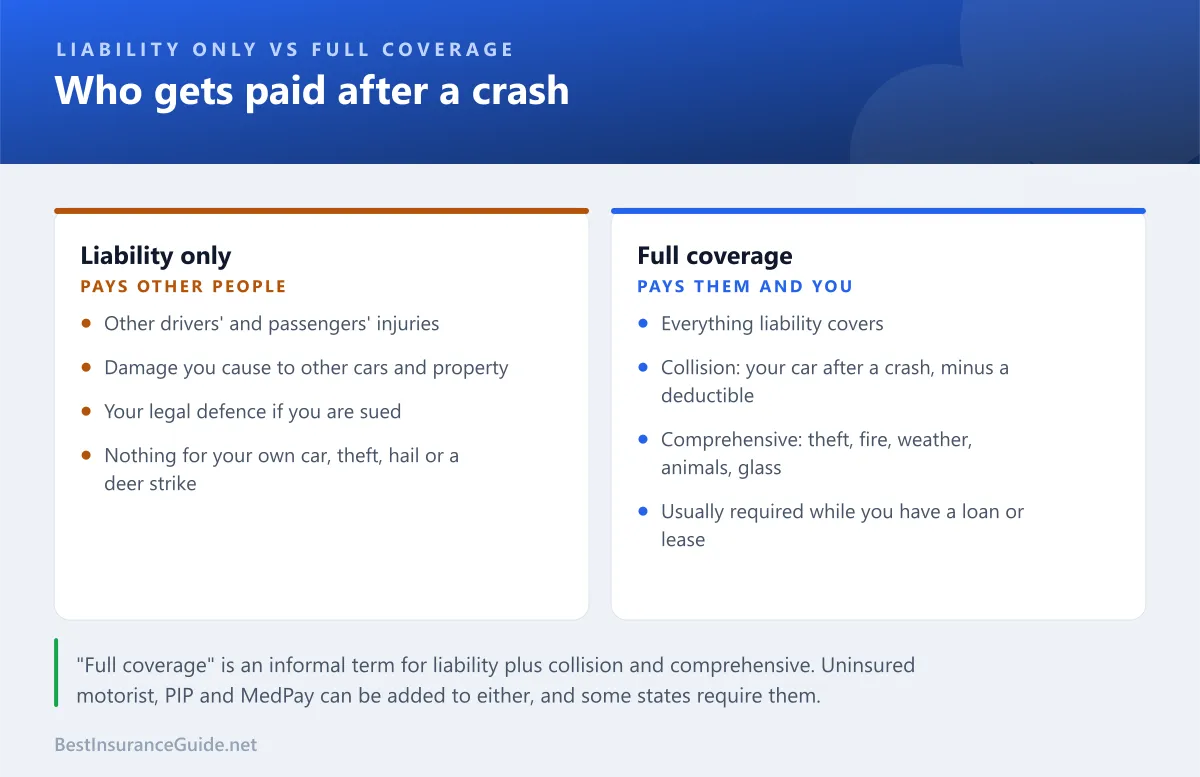
Liability insurance has two parts, written as three numbers such as 25/50/25:
- Bodily injury liability (the first two numbers): pays other people’s medical bills, lost wages and pain and suffering when you are at fault. The first number is the most it pays per person, the second the most per accident, in thousands of dollars.
- Property damage liability (the third number): pays to repair or replace other people’s vehicles and property, such as a fence, a shopfront or a lamp post.
Your insurer also defends you if you are sued over a covered accident, and legal costs are usually paid on top of your limits.
Liability cover follows the policy rules on who is driving. Our guide to whether insurance follows the car or the driver explains what happens when you lend your car.
What it does not cover
This is where people get caught out. A liability-only policy pays nothing for:
- your own car after a crash, even if you were not at fault and the other driver has no insurance (unless you add uninsured motorist property damage, where available);
- theft, vandalism or a break-in, as explained in does insurance cover a stolen car?;
- weather: hail, falling trees and flood damage;
- hitting an animal, a common autumn claim covered in our article on hitting a deer;
- your own injuries, unless you add MedPay or personal injury protection (PIP), which some states require;
- towing and rental cars, which are separate add-ons.
State minimums: the legal floor
Almost every state requires a minimum amount of liability insurance. Some common examples:
| State | Minimum liability | Notes |
|---|---|---|
| California | 30/60/15 | Raised from 15/30/5 on January 1, 2025 |
| Texas | 30/60/25 | |
| Pennsylvania | 15/30/5 | Plus first-party medical benefits |
| Alaska, Maine | 50/100/25 | Among the highest |
| Florida | $10,000 PDL + $10,000 PIP | No bodily injury liability required for most drivers; see our Florida car insurance guide |
| New Hampshire | None required | Drivers must show they can pay if they cause a crash |
Check your own state’s insurance department for current rules, since several states have raised minimums recently and some also require uninsured motorist or PIP cover.
Why the minimum is often not enough
Illustrative. Jordan carries 25/50/25 and causes a crash. The other driver has $60,000 of medical bills and lost wages, and their two-year-old SUV, worth $30,000, is written off.
- Jordan’s insurer pays $25,000 for the injury, the per-person limit.
- It pays $25,000 for the SUV, the property damage limit.
- That leaves $35,000 of injury costs and $5,000 of vehicle costs, which the other driver can pursue against Jordan personally, through savings, assets and, in many states, wage garnishment.
Moving from state minimum to 100/300/100 often costs much less than people expect, because the first dollars of cover are the most expensive. If you own a home or have savings, ask for both quotes. People with significant assets often add an umbrella policy, which usually requires underlying limits such as 250/500/100.
How much liability-only insurance costs
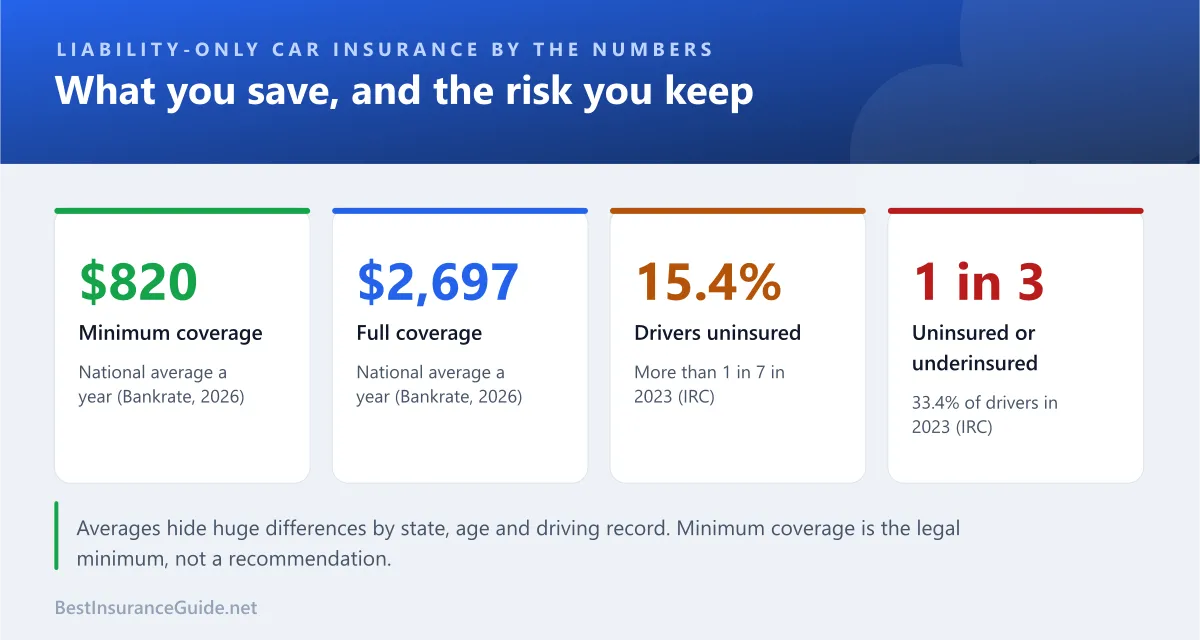
According to Bankrate’s 2026 analysis of rates from Quadrant Information Services:
- Minimum coverage averaged about $820 a year, roughly $68 a month.
- Full coverage averaged about $2,697 a year, roughly $225 a month.
The gap varies widely by state. In New Hampshire, Bankrate’s figures were about $466 for minimum coverage against $1,694 for full coverage; in New Jersey, about $1,413 against $3,254.
Your own price depends on your age, driving record, credit-based insurance score in most states, ZIP code and car. Young drivers often pay several times the average, which is one reason families move older cars to liability only. Our articles on car insurance for young drivers and auto insurance discounts cover other ways to cut the bill, and why your car insurance is going up explains recent increases.
When liability-only makes sense: a simple test
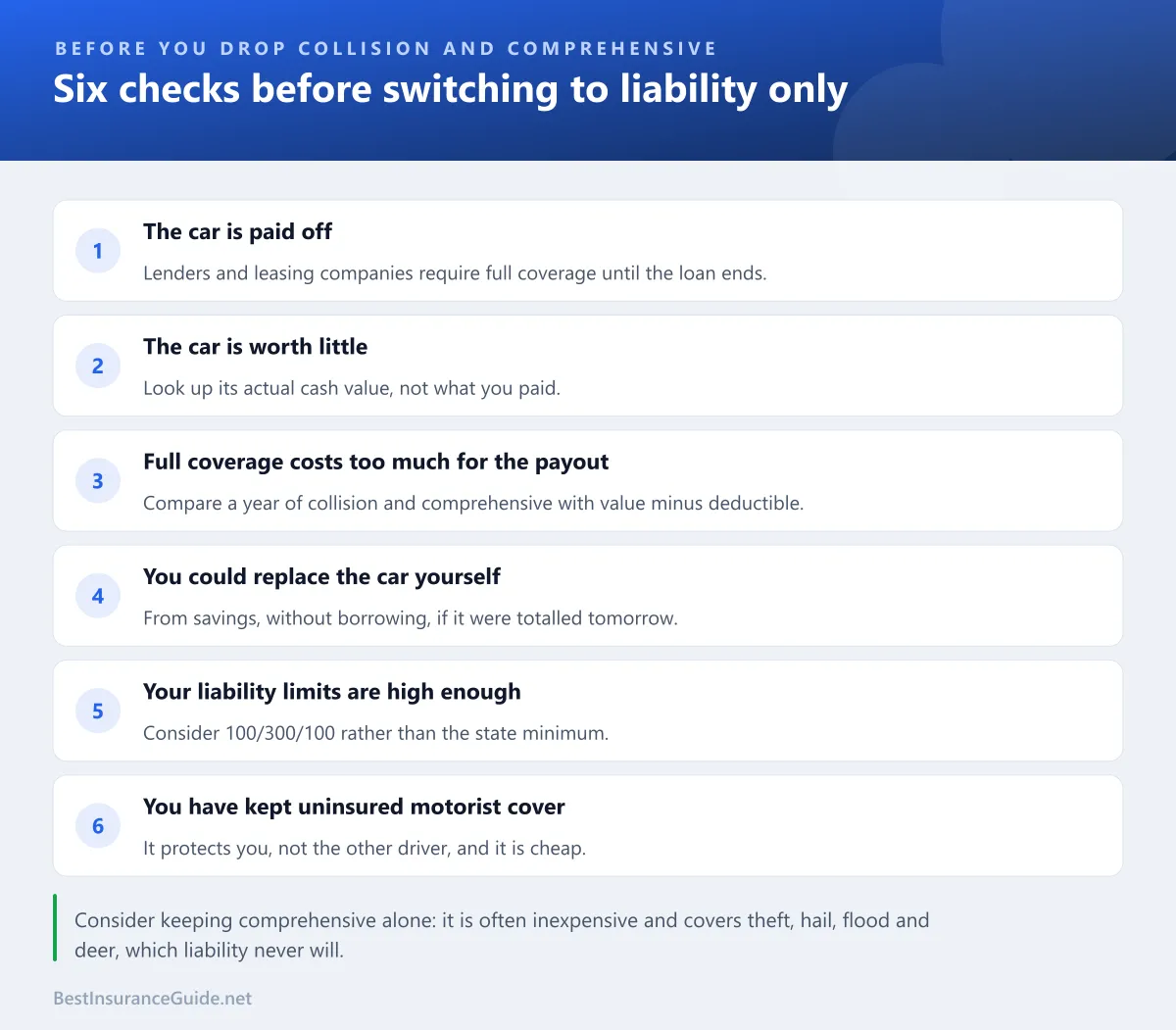
Collision and comprehensive pay at most your car’s actual cash value minus your deductible. So the question is whether you are paying too much for a small potential payout. Our guide to replacement cost vs actual cash value explains how that value is worked out.
The 10% rule of thumb: if a year of collision and comprehensive costs more than about 10% of the car’s actual cash value, dropping them is worth considering.
Illustrative. Your 14-year-old sedan is worth about $4,000. Collision and comprehensive add $900 a year with a $1,000 deductible.
- The most those coverages could ever pay is $4,000 − $1,000 = $3,000.
- You are paying $900 a year, or 22.5% of the car’s value, to protect that $3,000.
- Over three claim-free years you would spend $2,700, almost the maximum payout, while the car keeps losing value.
In that case, liability only, or liability plus comprehensive, is likely to be better value, as long as you could replace the car from savings if it were written off tomorrow.
Keep full coverage if:
- you have a loan or lease, because the lender requires it;
- you could not afford to repair or replace the car;
- the car is newer or valuable, including classics, which may need agreed-value cover;
- you live where theft, hail or flooding are common, in which case at least keep comprehensive.
If you owe more than the car is worth, gap insurance matters more than liability-only savings.
Two add-ons worth keeping on a liability-only policy
Uninsured and underinsured motorist coverage. The Insurance Research Council estimates that 15.4% of drivers were uninsured in 2023, more than one in seven, and that 33.4% were uninsured or underinsured. If one of them hits you, your liability cover pays nothing towards your injuries. Uninsured motorist cover does. In some states, uninsured motorist property damage also pays for your car, which partly fills the gap left by dropping collision.
Comprehensive coverage. Many insurers let you keep comprehensive without collision. It is usually much cheaper than collision and covers the risks you cannot drive away from: theft, hail, flood, fire, glass and animals. Our comprehensive deductible guide explains how to set it.
MedPay or PIP is also worth a look if your health insurance has a high deductible, and it is required in some states.
How to switch to liability only
- Confirm the car is paid off and the lender has released the title.
- Look up the car’s value using a pricing guide, and compare it with what collision and comprehensive cost on your current policy.
- Ask your insurer for quotes at two liability levels, such as the state minimum and 100/300/100, with and without comprehensive.
- Make the change mid-term if you like. Most insurers let you drop coverages at any time and refund or credit the difference.
- Shop around at the same time. A change in coverage is a good moment to compare insurers; our guide on how to switch car insurance explains how to avoid a gap.
- Keep the savings set aside to build a fund for repairing or replacing the car.
If you are in an accident that was the other driver’s fault, their liability insurance should pay for your car regardless of what you carry. Our guide to a car accident that was not your fault explains the claims process.
Related reading
- Gap insurance explained for when you owe more than the car is worth.
- Comprehensive deductible explained for choosing the right deductible.
- Auto insurance discounts for more ways to lower your premium.
- How to switch car insurance without a coverage gap.
- Non-owner SR-22 insurance for liability cover when you do not own a car.
Sources and notes
- Bankrate, national and state average car insurance rates (2026), based on Quadrant Information Services data: $820 minimum and $2,697 full coverage national averages; New Hampshire and New Jersey state figures.
- Insurance Research Council, Uninsured and Underinsured Motorists: 2017–2023 (2025): 15.4% uninsured and 33.4% uninsured or underinsured in 2023.
- State minimum liability limits from state law and insurance department guidance; California’s increase took effect January 1, 2025 under SB 1107. Check your state for current requirements.
- The 10% rule is a common rule of thumb, not an industry standard. Worked examples use hypothetical figures.
This article is general information, not personalised insurance or legal advice. Coverage terms vary by insurer and state, so read your policy and ask your insurer or a licensed agent before changing your coverage.