Where Is the Policy Number on an Insurance Card? Health, Car, Home and Medicare Explained
Find the policy number on your insurance card: member ID vs group number on health cards, Medicare's MBI, car ID cards, home declarations pages, and what to do if you lose your card.

Table of contents
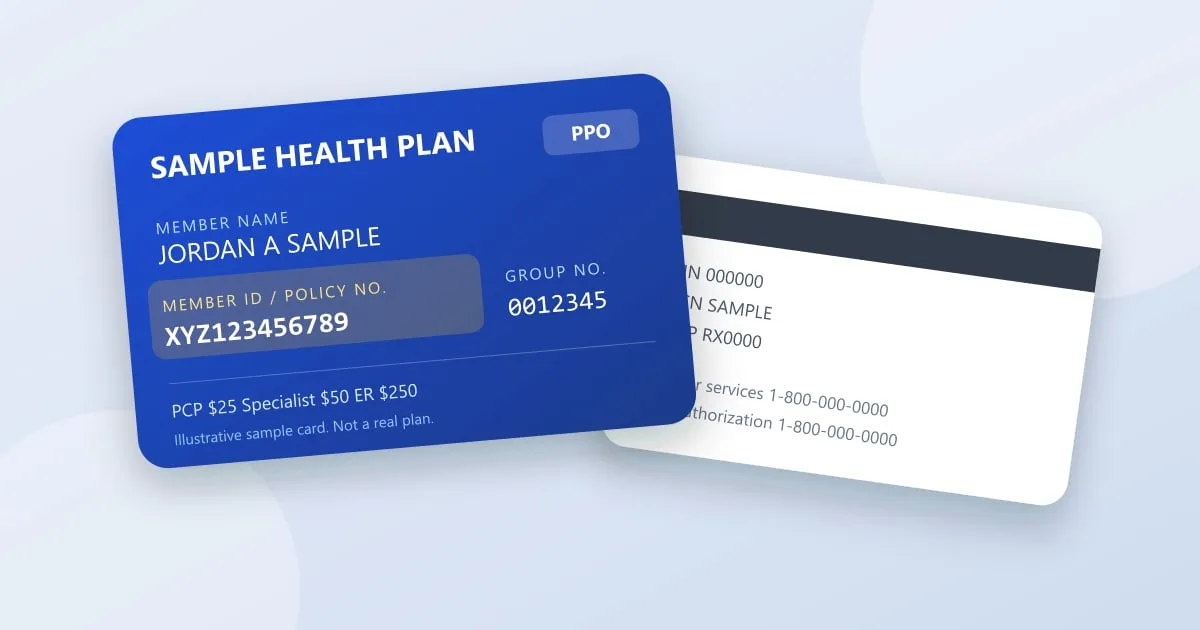
On most health insurance cards, the policy number is the member ID. It is usually printed on the front of the card next to your name, labelled Member ID, ID#, Identification Number or Subscriber ID. Very few health cards print a separate field called “policy number”, which is why so many people search for it. On car insurance cards the policy number is clearly labelled, and for home and renters insurance it sits at the top of your declarations page, because there is usually no card at all.
We are an independent site and do not work for any insurer. Card layouts vary, so use the guidance below alongside your own card and your insurer’s app.
Where to find your policy number, by type of insurance
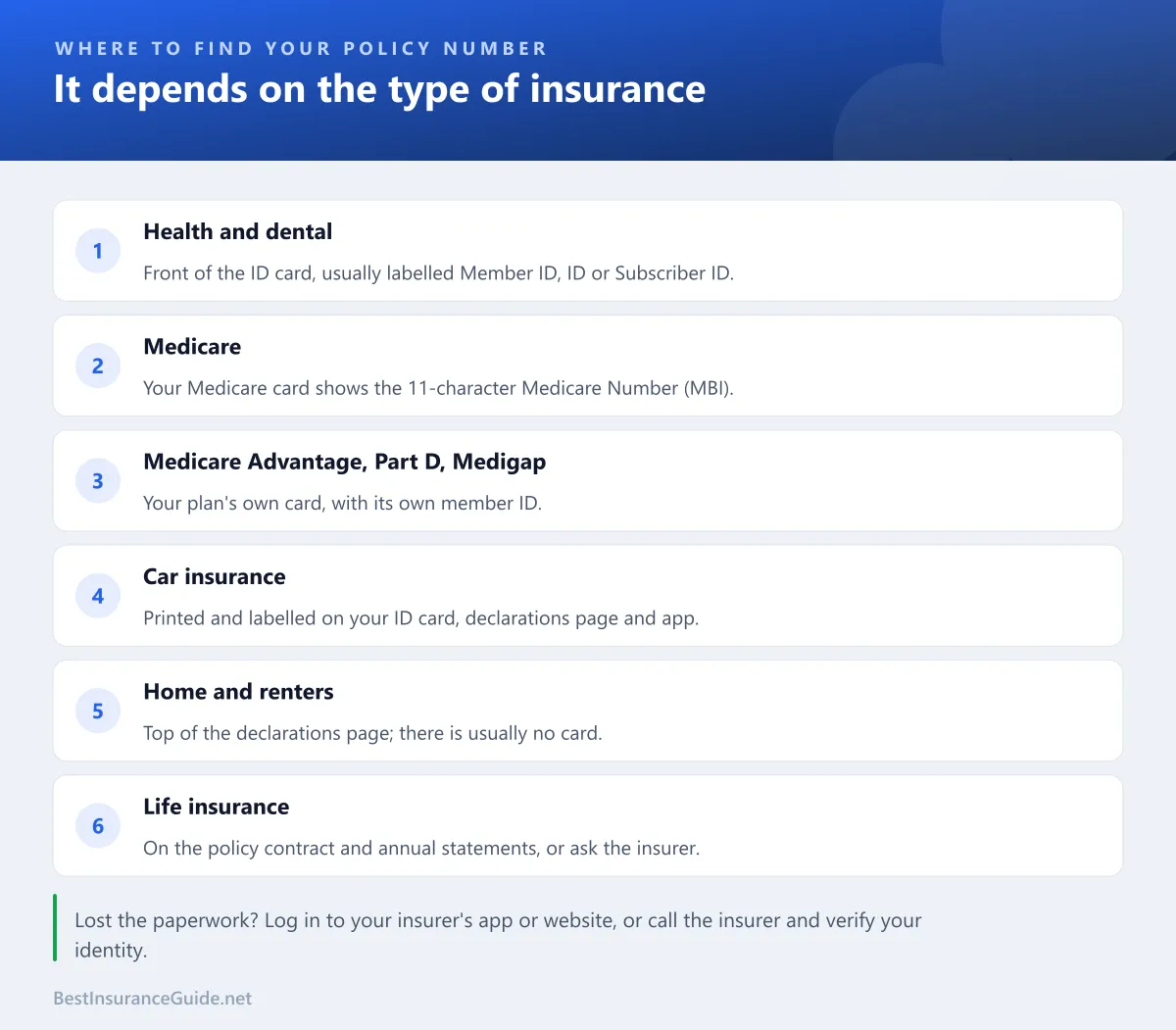
| Insurance | Where the policy number is | What it is usually called |
|---|---|---|
| Health (employer or marketplace) | Front of ID card | Member ID, ID#, Subscriber ID |
| Dental and vision | Front of ID card, or the medical card if bundled | Member ID |
| Original Medicare | Medicare card | Medicare Number (MBI) |
| Medicare Advantage, Part D, Medigap | The plan’s own card | Member ID |
| Medicaid and CHIP | State Medicaid card | Medicaid ID or Recipient ID |
| Car | ID card, declarations page, app | Policy Number |
| Home, condo, renters | Declarations page, bills, app | Policy Number |
| Life | Policy contract, annual statement | Policy Number or Contract Number |
| Pet, travel | Confirmation email, policy documents, app | Policy Number |
Health insurance cards: every number explained
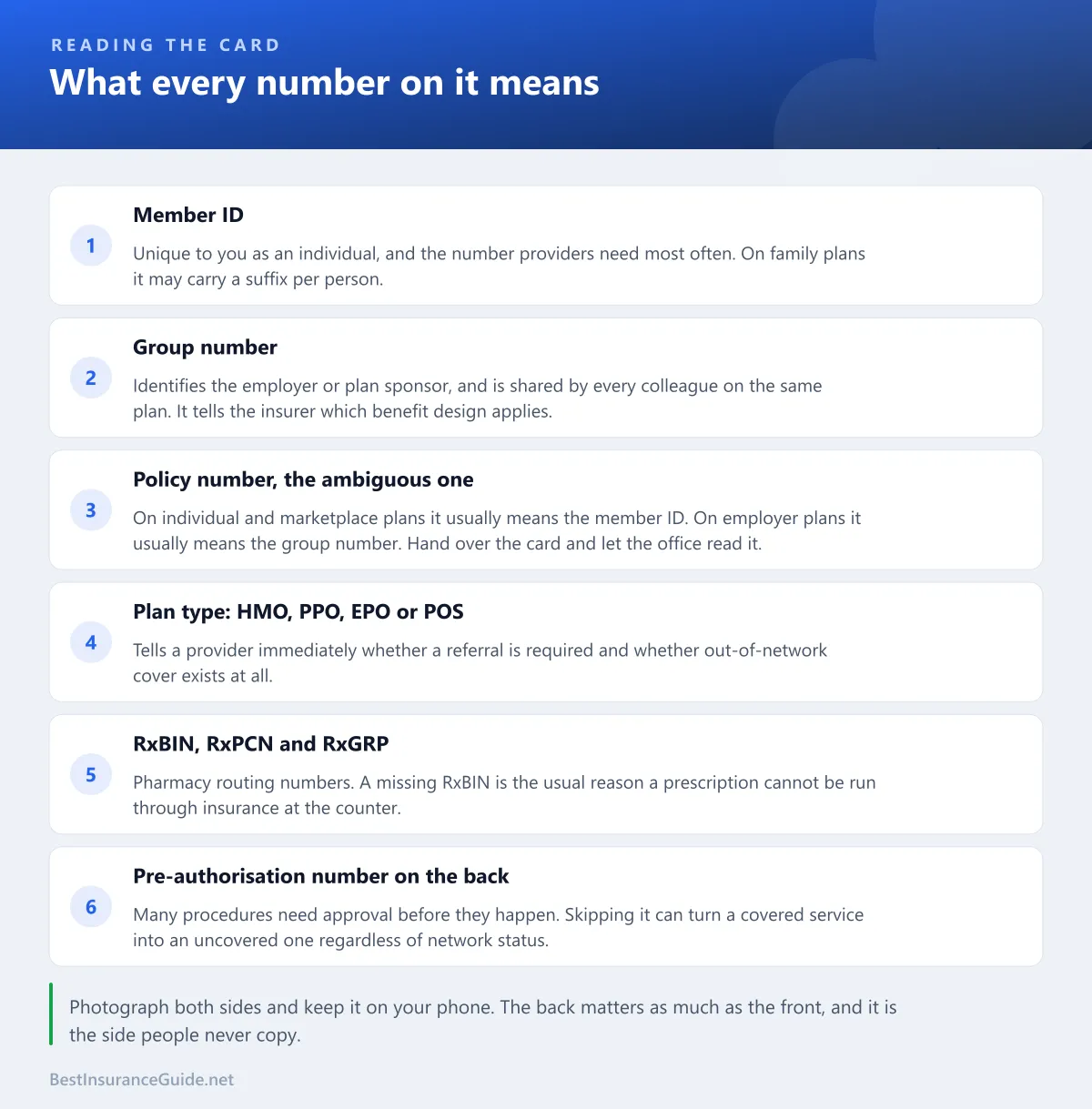
A typical health insurance card carries several numbers. Here is what each one does:
- Member ID (ID#, Subscriber ID). Unique to you or your policy, and the number most forms mean by “policy number”. On family plans, everyone may share the same base number with a two-digit suffix, such as -01 for the subscriber and -02 for a spouse, or each person may have a separate ID.
- Group number (Group#, GRP). Identifies the employer or organisation that sponsors the plan and which benefit design applies. Everyone in the same employer plan usually shares it. Individual and marketplace plans may leave it blank.
- Plan type. HMO, PPO, EPO or POS, which tells a provider whether you need a referral. Our EPO vs PPO guide explains the differences.
- RxBIN, RxPCN and RxGRP. Pharmacy routing numbers that send prescriptions to the right drug plan. A pharmacy needs these, and a missing RxBIN is a common reason a prescription will not go through.
- Copays. Often printed on the front for office visits, specialists, urgent care and the emergency room. They are a summary, not your full benefits.
- Phone numbers, usually on the back, for member services, nurse lines and prior authorisation.
Member ID vs group number
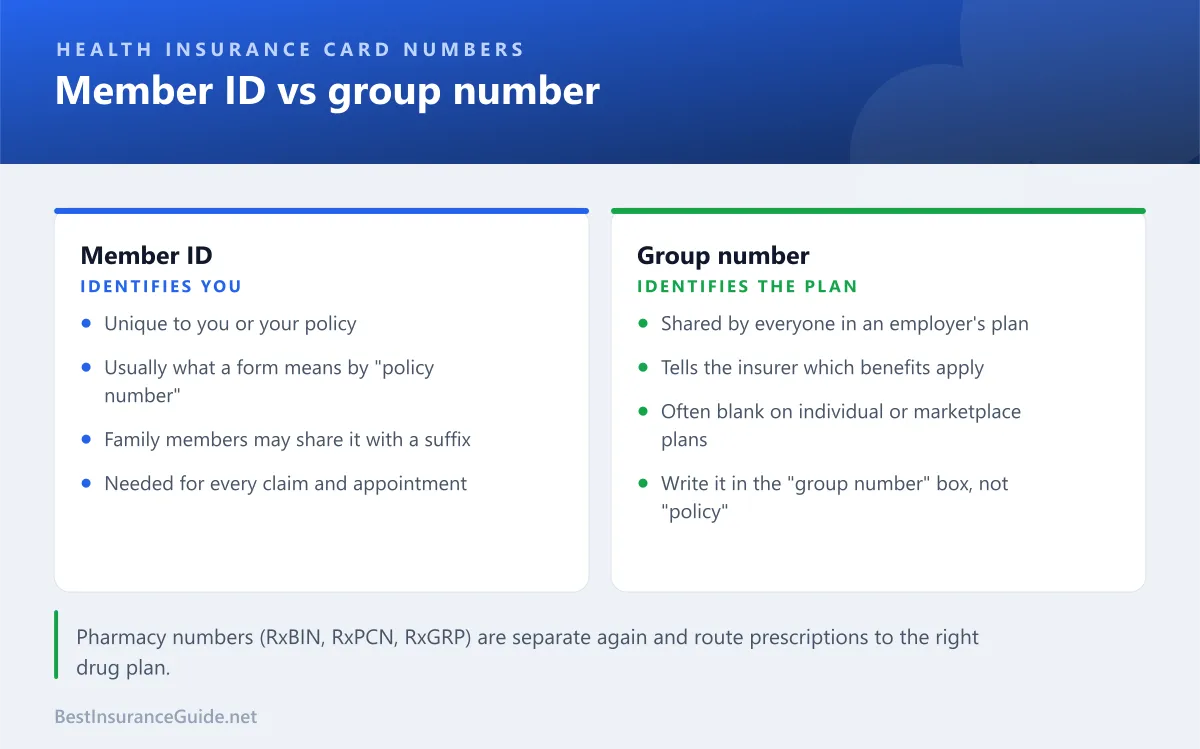
The rule of thumb when filling in a form:
- Policy number, policy ID, subscriber number or member number box: your member ID.
- Group number box: your group number.
- Policyholder or subscriber: the person whose name the coverage is in, usually the employee. If you are covered as a spouse or child, this is not you.
Illustrative. Sam is covered through a parent’s employer plan. Sam’s card shows ID: XYZ123456789-02 and Group: 0012345. On a new-patient form, Sam enters XYZ123456789-02 as the policy or member number, 0012345 as the group number, and the parent’s name and date of birth as the policyholder. Our guide to staying on a parent’s health insurance covers what changes at 26.
If a receptionist is unsure, hand over the card. Offices see hundreds of layouts and usually scan both sides anyway.
Medicare and Medicaid cards
Original Medicare does not have a policy number. Your Medicare card shows your Medicare Number, officially the Medicare Beneficiary Identifier (MBI): an 11-character mix of numbers and letters that CMS introduced to replace Social Security numbers on cards and reduce identity theft. The card also shows whether you have Part A (hospital) and Part B (medical) and the dates each started.
Medicare Advantage, Part D and Medigap plans are run by private insurers and issue their own cards with their own member IDs. If you have one of these, you usually show the plan card at appointments and the pharmacy. With Medigap and a stand-alone Part D plan, you show your Medicare card and both plan cards. Our guides to Medicare Part D in 2027 and Medigap Plan G vs Plan N explain these plans.
Protect your Medicare Number. Medicare will not call you out of the blue to ask for it. Share it only with your doctors, pharmacies, plans and people you trust to work with Medicare on your behalf.
Medicaid and CHIP cards are issued by your state and show a Medicaid ID or recipient number. If you are enrolled in a Medicaid managed care plan, you may also get that plan’s card. Our Medicaid eligibility 2027 guide explains how coverage works.
Car insurance cards
Car insurance ID cards clearly show the policy number, along with:
- the insurer’s name, and often its NAIC company code;
- the effective and expiry dates of the policy;
- the named insured and the vehicles covered, often with VINs.
You need the card to register a vehicle, show proof of insurance at a traffic stop, and exchange details after an accident. Most states accept digital ID cards on your phone, so it is worth downloading your insurer’s app. The same policy number is on your declarations page, which also lists your coverages and limits; our guide to liability-only car insurance explains what those limits mean.
After an accident, swap names, phone numbers, insurers and policy numbers with the other driver. Our guide to a car accident that was not your fault covers what to do next.
Home, renters and condo insurance
Homeowners and renters policies rarely come with a card. Your policy number is:
- at the top of the declarations page, the summary sent when you buy or renew;
- on renewal notices and bills;
- in your insurer’s app or online account;
- on your mortgage escrow statement, if your lender pays the premium.
Landlords often ask tenants for proof of renters insurance; the declarations page or an online certificate usually does the job. See our renters insurance guide for more.
Life insurance
Life insurance policy numbers are on the policy contract and on annual statements for permanent policies. Beneficiaries need it to make a claim, so keep a note of the insurer’s name and policy number with your important papers and tell your executor where it is. If a relative has died and you cannot find the policy, the NAIC Life Insurance Policy Locator lets you submit a free search request to participating insurers. Our guide on how long life insurance takes to pay out covers the claims process.
Policy number vs other numbers
- Policy number vs claim number. Your policy number identifies your coverage. A claim number is assigned to each claim, so one policy can have many claim numbers. Quote both when you call about a claim.
- Policy number vs NAIC code. The NAIC code identifies the insurance company, not you. It appears on car ID cards and in some state records.
- Policy number vs certificate number. Some employer life, disability and group policies give each employee a certificate number under the employer’s master policy.
Lost your card or cannot find the number?
- Check your insurer’s app or website. Most let you view, download and print a digital ID card immediately.
- Search your email for welcome, renewal or billing messages from the insurer.
- Ask your employer’s HR or benefits team for employer health, dental and life plans.
- Call the insurer. They will verify your identity with your name, date of birth and address.
- For Medicare, log in to your Medicare.gov account to print an official copy, or contact Social Security to request a replacement card.
Keep your numbers safe. Treat your member ID and Medicare Number like a credit card number. Do not post photos of your card online, and be wary of unsolicited calls or texts asking you to confirm them.
Related reading
- HMO vs PPO and your insurance card explains plan types and what each part of the card means.
- Health insurance terms is a glossary of the language on your card and plan documents.
- EPO vs PPO compares the four main plan types printed on cards.
- Medicare Part D 2027 covers drug plan cards and costs.
- Certificate of liability insurance explains proof of insurance for businesses.
Sources and notes
- CMS, New Medicare Card and Medicare Beneficiary Identifier (MBI) guidance: the 11-character MBI replaced Social Security-based numbers on Medicare cards.
- NAIC, Life Insurance Policy Locator service.
- Card layouts and field names vary by insurer. The sample card in this article is illustrative and does not represent any real insurer or person.
This article is general information. If you are unsure which number a form needs, contact your insurer or the provider’s billing office.