Certificate of Liability Insurance: How to Read the ACORD 25 Form
How to read a certificate of liability insurance (ACORD 25): each section, certificate holder vs additional insured, and how to verify a COI.

Table of contents

If you run a business, sooner or later a client, landlord or general contractor will say: send us your COI before you start. What they want is a certificate of liability insurance, almost always on a standard one-page form called the ACORD 25.
It looks like a dense grid of boxes, abbreviations and numbers, and it is easy to send one without understanding it or accept one without checking it. Both are mistakes. The certificate is the document that decides whether you get onto the job site, and it is also the document that people most often rely on for more than it actually proves.
This guide walks through the certificate of liability insurance form section by section, explains the difference between a certificate holder and an additional insured, and covers how to request, check and verify a COI.
What is a certificate of liability insurance?
A certificate of liability insurance (COI) is a summary of a business’s insurance at a single moment. It lists who is insured, which insurers provide the coverage, the policy numbers and dates, the limits, and whether certain endorsements apply.
It is issued by the insured business’s agent, broker or insurer, not by the business itself, and it is sent to a third party, the certificate holder, who wants evidence that coverage exists.
The most important sentence on the form is near the top. It states, in capitals, that the certificate is issued as a matter of information only and “confers no rights upon the certificate holder.” It then says the certificate does not amend, extend or alter the coverage in the policies.
In plain terms: the certificate is a description of the policy, not a part of it. If the certificate and the policy disagree, the policy wins.
The ACORD forms people confuse
ACORD is an insurance industry standards body, and its forms are used across the US so that a certificate from any agent looks broadly the same. Four of them are commonly mixed up.
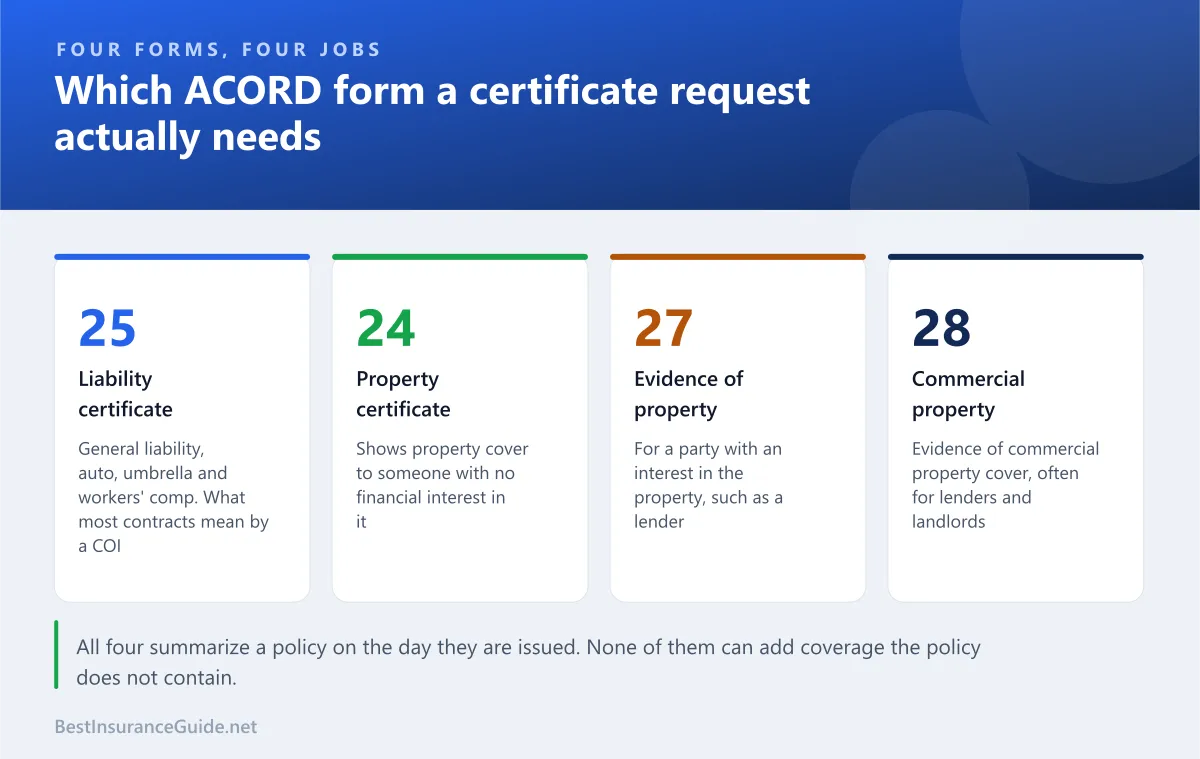
- ACORD 25, Certificate of Liability Insurance. General liability, auto liability, umbrella or excess, and workers’ compensation. This is the one most contracts mean when they ask for a COI.
- ACORD 24, Certificate of Property Insurance. The same idea for property coverage, for someone who wants to know the property is insured but has no financial interest in it.
- ACORD 27, Evidence of Property Insurance. Used where the requesting party has an interest in the property, such as a mortgage lender.
- ACORD 28, Evidence of Commercial Property Insurance. The commercial equivalent, often required by commercial lenders and landlords.
The edition date is printed in the bottom corner of the form. ACORD periodically publishes new editions, and a few contracts or public bodies specify which one they will accept.
How to read an ACORD 25, section by section
Take a certificate you have received, or one of your own, and work down the page.
1. Date
Top right. This is the date the certificate was issued, and it is the only date on which the certificate says anything is true. A certificate issued ten months ago says nothing about whether the policy is still in force today.
2. Producer
The agent or broker who issued the certificate, with contact details. This is who you call with questions, though for verification you should find their number independently (more on that below).
3. Insured
The named insured: the business whose coverage is being described. Check that this is the exact legal entity you are contracting with. A certificate for “Smith Roofing LLC” does not cover “Smith Roofing & Gutters Inc.”
4. Insurers affording coverage
A list of insurers, labelled A to F, each with an NAIC number. The NAIC number identifies the specific insurance company, which lets you check its licensing with your state’s insurance department. Each policy further down the page is tied to one of these letters.
5. Coverages
The main grid. Each row is a type of insurance, and the columns show:
| Column | What it tells you |
|---|---|
| INSR LTR | Which insurer (A to F) writes this policy |
| TYPE OF INSURANCE | General liability, automobile liability, umbrella/excess, workers’ comp and employers’ liability |
| ADDL INSD | Whether an additional insured endorsement applies to this policy |
| SUBR WVD | Whether a waiver of subrogation applies to this policy |
| POLICY NUMBER | The policy number |
| POLICY EFF / EXP | Effective and expiration dates |
| LIMITS | The limits for that policy |
For general liability you will see several limits. The ones most contracts specify are each occurrence (the most paid for a single incident) and general aggregate (the most paid for all claims in the policy period), plus products-completed operations aggregate. It also shows whether the policy is written on an occurrence or claims-made basis.
For automobile liability, look for a combined single limit and check which vehicles are covered: any auto, owned autos only, hired autos, non-owned autos.
For umbrella or excess liability, look at each occurrence and aggregate limits. These sit on top of the underlying policies. Our guide to business umbrella insurance explains how that layering works.
For workers’ compensation and employers’ liability, the workers’ comp limit is statutory, so the form simply indicates “per statute.” Employers’ liability has three limits: each accident, disease per employee and disease policy limit.
6. Description of operations, locations and vehicles
A free-text box where the agent can describe the project, the location, the contract number or the endorsements that apply. It is often used to name the certificate holder as an additional insured “as required by written contract.” If there is not enough room, a continuation form, ACORD 101, is attached.
This box describes; it does not create coverage. Wording here that goes beyond what the policy actually says has no effect.
7. Certificate holder
The name and address of the party the certificate is addressed to. Being the certificate holder gives no rights under the policy.
8. Cancellation
The standard wording says that if a policy is cancelled before its expiration date, notice will be delivered in accordance with the policy provisions. In practice, most policies do not require the insurer to notify certificate holders at all. If you need notice of cancellation, the contract should require an endorsement that provides it.
9. Authorized representative
The signature of the agent or broker who issued it.
Certificate holder vs additional insured
This distinction causes more disputes than any other part of the certificate.
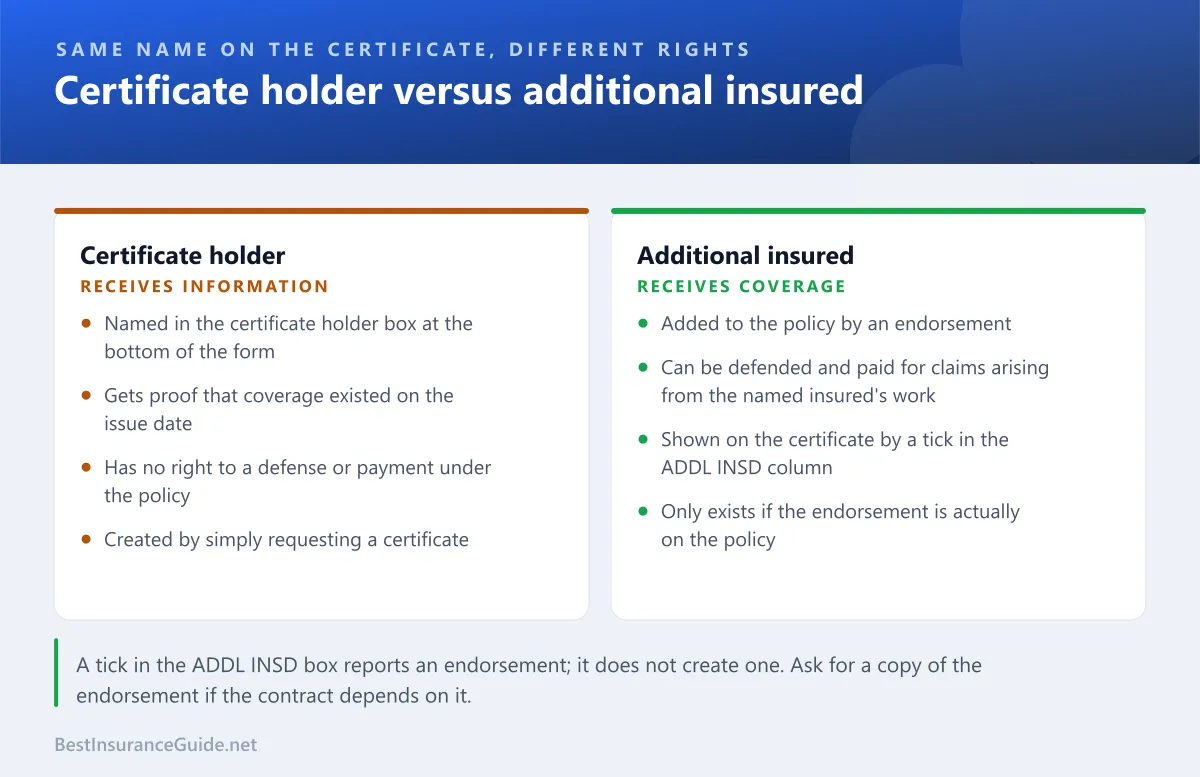
A certificate holder receives information. If the insured business causes an accident and the certificate holder is sued, the certificate holder has no claim on the insured’s policy just because they hold a certificate.
An additional insured has been added to the policy by an endorsement. If they are sued over something arising from the named insured’s work, the policy can defend and pay on their behalf, within the terms of the endorsement.
The certificate can show both: the holder’s name in the certificate holder box, a tick in the ADDL INSD column, and a note in the description box. But the tick only reports that an endorsement exists. If the endorsement was never added to the policy, the tick does not create one. The same applies to the SUBR WVD column, which reports a waiver of subrogation but cannot create one.
Many states have passed certificate of insurance laws, largely based on a model act from the National Council of Insurance Legislators, that prohibit certificates which alter or misrepresent coverage and restrict the use of non-standard certificate wording. These laws exist because requesting parties used to demand that agents add promises to the certificate that the policy did not contain.
How to request a certificate of insurance
If a client or landlord asks you for a COI, the process is quick when you give your agent what they need.
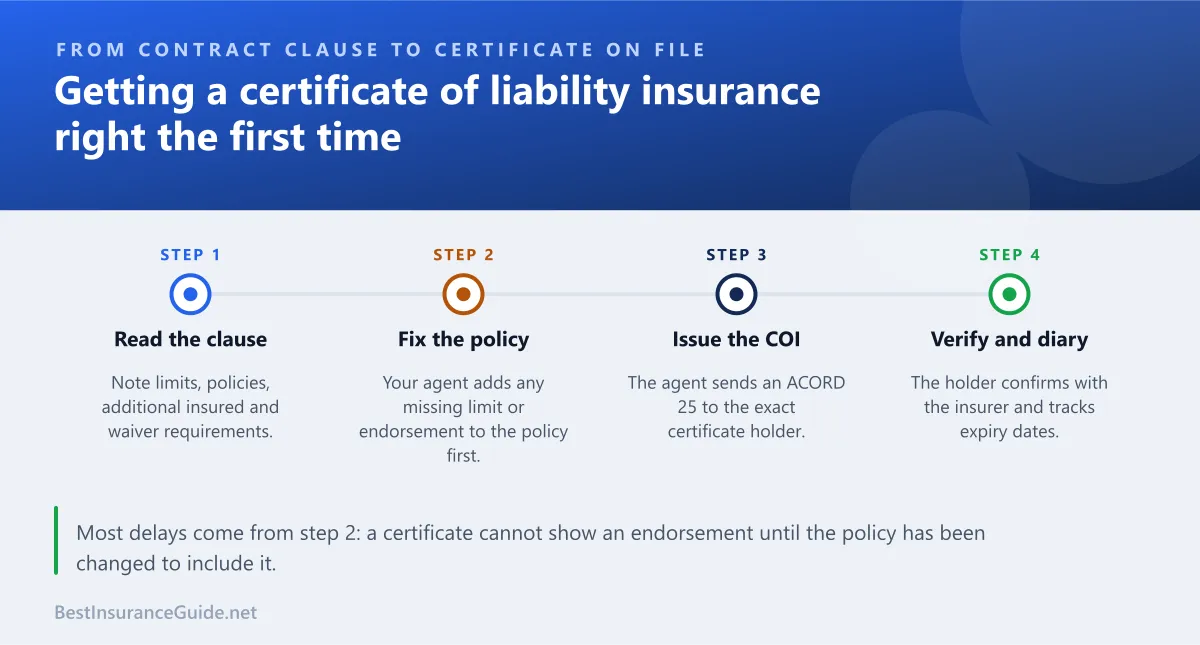
- Read the insurance clause in the contract first. Note the limits, the policies named, and whether additional insured status, waiver of subrogation or primary and non-contributory wording is required.
- Send your agent the certificate holder’s exact legal name and mailing address, plus the contract’s insurance section.
- Ask whether the policy already meets the requirements. If you need a higher limit or a new endorsement, that change is made to the policy first and then shown on the certificate.
- Request the certificate. Many agents turn them around the same day, and many insurers let you download certificates from an online account. There is normally no charge.
- Keep a copy with the contract, and note the expiration dates so that you can send a renewed certificate without being chased.
If you work with many clients, ask your agent whether your policies carry blanket additional insured and waiver of subrogation endorsements that apply wherever a written contract requires them. That avoids a policy change for every new job. Our business insurance checklist covers these contract-driven endorsements in more detail.
How to check a certificate you receive
If you hire contractors, rent space to tenants, or run events, you are probably on the receiving side. Every certificate deserves the same quick review.
- Named insured matches the entity you are contracting with, exactly.
- Dates cover the whole period of the work, including any completed operations period the contract requires.
- Limits meet or exceed the contract’s requirements for each policy.
- Workers’ compensation is shown if the contractor has employees. An uninsured subcontractor’s injured worker can become the hiring contractor’s problem in many states.
- ADDL INSD and SUBR WVD are ticked where the contract requires them, and you have copies of the endorsements themselves if the contract calls for them.
- The insurer is a real company, which you can check using its NAIC number with your state insurance department.
- The description box does not contain promises that sound more generous than the policy is likely to be.
How to verify a certificate of insurance
Certificate fraud exists. Altered and fabricated certificates are common enough that most large contractors verify directly.
Call the issuing agent or the insurer using a phone number you have found independently, from the insurer’s website or your state’s insurance department, not the one printed on the certificate. Confirm the policy number, the dates and the limits, and ask whether any additional insured endorsement names you. If you need it for your file, ask for a copy of the endorsement.
Diary the expiration dates. A certificate that was valid when work started means nothing once the policy lapses mid-project.
Other certificates you may be asked for
| Request | Form usually used | Who typically asks |
|---|---|---|
| Certificate of liability insurance | ACORD 25 | Clients, general contractors, landlords, venues |
| Workers’ comp certificate of insurance | ACORD 25, workers’ comp row | General contractors, state licensing boards |
| Certificate of property insurance | ACORD 24 | Landlords, business partners |
| Evidence of property insurance | ACORD 27 or 28 | Mortgage and commercial lenders |
| Proof of auto insurance | Insurer ID card | Police, DMV, rental companies |
Some states and public bodies have their own required workers’ comp certificate formats, particularly for construction licensing, so check before you send a standard ACORD 25.
The bottom line
A certificate of liability insurance is a useful, standard and usually free document that tells a third party what your insurance looked like on the day it was issued. It is not the policy. It cannot add coverage, it gives the holder no rights, and it can be out of date the day after it is printed.
If you are sending one, make sure your policy actually contains what the contract requires before the certificate says it does. If you are receiving one, read it against the contract, verify it independently and keep the dates in your diary. For the wider picture of what small businesses typically carry, see our guide to business insurance by trade.
BestInsuranceGuide.net is an independent publisher and is not affiliated with ACORD or any insurer. ACORD form names and numbers are used for identification only. This article is general information, not legal advice.