Home Warranty vs Home Insurance: What a Home Warranty Covers, Costs and Leaves Out
What is a home warranty? A service contract for worn-out systems and appliances, about $56 a month plus a $75-$125 service fee. How it differs from home insurance and when it pays off.

Table of contents

A home warranty is not insurance. It is a service contract that pays to repair or replace your home’s systems and appliances when they break down from age and normal use: think furnace, air conditioning, water heater, plumbing, electrics, dishwasher, oven and fridge. Home insurance does something different. It pays when your house or belongings are damaged suddenly and accidentally, by fire, storms, theft or a burst pipe, and it covers you if someone is hurt on your property. Home insurance excludes wear and tear, which is exactly the gap a home warranty fills, so the two do not replace each other.
We are an independent site and do not sell or recommend any home warranty company or insurer. Prices and terms below are averages; your own quote and contract are what count.
Home warranty vs home insurance at a glance
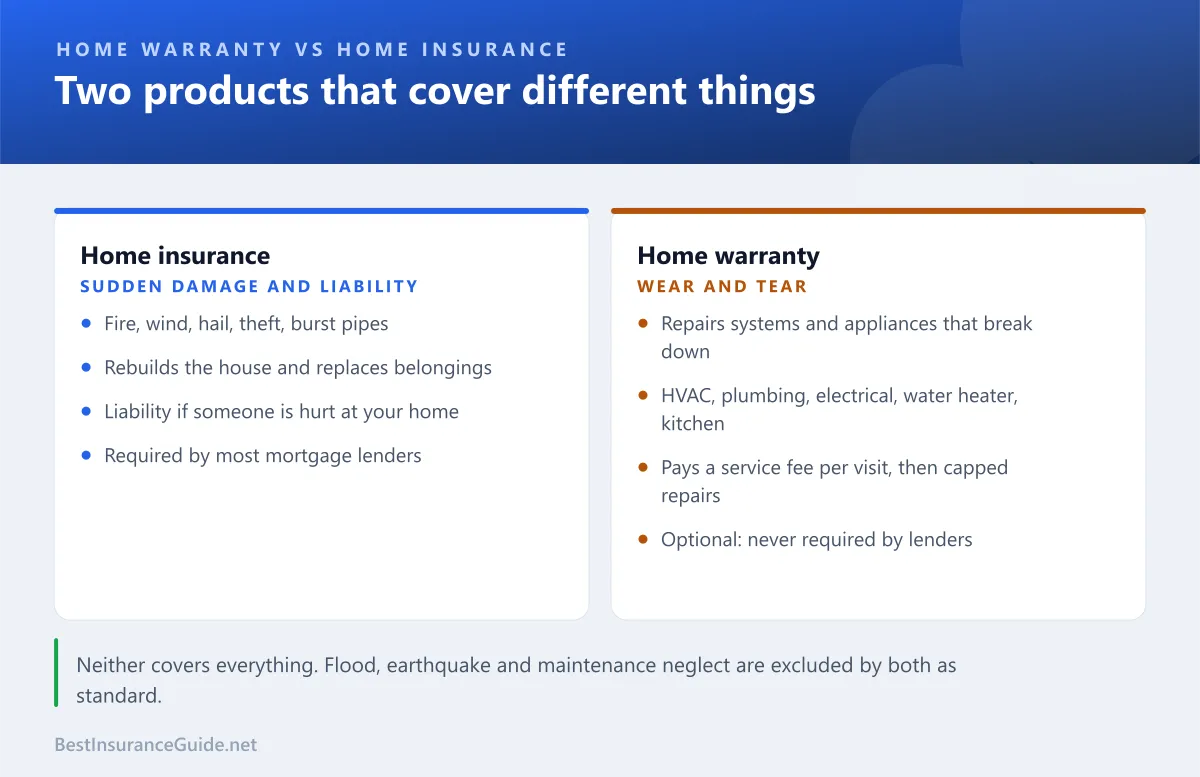
| Home insurance | Home warranty | |
|---|---|---|
| What it is | Insurance policy | Service contract |
| Covers | Sudden, accidental damage to the house and belongings, plus liability | Repair or replacement of systems and appliances that fail from wear and tear |
| Typical examples | Fire, wind and hail, theft, burst pipe, a tree falling on the roof | Broken AC compressor, failed water heater, dead dishwasher |
| How you pay | Annual premium, then a deductible per claim | Annual or monthly price, then a service fee per visit |
| Who fixes it | You choose the contractor; the insurer pays the claim | Usually a contractor the warranty company assigns |
| Required? | Usually, if you have a mortgage | Never required |
| Typical cost | $1,522 a year on average for mortgaged homes in 2023 (Freddie Mac) | About $56 a month, or $672 a year (This Old House, 2026) |
| Regulated by | State insurance departments | States, with rules that vary widely |
What is a home warranty?
A home warranty is usually a one-year contract with a company that maintains a network of contractors. When a covered item breaks, you call or file online, the company sends a technician, you pay a service fee (often called a trade call fee), and the company pays for the repair or, if it cannot be repaired, a replacement, up to the contract’s limits.
Plans are usually sold in tiers:
- Systems plans cover the parts built into the house: heating, air conditioning, ductwork, plumbing, electrical systems and the water heater.
- Appliance plans cover kitchen appliances and laundry: dishwasher, oven and range, built-in microwave, fridge, washer and dryer.
- Combination plans cover both.
- Add-ons such as a pool or spa, a second fridge, a well pump, a septic system or limited roof leak cover cost extra.
Do not confuse a home warranty with a builder’s warranty. A builder’s warranty comes free with a newly built home and covers defects in the builder’s workmanship and materials for set periods. A home warranty is a separate contract you, or the seller, pay for.
What home insurance covers instead
A standard homeowners policy covers the dwelling, other structures, personal property, loss of use (extra living costs while you are displaced) and personal liability. It pays for damage from covered perils, such as fire, lightning, windstorm, hail, theft, vandalism and the sudden discharge of water from a burst pipe. Our guide to what home insurance covers goes through each part.
Every homeowners policy excludes wear and tear, deterioration and mechanical breakdown. If your 15-year-old water heater simply stops working, home insurance will not replace it. If that water heater bursts and floods the basement, home insurance will usually pay to repair the water damage to the house, minus your deductible, but still not for the heater itself.
Flood and earthquake are excluded by home insurance and are not covered by home warranties either; they need separate policies. See do I need flood insurance?
Equipment breakdown coverage: the insurance alternative
Many insurers sell an equipment breakdown endorsement that adds mechanical and electrical failure of systems and appliances to your homeowners policy. It is insurance, not a service contract, so you choose your own repair company and pay your policy deductible rather than a service fee. Availability and limits vary by insurer and state, but it is worth asking your insurer to price it before buying a separate home warranty. The same endorsement is explained from the renter’s side in does renters insurance cover appliances?
How much does a home warranty cost?
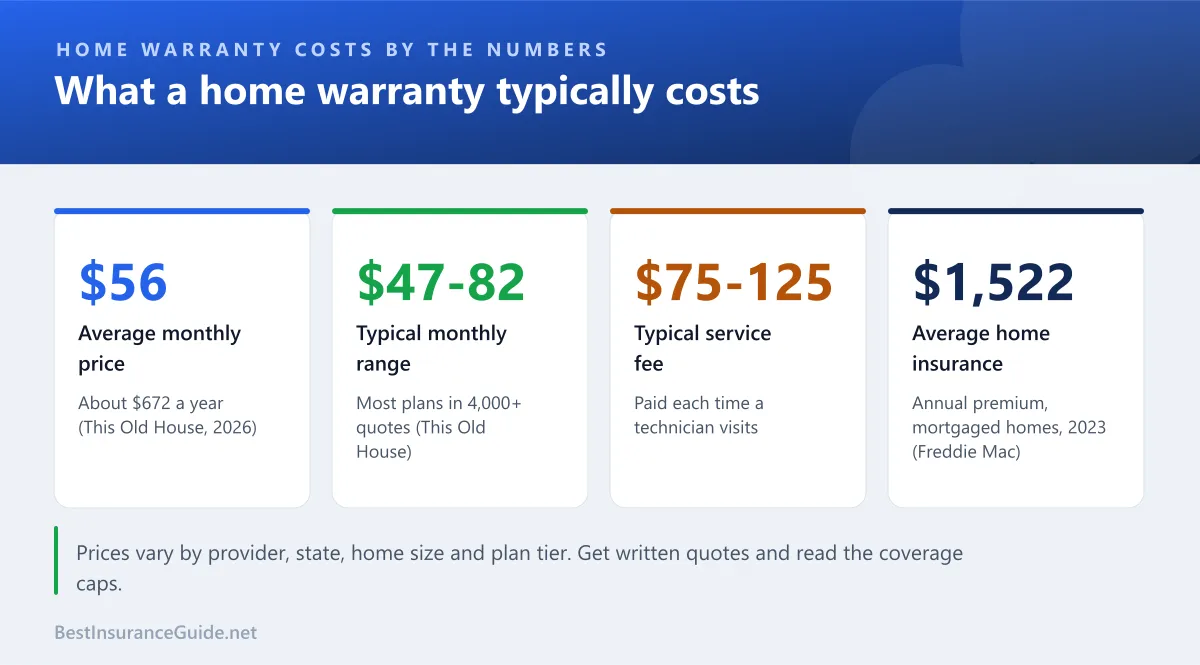
- Price: This Old House’s research, updated in June 2026 and based on more than 4,000 quotes from 13 companies in all 50 states, puts the average at about $56 a month ($672 a year), with most plans between $47 and $82 a month. NerdWallet’s 2026 figure was higher at $73 a month, with plans ranging from $28 to $191 a month.
- Service fee: typically about $75 to $125 per visit. Some companies let you choose a higher fee for a lower monthly price, the same trade-off as an insurance deductible.
- What moves the price: the plan tier, add-ons, the size and type of home, your state, and whether you pay monthly or annually.
For comparison, Freddie Mac found the average homeowners insurance premium for mortgaged single-family homes was $1,522 in 2023, and premiums have risen sharply in many states since. Our guide to homeowners insurance cost on a $400k house shows how insurance prices are set.
What home warranties usually do not cover
The exclusions and limits are where home warranties disappoint people. The FTC’s consumer guidance warns that a home warranty may duplicate coverage you already have, cover only part of a product, or make repairs hard to get. Look for these in the contract:
- Coverage caps. A per-item limit (for example, a set amount for the HVAC system) and often an overall annual cap. If a repair costs more than the cap, you pay the difference.
- Pre-existing conditions. Problems that existed before the contract started, even if you did not know about them, are commonly excluded.
- Poor maintenance. Claims can be denied if the company decides the failure came from a lack of maintenance, such as never changing the furnace filter or flushing the water heater. Keep receipts.
- Improper installation and code upgrades. The cost of bringing a system up to current building code, permits, and work needed to access an item (cutting into walls, cranes, removing old equipment) are often limited or excluded.
- Cosmetic damage and parts. Some plans exclude specific components, such as refrigerant, ductwork or the ice maker.
- Waiting periods. Many plans do not cover breakdowns in the first 30 days, which stops people buying after something has already failed.
- Their contractor, their choice. The company usually picks the technician and decides whether to repair or replace. It may offer cash in lieu of replacement, often below what you would pay retail.
Is a home warranty worth it?
Illustrative. Pat buys a combination plan at $672 a year with a $100 service fee and a $1,500 cap per system.
| Year with no breakdowns | Year with a failed AC compressor | |
|---|---|---|
| Plan price | $672 | $672 |
| Service fees | $0 | $100 |
| Repair cost | $0 | $3,000 |
| Paid by the warranty | $0 | $1,500 (the cap) |
| Pat pays above the cap | $0 | $1,500 |
| Pat’s total for the year | $672 | $2,272 |
Without a warranty, the AC year would have cost Pat $3,000, so the warranty saved $728. In the quiet year, it cost $672 for nothing. Over several years, whether a warranty pays off comes down to how often things break, how close the bills come to the caps, and how many claims the company approves.
A home warranty is more likely to be worth it if:
- your systems and appliances are old and out of their manufacturer’s warranty;
- a surprise $1,500 to $3,000 repair would mean borrowing or using a credit card;
- you have just bought an older home and do not yet know its history;
- you value having one number to call rather than finding contractors yourself.
It is less likely to be worth it if:
- your systems and appliances are new and still under the manufacturer’s warranty;
- you have savings to cover repairs and are comfortable choosing your own contractors;
- your insurer offers equipment breakdown cover for less;
- you are handy, or your home has few covered items (for example, a condo where the association maintains major systems).
The repair-fund alternative. Putting the same $56 a month into a savings account builds $672 in a year and over $2,000 in three, which you keep if nothing breaks. Consumer advocates often suggest this route for people who can manage it.
Home warranties when buying or selling a house
Home warranties often appear at closing. A seller may buy one for the buyer to make the house more attractive, or a buyer may ask for one in negotiations. A seller-paid warranty costs the buyer nothing for the first year, so it is generally worth accepting, especially on an older house. Some plans also offer seller coverage while the home is on the market.
Two points to keep in mind:
- A home warranty never replaces home insurance. Your lender will still require a homeowners policy, usually paid through escrow. Our explainer on hazard insurance vs homeowners insurance covers what lenders require.
- Read the contract before you rely on it, and diarise the renewal date. Many plans renew automatically at a higher price.
How to compare home warranty companies
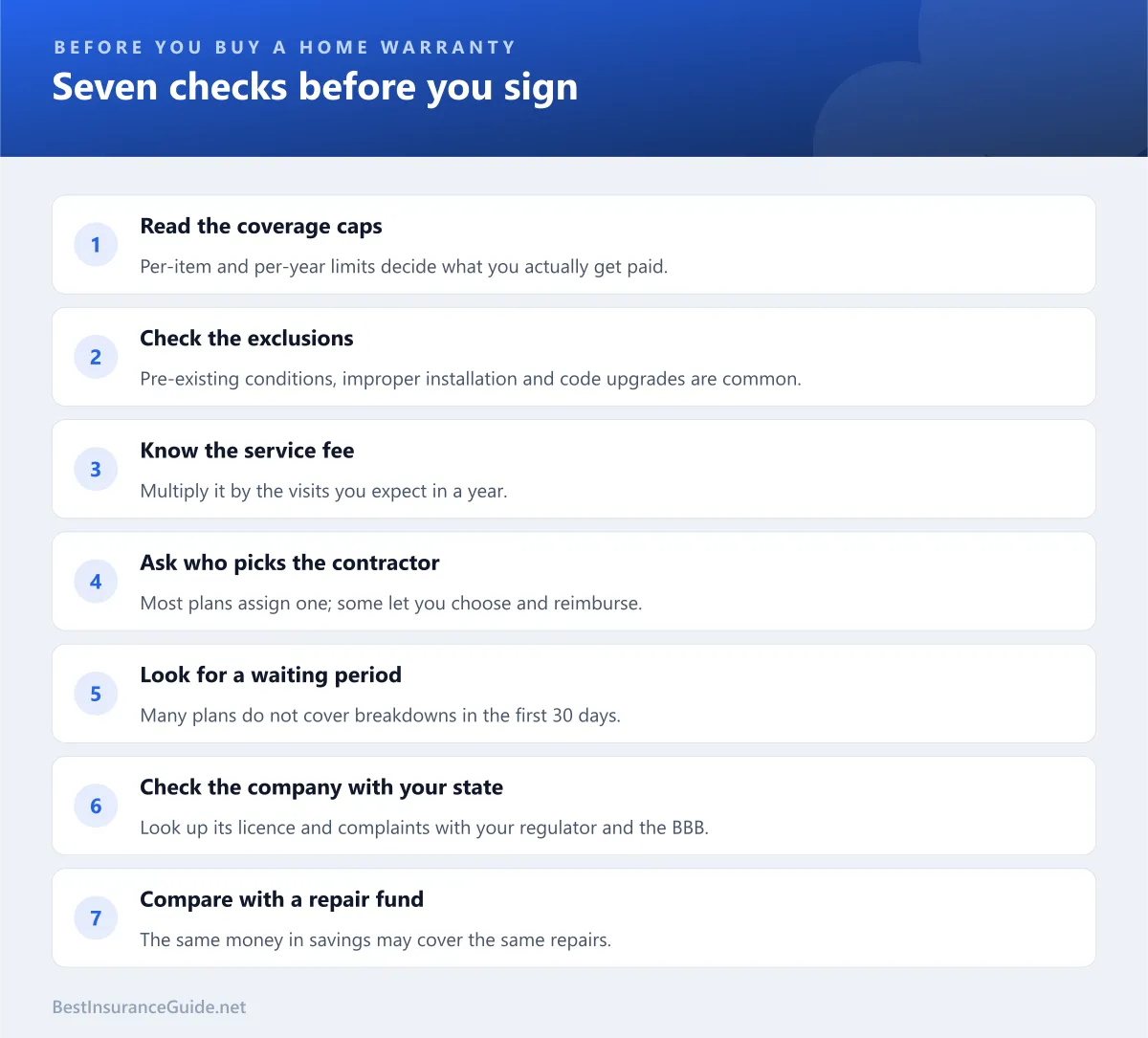
Searches for the “best home warranty company” are popular, but rankings change and every contract is different. Compare plans on the things that decide whether claims are paid:
- Get the sample contract, not just the brochure, and read the limits and exclusions.
- Compare caps per item and per year against realistic repair and replacement prices in your area.
- Price the whole year: the plan price plus the service fees you would expect to pay.
- Ask how contractors are chosen, how quickly they are dispatched, and whether you can use your own.
- Check the company’s licence and complaints with your state insurance department or consumer protection office, and look at its Better Business Bureau record.
- Check cancellation and refund terms, and whether the plan renews automatically.
Who regulates home warranties?
There is no federal regulator for home warranty companies. States set the rules, and they differ a great deal. In 1995 the NAIC produced a Service Contracts Model Act for states to adapt, but states choose whether and how to adopt it. Depending on the state, home warranty companies may be licensed by the insurance department (California’s Department of Insurance, for example, licenses home protection companies) or by a consumer protection agency, while some states have few specific rules. The FTC’s consumer advice treats home warranties as service contracts, and you can report deceptive practices to the FTC at ReportFraud.ftc.gov.
Related reading
- What home insurance covers explains the parts of a homeowners policy and the endorsements worth adding.
- Homeowners insurance deductible shows how deductibles work when you do claim.
- Hazard insurance vs homeowners insurance covers what mortgage lenders require.
- Does renters insurance cover appliances? explains equipment breakdown cover for tenants.
- Do I need flood insurance? covers the risk neither product includes.
Sources and notes
- This Old House, home warranty cost research (updated June 17, 2026): average about $56 a month ($672 a year), most plans $47 to $82 a month, based on more than 4,000 quotes from 13 companies in 50 states.
- NerdWallet, home warranty cost (2026): average $73 a month; plans from $28 to $191 a month.
- Freddie Mac, “Homeowners insurance costs” (March 20, 2024): average annual premium of $1,522 in 2023 for single-family, owner-occupied homes with conventional 30-year fixed-rate mortgages.
- Federal Trade Commission consumer guidance on home warranties and service contracts, including MilitaryConsumer.gov.
- NAIC, Service Contracts Model Act (1995).
- Coverage, caps and exclusions vary by company, plan and state. The worked example is illustrative.
This article is general information, not advice on any specific contract or policy. Read the full terms of any home warranty or insurance policy before you buy, and check with your state regulator if you have a complaint.