What Is an Insurance Score? The Credit Number Behind Your Premium
What is an insurance score? How it differs from a credit score, what a good score looks like, states that ban it, and how to improve yours.

Table of contents
Two drivers with the same car, the same address and the same spotless driving record can be quoted very different premiums. In most states, one of the reasons is a number neither of them has ever seen: their insurance score.
An insurance score, more formally a credit-based insurance score, is calculated from your credit report and used by car and home insurers to help predict how likely you are to file a claim. It is controversial, it is banned in a handful of states, and it is one of the few rating factors you can improve on your own.
This guide explains what an insurance score is, how it differs from a credit score, what goes into it, where it is restricted and what you can do about it.
What is an insurance score?
An insurance score is a number built from the information in your credit report, using a model designed to predict insurance losses rather than loan defaults.
Insurers do not use it on its own. It is one factor in the rating plan alongside your driving or claims history, location, the vehicle or home, and the coverage you choose. Our guide to what drives your insurance premiums shows where it typically ranks among the others: well behind claims history and location, but ahead of many factors people worry about more.
Why insurers use it
Insurers and the scoring companies argue that credit-based insurance scores are statistically associated with how often people file claims and how expensive those claims are. Studies commissioned by regulators, including a Federal Trade Commission report on auto insurance, found that the scores do predict claims.
Critics argue that the scores penalize people for financial hardship that has nothing to do with how they drive or maintain a home, and that they widen premium gaps for lower-income households. That debate is why several states ban or restrict them, and why bills to restrict them keep appearing in state legislatures.
How much it can affect your premium
The effect is large where it is allowed. A March 2026 NerdWallet analysis, as reported in the press, found that drivers with poor credit paid about 69% more on average for car insurance than drivers with good credit. Research published through the National Bureau of Economic Research found homeowners with low credit scores paid about 24% more than high-score homeowners for identical coverage. Exact figures vary by state, insurer and the rest of your profile.
Insurance score vs credit score
Both come from the same credit report, which is why people confuse them. They are different numbers built for different jobs.
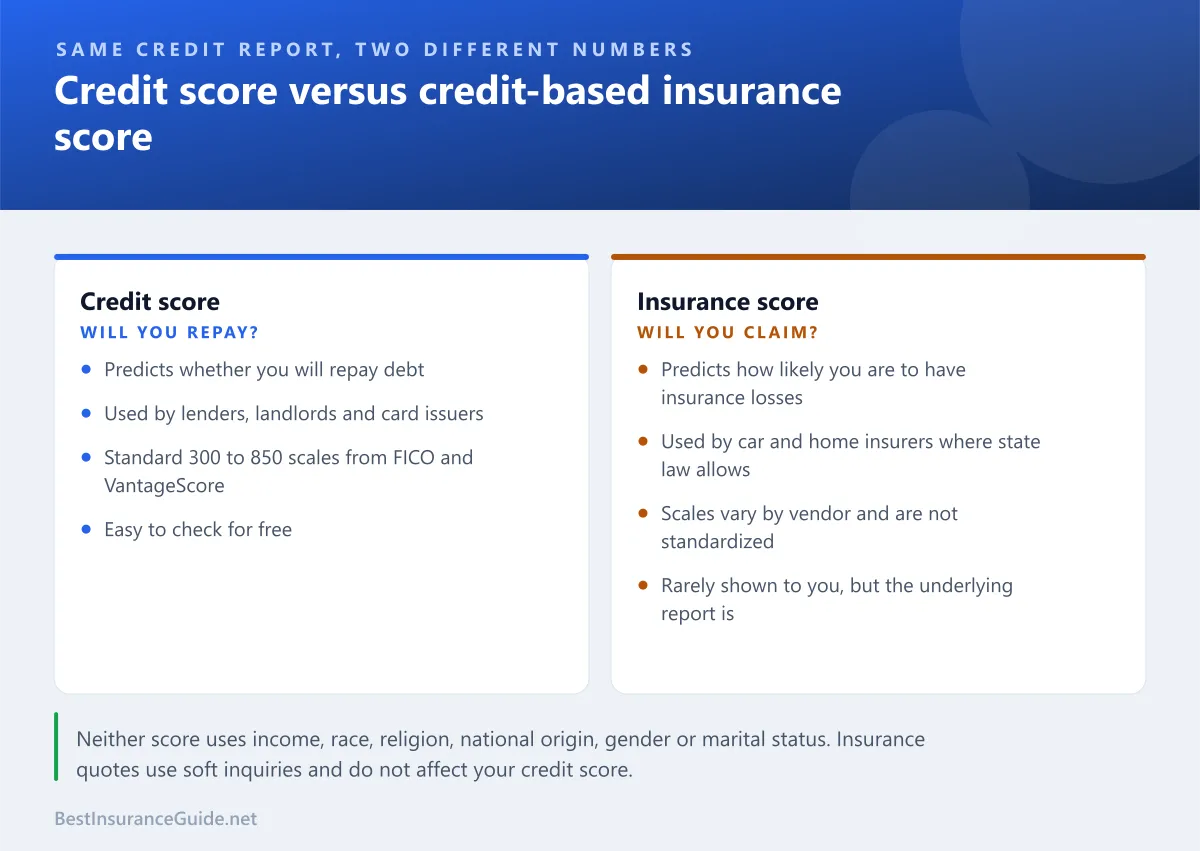
| Detail | Credit score | Insurance score |
|---|---|---|
| Predicts | Whether you will repay debt | How likely you are to have insurance losses |
| Used by | Lenders, landlords, card issuers | Car and home insurers, where allowed |
| Built from | Your credit report | Your credit report |
| Common scale | FICO and VantageScore, 300 to 850 | Varies by vendor; not standardized |
| Can you see it? | Yes, widely available | Rarely directly; you can see the underlying report |
| Affected by shopping around | Hard inquiries for loans can lower it | Insurance quotes use soft inquiries, no effect |
Because the models weight the same data differently, it is possible to have a good credit score and a middling insurance score, or the reverse, although most people land in similar bands on both.
What goes into an insurance score
The exact models are proprietary and vary by vendor. FICO, one of the main providers, publishes approximate weightings for its insurance scores.
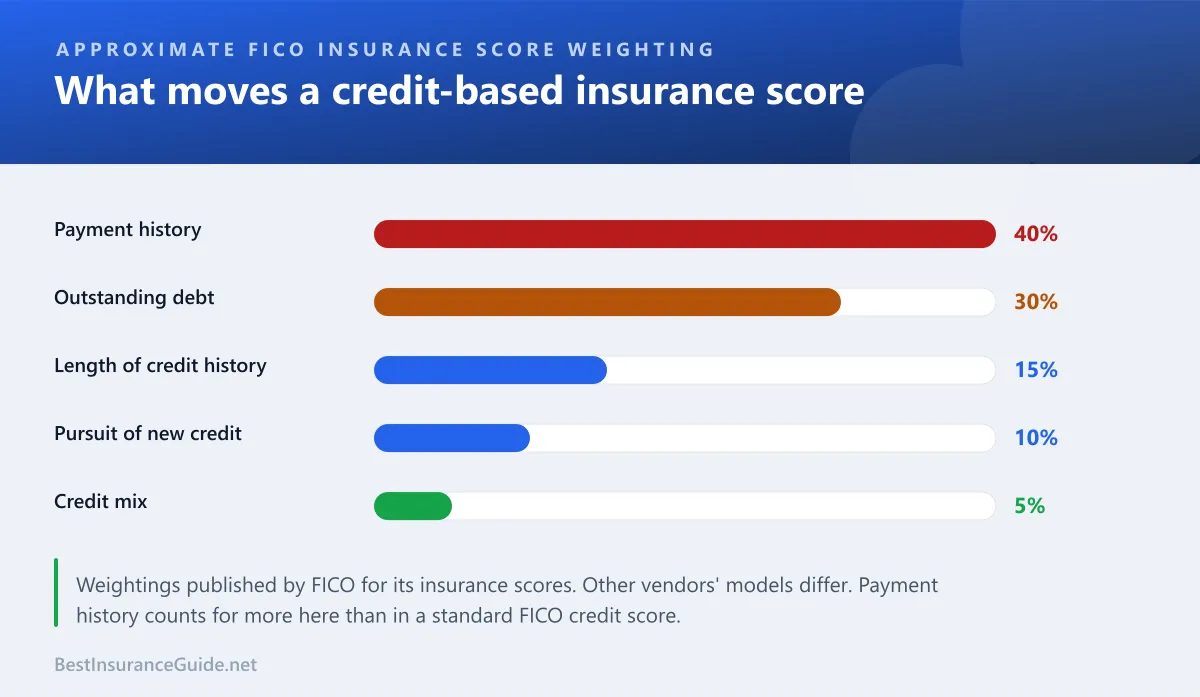
- Payment history, about 40%. Late payments, collections, bankruptcies. This carries more weight than in a standard FICO credit score, which puts payment history at about 35%.
- Outstanding debt, about 30%. How much you owe, particularly how much of your available revolving credit you are using.
- Length of credit history, about 15%. How long your accounts have been open.
- Pursuit of new credit, about 10%. Recent applications and newly opened accounts.
- Credit mix, about 5%. The variety of account types, such as cards, installment loans and a mortgage.
What an insurance score cannot include
Insurance scores do not use income, and they are not allowed to consider race, religion, national origin, gender or marital status. They also do not use your address, age or driving record, although insurers may use some of those separately in the rest of the rating plan.
Many states have adopted a model law from the National Council of Insurance Legislators that sets further rules, including that insurers cannot base a decision on credit alone and must consider exceptions for extraordinary life circumstances, such as a catastrophic illness, the death of a spouse, divorce, job loss, identity theft or military deployment. If one of those damaged your credit, it is worth asking your insurer whether it will reconsider.
When insurers check your credit
Knowing when the score is pulled helps you time improvements.
- At a new quote. Almost every insurer that uses credit checks it when you apply. This is where a better score produces the fastest saving.
- At renewal, sometimes. Some insurers re-check periodically, often every few years; others only on request. Several states limit how an insurer can use a worse score at renewal, and some require insurers to re-rate you on request once a year.
- After a big life event. If a divorce, medical bills or a job loss damaged your credit, ask whether your state’s extraordinary life circumstances rule applies.
What if you have no credit history?
Young adults, recent immigrants and people who have always paid cash can have a thin file or no file at all. The model law followed by many states stops insurers treating an absence of credit as if it were bad credit, typically requiring them to treat it neutrally or rate you as if credit were not a factor. It does not guarantee the best rate, but it should not put you in the worst tier. Opening a single card, using it lightly and paying it in full each month builds a history within a year or so.
What is a good insurance score?
There is no universal answer, because there is no universal scale. Different vendors produce scores with different ranges, some higher-is-better and some not, and insurers rarely publish the bands they use.
In practice, you do not need the number. The habits that produce a strong credit score produce a strong insurance score: paying every account on time, keeping card balances low relative to their limits, not opening several new accounts at once, and keeping older accounts open. If your credit score is in the good-to-excellent range, your insurance score is very likely to be in a favorable band too.
Where insurance credit scores are banned or restricted
State law decides whether and how insurers can use your credit.
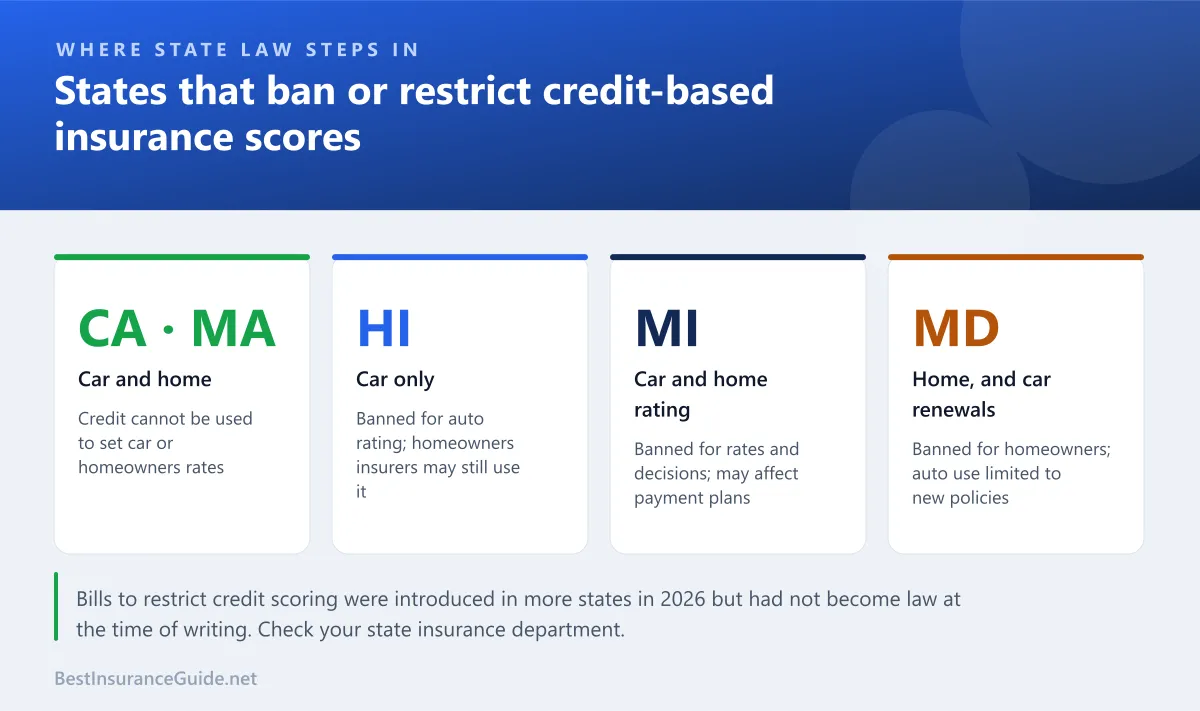
- California and Massachusetts prohibit using credit to set car or homeowners insurance rates.
- Hawaii prohibits it for car insurance but not homeowners insurance.
- Michigan bans insurers from using credit scores to set car and home insurance rates or to deny, cancel or non-renew policies, although it can still affect which payment plans are offered.
- Maryland bans credit for homeowners insurance decisions and pricing, and limits its use in car insurance to new policies. It cannot be used to raise your premium at renewal.
Other states have narrower rules, such as limits on using credit at renewal or bans on using the absence of credit history against you. Bills to restrict or ban credit-based insurance scores were introduced in several more states in 2026, including Iowa, New York, Oklahoma and Pennsylvania, but at the time of writing they had not become law. Check your state insurance department’s website for the current position.
Insurance companies that do not use credit scores
If you live in a state that allows credit-based pricing and your credit is weak, your options are:
- Insurers or programs that do not use credit. Some smaller insurers and usage-based programs price mainly on driving data instead. Availability varies by state, and these programs change often, so ask each insurer directly rather than relying on a list.
- Usage-based or telematics insurance. Your actual driving can offset part of a credit-based surcharge, though many telematics programs still use credit in the base rate.
- Shopping widely. Insurers weight credit very differently. The same credit history can cost much more with one insurer than another, which makes a thorough comparison of insurance quotes more valuable for people with weaker credit than for anyone else.
Do insurance quotes affect your credit score?
No. Insurers check your credit with a soft inquiry, which is visible only on your own copy of your credit report and has no effect on your credit score. You can request as many insurance quotes as you like without harming your credit.
Your rights under federal law
The Fair Credit Reporting Act gives you several protections whenever credit affects your insurance.
- Adverse action notice. If an insurer charges you more, or offers you less favorable terms, because of information in your credit report, it must tell you, name the credit reporting agency it used and explain your right to a free copy of the report.
- Free report. You are then entitled to a free copy of the report from that agency. You can also get free credit reports from each of the three nationwide bureaus through AnnualCreditReport.com.
- Disputes. If the report contains errors, you can dispute them with the bureau, which must investigate. Correcting an error can change your insurance score at the next renewal or re-quote.
Insurers may also use claims history reports, such as the CLUE report for property and auto claims, which you can request free once a year. Our guide to what an insurance underwriter does covers how those reports feed into the decision.
How to improve your insurance score
Insurance scores respond to the same changes as credit scores, but insurers usually re-check credit only at renewal or when you ask for a new quote, so improvement shows up with a lag.
- Pay every account on time. Payment history is the largest single category. Set up automatic minimum payments so a missed due date never becomes a late payment on your report.
- Bring card balances down. Lower utilization of revolving credit is one of the quickest ways to move both scores.
- Avoid opening several new accounts in the months before you shop for insurance.
- Keep older accounts open where it makes sense, to protect the length of your history.
- Check your reports for errors and dispute anything inaccurate.
- Ask for a re-rating once your credit has improved. Some insurers will re-check credit mid-term on request; otherwise, shop around at renewal.
Meanwhile, the factors you control more quickly still matter. Our guide to auto insurance discounts covers the ones most drivers miss, and raising your deductible, as explained in why higher deductibles lower premiums, can offset part of a credit-based surcharge.
The bottom line
An insurance score is your credit report, read through an insurer’s lens. In most states it is a significant pricing factor for car and home insurance, it does not affect your credit when you shop for quotes, and it improves through the same habits as a credit score: paying on time and keeping balances low. If your state allows it and your credit is weak, shopping widely is the most effective short-term fix; improving your credit is the lasting one.
BestInsuranceGuide.net is an independent publisher and is not affiliated with any insurer or credit scoring company. State laws on credit-based insurance scoring change; check with your state insurance department for the current rules. Premium impact figures are as reported by the sources named and vary by insurer and state.