Can You Cancel an Insurance Claim? Yes, But It May Not Disappear
Can you cancel an insurance claim? How to withdraw a car or home claim, whether it stays on your CLUE report, and when withdrawing is a mistake.

Table of contents

You filed a claim, then got the repair estimate and realized it was barely more than your deductible. Or the other driver offered to pay cash. Or you found out the damage was not covered after all. Now you want to take the claim back.
Can you cancel an insurance claim? Usually, yes. Insurers generally let you withdraw a first-party claim that has not been paid. But cancelling a claim is not the same as it never having happened. The record of the loss can remain on your claims history, and in some situations withdrawing is not possible or not wise.
This guide explains when you can cancel an insurance claim, how to do it, what stays on your record, and how to avoid the problem next time.
Can you cancel an insurance claim? The short answer
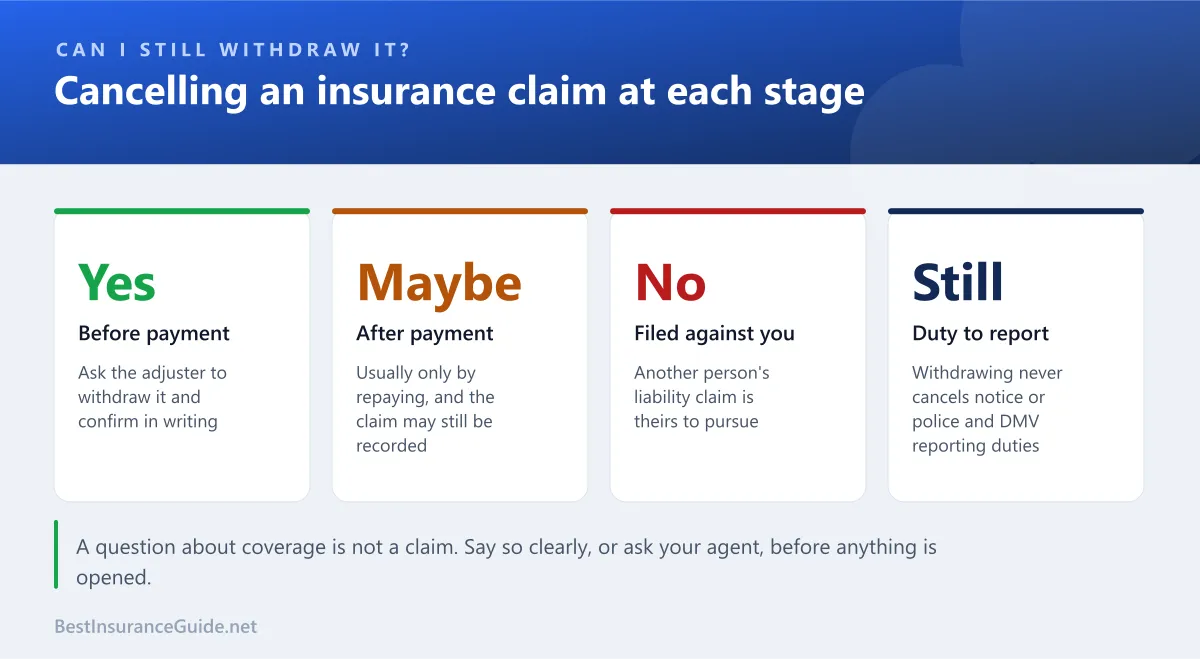
- Before the insurer pays: you can usually withdraw it by contacting the insurer or adjuster.
- After the insurer pays: you would generally have to repay the money, and the insurer is under no obligation to erase the claim.
- If someone else filed it against you: you cannot cancel it. It is their claim.
- If the loss involved injuries or the law requires a report: withdrawing the claim does not cancel your reporting duties.
Why people want to drop a claim
The most common reasons:
- The damage is close to the deductible. A $1,200 repair on a $1,000 deductible pays you $200 and may cost far more in higher premiums.
- The other party will pay directly. A neighbor offers to replace the fence their tree damaged, or the other driver pays for the scratch on your bumper.
- The loss is not covered. The adjuster explains that gradual leaks, wear and tear or a specific exclusion applies.
- Worry about a rate increase or non-renewal. Particularly after a second claim in a short period.
- The claim was opened by mistake. You called to ask a question and the insurer opened a claim.
All of these are legitimate reasons, and insurers deal with withdrawal requests routinely.
Does a cancelled claim stay on your record?
This is the part that matters most, and the honest answer is: it can.
Most insurers report claims to the CLUE database (Comprehensive Loss Underwriting Exchange), run by LexisNexis. Insurers check it when you apply for a new policy. According to the Washington State Office of the Insurance Commissioner, a CLUE report generally contains up to seven years of personal auto and property claims history.
A claim that was filed and then withdrawn, or closed without payment, can still appear on that report, typically showing a zero payment. Whether a future insurer treats it as a negative depends on the insurer, the type of claim and your state. Some insurers give little weight to zero-paid claims; others count any reported loss when deciding eligibility.
Inquiries are different. LexisNexis advises insurers not to report calls that simply ask a question about coverage or your deductible. That is why the way you first contact your insurer matters. More on that below.
What cancelling does and does not achieve
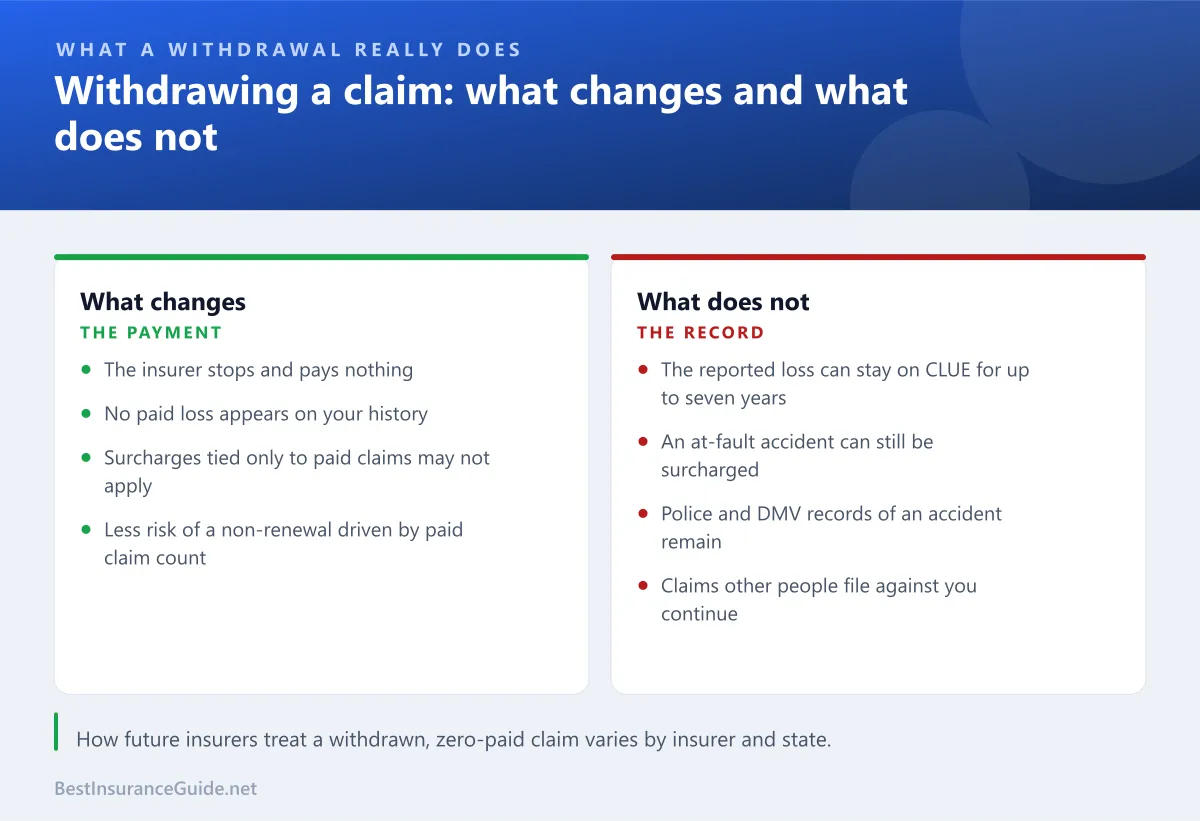
Withdrawing a claim can:
- stop the insurer paying, so there is no paid loss on your record;
- avoid some claim-based surcharges that apply only to paid claims;
- reduce the chance of a non-renewal triggered by a paid claim count.
Withdrawing a claim does not:
- erase the fact that you reported a loss;
- remove an at-fault accident from your insurer’s knowledge, or from your driving record if police or the state recorded it;
- cancel a claim someone else made against you;
- remove your obligation to cooperate if another party pursues the loss.
Cancelling a car insurance claim
Car claims have more moving parts, because other drivers and state reporting rules are often involved.
Your own collision or comprehensive claim. You can usually withdraw it before payment. Common cases are minor damage close to the deductible, or a repair you decide to pay for yourself.
An at-fault accident. Even if you withdraw your collision claim, your insurer knows about the accident. Many insurers can surcharge for an at-fault accident based on the accident itself, not only on a payment. Our guide to how much car insurance goes up after an accident explains how those surcharges are applied.
A not-at-fault accident. Rather than cancelling, it is often better to let your insurer pursue the at-fault driver’s insurer through subrogation, which may refund your deductible. See what to do after a car accident that wasn’t your fault.
A claim against your liability coverage. If the other driver files a claim against your policy, you cannot cancel it. Your insurer has a contractual duty to handle it, and you are obliged to cooperate. You can offer to pay the other driver directly before any claim is filed, but once it is filed, it runs its course.
Reporting duties. Most policies require you to notify the insurer promptly of any accident, even one you do not intend to claim for. Many states also require accidents above a damage threshold, or involving injury, to be reported to the police or the motor vehicle agency. Withdrawing a claim does not change either obligation.
Cancelling a home insurance claim
Home and renters claims are usually first-party claims, so withdrawal is simpler, but the record issue matters more. Homeowners insurers weigh claim history heavily, and water damage claims in particular are often treated as a sign of future losses. A home with several recent claims can be harder to insure, and that history can follow the property, affecting a future buyer as well as you.
Common situations:
- Small losses near the deductible, such as minor storm damage or a broken window.
- Losses that turn out not to be covered, such as gradual leaks, mold from long-term moisture or wear and tear.
- Losses another party will pay for, such as a contractor who damaged your property.
If the damage is significant, withdrawing to protect your record is usually a false economy. Insurance exists for the losses you cannot comfortably absorb. Our guide to choosing your homeowners insurance deductible covers where that line should sit.
How to cancel an insurance claim
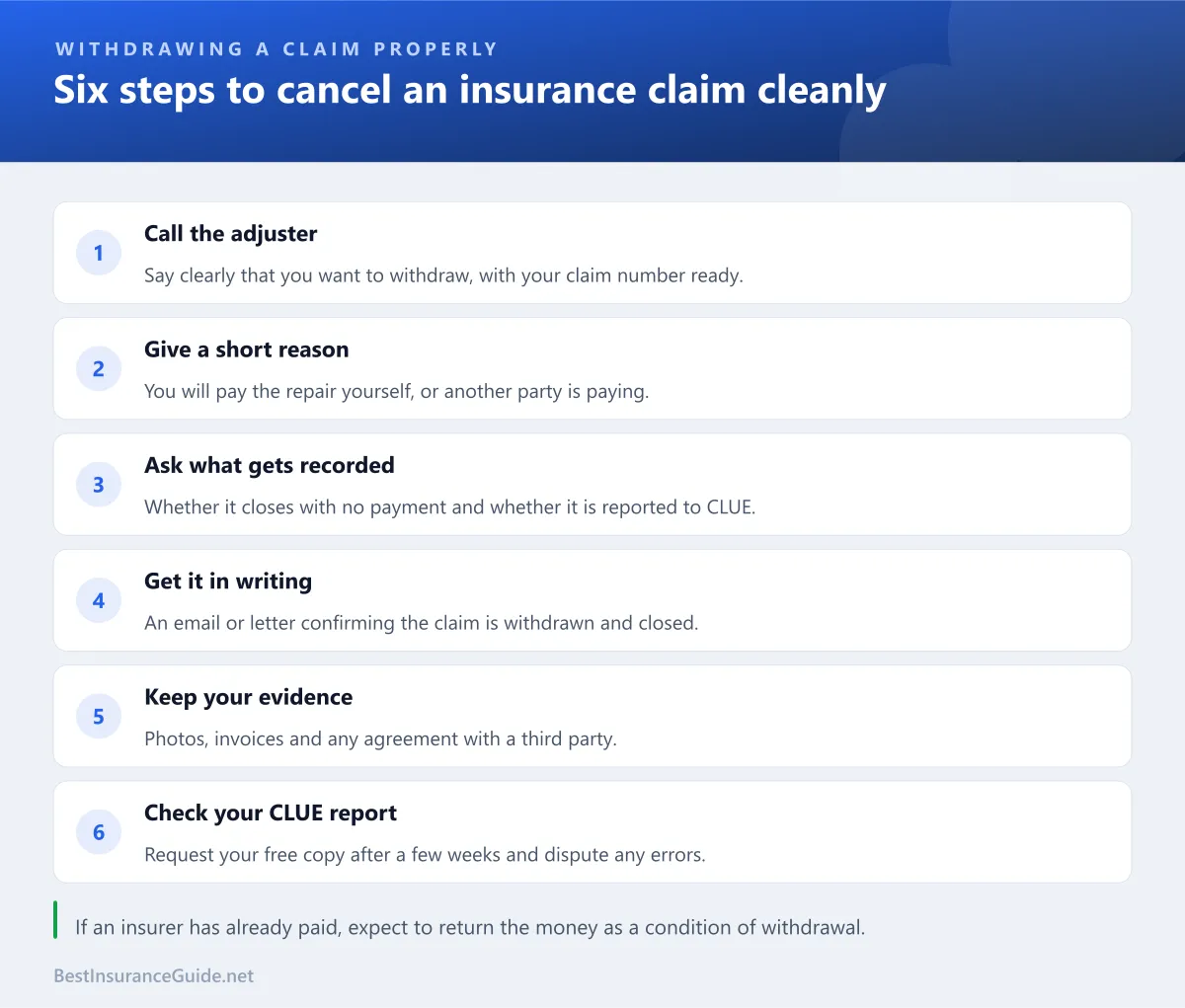
- Call your adjuster or the claims line and say clearly that you want to withdraw the claim. Have your claim number ready.
- Explain why, briefly, for example that you will pay the repair yourself or that another party is paying.
- Ask what will be recorded: whether the claim will be closed without payment and whether it will be reported to CLUE.
- Get written confirmation by email or letter that the claim has been withdrawn and closed with no payment.
- Return any payment you have already received, if the insurer requires it as a condition of withdrawal.
- Keep records of the damage, repair invoices and any agreement with a third party, in case the issue resurfaces.
- Check your CLUE report a few weeks later. You are entitled to a free copy under the Fair Credit Reporting Act.
A worked example: is the claim worth keeping?
A driver backs into a pole. The repair estimate is $1,400 and the collision deductible is $500, so the claim would pay $900.
Suppose, for illustration, the driver’s annual premium is $1,800 and the insurer applies a 25% surcharge for an at-fault claim for three years. That adds about $450 a year, or $1,350 over three years, more than the claim pays.
In that case, paying for the repair and not claiming makes financial sense, provided the insurer does not surcharge the accident anyway once it knows about it. The real lesson is that this decision is easier to make before filing than after. Surcharge rules differ widely by insurer and state, so ask your agent how a claim of this size would be treated.
Settling privately instead of claiming
Paying the other party directly, or accepting their payment, is the most common reason people drop a claim. It can work well for genuinely minor damage, but it carries risks worth managing.
- Get a written agreement. A short signed note stating what was damaged, the amount paid and that it settles the matter protects both sides. For anything beyond minor property damage, a formal release reviewed by a lawyer is safer.
- Use a real estimate. Pay or accept payment based on a body shop or contractor quote, not a guess at the scene.
- Do not settle injuries informally. Soreness after a car accident can turn into a significant claim weeks later. If anyone might be hurt, involve the insurers.
- Still notify your insurer if your policy requires it. Reporting an accident is not the same as filing a claim, and failing to report can jeopardize your coverage if the other party changes their mind.
- Expect the unexpected. If the other driver later files against your policy, your insurer will handle it, and your private payment may count toward the settlement if you kept proof of it.
Handled carefully, a private settlement avoids a claim entirely, which is better for your record than filing and then withdrawing.
Ask first, claim second
The cleanest way to avoid a claim you later want to cancel is not to open one until you have decided.
- Get a repair estimate first when the damage is minor and nobody is hurt.
- Ask your agent rather than the claims line. An agent can usually tell you whether something is covered and what your deductible would leave, without opening a claim.
- If you call the insurer, say explicitly that you are asking a question, not reporting a claim.
- Know your deductible before anything happens. Our explainer on why higher deductibles lower premiums covers how to set it at a level you can pay.
Do not let this become an excuse to delay reporting a genuine loss. Most policies require prompt notice, and late notice can jeopardize coverage, especially where injuries or other parties are involved.
How long do you have to file an insurance claim?
There is no single deadline. Policies generally require prompt notice of a loss, and many set specific time limits for submitting a proof of loss or for filing a lawsuit against the insurer, commonly one or two years depending on the policy and the state. Deadlines can be extended after declared disasters in some states.
Because the rules vary, the practical rule is to notify your insurer or agent as soon as reasonably possible after any significant loss, even while you decide whether to pursue payment.
When you should not cancel a claim
- Injuries are involved. Medical costs and liability claims can grow long after the event.
- Another party may make a claim later. If you withdraw and they sue months later, you still need your insurer.
- The damage may be larger than it looks. Hidden structural, water or mechanical damage often appears after the first estimate.
- The other driver was at fault. Let your insurer recover from them rather than absorbing the cost yourself.
- The loss is large. Protecting your claims record is not worth absorbing a loss you cannot afford.
The bottom line
You can usually cancel an insurance claim before it is paid, and insurers handle withdrawals routinely. But withdrawing does not make the loss disappear: the report can stay on your CLUE history for years, an at-fault accident can still be surcharged, and a claim someone else filed against you cannot be withdrawn at all.
The better habit is to ask before you claim: get an estimate, check your deductible, and talk to your agent. For how insurers use your claims history when you next shop, see our guides to what an underwriter checks and your insurance score.
BestInsuranceGuide.net is an independent publisher and is not affiliated with any insurer or with LexisNexis. The worked example is illustrative; surcharge rules, reporting requirements and claim deadlines vary by insurer and state.