Social Security COLA 2027: How Much Medicare Part B Will Take From Your Raise
The 2027 Social Security COLA is announced Oct 14, 2026, with forecasts near 3.5%. What it adds to your check after the Medicare Part B increase.

Table of contents

The 2027 Social Security cost-of-living adjustment (COLA) will be announced on October 14, 2026, the day the Bureau of Labor Statistics releases September’s inflation data. Forecasts point to a raise of roughly 3.5% to 3.6%, higher than the 2.8% COLA for 2026.
For most retirees, though, the headline number is not what lands in the bank. Medicare Part B premiums are deducted straight from Social Security checks, and Part B is going up too. This guide explains how big the 2027 raise is likely to be, how much Medicare is projected to take back, and how the hold-harmless rule protects many beneficiaries.
We will update this article with the official COLA on October 14 and the official 2027 Part B premium when CMS announces it, usually in November.
This site is independent and not affiliated with the Social Security Administration or Medicare. Figures are attributed to SSA, the BLS, the Medicare Trustees and named forecasters below.
The short version
- Announcement date: October 14, 2026, after the 8:30 a.m. ET release of September’s Consumer Price Index.
- Forecast COLA: about 3.5% (The Senior Citizens League) to 3.6% (AARP).
- 2026 COLA for comparison: 2.8%.
- Projected 2027 Part B premium: $209.50 a month, up $6.60 from $202.90 (2026 Medicare Trustees Report).
- Net effect for an average retiree: roughly +$65 to +$69 a month after the projected Part B increase.
- When it arrives: in benefits paid in January 2027.
How the COLA is calculated
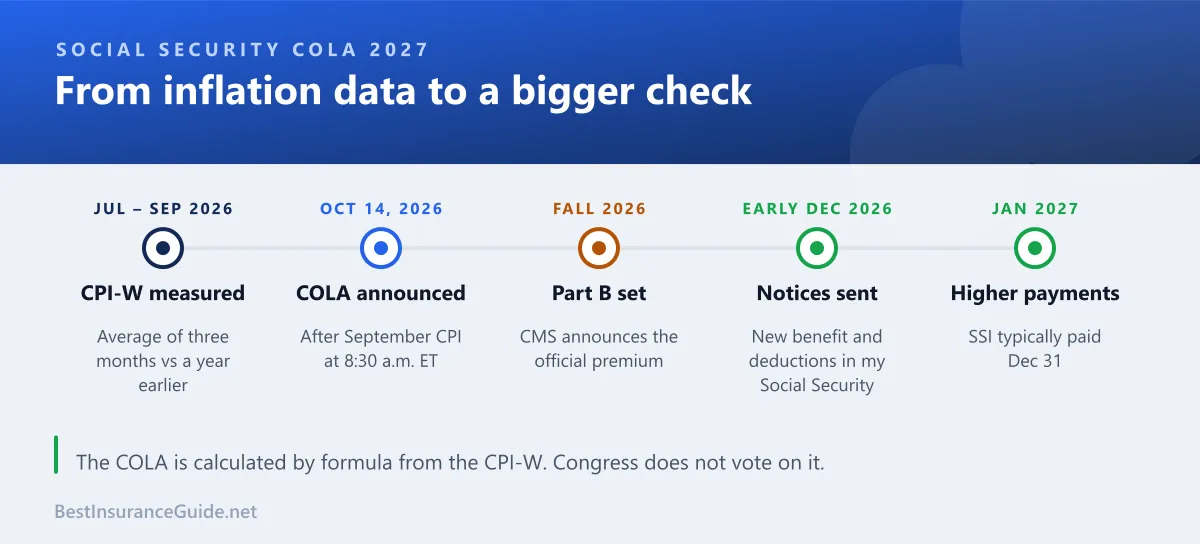
The COLA is set by formula, not by Congress. Social Security compares the average Consumer Price Index for Urban Wage Earners and Clerical Workers (CPI-W) for July, August and September with the same three months a year earlier. The percentage increase, rounded to the nearest tenth, becomes the COLA.
By early October, two of the three months are known. That is why forecasters can estimate the result closely, and why the final number depends on one last data point: September’s CPI, released on October 14, 2026.
What the forecasts say
| Forecaster | 2027 COLA estimate | When |
|---|---|---|
| The Senior Citizens League | 3.5% | Final estimate after August CPI, September 2026 |
| AARP | 3.6% | Revised up from 3.5% after August CPI, September 2026 |
| 2026 actual COLA (for comparison) | 2.8% | Announced October 2025 |
A COLA of 3.5% to 3.6% would be the largest since the 8.7% COLA for 2023, above 2024’s 3.2%, 2025’s 2.5% and 2026’s 2.8%. The increase reflects inflation that has stayed stubbornly firm through the summer of 2026.
COLA history: the last ten years
| Benefit year | COLA |
|---|---|
| 2017 | 0.3% |
| 2018 | 2.0% |
| 2019 | 2.8% |
| 2020 | 1.6% |
| 2021 | 1.3% |
| 2022 | 5.9% |
| 2023 | 8.7% |
| 2024 | 3.2% |
| 2025 | 2.5% |
| 2026 | 2.8% |
| 2027 | ≈3.5%–3.6% (forecast) |
Source: Social Security Administration COLA history. 2027 is a forecast until October 14, 2026.
What it means for your check
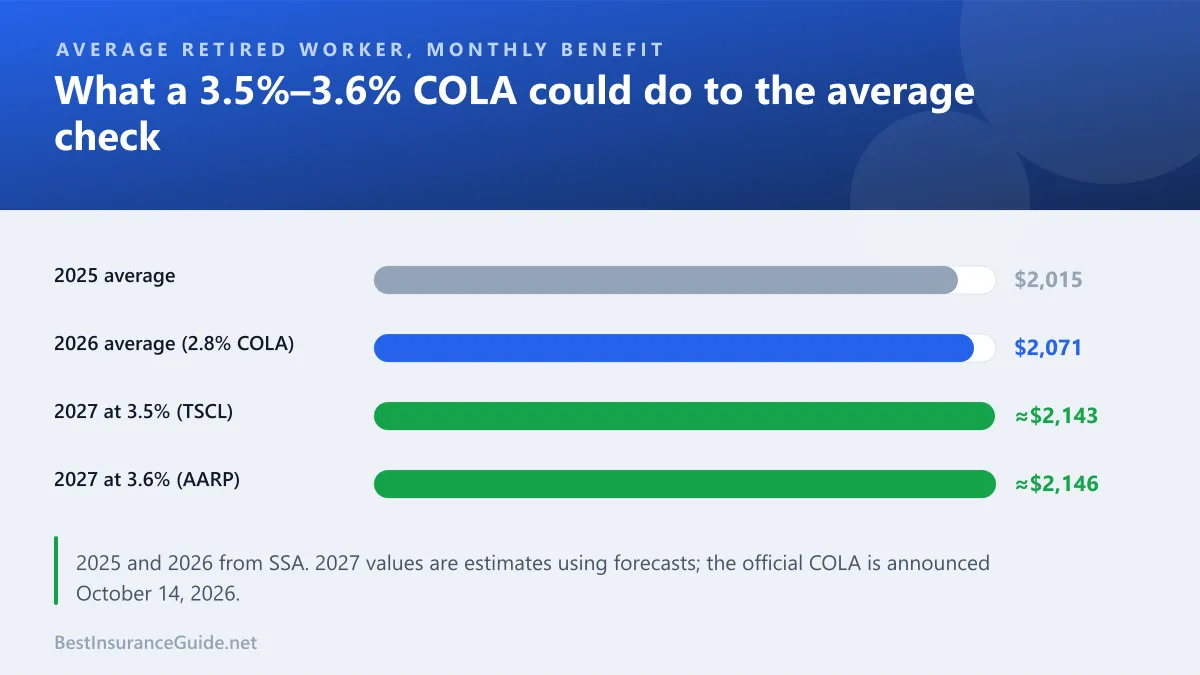
According to SSA, the average retired worker’s benefit rose from $2,015 to $2,071 a month with the 2026 COLA. Applying the forecasts to that average:
| Scenario | Monthly increase | New average benefit |
|---|---|---|
| 3.5% COLA | +$72 | about $2,143 |
| 3.6% COLA | +$75 | about $2,146 |
Rounded estimates based on SSA’s published 2026 average. Your own increase equals your benefit multiplied by the official COLA.
How much Medicare Part B takes back
Most people with both Social Security and Medicare have their Part B premium deducted from their monthly benefit. So when Part B goes up, part of the COLA disappears before you see it.
- 2026 standard Part B premium: $202.90 a month (CMS).
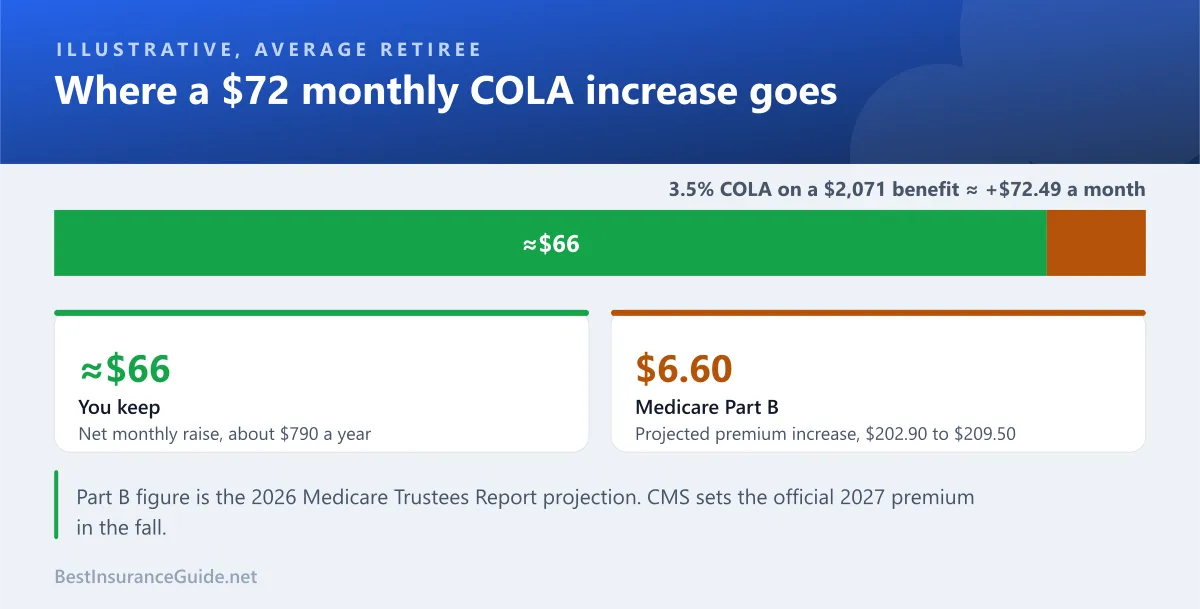
- 2027 projection: $209.50 a month, according to the 2026 Medicare Trustees Report. That is an increase of $6.60.
Worked example: the average retiree
Illustrative, using the 3.5% forecast and the Trustees’ Part B projection.
| Detail | Amount |
|---|---|
| 2026 average benefit | $2,071.00 |
| 3.5% COLA increase | +$72.49 |
| Part B premium increase ($202.90 → $209.50) | −$6.60 |
| Net monthly increase | ≈ +$65.89 |
| Net yearly increase | ≈ +$790 |
That is a meaningful raise, and a better net result than in years when Part B jumped sharply. In 2026, for example, Part B rose $17.90 while the COLA was 2.8%.
Caution: the Part B figure is a projection. CMS sets the official 2027 premium in the fall. If it comes in higher, the net raise shrinks. We will update this table when CMS announces it.
Who else gets the COLA
The same percentage applies well beyond retirement benefits:
- Social Security Disability Insurance (SSDI) benefits rise by the same COLA.
- Survivor benefits, for widows, widowers and children, rise by the same COLA.
- Supplemental Security Income (SSI): the federal payment amounts rise by the COLA percentage. SSI recipients usually receive their first higher payment on the last business day of December.
- Veterans’ disability compensation has traditionally been increased by the same percentage as the Social Security COLA, through annual legislation.
If you receive more than one of these, each increase is calculated separately. Check each notice you receive.
The hold-harmless rule: who is protected
The hold-harmless provision in the Social Security Act protects many beneficiaries from a shrinking check. If your Part B premium is deducted from your Social Security benefit, a Part B increase cannot reduce your net benefit below what you received the year before. In practice, your Part B increase is capped at the dollar amount of your COLA.
With a COLA of about 3.5% and a projected Part B increase of only $6.60, the rule is unlikely to come into play for most people in 2027. It matters most for people with very small benefits in years when Part B rises sharply.
Not everyone is protected. Generally, the rule does not apply to:
- People newly enrolled in Part B who did not have premiums deducted the previous year.
- Higher-income beneficiaries who pay the income-related monthly adjustment amount (IRMAA).
- People whose Part B premium is paid by Medicaid through a Medicare Savings Program. They are not affected by premium increases anyway.
Why your raise may still feel too small
Many retirees find that the COLA lags their real costs. There are three main reasons.
The index is not built around retirees. The COLA follows the CPI-W, which reflects spending by working households. Older adults typically spend a larger share of their budget on healthcare and housing, costs that often rise faster than the overall index. The Bureau of Labor Statistics publishes an experimental index for older Americans, known as CPI-E, but by law the COLA uses the CPI-W.
Healthcare premiums come off the top. Part B is only one deduction. Part D, Medigap and Medicare Advantage premiums can all rise in the same year, and those increases are not offset by the COLA.
Taxes on benefits. A higher benefit can push more of your Social Security income into the taxable range, which the next section explains.
Will the COLA make more of your benefit taxable?
Up to 85% of Social Security benefits can be subject to federal income tax, depending on your provisional income: roughly your other income plus half your benefits. The thresholds are $25,000 for single filers and $32,000 for married couples filing jointly. Above $34,000 for single filers and $44,000 for joint filers, up to 85% of benefits can be taxed.
Those thresholds have never been indexed to inflation. As COLAs raise benefits year after year, more retirees cross them. For tax years 2025 through 2028, federal law also provides a temporary additional deduction for taxpayers aged 65 and older, which can offset some of this. Because these rules interact with your other income, a tax professional or the IRS’s free tax help programmes can tell you how they apply to you.
Other 2027 changes to watch
- IRMAA brackets. Higher-income beneficiaries pay more for Part B and Part D. The 2027 brackets come with CMS’s fall announcement and are based on your 2025 tax return.
- Part D costs. The Part D deductible rises to $700 and the out-of-pocket cap to $2,400 in 2027. See our Medicare 2027 changes guide.
- Medicare Advantage premiums, deducted from Social Security for some members, can change. Check your plan’s Annual Notice of Change.
- Taxable earnings and earnings-test limits change with the COLA announcement. They matter if you still work.

Photo: National Cancer Institute / Rhoda Baer, public domain, via Wikimedia Commons.
When the 2027 COLA arrives
- October 14, 2026: COLA announced.
- Early December 2026: Social Security sends COLA notices by mail and posts them in your my Social Security account, showing your new benefit and Medicare deductions.
- December 31, 2026: SSI recipients typically receive their increased January payment.
- January 2027: Social Security beneficiaries receive their first higher payment, paid on the usual schedule based on birth date.
How to make the most of your 2027 raise
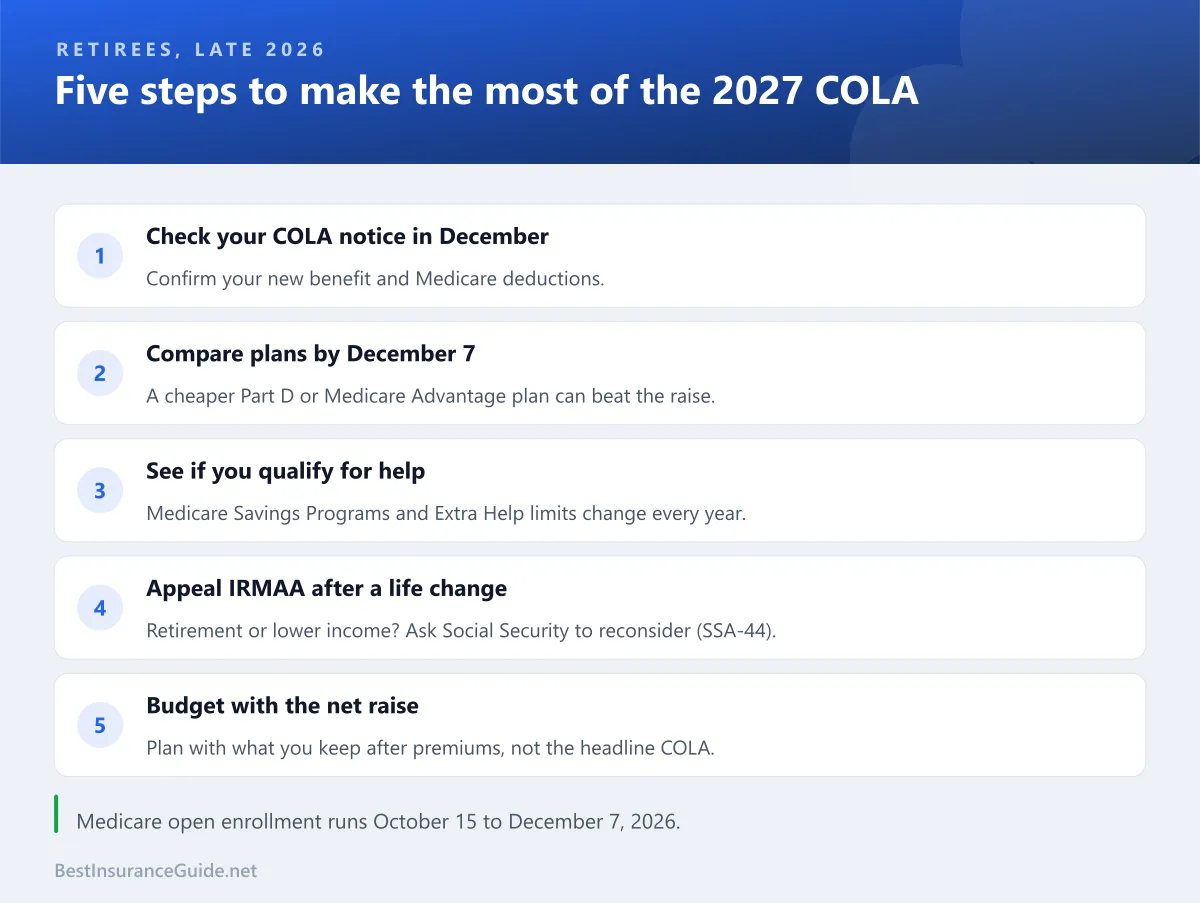
- Check your COLA notice in December. Confirm your new gross benefit and your Part B and Part D deductions.
- Use Medicare open enrollment, October 15 to December 7. A cheaper Part D or Medicare Advantage plan can matter more than the COLA. Compare total yearly costs on Medicare.gov.
- Check whether you qualify for help. Medicare Savings Programs can pay your Part B premium, and Extra Help lowers Part D costs. Income limits change each year, so check again even if you were turned down before.
- Review IRMAA if your income dropped. If your income fell because of a life-changing event such as retirement, you can ask Social Security to reconsider IRMAA using form SSA-44.
- Update your budget for 2027. Use the net raise, not the headline COLA, when planning.
Related reading
Medicare 2027 changes covers the Part B projection, Part D and Medicare Advantage in detail. Can you get Medicare at 62? explains coverage before 65, and Medicare vs Medicaid explains how the two programmes work together for people with limited income.
Sources and notes
- Social Security Administration, 2026 COLA fact sheet and press release, October 2025: 2.8% COLA; average retired worker benefit $2,015 to $2,071.
- U.S. Bureau of Labor Statistics, Consumer Price Index release schedule: September 2026 CPI released October 14, 2026.
- The Senior Citizens League, final 2027 COLA estimate of 3.5%, September 2026, as reported by FedSmith.
- AARP projection of a 3.6% 2027 COLA, as reported by CBS News, September 11, 2026.
- CMS, 2026 Medicare Part B premium of $202.90; 2026 Medicare Trustees Report projection of $209.50 for 2027, as reported by MOAA.
- Featured photo: National Cancer Institute / Rhoda Baer, public domain, via Wikimedia Commons.
COLA and premium figures above are forecasts and projections until officially announced. This article is general information, not financial or legal advice. This site is independent and not affiliated with the Social Security Administration, CMS or Medicare.