General Liability Insurance: What It Covers, What It Costs and Who Needs It
What general liability business insurance covers and excludes, typical cost (about $45 a month), $1M/$2M limits explained, BOP vs standalone, and how to buy the right policy.

Table of contents

General liability insurance pays when your business is blamed for hurting someone or damaging their property. A customer slips on a wet floor, a contractor cracks a client’s countertop, a product injures a buyer, or an advert is accused of defaming a competitor: a standard commercial general liability (CGL) policy covers the claim and your legal defence. For most small businesses it costs about $45 a month, according to Insureon, and it is the policy landlords and clients ask for first.
We are an independent site; figures below are attributed to Insureon and The Hartford, and examples are labelled illustrative.
The risk is growing. The Hartford’s December 2025 analysis of more than a million small business policies found that slip-and-fall incidents made up 20% of claims, double their share in 2015, and that their average cost had risen from $20,000 to $45,000, which the insurer partly put down to litigation and larger settlements.
General liability insurance at a glance
| Question | Short answer |
|---|---|
| What it covers | Third-party bodily injury, property damage, products and completed work, personal and advertising injury, legal defence |
| What it does not | Your employees’ injuries, your own property, professional mistakes, vehicles, cyber incidents |
| Typical limits | $1 million per occurrence / $2 million aggregate |
| Typical cost | About $45 a month (Insureon customers); far more for high-risk trades |
| Required by law? | Rarely, but often required by leases and contracts |
| Usual policy type | Occurrence basis |
| Cheaper bundle | Business owner’s policy (BOP) for eligible small businesses |
What general liability insurance covers
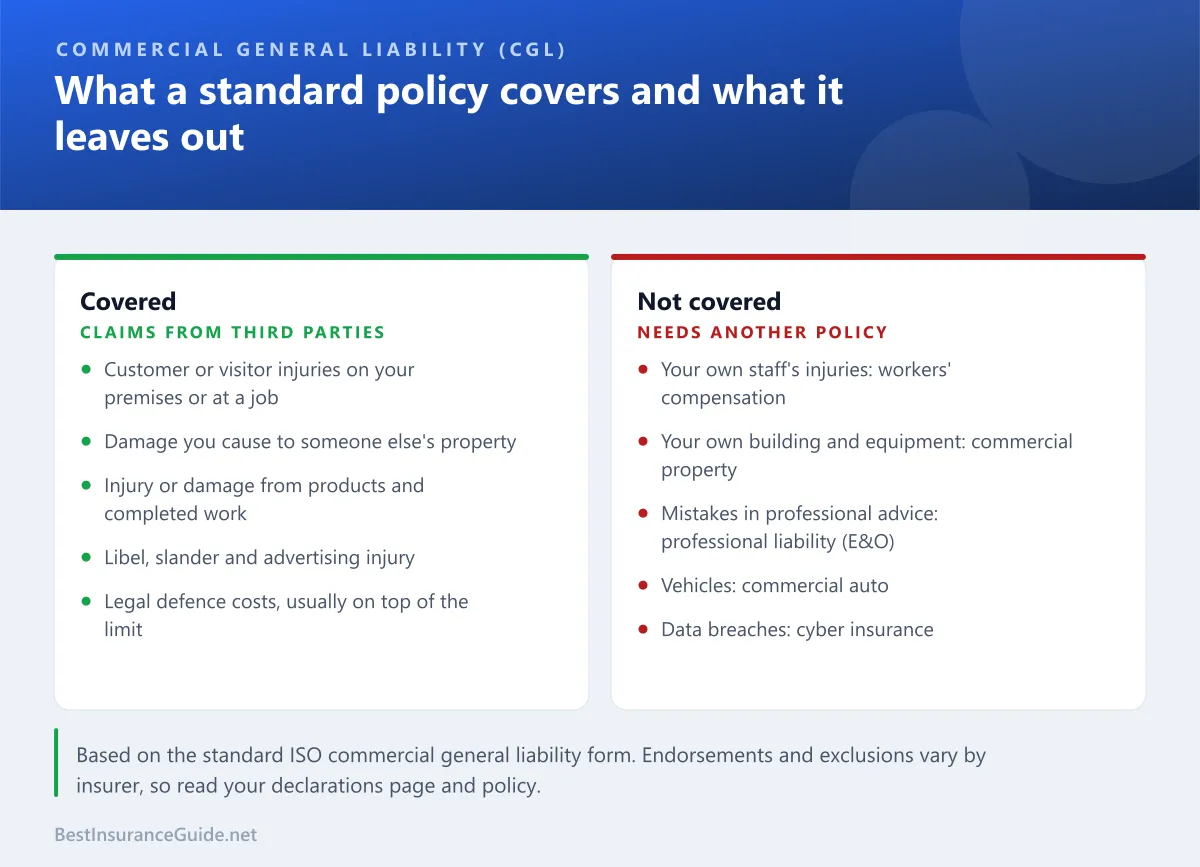
The standard CGL form used by most insurers, published by ISO, is built around three coverage parts.
Coverage A: bodily injury and property damage
This is the core. It pays when your business operations, premises, products or completed work cause:
- bodily injury to someone who is not your employee, such as a customer who trips over a cable;
- property damage to something you do not own, such as water damage to a client’s home from a fitting you installed.
It includes products-completed operations cover, for injury or damage that happens after a product leaves your hands or a job is finished. That is essential for contractors, manufacturers, food businesses and retailers, and usually has its own aggregate limit.
It also includes damage to premises rented to you, which helps if you accidentally damage a space you lease, for example through a fire. The limit is usually much lower than the main limit.
Coverage B: personal and advertising injury
This covers non-physical harms, including:
- libel and slander, written or spoken statements that damage someone’s reputation;
- false arrest or detention, a real risk for retailers handling suspected shoplifters;
- wrongful eviction or invasion of the right of private occupancy;
- copyright, trade dress or slogan infringement in your advertising, though other intellectual property claims are usually excluded.
Coverage C: medical payments
This pays small medical bills for people injured on your premises regardless of fault, typically up to $5,000 or $10,000 per person. It can settle a minor incident quickly, before it turns into a lawsuit.
Legal defence
The insurer must defend you against suits seeking covered damages, even if they are groundless. On a standard CGL form, defence costs are paid as “supplementary payments” in addition to your limits, which means a long legal fight does not eat into the money available for a settlement.
What general liability does not cover
General liability is broad but not complete. These are the most common gaps, and the policies that fill them:
| Not covered by GL | Policy you need |
|---|---|
| Injuries to your own employees | Workers’ compensation |
| Your own building, equipment and stock | Commercial property or a BOP |
| Financial loss from your advice or services | Professional liability (E&O) |
| Accidents in vehicles you own or use for work | Commercial auto |
| Data breaches and hacking | Cyber liability |
| Claims above your limits | Commercial umbrella |
| Pollution, intentional acts, contractual liability you take on | Specialist cover or careful contract review |
Many insurers also add industry-specific exclusions, for example for roofing, height work, certain products or abuse and molestation. Read the exclusions page before you sign.
How much general liability insurance costs
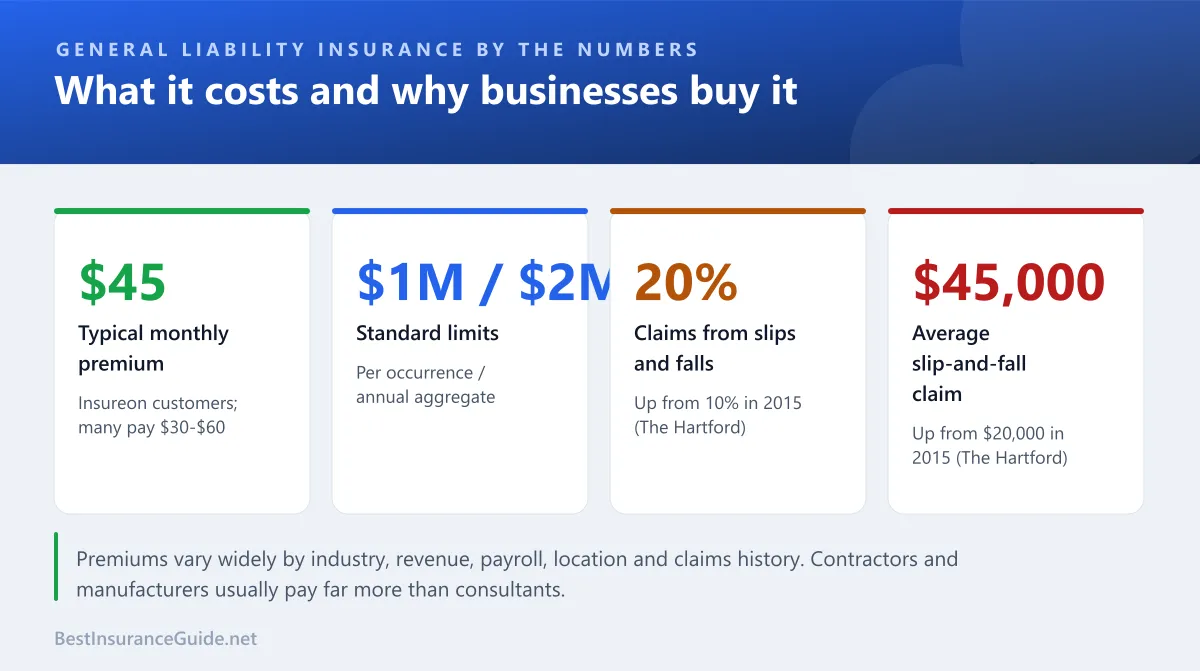
Insureon, an online broker, reports a typical premium of about $45 a month, roughly $540 a year, for general liability bought by its small business customers. It says 41% pay between $30 and $60 a month and 22% pay under $30.
What drives your price:
- Industry and the type of work. A bookkeeper working from home is a very different risk from a roofer or a restaurant. Contractors are often rated on payroll; retailers and restaurants on sales.
- Revenue or payroll. More sales or more work means more exposure.
- Location and foot traffic. Customers on your premises raise the slip-and-fall risk.
- Claims history. Past claims raise premiums for years.
- Limits and deductible. Higher limits cost more, but the second million is usually much cheaper than the first.
- How you buy. A BOP bundling liability with property often costs less than separate policies for eligible businesses.
Our guides to startup business insurance costs and business insurance by trade give more examples.
Choosing your limits
$1 million per occurrence and $2 million aggregate is the standard starting point, and it is what most landlords and clients require.
- Per occurrence ($1 million): the most the policy pays for one incident.
- General aggregate ($2 million): the most it pays for all claims in the policy year, apart from products-completed operations.
- Products-completed operations aggregate (often $2 million): a separate annual cap for those claims.
Illustrative. A customer at a small shop is badly hurt in a fall and wins $1.4 million. A $1 million per-occurrence limit leaves $400,000 unpaid, which the business owes. With a $1 million umbrella on top, the umbrella pays the $400,000. As our business umbrella insurance guide explains, adding an umbrella is usually cheaper than raising the primary limit, and it sits over several policies at once.
Go higher if contracts require it, if you work on large commercial projects, sell products widely, host events or serve alcohol.
Who needs general liability insurance?
Almost any business that deals with the public, works at other people’s premises or sells products. In practice, you will need it if:
- you lease commercial space: landlords almost always require it and want to be named as an additional insured;
- you work for other businesses or general contractors, who will ask for a certificate of liability insurance and sometimes a waiver of subrogation before you start;
- you exhibit at events or markets, where venues require proof of cover, as in our event planner insurance guide;
- you visit clients’ homes or sites, such as cleaners, landscapers and tradespeople; see our landscaping business insurance guide;
- you sell or make products, including online sellers;
- you run a home-based business: homeowners policies usually exclude business activities, so a client injured at your home office may not be covered.
Sole traders are not exempt. If you work alone, you are personally exposed to a claim; our guide to business insurance for sole proprietors covers what to prioritise.
Business liability vs personal liability insurance
If you searched for “liability insurance” and are not running a business, you may need personal liability cover instead. It is included in homeowners and renters insurance, typically from $100,000 to $500,000, and covers you if a guest is injured at home or you accidentally damage someone else’s property. Our renters insurance guide and the article on whether renters insurance covers injuries explain how it works. A personal umbrella policy adds higher limits on top. Car accidents are covered by auto liability insurance, not general liability.
How to buy general liability insurance
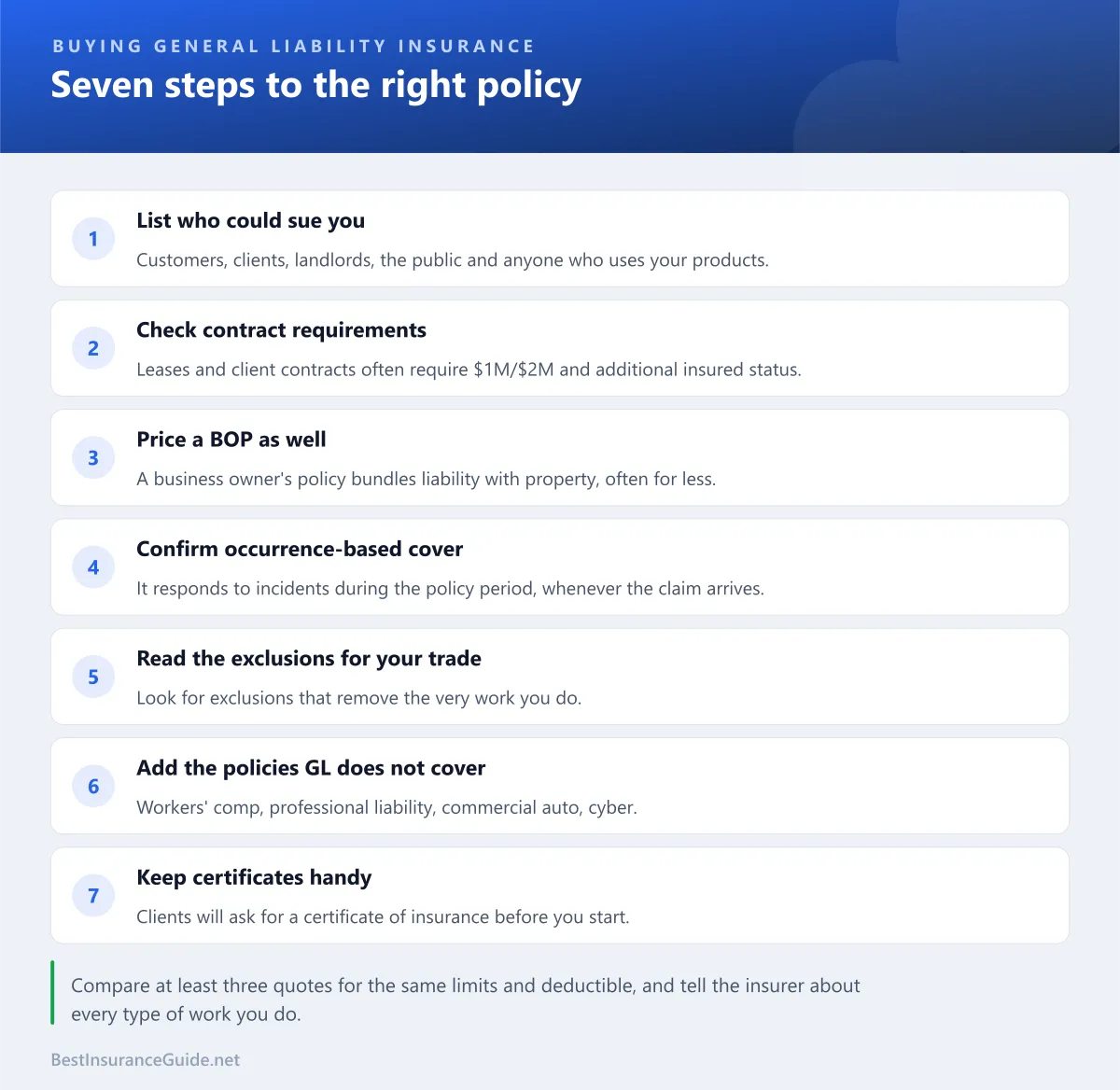
- List your exposures. Who visits your premises? Whose property do you work on? What do you sell or advertise?
- Collect contract requirements. Leases and client contracts set minimum limits and often require additional insured status and a waiver of subrogation.
- Get BOP and standalone quotes. If you also need property cover, a BOP is often the better buy.
- Confirm the policy is occurrence-based and that defence costs are outside the limits.
- Describe all your work accurately. Misclassifying your business, or leaving out a type of work, is one of the main reasons claims are denied.
- Fill the gaps with workers’ compensation, professional liability, commercial auto and cyber cover as needed. Our business insurance checklist walks through each one.
- Compare at least three quotes for the same limits and deductible, and check each insurer’s financial strength rating.
Once you have a policy, keep certificates of insurance ready for clients, and review your limits each year as your revenue and contracts grow.
Related reading
- Business insurance checklist for every policy a small business may need.
- Certificate of liability insurance for how to read and request a COI.
- Additional insured for what it means to add a landlord or client to your policy.
- Business umbrella insurance for higher limits at lower cost.
- Startup business insurance costs for first-year budgets.
Sources and notes
- Insureon, general liability insurance cost data: typical premium of about $45 a month; 41% of customers pay $30 to $60 and 22% pay under $30. Based on policies bought by Insureon’s small business customers.
- The Hartford, small business claims analysis (December 2025, via Business Wire): slip-and-fall claims at 20% of claims versus 10% in 2015; average cost up from $20,000 to $45,000; based on more than one million small business policies.
- ISO commercial general liability coverage form: structure of Coverages A, B and C and supplementary payments. Individual insurers’ forms and endorsements vary.
- Worked examples use hypothetical figures for illustration.
This article is general information, not legal or insurance advice. Coverage depends on your policy’s wording, endorsements and exclusions. Speak to a licensed agent or broker about your business.