Contractor Insurance: What You Need, What It Costs and How to Get Covered
What contractor insurance covers, what it costs (general liability averages about $83 a month), which policies states and clients require, and the coverage gaps to avoid.

Table of contents

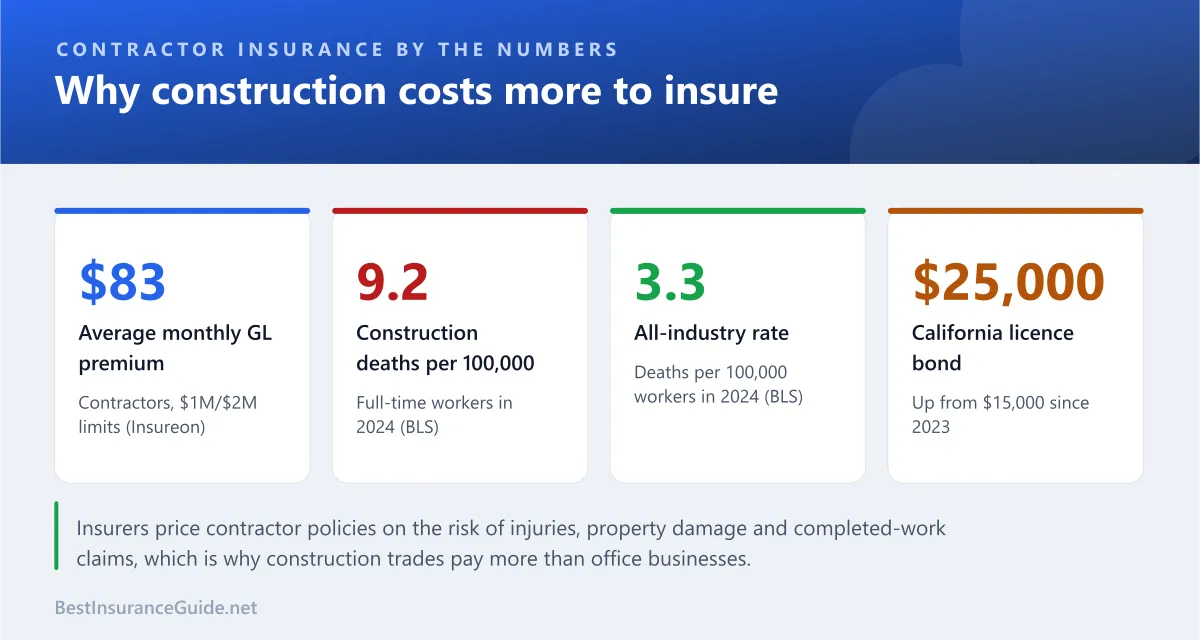
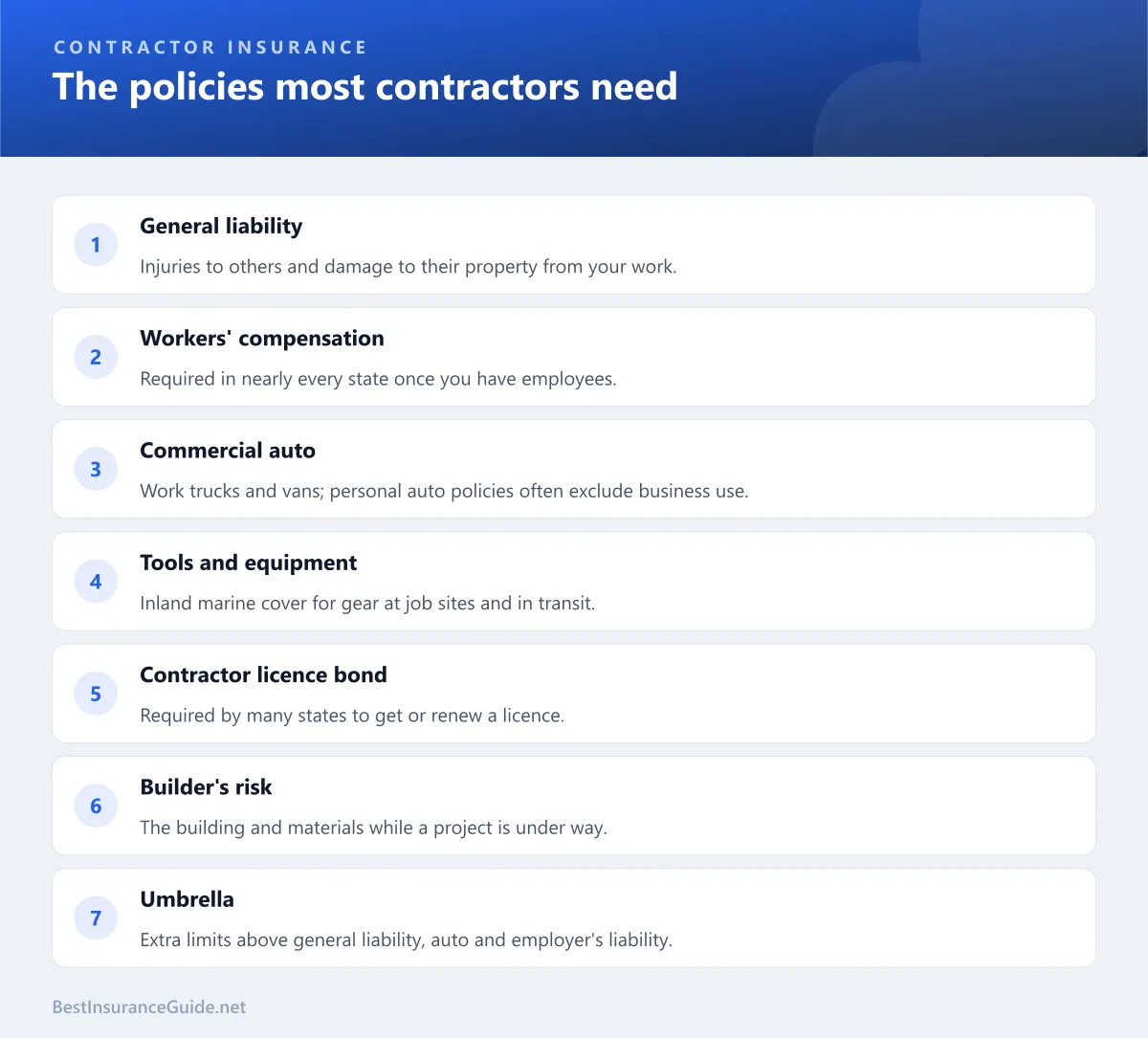
Contractor insurance is not one policy but a small set of them. For most contractors that means general liability, workers’ compensation once you hire, commercial auto for work vehicles and cover for tools and equipment, plus a licence bond in many states. General liability alone costs contractors an average of about $83 a month, according to the online broker Insureon, but roofers and general contractors pay much more.
We are an independent site and do not sell insurance. Costs below are attributed to Insureon and safety figures to the Bureau of Labor Statistics. Worked examples are labelled illustrative.
Construction is priced as a high-risk trade for a reason. The BLS recorded 9.2 deaths per 100,000 full-time construction workers in 2024, nearly three times the all-industry rate of 3.3, and contractors also face claims for damage to clients’ homes and for problems that show up long after a job is finished.
Contractor insurance at a glance
| Policy | What it covers | Who needs it | Average cost (Insureon) |
|---|---|---|---|
| General liability | Injuries to others and damage to their property from your work | Almost every contractor | $83 a month for contractors |
| Workers’ compensation | Medical bills and lost wages for injured employees | Employers, by law in nearly every state | $175 a month for construction |
| Commercial auto | Work trucks, vans and trailers | Anyone driving for the business | Varies by vehicle and driver |
| Tools and equipment | Theft or damage to your gear at job sites and in transit | Anyone with valuable tools | $42 a month for construction |
| Business owner’s policy | General liability bundled with property cover | Contractors with an office, shop or stock | $125 a month for construction |
| Licence bond | Protects customers if you break licensing rules | Required in many states | Set by the state amount and your credit |
| Builder’s risk | The structure and materials during a project | Builders and remodelers on larger jobs | Priced per project |
The policies most contractors need
General liability
General liability is the policy clients ask for first, and the one most licensing boards want to see. A standard commercial general liability (CGL) policy covers:
- Bodily injury to people who are not your employees, such as a homeowner who trips over your extension lead.
- Property damage to other people’s property, such as a ladder through a neighbour’s window.
- Completed operations, meaning injury or damage your work causes after the job is finished.
- Legal defence costs, usually on top of the policy limit.
Our full guide to general liability insurance explains each part of the policy and the standard exclusions.
Completed operations matters most for contractors. A deck that collapses two years later, a gas fitting that leaks, or a roof that lets water in after the first storm can all lead to claims long after you have been paid. Check that your policy includes products-completed operations cover and that its aggregate limit meets the contracts you sign.
Workers’ compensation
Workers’ compensation pays medical bills and part of lost wages when an employee is hurt on the job. It usually includes employer’s liability cover too, which responds if an injured worker or their family sues you.
Nearly every state requires it once you have employees. Texas is the main exception: private employers there can opt out, although the Texas Department of Insurance says coverage is required for contractors working on government construction projects. Rules for sole proprietors, partners and LLC members vary by state, and some states let owners exclude themselves.
Construction premiums are based on payroll and job classification, so a roofing crew costs far more to cover than a painting crew with the same wages.
Commercial auto
If you drive a truck or van for work, carrying tools, materials or crew, a personal auto policy may refuse the claim. Commercial auto covers business vehicles, and hired and non-owned auto cover protects you when employees use their own cars or you rent a vehicle for a job. Our guide to commercial auto insurance costs breaks down prices by vehicle type.
Tools and equipment (inland marine)
A standard business property policy covers property at your premises. Tools and equipment at a job site, in a van or on a trailer usually need inland marine cover, sold as a contractor’s tools and equipment policy or an equipment floater.
Check three things:
- Valuation. Replacement cost pays what it costs to buy new; actual cash value deducts depreciation. Our guide to replacement cost vs actual cash value explains the difference.
- Theft conditions. Many policies restrict cover for tools left in an unattended vehicle overnight or require signs of forced entry.
- Scheduled items. Expensive pieces, often anything above about $2,500, may need to be listed individually.
Contractor licence bond
Many states and cities require a licence bond to get or renew a contractor licence. California, for example, has required a $25,000 bond since January 1, 2023, up from $15,000.
A bond is not insurance for you. It protects your customers and the state: if you break licensing law or walk away from a job, a customer can claim against the bond, and the surety company will expect you to repay it. The premium is usually a small percentage of the bond amount and depends largely on your credit.
Builder’s risk
Builder’s risk covers the building and materials while a project is under way, against risks such as fire, theft, vandalism and certain weather damage. Either the owner or the contractor may buy it, so the contract should say who does. It usually ends when the project is finished or occupied.
Umbrella insurance
Commercial contracts often ask for $2 million or more in liability limits. An umbrella policy adds limits above your general liability, commercial auto and employer’s liability, usually more cheaply than raising each limit. See our guide to business umbrella insurance.
Professional liability, for design-build work
If you give design advice, draw plans or manage projects for a fee, a mistake in that advice may not count as bodily injury or property damage. Contractor’s professional liability, sometimes called errors and omissions, fills that gap.
How much contractor insurance costs
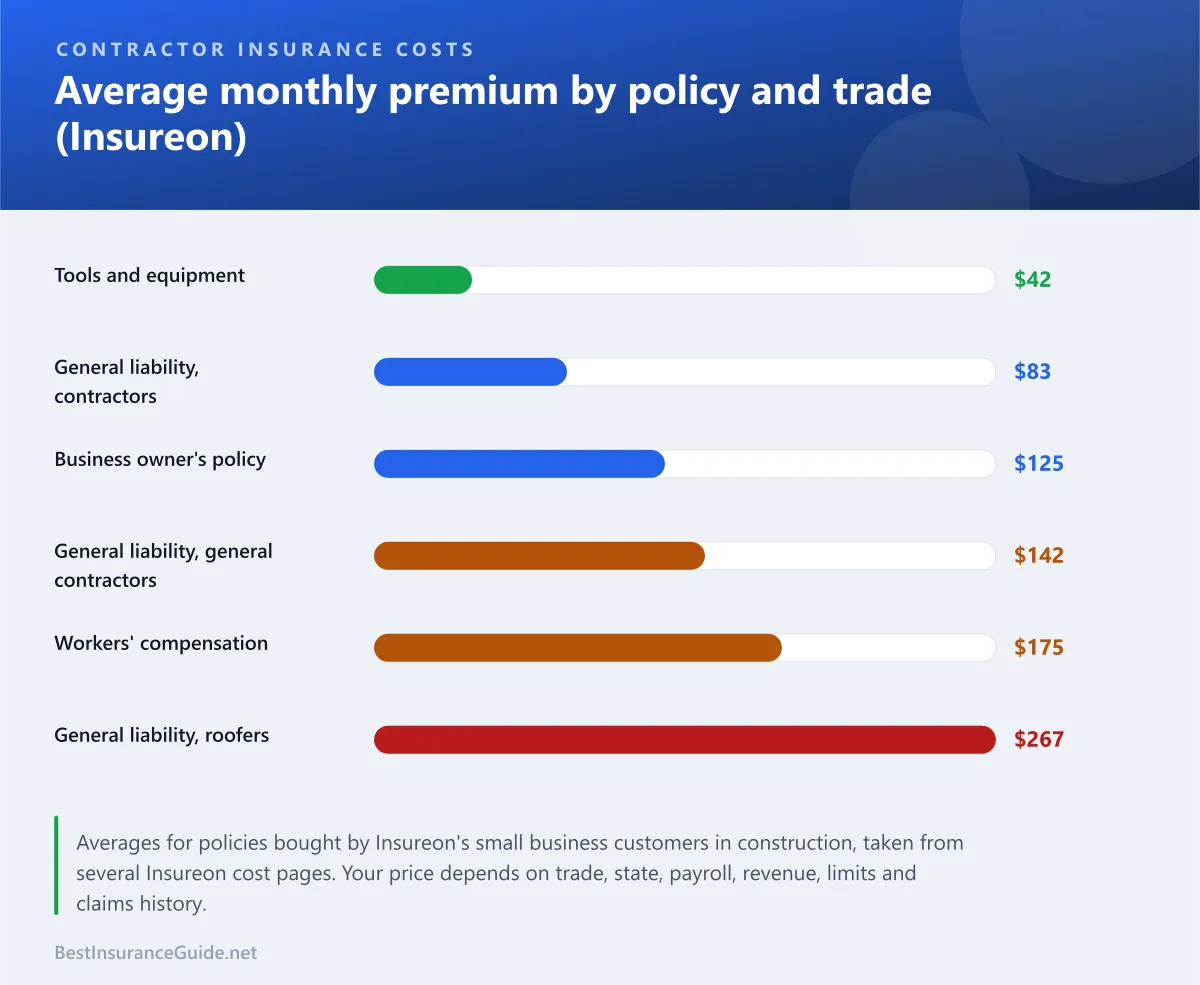
Insureon publishes averages for policies bought by its small business customers in construction:
- General liability for contractors: about $83 a month, or $990 a year, with $1 million per occurrence and $2 million aggregate limits.
- General liability for general contractors: about $142 a month, or $1,700 a year.
- General liability for roofers: about $267 a month, or $3,200 a year, among the highest of any trade.
- Business owner’s policy: about $125 a month for construction businesses.
- Workers’ compensation: about $175 a month for construction businesses.
- Tools and equipment: about $42 a month for construction businesses.
These are averages, not quotes. Insureon’s pages give slightly different figures depending on the data period and the mix of trades, and your premium depends on:
- Your trade. Roofing, structural and tree work cost far more than painting or flooring.
- Revenue and payroll, which most liability and workers’ compensation premiums are based on.
- Where you work, including your state’s legal climate and weather risks.
- Claims history and years in business.
- Limits, deductibles and endorsements, such as additional insured and waiver of subrogation.
- Subcontractors. Uninsured subcontractors raise your premium.
Illustrative example: a one-person handyman business
Illustrative. Dev works alone doing small repairs and installations, with no employees and a single van.
- General liability at the contractor average: $83 a month.
- Tools and equipment: $42 a month.
- Together that is $125 a month, or $1,500 a year, before commercial auto, which depends on Dev’s van, driving record and postcode.
If Dev later takes on an apprentice, Dev will need workers’ compensation in almost every state, and the premium will be based on the apprentice’s wages and job class.
What contractor insurance does not cover
The most common surprises for contractors are:
- Your own faulty work. If a tiled floor you laid cracks because it was installed badly, general liability will not pay to redo the job. It may pay for other property your work damages, such as the ceiling below a leaking shower you fitted.
- Injuries to your own employees. These belong under workers’ compensation, not general liability.
- Vehicles. Accidents involving your work van fall under auto insurance.
- Your tools and materials. These need inland marine or property cover.
- Contract penalties and delays. Late-completion damages and fines are not insured losses.
- Excluded work. Some lower-cost policies exclude residential, roofing, height or EIFS (exterior insulation) work. Read the exclusions before you sign.
Illustrative example: a leak months after the job
Illustrative. A plumber fits a new water line in March. In October a fitting fails while the owners are away, flooding the kitchen.
- Covered, under completed operations: replacing the damaged floors, cabinets and drywall, and defending the plumber if the owners sue.
- Not covered: the cost of the plumber’s own labour and parts to replace the faulty fitting.
What clients and contracts will ask for
Before you start a job, a client or general contractor will usually ask for:
- A certificate of insurance showing your policies and limits. Our guide to the certificate of liability insurance explains how to read and request one.
- Additional insured status, which extends your policy to protect the client for claims arising from your work. See additional insured.
- A waiver of subrogation, which stops your insurer recovering its payout from the client. See waiver of subrogation.
- Minimum limits, often $1 million per occurrence and $2 million aggregate, and sometimes an umbrella on top.
Ask your insurer for the right endorsements before you sign the contract, not after. Some are free and some add to the premium.
Licensing boards
Many state contractor boards require proof of insurance, a bond or both before they issue or renew a licence. Ohio, for example, requires licensed specialty contractors such as electricians and plumbers to carry at least $500,000 in general liability insurance. Requirements differ by state, trade and project size, so check with your state’s contractor licensing board.
Subcontractors: the audit trap
If you hire subcontractors, collect a current certificate of insurance from every one before they start, showing their own general liability and workers’ compensation.
At the end of each policy year, your workers’ compensation and often your general liability insurer audits your payroll and payments. If a subcontractor had no valid cover, the insurer will usually treat what you paid them as your own payroll and send you a bill for the extra premium. If their worker is hurt, you may also be responsible.
How to buy contractor insurance
- List what you do, including occasional work such as roofing or work at height, and what your contracts require.
- Check your licensing board’s requirements for insurance and bonds.
- Get quotes from an independent agent or online broker who works with construction trades. Our guide to insurance brokers vs agents explains the difference.
- Compare the exclusions, not just the price, especially for residential and completed operations work.
- Bundle where it makes sense. A business owner’s policy combines general liability and property cover for many small contractors.
- Set up certificates and endorsements before your first job.
- Review cover every year as your revenue, payroll and type of work change.
Related reading
- General liability insurance explains what a CGL policy covers and costs.
- Business insurance by trade covers landscapers, caterers and other trades.
- Landscaping business insurance looks at equipment, seasonal payroll and chemical risks.
- Business insurance for sole proprietors covers one-person businesses.
- Startup business insurance costs helps you budget for a new business.
Sources and notes
- Insureon, contractor, general contractor and roofing contractor insurance cost pages: average premiums for general liability ($83 a month for contractors, $142 for general contractors, $267 for roofers), business owner’s policy ($125), workers’ compensation ($175) and tools and equipment ($42). These are averages for Insureon customers, and figures vary between Insureon pages.
- U.S. Bureau of Labor Statistics, Census of Fatal Occupational Injuries Summary, 2024: 5,070 fatal work injuries, an all-industry rate of 3.3 per 100,000 full-time equivalent workers, and 9.2 in construction.
- California Contractors State License Board, Bond Requirements, and Business and Professions Code section 7071.6: $25,000 contractor licence bond from January 1, 2023 (Senate Bill 607).
- Texas Department of Insurance, workers’ compensation consumer guide: workers’ compensation is optional for most private employers but required for contractors on government construction projects.
- Ohio Construction Industry Licensing Board, Ohio Department of Commerce: $500,000 minimum general liability for licensed specialty contractors.
- Policy features such as completed operations, the faulty workmanship exclusion and inland marine valuation vary between insurers. Check your own policy wording.
- Dev and the plumber are illustrative examples.
This article is general information, not legal or insurance advice. Coverage depends on your policy wording and state rules. Speak to a licensed agent or broker and your state’s contractor licensing board about your own situation.