Waiver of Subrogation: What It Means and Why Contracts Demand It
What is a waiver of subrogation? A plain-English definition, how the endorsement works on liability, workers comp and property policies, and what it costs.

Table of contents

A waiver of subrogation turns up in the insurance section of almost every commercial contract, lease and subcontract, usually in a sentence that reads something like “Contractor shall obtain a waiver of subrogation in favor of Owner on all required policies.” Most people sign it without knowing what they have agreed to.
The short version: a waiver of subrogation is a promise that your insurer will not sue the other party to recover money it paid out on your claim. It is simple to describe and easy to get wrong in practice, because signing the contract does not change your insurance policy. That takes a separate endorsement, and if you skip it, you may have made a promise your insurer never agreed to keep.
This guide covers the subrogation meaning first, because the waiver makes no sense without it, then the waiver itself, where it is required, what it costs and how to handle one in a contract you are about to sign.
What is subrogation?
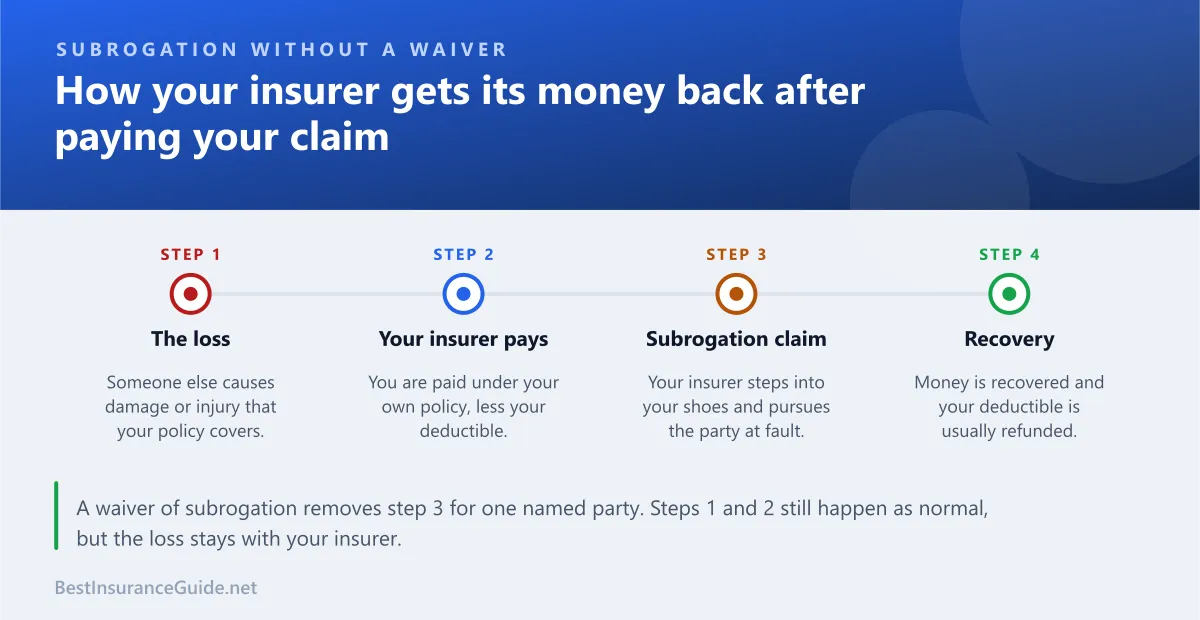
Subrogation is how an insurer recovers money from whoever actually caused a loss.
When your insurer pays a claim, it takes over whatever legal right you had to recover that loss from someone else. It “steps into your shoes.” It can then pursue the responsible party (or, more often, the responsible party’s insurer) for the amount it paid.
A common example comes from car insurance. Another driver runs a red light and hits you. You claim on your own collision coverage because it is faster, pay your deductible, and your car is repaired. Your insurer then brings a subrogation claim against the other driver’s insurer. When it recovers, it usually refunds your deductible. We walk through that sequence in our guide to what to do after a car accident that wasn’t your fault.
Subrogation matters to everyone who buys insurance, including people who never see a claim:
- It keeps premiums lower. Money insurers recover through subrogation offsets what they pay out, and rates are built on net losses.
- It puts the cost on the party at fault. Without it, careful policyholders would effectively subsidize careless third parties.
- It stops double recovery. You cannot collect from your insurer and then sue the at-fault party for the same loss. The right to sue passes to the insurer.
Most policies spell this out in a condition. On a standard commercial general liability policy it is headed Transfer of Rights of Recovery Against Others to Us. It says that once the insurer pays, any right you had to recover passes to the insurer, and that you must do nothing after the loss to impair it.
What is a waiver of subrogation?
A waiver of subrogation is the exception to all of that. It is an agreement, made before any loss, that you give up the right to recover from a specific party, and because the insurer’s rights come from yours, it cannot recover from them either.
Put another way: if something goes wrong and your policy pays, the loss stays with your insurer. It cannot turn around and sue the client, landlord or contractor you signed the waiver in favor of, even if that party caused the loss.
Two pieces have to be in place for the waiver to work properly:
- The contract. Your agreement with the other party says you will waive subrogation, and usually says you will get your insurers to do the same.
- The endorsement. Your insurer adds wording to your policy agreeing not to pursue that party. Without it, the insurer has not agreed to anything.
People often confuse the two, and the gap between them causes most of the problems. A signed contract with no endorsement leaves you exposed in two directions at once: in breach of the contract if your insurer does pursue the other party, and potentially in breach of your policy conditions for having given away the insurer’s rights without its consent.
A worked example
A landscaping company signs a maintenance contract with a property management firm. The contract requires the landscaper to carry general liability and workers’ compensation, and to waive subrogation in favor of the property manager on both.
One of the landscaper’s employees trips over a broken irrigation cover that the property manager had been told about and never fixed. He breaks his wrist and is off work for eight weeks. The landscaper’s workers’ compensation policy pays his medical bills and lost wages.
- Without a waiver, the workers’ comp insurer could look at the facts, conclude the property manager’s negligence caused the injury, and pursue the property manager (or its liability insurer) to recover what it paid.
- With a waiver properly endorsed on the workers’ comp policy, it cannot. The cost of the claim stays on the landscaper’s workers’ comp policy, and on the landscaper’s own loss history.
That is exactly why the property manager asked for it. It is also why the landscaper’s insurer may charge for it. For more on what service businesses in this position typically carry, see our guide to landscaping business insurance.
Why do contracts require a waiver of subrogation?
From the outside it can look one-sided. The party asking for the waiver is protecting itself from being sued. But waivers exist for reasons that often suit both sides.
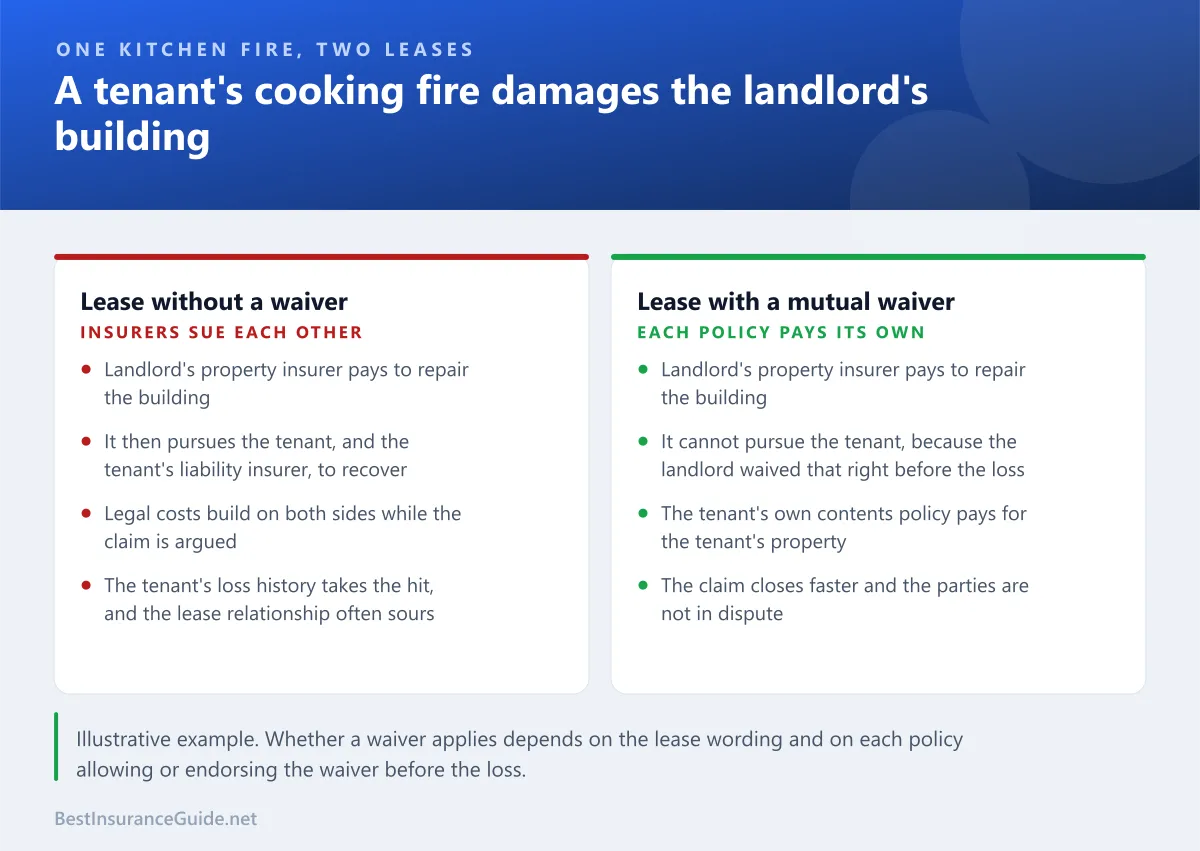
They prevent circular lawsuits. On a construction site with a dozen subcontractors, one loss can trigger a chain of insurers suing each other. Each suit costs legal fees that eventually show up in everyone’s premiums. Mutual waivers keep each party’s insurance paying for its own losses and end the chain at the first step.
They keep business relationships working. A landlord and tenant who are suing each other over a kitchen fire are unlikely to renew a lease. A waiver takes the question of who pays out of the relationship.
They reflect who is already insured for the risk. Many standard construction contracts, including the widely used AIA forms, build in mutual waivers for losses covered by property insurance. The logic is that the project’s property insurance is bought to cover the building, so the parties should not then sue each other over what it paid.
They are part of a standard package. Contracts that ask for a waiver of subrogation usually ask, in the same clause, for additional insured status and for your coverage to be primary and non-contributory. The three work together: additional insured status gives the other party coverage under your policy, primary and non-contributory wording means your policy pays first, and the waiver stops your insurer recovering from them afterwards.
Where you will be asked for one
| Situation | Who usually asks | Policies typically named |
|---|---|---|
| Construction subcontracts | General contractor, project owner | General liability, workers’ comp, auto, umbrella |
| Commercial leases | Landlord, often mutual with the tenant | Property, general liability |
| Service and maintenance contracts | Property managers, facilities firms | General liability, workers’ comp |
| Large corporate vendor agreements | Procurement or legal department | All required policies |
| Event and venue hire | Venue owner | General liability, liquor liability |
| Residential leases | Some landlords, less commonly | Renters or landlord property policy |
Personal policies are less often involved, but not immune. Some residential leases include a mutual waiver so that the landlord’s property insurer and the tenant’s renters insurer each absorb their own losses. If you rent, our renters insurance guide explains the policy that would be affected.
The waiver of subrogation endorsement, policy by policy
Each policy needs its own endorsement. A waiver on your general liability policy does nothing for your workers’ comp, and vice versa. Many standard contracts list every policy the waiver must apply to, so read that list carefully.
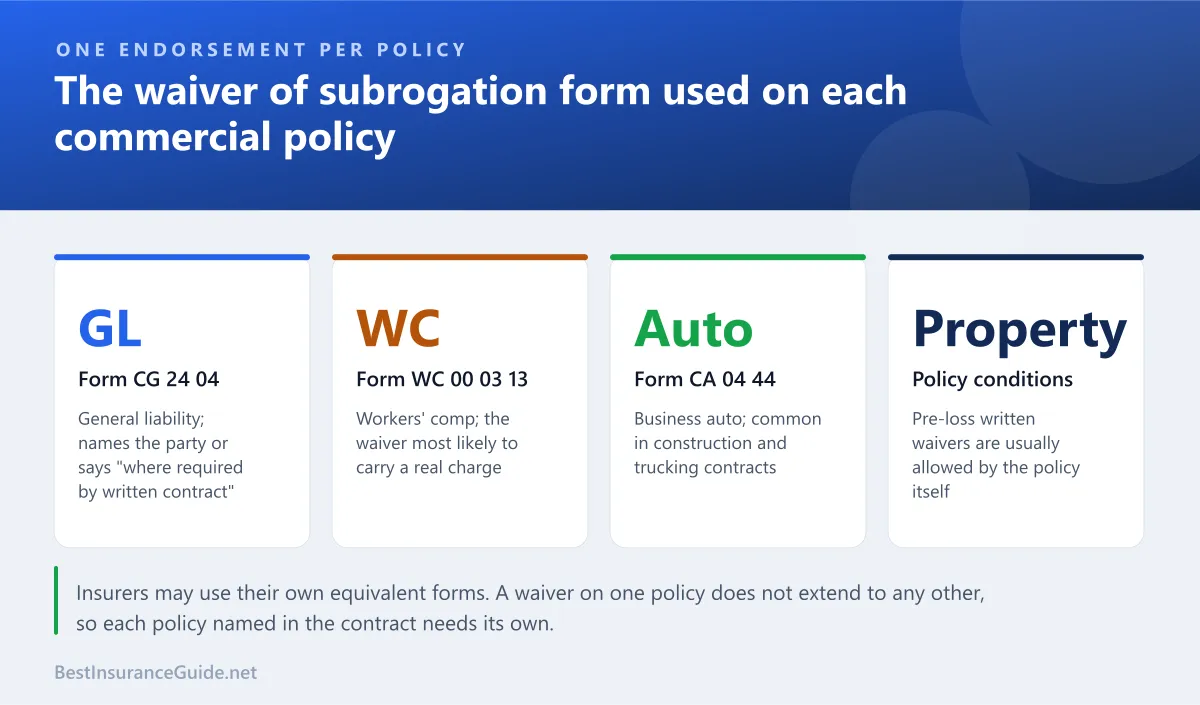
General liability. The ISO endorsement commonly used is CG 24 04, Waiver of Transfer of Rights of Recovery Against Others to Us. Its schedule either names the party or uses wording such as “where required by written contract.” Many insurers use their own equivalent forms. Check that it covers both ongoing operations and completed work if the contract requires it.
Workers’ compensation. In most states this is NCCI form WC 00 03 13, Waiver of Our Right to Recover From Others Endorsement. States with their own rating bureaus use equivalents. This is the waiver that most often carries a real cost, because workplace injuries caused by a third party are a meaningful source of recovery for workers’ comp insurers.
Business auto. The equivalent ISO form is CA 04 44. Construction and trucking contracts frequently name it.
Commercial property. Standard property conditions generally already allow you to waive recovery in writing before a loss, which is why leases often include mutual property waivers without anyone buying an endorsement. Confirm this with your insurer rather than assuming it.
Umbrella and excess. Umbrella policies usually follow the underlying policies, but some contracts ask for the waiver to be confirmed on the umbrella as well. Our guide to business umbrella insurance covers how those layers fit together.
Blanket versus specific waivers
A specific (or scheduled) waiver names one person or organization. Every new contract means asking your agent to add another name.
A blanket waiver applies automatically to any party you have agreed in a written contract to waive against. It is the practical choice if you sign many contracts, and it avoids the risk of starting a job before the endorsement is issued. The trade-off is that some insurers charge more for blanket wording, particularly on workers’ comp.
Whichever you use, the phrase “written contract” matters. Most blanket forms apply only where a written agreement, signed before the loss, requires the waiver. A verbal understanding or an email exchanged after an accident is unlikely to qualify.
How much does a waiver of subrogation cost?
There is no single price, and it is worth being cautious about any figure quoted as typical. What can be said reliably:
- General liability waivers are often inexpensive, sometimes included at no charge in contractor or business owner policy packages, and otherwise commonly charged as a modest flat fee.
- Workers’ compensation waivers are more often priced as a percentage of the policy premium, frequently with a minimum charge. For a business with a large payroll, that can be a real sum.
- Blanket waivers may cost more than a single named waiver, because the insurer is giving up rights against an unknown number of parties.
- The class of business matters. Insurers charge more where third-party recoveries are more likely, which is why construction trades see higher charges than office-based consultants.
Ask your agent for the price of both options, specific and blanket, before you commit. If a contract requires a waiver you cannot price in, it is a legitimate point to raise with the client before signing, or to build into your bid.
Where waivers are restricted
Waivers of subrogation on liability and property policies are generally enforceable, subject to the wording of the contract. Workers’ compensation is different, because workers’ comp is a statutory system and some states limit what employers can contract away.
- New Hampshire prohibits contract provisions requiring an employer or its insurer to waive workers’ comp subrogation rights.
- Kentucky treats such waivers as contrary to public policy.
- Missouri restricts them for construction work.
Other states have narrower rules, and those rules change. If you work across state lines, ask your agent whether the waiver you are being asked for can actually be issued in each state where you have employees. If it cannot, the contract needs amending, not ignoring.
How to handle a waiver of subrogation request
Follow this sequence whenever a contract asks for one.
- Find every mention. Waiver requirements can appear in the insurance clause, the indemnity clause and in a separate insurance exhibit. Note which policies each one names.
- Send the clause to your agent before you sign. Ask whether your policies already allow it, whether an endorsement is needed on each named policy, and what it will cost.
- Check for state restrictions on the workers’ comp waiver if the work is in a state that limits them.
- Choose specific or blanket wording based on how many contracts you sign a year.
- Get the endorsement issued before work starts. A waiver added after a loss is too late for most policies.
- Get it shown on your certificate of insurance. The certificate will usually have a box indicating a waiver applies, but the certificate itself does not create coverage. The endorsement does. Keep a copy of the endorsement with the contract.
- Diary the renewal. Endorsements do not always carry over automatically when a policy renews or moves to a new insurer.
Waiver of subrogation versus related terms
| Term | What it does | Who benefits |
|---|---|---|
| Waiver of subrogation | Stops your insurer recovering from a named party after it pays your claim | The other party to the contract |
| Additional insured | Gives the other party coverage under your policy for claims arising from your work | The other party |
| Primary and non-contributory | Makes your policy pay first without asking the other party’s insurer to share | The other party’s insurer |
| Hold harmless / indemnity | Your contractual promise to cover the other party’s losses caused by your work | The other party |
| Subrogation | Your insurer’s right to recover from whoever caused the loss | Your insurer, and you through a refunded deductible |
These terms are often requested together, but each one is a separate obligation, and each insurance requirement is met by a separate endorsement.
The bottom line
A waiver of subrogation is a reasonable request in most commercial contracts, and refusing one will often cost you the work. The risk is not the waiver itself but agreeing to it in a contract and never putting it on your policy.
Read the clause, list the policies it names, ask your agent to endorse each one before the job starts, and confirm the cost before you price the job. If you are new to how policy conditions like this fit into the wider contract, our Insurance 101 guide is a good starting point.
BestInsuranceGuide.net is an independent publisher and is not affiliated with any insurer, rating bureau or forms provider. Endorsement form numbers refer to standard ISO and NCCI forms; your insurer may use its own equivalent wording. This article is general information, not legal advice. Have a contract reviewed by a qualified attorney where the stakes justify it.