Business Insurance for Consultants, Caterers and Sole Proprietors
Business insurance for consultants, caterers, landscapers and sole proprietors: the policy that matters most per trade, plus umbrella and start-up costs.

Table of contents

The mistake nearly every new business makes is buying general liability, ticking the box, and assuming the job is done.
General liability is genuinely useful. It is also, for a large share of businesses, the policy least likely to pay out. The claim that actually arrives is usually a different shape entirely, and the policy that would have covered it was the one nobody mentioned.
What follows is the trade-by-trade version. For the full checklist across every category, our business insurance checklist covers the core policies and the gaps businesses forget.
The two questions that pick your policies
Before any trade specifics, two questions sort most of it.
Do you give advice, or do you do physical work? Advice businesses get sued for being wrong. Physical businesses get sued for causing injury or damage. Those are different policies, and buying the wrong one is the most common expensive error.
Do other people rely on your work product, or on your presence on their property? Reliance points to professional liability. Presence points to general liability.
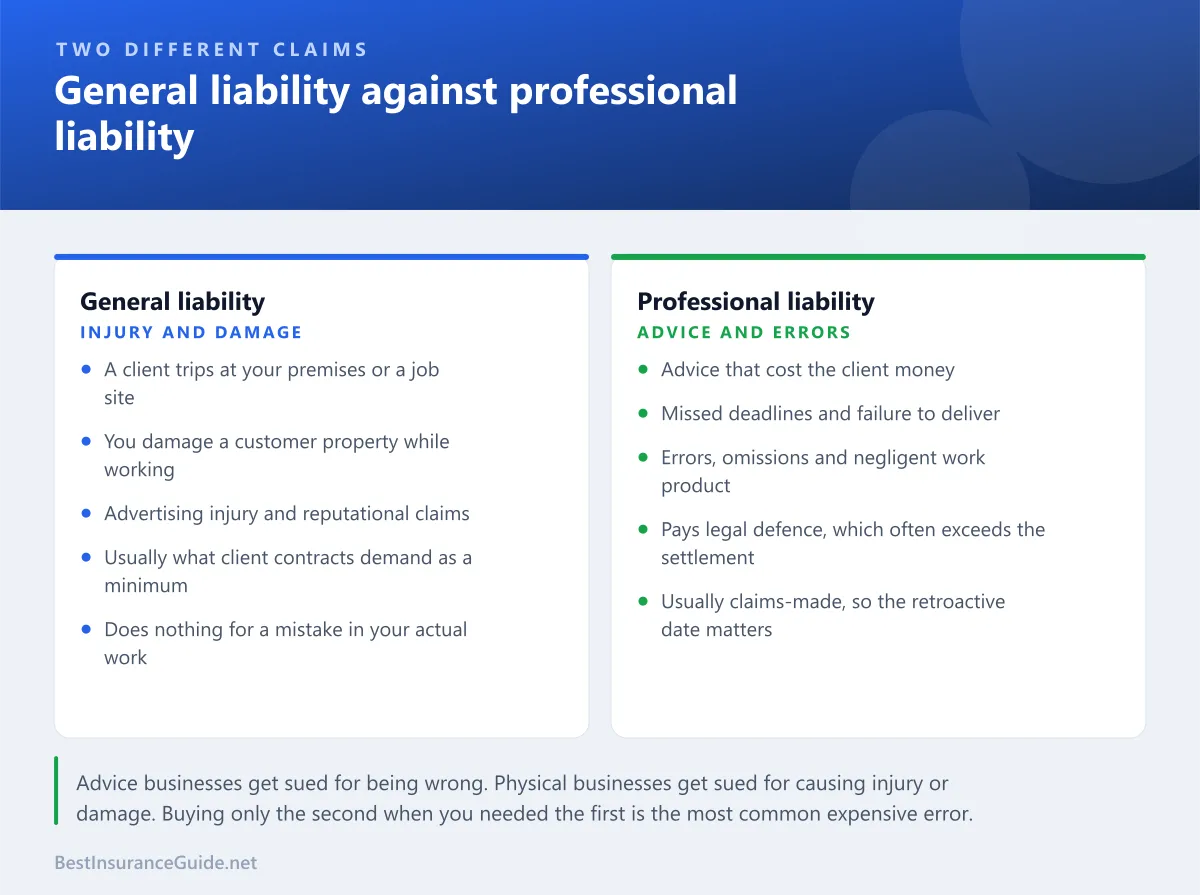
Most businesses need both, but the order of importance flips depending on the answer.
Business insurance for consultants
If you consult, professional liability is your primary policy, not general liability.
The realistic claim against a consultant is not that someone tripped over your laptop bag. It is that your advice, your model, your recommendation or your implementation cost the client money, and they want it back.
General liability will not touch that. It covers bodily injury and property damage. A client’s lost revenue is neither.
Professional liability, also sold as errors and omissions, covers exactly this: negligence, mistakes, missed deadlines, bad advice, failure to deliver to a professional standard. Crucially, it covers defence costs, which frequently exceed the settlement. A claim that goes nowhere can still cost tens of thousands to make go nowhere.
Worked example: a consultant sued for a recommendation
An operations consultant recommends a systems migration. It runs badly, the client claims six months of lost productivity.
| Item | Amount |
|---|---|
| Client’s claimed losses | $310,000 |
| Legal defence over 14 months | $86,000 |
| Expert witness and forensic accounting | $22,000 |
| Eventual settlement | $95,000 |
| Total | $203,000 |
| Covered by general liability | $0 |
| Covered by professional liability | Everything above the retention |
The consultant did not think of themselves as someone who could be sued for $200,000. Almost no consultant does.
Two features of these policies matter more than the price.
They are usually claims-made. Cover responds based on when the claim is made, not when the work was done. That means you must keep the policy in force after the work ends, and if you close the business or switch insurers you need either continuous retroactive cover or a tail extension. Letting a claims-made policy lapse after finishing a project leaves you exposed for work you already delivered.
The retroactive date is the number to check. It sets how far back your covered work reaches. A new policy with today’s retroactive date covers nothing you have already done.
Many consultants also need cyber liability if they hold client data, and most client contracts will require general liability regardless of whether it is the real risk. Buying it to satisfy a contract is a legitimate reason to buy it.
Business insurance for sole proprietors
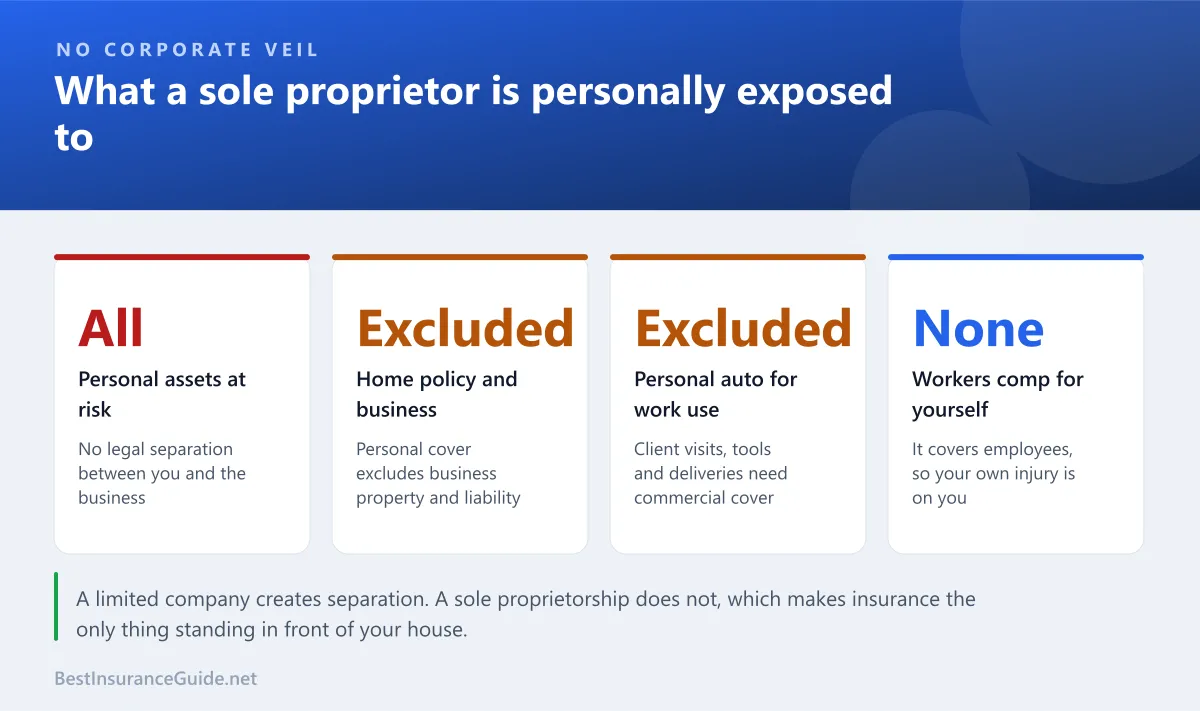
A sole proprietorship is legally you. There is no separation, no corporate veil, nothing standing between a business claim and your house.
That is the whole argument. A limited company creates separation; a sole proprietorship does not. Insurance is the only thing standing in front of personal assets.
Two specific traps catch sole proprietors regularly.
Homeowners and renters policies exclude business activity. If you work from home, your personal policy almost certainly excludes business property and business liability. A client injured at your home office, or business equipment stolen from it, is very often not covered. The fix is usually a small business endorsement on the personal policy or a separate policy, and it is inexpensive.
Personal auto excludes business use. Driving to client sites is often treated as business use. Carrying tools, stock or deliveries almost certainly is. A commercial auto policy or a business use endorsement closes that gap, and it is the same principle that applies to motorcycle courier insurance on two wheels.
Sole proprietors also cannot rely on workers compensation for themselves in most states, since it covers employees. If you are the business and you are injured, that is your own health and disability cover.
Business insurance for a catering business
Catering carries an unusually wide risk surface for a small operation, because it combines food, vehicles, equipment, other people’s premises and often alcohol.
General liability for injury and property damage at venues.
Product liability for foodborne illness. This is the defining catering claim, it can affect many people at once from a single event, and it is the reason venues ask for certificates.
Commercial auto for the vehicles. Personal auto will not cover a van carrying equipment and stock to a paid job.
Inland marine or equipment cover for what you transport. Ovens, chafers, refrigeration and serving equipment are moved constantly, and standard property cover often stops at your premises.
Liquor liability if you serve alcohol. This is excluded from standard general liability, and in states with dram shop laws the exposure is significant.
Workers compensation if you use staff, including casual and event-day help. Many caterers assume casual help does not count. In most states it does.
Spoilage cover for refrigeration failure, which is a small addition that pays for itself the first time a fridge dies overnight.
Business insurance for a landscaping business
Landscaping looks lower-risk than it is, mostly because of vehicles and equipment.
General liability for damage to client property, which in this trade is the common claim: an irrigation line cut, a retaining wall that fails, damage to a neighbouring property.
Commercial auto for trucks and trailers, which are on the road constantly and often towing.
Inland marine for mowers, blowers, trimmers and hand tools. This is the policy landscapers most often skip and most often need, because equipment theft from trucks and job sites is routine and standard property cover excludes items away from premises.
Workers compensation, which in this trade is expensive and unavoidable, because the injury rate is genuinely high.
Herbicide and pesticide application cover. This is the specific trap. Many general liability policies exclude damage arising from chemical application, which is precisely the claim a landscaper faces when a treatment kills a client’s lawn or drifts onto a neighbour’s garden. Check the exclusion explicitly and buy it back if you apply anything.
Completed operations cover, so that work you finished last season is still covered when a wall fails this season.
Business umbrella insurance
Umbrella cover is the most under-bought policy in small business, and the easiest to justify.
It sits above your existing liability policies. When general liability, commercial auto or employers liability hits its limit, the umbrella keeps paying.
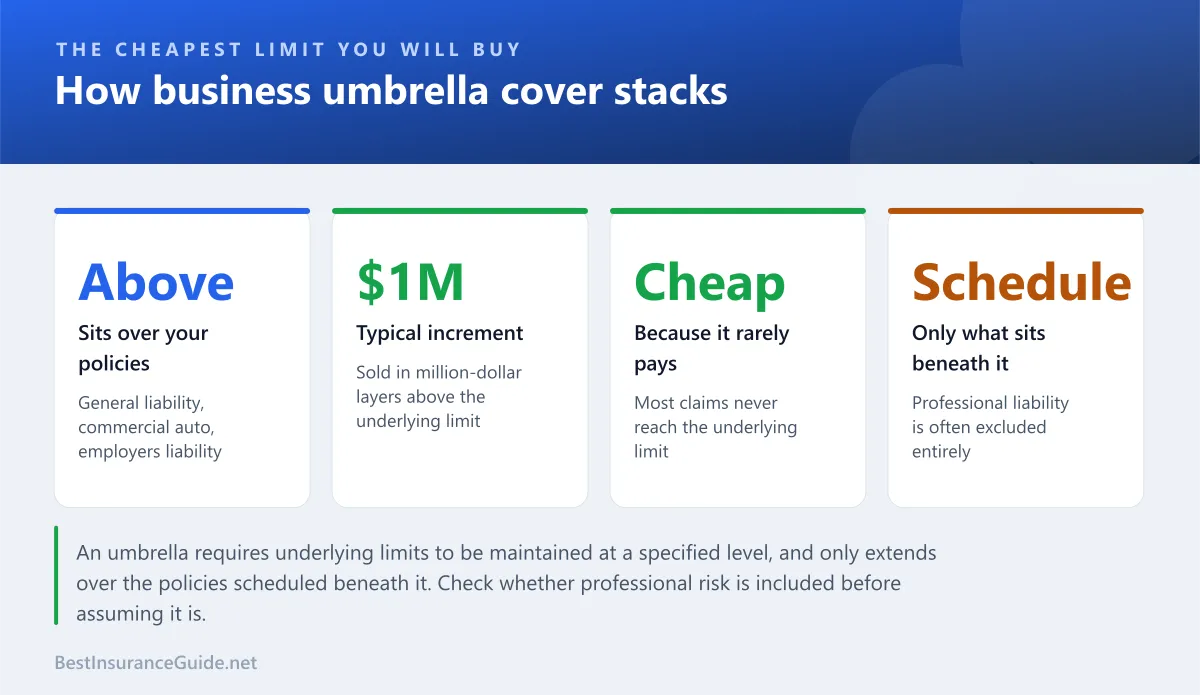
The reason it is good value is arithmetic. Most claims are small, so the umbrella rarely pays. Insurers price it accordingly, and an extra million of limit costs a fraction of what the first million did.
Worked example: where the underlying policy stops
A catering van is at fault in a multi-vehicle collision with injuries.
| Detail | Amount |
|---|---|
| Total claims against the business | $1,740,000 |
| Commercial auto liability limit | $1,000,000 |
| Shortfall without umbrella | $740,000 |
| Umbrella limit | $2,000,000 |
| Paid by umbrella | $740,000 |
| Business absorbs | $0 |
Without it, $740,000 comes from the business, and for a sole proprietor, from the owner personally.
Two conditions attach. The umbrella requires underlying limits to be maintained at a specified level, and it only extends over the policies scheduled beneath it. An umbrella above general liability does not respond to a professional liability claim unless professional liability is scheduled under it, and many umbrellas exclude professional risk entirely.
What it costs to start
The honest range is wide, and the variables are predictable.
| Factor | Effect on premium |
|---|---|
| Employees | The largest single factor, through workers compensation |
| Vehicles | Commercial auto is often the biggest line after payroll |
| Revenue | Most liability policies rate on turnover |
| Physical work versus advice | Physical trades price well above desk-based ones |
| Client contract requirements | Higher required limits raise the floor |
| Claims history | As everywhere, prior claims raise the price |
A home-based consultancy with no employees and no vehicles can often be insured for a few hundred dollars a year across general and professional liability. A landscaping business with three staff and two trucks is in a different order of magnitude, mostly because of workers compensation.
Two ways to start sensibly.
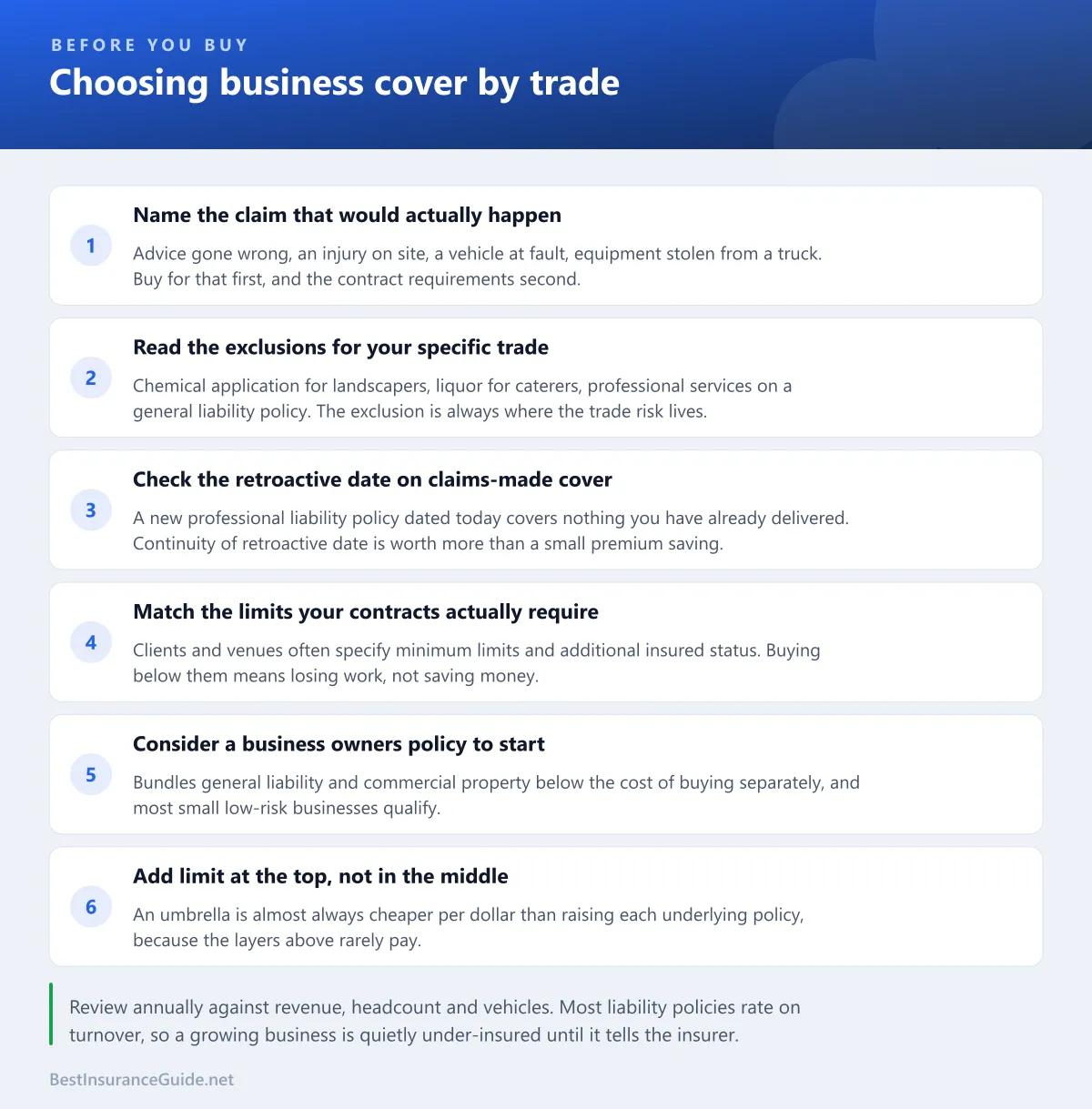
A business owners policy bundles general liability and commercial property at a lower combined price than buying separately. Most small low-risk businesses qualify, and it is usually the right starting point.
Buy the limits your contracts require, then look at an umbrella rather than raising each underlying policy. It is almost always cheaper to add limit at the top than in the middle.
Reviewing cover as the business changes
Most business insurance gaps open through growth rather than through a bad decision at purchase.
Liability policies rate on revenue, so a business that has doubled turnover since binding is carrying limits sized for a smaller company and may be in breach of a declaration condition. Hiring the first employee triggers workers compensation obligations in almost every state, and the first vehicle triggers commercial auto. Neither happens automatically.
Set an annual review against five questions: has revenue moved materially, have you hired anyone including casual help, have you added vehicles, have you started offering a new service, and have any client contracts imposed higher limits or additional insured requirements than the ones you carry.
The new service question catches consultants especially. Professional liability is underwritten against the work you described at application. Adding implementation, staffing or software resale to an advisory practice can move you outside the covered activities without anybody noticing until a claim.
Finally, keep certificates of insurance current and issue them promptly. Slow certificates lose work, and a client discovering at renewal that your cover lapsed is a commercial problem as much as an insurance one.
Two trades where the standard programme leaves a gap
Most trades are covered by the general pattern above. Two are worth setting out separately, because in both cases a standard general liability policy leaves an exposure the business would not expect.
Catering. Almost none of the risk sits where the business does: the food travels, the equipment travels and the liability happens in somebody else’s building. The critical coverage is liquor liability, which general liability excludes for any business in the trade of serving alcohol, and the most commonly missing one is inland marine, because the equipment is almost never at the premises the property policy describes.
Landscaping. The work happens on the client’s grounds, which puts a great deal of it inside the care, custody and control exclusion on a standard policy. Chemical application sits close to the pollution exclusion and needs specific herbicide and pesticide cover. And the equipment lives on a trailer rather than at a yard.
The common thread is that both trades operate on property they do not own, using equipment that is rarely at base. Any trade fitting that description should treat inland marine as its main property coverage and should ask the broker directly what happens to damage caused to the thing being worked on.
Related reading
Drone operators face a separate set of requirements. Drone insurance explains what Part 107 commercial flying needs.
Wedding and event planners have their own checklist. See event planner insurance.
The short version
The policy that matters most depends entirely on what you do. Consultants need professional liability first and should watch the retroactive date and the claims-made structure. Sole proprietors need to know their personal assets are directly exposed and that home and auto policies exclude business use. Caterers need product liability and, if alcohol is involved, liquor liability. Landscapers need equipment cover away from premises and an explicit answer on chemical application exclusions.
Then, once the underlying policies are right, add a business umbrella. It is the cheapest limit you will ever buy, and it is what stands between a bad day and the end of the business.
For the full policy-by-policy walkthrough including property, cyber and business interruption, see our business insurance checklist.