Additional Insured: What It Means and What It Actually Covers
What does additional insured mean? How the endorsement works, named insured vs additional insured, loss payee vs additional insured.

Table of contents

“Please name us as an additional insured” is one of the most common requests in business insurance. Clients, landlords, general contractors, event venues and property managers all ask for it, usually in the insurance clause of a contract you are about to sign.
It is also one of the most misunderstood. Being an additional insured does not give someone full access to your policy, and being listed on your certificate of insurance does not make them an additional insured. This guide explains what additional insured status really means, how the additional insured endorsement works, and how it differs from the named insured, additional named insured, certificate holder and loss payee.
What does additional insured mean?
An additional insured is a person or organization that is not the policyholder but has been added to the policy, by endorsement, so that the policy protects them against certain claims.
The word that matters is certain. Additional insured coverage is almost always limited to liability that arises from the named insured’s work, premises, products or operations. It does not give the additional insured coverage for their own unrelated activities.
An example
A plumbing company is hired to renovate the bathrooms in an office building. The building owner’s contract requires the plumber to name the owner as an additional insured on the plumber’s general liability policy.
During the job, a visitor trips over the plumber’s tools left in a corridor and sues both the plumber and the building owner. Because the owner is an additional insured, the owner can send the lawsuit to the plumber’s insurer, which can defend and pay on the owner’s behalf. The owner’s own insurer, and its loss history, may never be involved.
If the same visitor had slipped on an icy car park the owner failed to grit, a claim unrelated to the plumber’s work, the plumber’s policy would not respond. The additional insured endorsement follows the plumber’s work, not the owner’s property in general.
Why clients and landlords ask for it
The party asking is transferring risk to you, and more importantly to your insurer. If they are sued because of your work, they want your policy to pay first, not theirs.
It usually comes packaged with two other requirements:
- Primary and non-contributory wording, so your policy pays before theirs and does not ask their insurer to share the cost.
- A waiver of subrogation, so your insurer cannot pay the claim and then pursue them. Our guide to the waiver of subrogation covers that half of the package.
Together they mean a claim arising from your work stays on your policy. That is a reasonable request in most contracts, and it is often non-negotiable.
Named insured vs additional insured vs additional named insured
Three similar phrases, three different levels of protection.
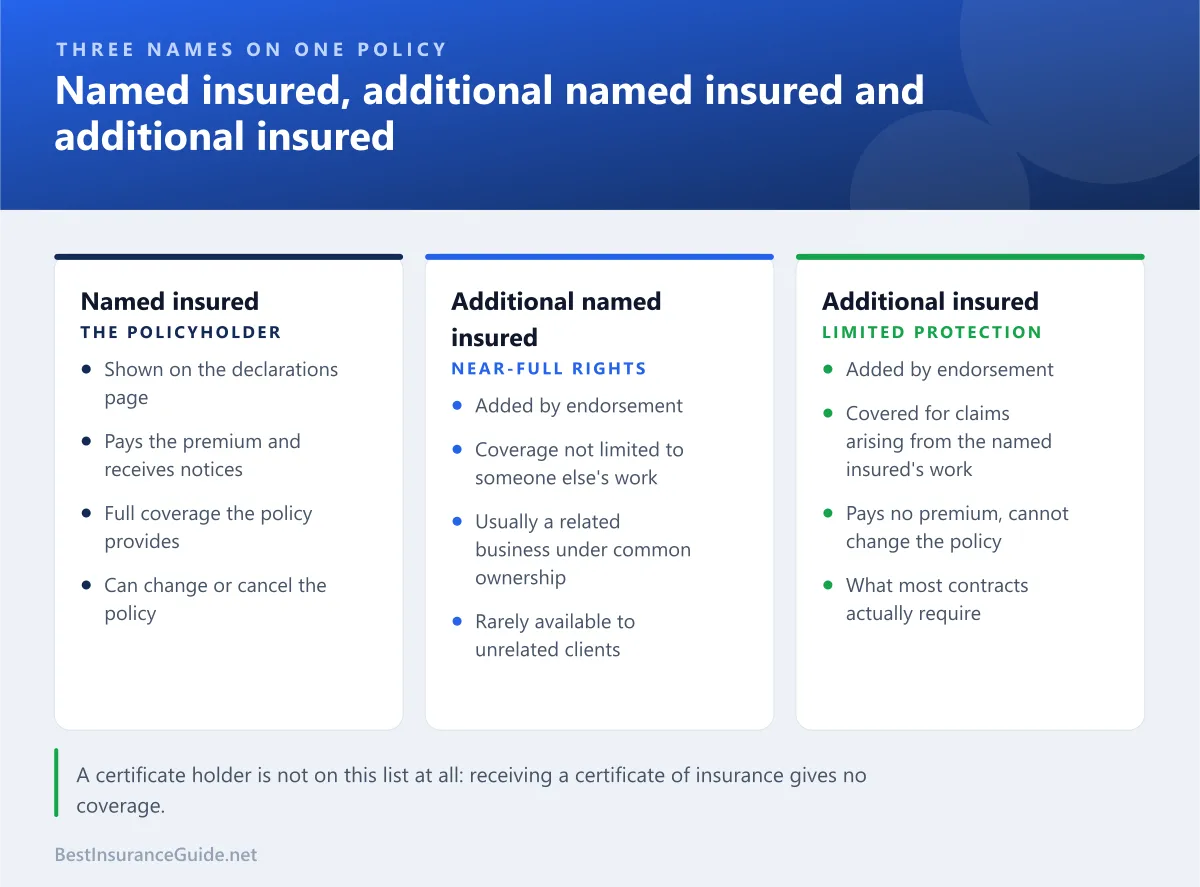
Named insured. The policyholder, shown on the declarations page. The first named insured is the one responsible for paying the premium and receiving notices such as cancellation. The named insured has the full coverage the policy provides.
Additional named insured. Added to the policy with rights close to those of the named insured. Their coverage is not limited to claims arising from someone else’s work. This status is normally reserved for affiliated entities, such as a sister company or a holding company that owns the premises, not for clients or landlords.
Additional insured. A third party with narrower coverage, typically only for claims arising from the named insured’s operations. They do not pay premium, usually receive no cancellation notice unless an endorsement provides it, and cannot change the policy.
If a contract asks for “additional named insured” status when it means “additional insured,” which happens more often than it should, ask your agent. Insurers may decline to add an unrelated business as an additional named insured, and it is rarely what the other party needs.
The additional insured endorsement
Additional insured status only exists if there is an endorsement on the policy. On general liability policies, many insurers use standard ISO forms or close equivalents. The ones you will see named in contracts most often:
| Form | Common use |
|---|---|
| CG 20 10 | Owners, lessees or contractors, for the named insured’s ongoing operations |
| CG 20 37 | Owners, lessees or contractors, for completed operations after the work is finished |
| CG 20 11 | Managers or lessors of premises, typically a tenant’s landlord |
| CG 20 26 | A designated person or organization, a general form used outside construction |
| CG 20 33 / CG 20 38 | Blanket or automatic status where a written construction contract requires it |
Many insurers write their own blanket additional insured endorsements instead of using ISO wording, particularly in business owner’s policies. They work the same way: anyone you have agreed in a written contract to add becomes an additional insured automatically.
Ongoing operations vs completed operations
This is the distinction that matters most in construction and trades work.
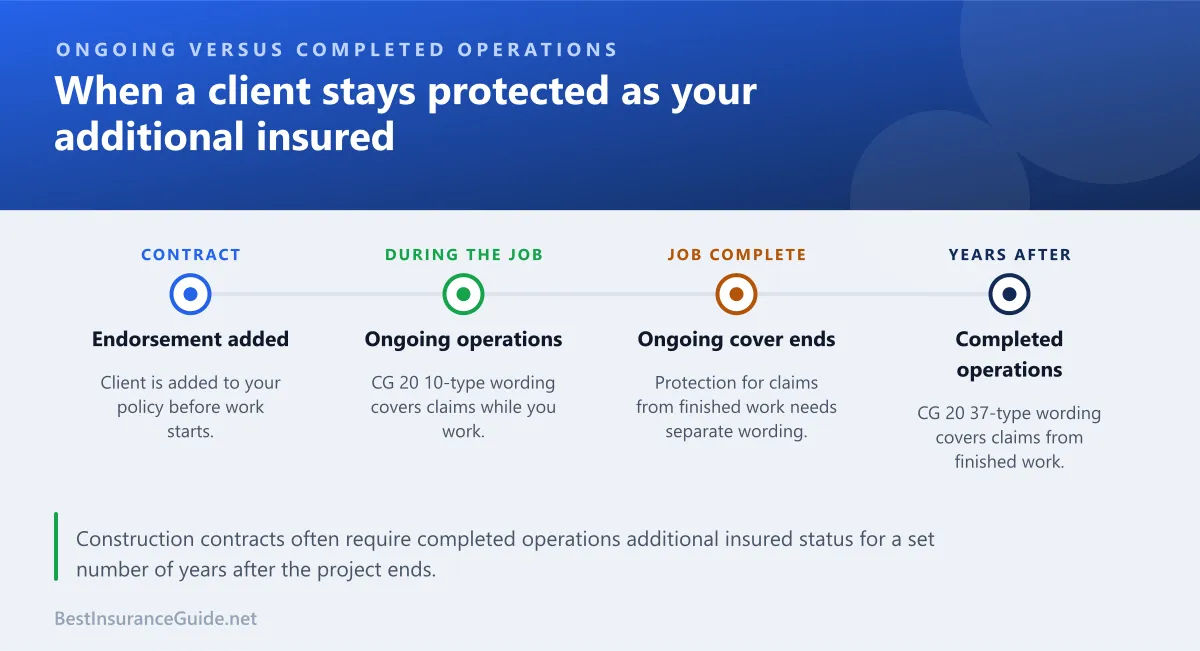
Ongoing operations coverage (CG 20 10 and similar) protects the additional insured against claims arising while you are doing the work. It ends when the work is completed.
Completed operations coverage (CG 20 37 and similar) protects them against claims arising from your finished work: a leak from pipework you installed, a roof you fitted that fails, a deck you built that collapses. Those claims can surface months or years later.
Many construction contracts require both, and require the completed operations coverage to stay in place for a set number of years after the project ends. If your policy only has ongoing operations wording, the additional insured is unprotected once you leave the site.
What the 2013 ISO changes did
The 2013 editions of the ISO additional insured endorsements added three important limits:
- Coverage applies only to the extent permitted by law, which matters in states with anti-indemnity statutes that restrict shifting certain liability in construction contracts.
- Coverage is no broader than the contract requires. If the contract asks for less, the additional insured gets less.
- The limits available to the additional insured are the lesser of the contract’s required limits or the policy’s limits. If you carry $2 million but the contract only requires $1 million, the additional insured gets $1 million.
That third change matters to you as the named insured, because it preserves more of your limit for your own claims.
Loss payee vs additional insured
A loss payee is completely different. A loss payee has a financial interest in property and is entitled to be paid, alongside or instead of you, when that property is damaged or destroyed. It relates to property coverage, not liability.
| Detail | Additional insured | Loss payee |
|---|---|---|
| What they get | Liability protection when sued | Payment for damage to property they have an interest in |
| Typical examples | Clients, landlords, general contractors | Lenders, equipment lessors, auto finance companies |
| Policy section | General liability, auto liability, umbrella | Property, equipment, auto physical damage |
| Why they want it | To avoid paying claims caused by your work | To protect their collateral |
The mortgagee on a homeowners policy is a close cousin of the loss payee: the mortgage lender is named so that claim checks for dwelling damage include them.
Leased vehicles often require both. The leasing company is a loss payee for damage to the car and an additional insured on the liability coverage, because as the vehicle’s owner it could be named in a lawsuit after an accident. If you are financing or leasing a car, our guide to gap insurance explains the other protection lenders expect.
Certificate holder vs additional insured
This confusion causes real disputes. A certificate holder is simply the party that receives your certificate of insurance. It gives them no coverage at all. They become an additional insured only when the endorsement is added to your policy.
The certificate can show additional insured status, with a tick in the ADDL INSD column and a note in the description box, but the tick reports an endorsement; it does not create one. Our guide to the certificate of liability insurance walks through that form box by box.
Additional insured on personal insurance
Additional insured status is mainly a business insurance concept, but it shows up on personal policies too.
- Renters insurance. Many landlords ask to be listed on a tenant’s renters policy. Most insurers do this as an interested party or additional interest, which means the landlord is notified if the policy lapses, rather than as a true additional insured with coverage. Our renters insurance guide covers what the policy protects.
- Homeowners insurance. Relatives who live elsewhere but have an interest in the home, a trust that owns the property, or a co-owner not on the deed can sometimes be added as additional insureds.
- Auto insurance. Leasing companies, and sometimes employers whose employees drive their own cars for work, may be added as additional insureds.
What adding an additional insured means for you
Adding someone as an additional insured is not free of consequences for the named insured.
- Shared limits. Anything paid on behalf of an additional insured comes out of your policy limits. If the limit is exhausted defending a client, less is left for claims against you.
- Loss history. Claims paid on an additional insured’s behalf go on your record and can affect your renewal pricing.
- Cost. Many business policies include blanket additional insured endorsements at no extra charge. Others charge a modest fee per name or for blanket wording.
- Contract compliance. If the contract requires specific forms, completed operations coverage for years afterwards, or primary and non-contributory wording, your endorsement needs to match it.
Common additional insured mistakes
Most additional insured disputes come from a handful of avoidable errors.
- Sending the certificate before the endorsement exists. The certificate says the client is covered; the policy says they are not. When a claim arrives, the client finds out the hard way, and you may be in breach of contract.
- Relying on a blanket endorsement that does not match the contract. Many blanket forms only apply where the written contract was signed before the work began, or only cover ongoing operations. If the contract asks for completed operations too, a blanket form without it falls short.
- Naming the wrong entity. Property owners frequently hold buildings through a separate company. If the contract says “Owner and its affiliates,” the endorsement or blanket wording needs to capture them.
- Forgetting the auto and umbrella policies. Contracts often require additional insured status on every liability policy, not just general liability.
- Letting it lapse at renewal. Scheduled endorsements do not always carry across when you change insurer. Check each renewal against your active contracts.
Before you agree to add an additional insured
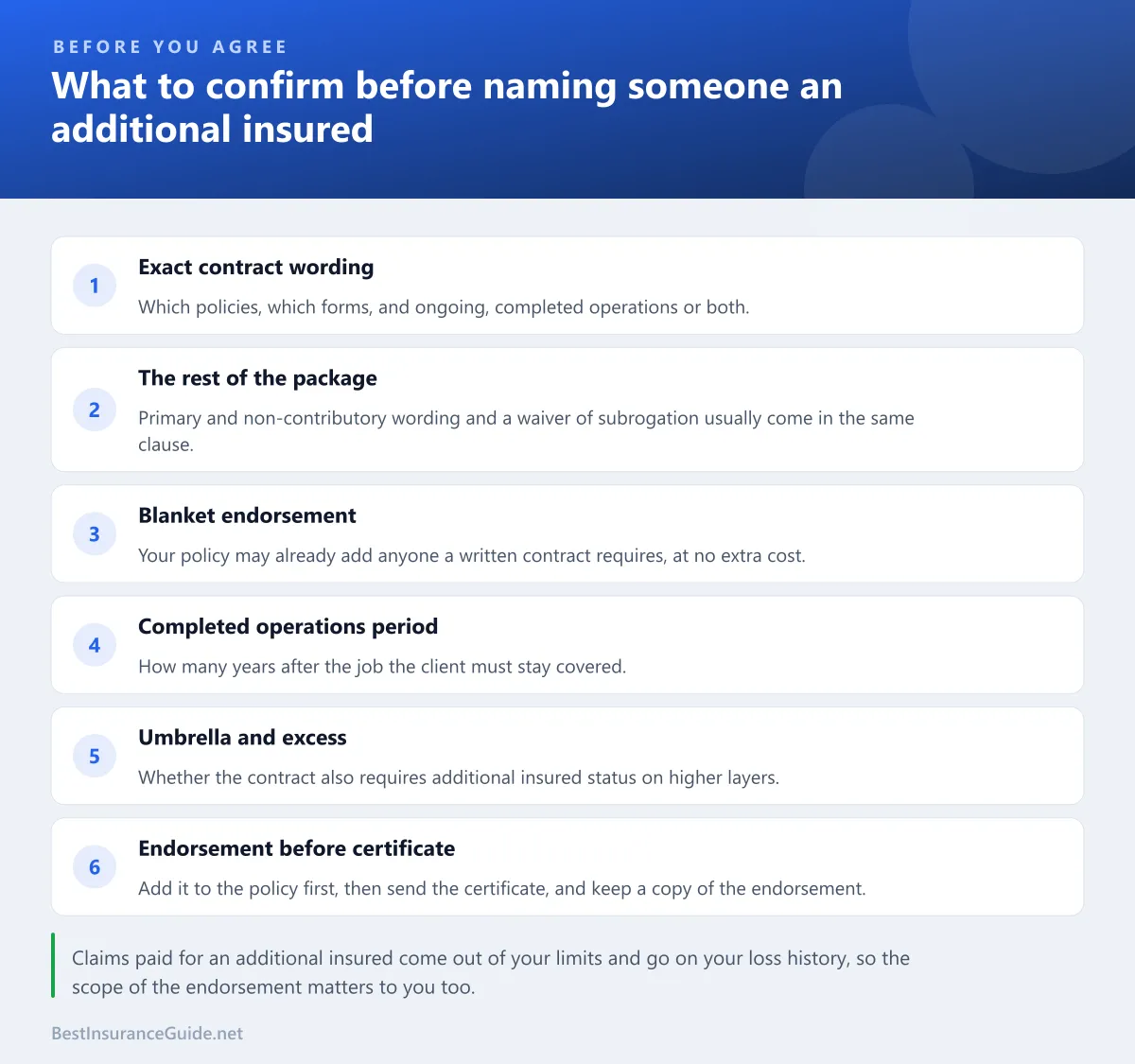
- Read the exact contract wording. Note which policies, which forms and whether ongoing, completed operations or both are required.
- Check for primary and non-contributory and waiver of subrogation requirements in the same clause.
- Ask your agent whether your policy already has a blanket endorsement that meets the contract.
- Confirm how long completed operations coverage must last and whether your policy can support it.
- Check your umbrella if the contract requires additional insured status on excess limits too. Our business umbrella insurance guide covers how those layers follow the primary policy.
- Get the endorsement issued before work starts, then send the certificate.
- Keep a copy of the endorsement with the contract.
The bottom line
An additional insured is a third party your policy protects for claims arising from your work. It is narrower than being a named insured, broader than being a certificate holder, and has nothing to do with being a loss payee. The protection comes from the endorsement, not the certificate, and the details, ongoing versus completed operations, blanket versus scheduled, primary or not, decide whether it actually does what the contract promised.
For the full list of contract-driven endorsements small businesses are asked for, see our business insurance checklist.
BestInsuranceGuide.net is an independent publisher and is not affiliated with any insurer or with ISO. Endorsement form numbers refer to standard ISO forms; your insurer may use its own equivalent wording. This article is general information, not legal advice.