What Is Supplemental Life Insurance? Voluntary Life at Work, Explained for Open Enrollment
Supplemental life insurance, or voluntary life, is extra term life you buy at work. Spouse and child cover, guaranteed issue, age-band costs, and is it worth it?

Table of contents

If you’re going through open enrollment, there’s a good chance your benefits screen is offering supplemental life insurance, sometimes labelled voluntary life insurance, optional life, or additional life. It’s one of the most common workplace benefits and one of the least understood.
Supplemental life insurance is extra term life insurance you buy through your employer, on top of the basic life coverage many employers provide for free. You pick the amount, the premium comes out of your paycheck, and if you die while covered, your beneficiary receives the death benefit.
This guide explains how it works, what the spouse and dependent options mean, how much it costs as you age, and how to decide whether to buy it or a personal term policy instead. This site is independent and not affiliated with any employer, insurer or benefits platform. Your own plan documents decide the details.
Supplemental vs basic life insurance
Most workplace life insurance comes in two layers:
| Basic life insurance | Supplemental (voluntary) life insurance | |
|---|---|---|
| Who pays | Employer, usually | You, through payroll deduction |
| Amount | Often a flat amount or 1× salary | You choose: often 1× to 5× salary, or fixed increments |
| Enrollment | Often automatic | You must elect it |
| Health questions | None | None up to the guaranteed issue amount when you first enroll |
| Covers spouse or children | No | Optional add-ons |
| If you leave the job | Usually ends | Usually ends, with portability or conversion options |
Basic life is often packaged with AD&D. See what basic life and AD&D gives you. Supplemental life is the part you control.
How supplemental life insurance works
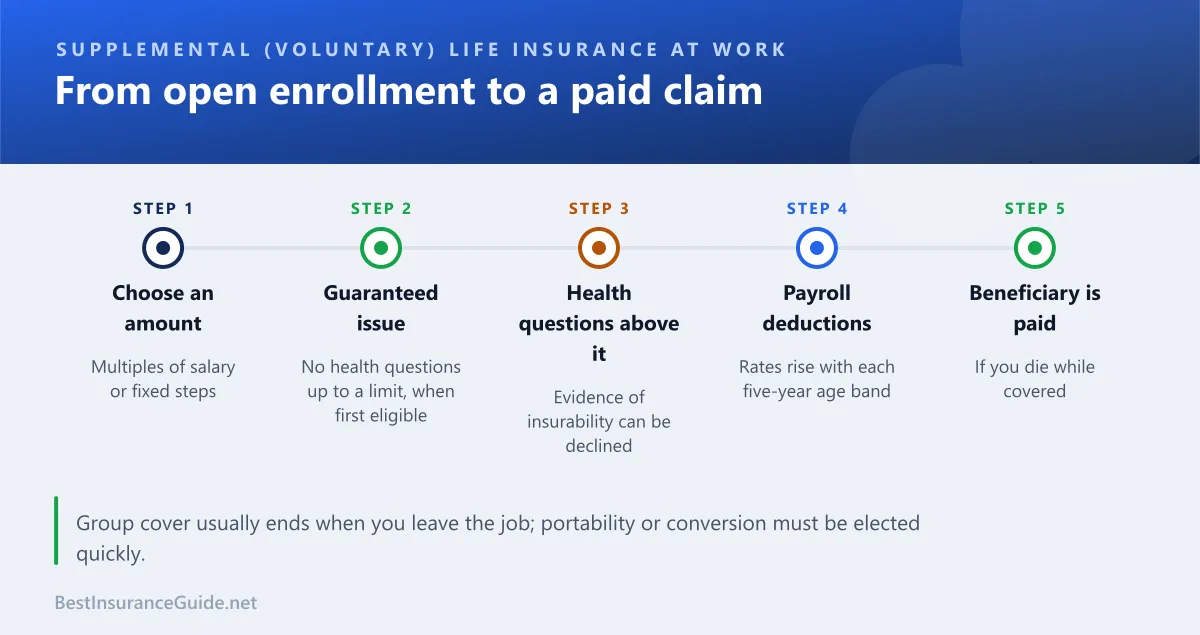
- You choose an amount. Plans usually offer multiples of your salary, such as 1×, 2× or 3×, or fixed steps such as $10,000, up to a maximum.
- You may get it without health questions. Up to the plan’s guaranteed issue amount, you can enroll without medical underwriting, but only when you’re first eligible, typically as a new hire or at a qualifying life event.
- Above that, you answer health questions. Coverage above the guaranteed amount, or bought later, usually needs an evidence of insurability (EOI) form, which the insurer can approve, limit or decline.
- You pay through payroll. Premiums are usually deducted after tax, and they’re set by age band, so they rise as you move into older bands.
- Your beneficiary is paid if you die while covered. You name beneficiaries separately for supplemental coverage, so check they’re up to date.
Spouse and dependent life insurance
Two add-ons often appear on the same screen:
Spouse (or domestic partner) life insurance covers your spouse’s life, paid to you if they die. It’s usually:
- available in fixed amounts or as a percentage of your supplemental coverage, often up to 50% or 100%;
- capped at a maximum amount;
- subject to health questions above a guaranteed amount.
Dependent (child) life insurance pays a small flat benefit, often $5,000 to $20,000, if a covered child dies. One premium usually covers all eligible children, commonly up to age 19, or 26 if they’re students. It’s designed for funeral costs, not income replacement, and it’s usually inexpensive.
A practical check: if your spouse doesn’t earn an income but cares for children, their death would still create real costs, such as childcare and lost flexibility at work. Spouse coverage, or an individual policy on them, is worth pricing.
How much does supplemental life insurance cost?
Group supplemental life is usually priced per $1,000 of coverage, per month, in five-year age bands. The rate jumps each time you move into a new band.
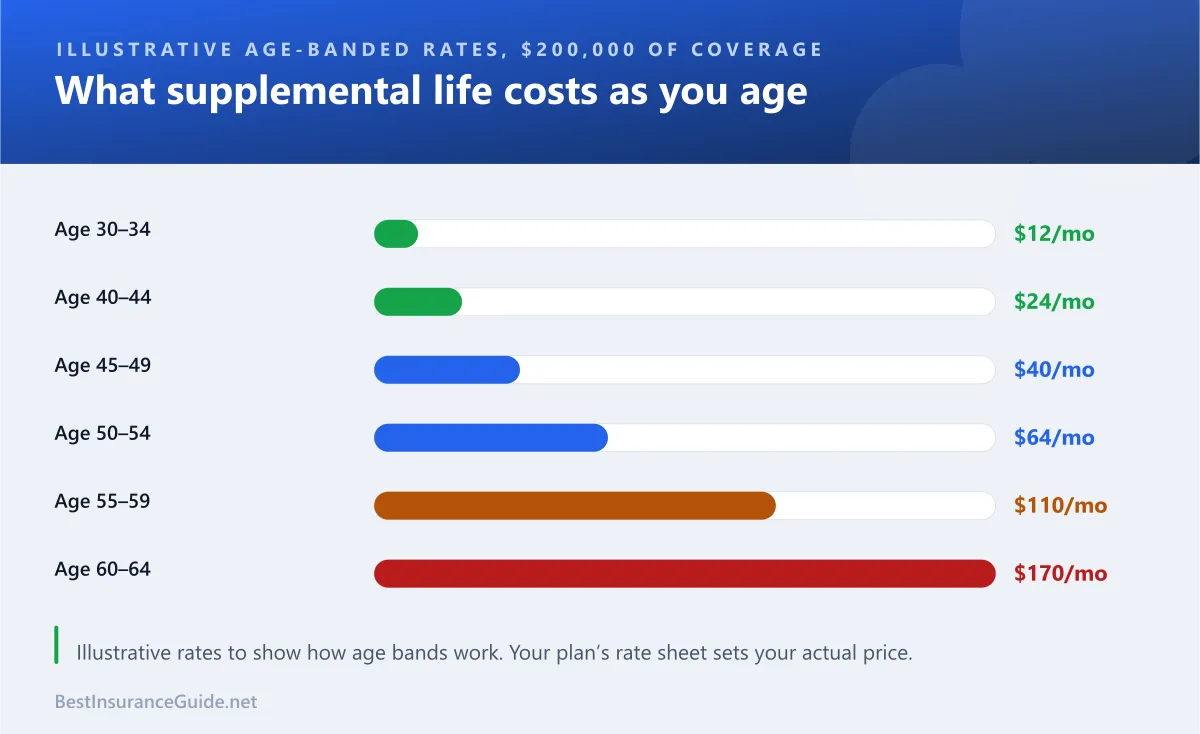
Worked example: $200,000 through work, as you age
The rates below are illustrative to show how age bands work. Your plan’s rate sheet is the only source for your real cost.
| Age band | Illustrative rate per $1,000 per month | Monthly cost for $200,000 | Yearly cost |
|---|---|---|---|
| 30–34 | $0.06 | $12 | $144 |
| 35–39 | $0.08 | $16 | $192 |
| 40–44 | $0.12 | $24 | $288 |
| 45–49 | $0.20 | $40 | $480 |
| 50–54 | $0.32 | $64 | $768 |
| 55–59 | $0.55 | $110 | $1,320 |
| 60–64 | $0.85 | $170 | $2,040 |
Two patterns stand out. Group life is often very cheap when you’re young, and the cost climbs steeply after 50. An individual 20- or 30-year term policy bought young keeps the same premium for the whole term.
Is supplemental life insurance worth it?
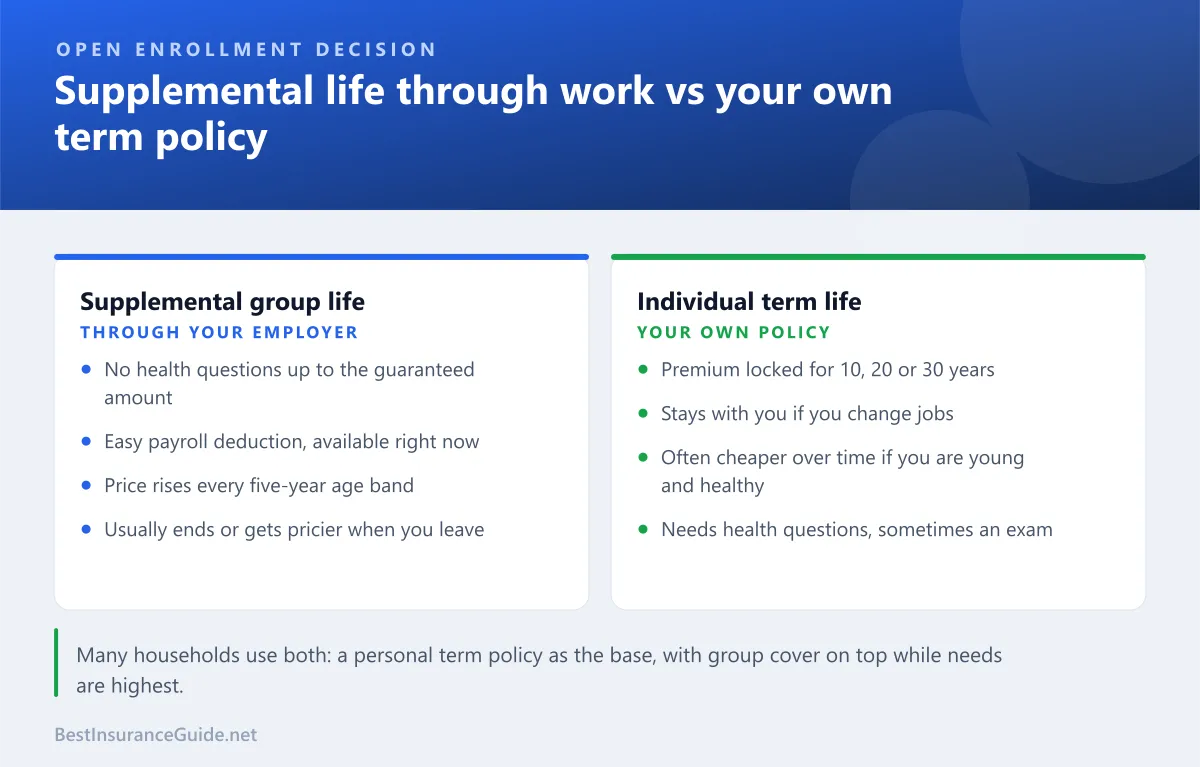
It depends on your health, age and how long you’ll stay with the employer.
Supplemental life through work makes sense if:
- you have health conditions that would make individual coverage expensive or hard to get, because group coverage up to the guaranteed amount needs no medical exam;
- you need cover quickly and it’s available now at open enrollment;
- you want to top up an individual policy for a period when your needs are highest;
- you expect to stay with the employer, so portability isn’t a concern.
An individual term policy is usually better if:
- you’re young and healthy, because you can lock in a level premium for 20 or 30 years that may cost less than the group age bands over time;
- you might change jobs, since individual cover goes with you;
- you need a large amount, beyond the plan’s maximum or guaranteed issue limit;
- you want the premium to stay the same.
Many people do both. A personal term policy forms the base that follows you everywhere, and supplemental group life tops it up while the kids are young. That combination is often the cheapest way to get enough cover.
How much life insurance do you actually need?
A common starting point is enough to replace several years of income and pay off major debts, such as a mortgage, plus future costs like college. Employer coverage of one or two times salary rarely gets there. See life insurance basics for a step-by-step way to estimate it, and term vs whole life insurance for the policy types.
Supplemental life vs supplemental AD&D
Benefits screens often list supplemental life and supplemental AD&D next to each other, at very different prices. They are not interchangeable:
- Supplemental life pays if you die of almost any cause, including illness.
- Supplemental AD&D pays only if you die in an accident or suffer certain listed injuries. It’s cheaper because accidents cause a small share of deaths.
If you can only afford one, choose supplemental life. AD&D can be a cheap extra on top, but it won’t pay if you die of cancer or a heart attack. Our guide to AD&D insurance explains the exclusions.
Worked example: a household’s total cover
Priya, 38, earns $80,000. Her employer gives her basic life of 1× salary ($80,000) plus matching AD&D. She has two children and a mortgage, and estimates her family needs about $800,000 if she dies.
| Cover | Amount | Pays if she dies of illness? |
|---|---|---|
| Basic life (employer-paid) | $80,000 | Yes |
| Supplemental life, 3× salary | $240,000 | Yes |
| Individual 20-year term policy | $500,000 | Yes |
| Total life cover | $820,000 | |
| Basic AD&D (accidents only) | $80,000 | No |
Her own term policy does most of the work and stays with her if she changes jobs. The supplemental group cover fills the gap while the children are young, and she can drop it later. The AD&D is a free extra, but she doesn’t count it in her plan.
Illustrative example. Your needs and the amounts your plan offers will differ.
Who can usually skip it
Supplemental life isn’t for everyone. You can often leave it unelected if nobody depends on your income: for example, you’re single with no children and no co-signed debts, or you’re retired with enough savings to cover a surviving spouse. The same applies if you already have enough individual term cover for your family’s needs. In those cases a small amount for final expenses may be all you need, and basic employer coverage often handles that.
Common open enrollment mistakes
- Skipping the guaranteed issue window. If you decline coverage when you’re first eligible, adding it later usually means health questions, and the insurer can say no.
- Counting AD&D as life insurance. It isn’t. Count only coverage that pays for death from any cause.
- Forgetting the age bands. This year’s price can double over a few birthdays. Budget for the bands ahead.
- Not naming beneficiaries. Supplemental coverage often needs its own designation. Without one, the benefit may go to your estate and through probate.
- Relying on group cover alone. Your highest-need years can include a job change or layoff, which is exactly when group coverage ends.
- Buying child cover instead of insuring the parents. Child life insurance is cheap, but the household’s real risk is losing a parent’s income or care.
Open enrollment checklist
- Find your basic coverage amount. Basic life plus supplemental is your total group cover.
- Check the guaranteed issue amount. If this is your first eligibility, electing up to it now avoids health questions later.
- Look at the age-band rate sheet, not just this year’s price. Note the bands you’ll move into.
- Price an individual term policy for the same amount, to compare.
- Decide on spouse and child cover separately.
- Update your beneficiaries. Supplemental cover has its own beneficiary designation, and naming a contingent beneficiary avoids probate if your first choice dies before you.
- Read the portability and conversion terms so you know what happens if you leave.
Supplemental life and taxes
- Death benefits paid to your beneficiaries are generally income tax-free. See do you pay taxes on life insurance for the exceptions.
- Premiums for supplemental life are usually deducted after tax, which keeps the benefit tax-free and avoids “imputed income”.
- Employer-paid group-term life above $50,000 is treated as taxable imputed income under IRS rules, which is why some pay stubs show a small extra amount for basic life coverage.
If you leave your job
Group coverage normally ends when your employment ends. Two options often exist, each with a short deadline, usually around 31 days:
- Portability: keep the group term coverage by paying the insurer directly, often at group rates that continue to rise by age band.
- Conversion: turn the group coverage into an individual permanent policy without health questions, usually at a much higher price.
If you’re healthy, a new individual term policy may be cheaper than either option. If your health has changed, portability or conversion can be valuable because they don’t need medical underwriting.
Related reading
Is life insurance worth it? helps you decide whether you need cover at all, can you have multiple life insurance policies? explains combining group and individual cover, and how long life insurance takes to pay out explains what your family experiences when they claim.
Sources and notes
- Group life insurance structure (basic and supplemental coverage, guaranteed issue, evidence of insurability, age-banded rates, portability and conversion) as described in typical employer group life certificates and insurer plan summaries. Your own certificate and rate sheet are authoritative.
- IRS Publication 15-B, Employer’s Tax Guide to Fringe Benefits: group-term life insurance coverage above $50,000 and imputed income.
- NAIC consumer guides to life insurance (naic.org).
This article is general information, not financial or tax advice. Group life plans differ by employer and insurer. Check your plan’s certificate, rate sheet and beneficiary forms before you enroll.