Is Lemonade Pet Insurance Good? An Honest 2026 Review of Coverage, Add-Ons and Claims
Is Lemonade pet insurance good? What the base policy covers, which add-ons you need, waiting periods, cruciate rules, discounts, claims and how to cancel.

Table of contents

Lemonade built its name on renters insurance with an app, a chatbot and fast claims, and it brought the same approach to pet insurance. So is Lemonade pet insurance good? It can be, but only if you understand what’s in the base policy and what you’re paying extra for.
This review is based on Lemonade’s own pet insurance FAQ and policy information, cross-checked with independent reviews. Lemonade issues its own policies, and terms vary by state, so your quote and policy documents in the app always take priority.
This site is independent and not affiliated with Lemonade or any insurer.
Lemonade pet insurance at a glance
| Feature | What Lemonade says |
|---|---|
| Pets covered | Dogs and cats only |
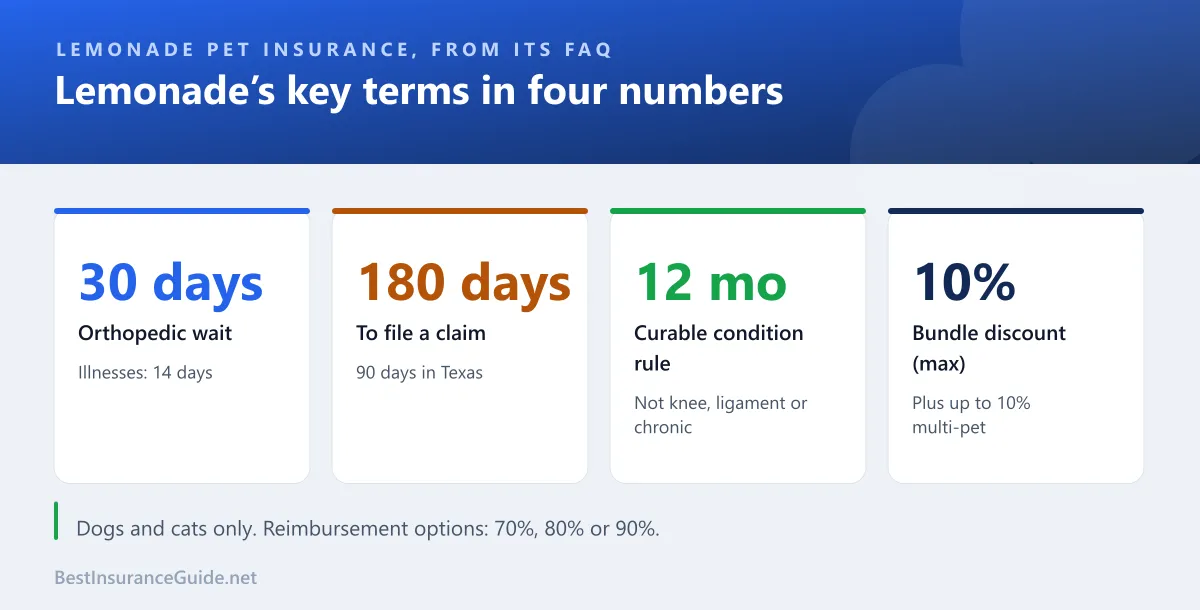
| Illness waiting period | 14 days |
| Orthopedic waiting period | 30 days |
| Reimbursement (co-insurance) | 70%, 80% or 90% |
| Deductible and annual limit | You choose; both affect the price |
| Exam fees | Add-on (vet visit fees) |
| Curable pre-existing conditions | Can be covered after 12 months, in most states |
| Claims | In the app, within 180 days (90 in Texas) |
| Discounts | Up to 5% annual pay, up to 10% multi-pet, up to 10% bundle |
| Cancel | In the app |
What the base policy covers, and what costs extra
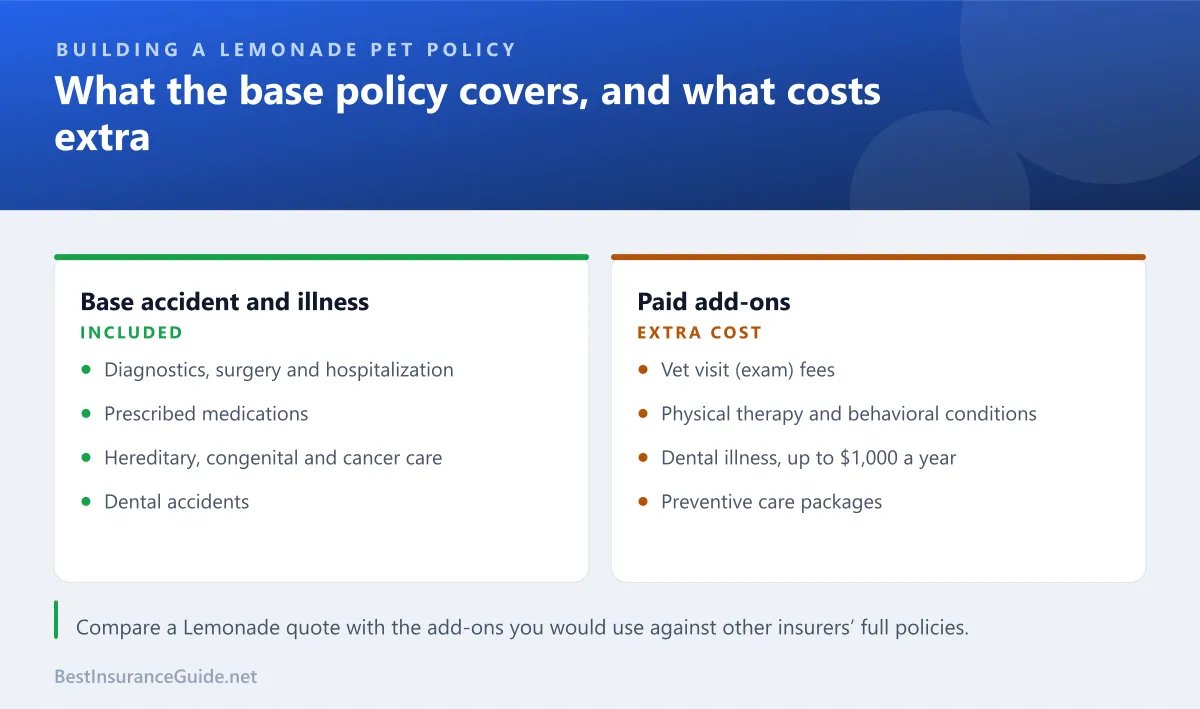
Lemonade’s base accident and illness policy covers unexpected accidents and illnesses: diagnostics, procedures, hospitalization, surgery and prescribed medications, including hereditary and congenital conditions and cancer care, as long as they aren’t pre-existing. You can see any licensed vet in the U.S.; there’s no network.
Several things other insurers include are paid add-ons with Lemonade:
- Vet visit fees, meaning the exam charge itself, which can be $60 to $100 or more per visit.
- Physical therapy.
- Behavioral conditions.
- Dental illness, such as periodontal disease, covered up to $1,000 a year with the relevant add-on. Dental accidents are covered by the base policy.
- Preventive care packages, including Puppy and Kitten packages that can help with spay and neuter costs.
The practical point: compare a Lemonade quote with the add-ons you’d actually want against other insurers’ full policies. The base price alone isn’t a fair comparison.
Waiting periods and the cruciate ligament rule
Lemonade’s FAQ lists two waiting periods that apply to every policy:
- 14 days for illnesses.
- 30 days for orthopedic conditions.
Accident waiting periods are short but vary by state, so check your quote.
The important detail is about cruciate ligament events, the dog equivalent of a torn ACL, which usually need surgery. If your pet shows signs or symptoms of a cruciate problem before or during the orthopedic waiting period, Lemonade treats it as pre-existing. And because knee and ligament conditions can’t be “cured”, they never come back into cover. That makes it worth getting an active, large or older dog covered before any limping starts.
Pre-existing conditions: the curable rule
In most states, Lemonade can cover a temporary pre-existing condition or injury that has resolved, with no recurrent symptoms or continued treatment for at least 12 months. A one-off stomach upset before you enrolled won’t exclude stomach problems forever.
What won’t come back into cover: chronic conditions (such as diabetes or ongoing allergies) and knee or ligament conditions.
Lemonade reviews your pet’s medical records to identify pre-existing conditions. Get them uploaded soon after the illness waiting period ends, so you aren’t scrambling when you need to claim.
How Lemonade pays a claim
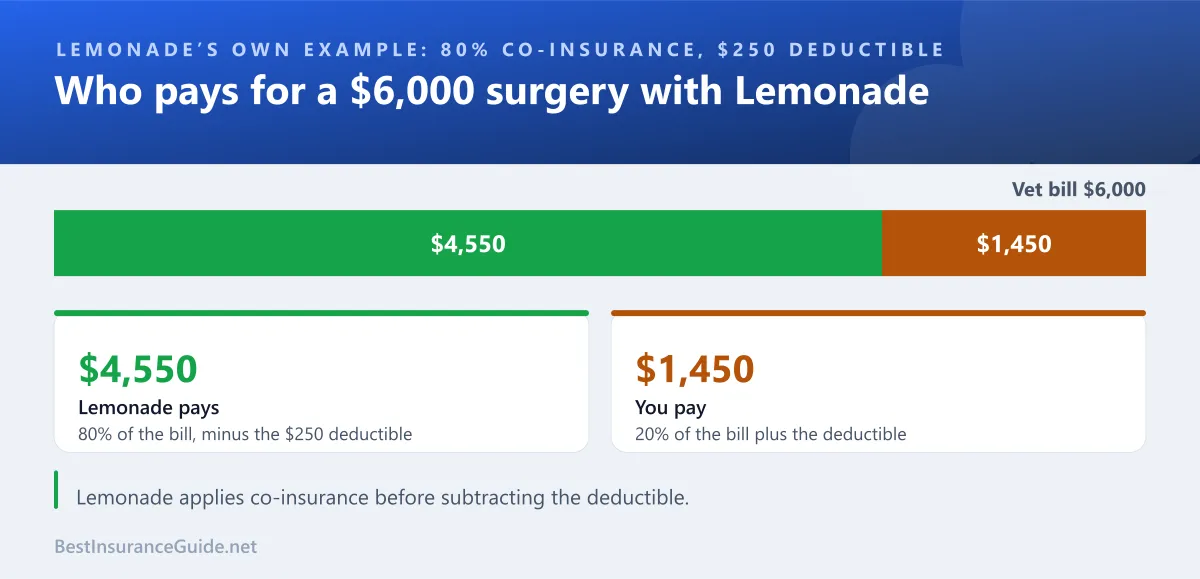
Lemonade’s own example: your dog needs surgery costing $6,000. Your policy has 80% co-insurance and a $250 deductible. Lemonade calculates the payment as cost × co-insurance − deductible:
- $6,000 × 80% = $4,800
- $4,800 − $250 = $4,550 paid by Lemonade
- You pay $1,450.
Note the order: Lemonade applies co-insurance before subtracting the deductible, which is slightly different from insurers that subtract the deductible first. Higher co-insurance means a higher premium but a bigger payout.
How to file a claim with Lemonade
Claims are filed in the Lemonade app:
- Open your pet policy and start a claim.
- Answer a few questions and upload the itemized invoice and any records.
- Lemonade says about half of eligible claims are paid instantly by its automated system. The rest go to its claims team.
- File within 180 days of treatment, or 90 days in Texas, or you lose the right to reimbursement.
You pay the vet first and Lemonade reimburses you, as with most pet insurers.
Discounts
Lemonade lists three discounts:
- Up to 5% for paying annually.
- Up to 10% for insuring more than one cat or dog.
- Up to 10% for bundling with Lemonade renters, homeowners or car insurance.
The discounts apply to the base policy and the vet visit fee and physical therapy add-ons, not to other add-ons or preventive packages.
Changing or cancelling your policy
- Increase coverage (lower deductible, higher limit or co-insurance, add-ons) within 14 days of buying. After that, you generally have to wait.
- Decrease coverage at any time in the app.
- Policies can’t be transferred to someone else, even a listed co-owner. A new owner has to buy their own policy.
To cancel: in the Lemonade app, open your pet policy, tap the three dots in the top right corner, and choose Cancel Policy. Questions first? Call 1-844-733-8666.
Lemonade pros and cons
Pros
- Low base premiums and a simple app.
- Fast claims, with about half of eligible claims paid instantly, Lemonade says.
- Curable pre-existing conditions can be covered after 12 months.
- Good discounts for bundling and multiple pets.
- Only a 30-day orthopedic waiting period, shorter than some rivals.
Cons
- Exam fees cost extra, as do physical therapy and behavioral cover.
- Only covers dogs and cats.
- You can only increase coverage in the first 14 days.
- Policies can’t be transferred to a new owner.
- Everything happens in the app, which isn’t ideal if you prefer phone or paper.
Lemonade vs MetLife and Embrace
| Feature | Lemonade | MetLife | Embrace |
|---|---|---|---|
| Exam fees | Add-on | Included | If on your schedule |
| Orthopedic wait | 30 days | Not shown in sample | 180 days, waivable |
| Shrinking deductible | No | $50 a year | $50 a year |
| Curable pre-existing rule | 12 months (most states) | Not shown in sample | 12 months |
| Claim deadline | 180 days (90 in Texas) | 90 days | 60 days after policy end or renewal |
From each insurer’s published FAQ or sample policy. See our MetLife and Embrace reviews.
How to build a sensible Lemonade policy
Because so much is optional, it helps to build the policy in order:
- Start with the base accident and illness policy. This is the part that protects you from the big, unexpected bills.
- Pick the annual limit first, not the price. For a large or active dog, choose a limit that would cover a major surgery and follow-up care.
- Choose co-insurance and deductible together. Price a few combinations. A higher deductible with 90% co-insurance can cost about the same as a lower deductible with 70%, and it pays far more on a big claim.
- Add vet visit fees if you’d rather not pay the exam charge on every sick visit. For many owners this is the add-on that makes Lemonade comparable to insurers that include exams.
- Add physical therapy for breeds prone to joint problems, and behavioral cover if anxiety or behavior issues are a concern.
- Decide on dental illness cover if your pet is prone to periodontal disease. Many small breeds and cats are.
- Treat preventive care as a budget tool, not insurance. Price it against what you actually spend on vaccines and checkups.
- Lock in your choices within 14 days, because after that you can only reduce coverage.
Common mistakes with Lemonade claims
- Filing too late. You have 180 days, or only 90 days in Texas.
- Not uploading records early. Pre-existing condition reviews can slow a first claim.
- Assuming exams are covered. Without the vet visit fee add-on, the exam charge isn’t reimbursed.
- Waiting to raise coverage until a problem appears. Increases are only allowed in the first 14 days.
- Expecting a policy to move with the pet. Lemonade policies can’t be transferred to a new owner.
Lemonade for puppies, kittens and older pets
Puppies and kittens. This is where Lemonade’s structure works best. Enroll early, before any vet notes can create pre-existing conditions, and consider the Puppy or Kitten preventive package if you’d use the vaccines and spay or neuter help it includes. Set your coverage carefully at the start, because you only have 14 days to increase it.
Cats. Cats are generally cheaper to insure. The add-ons that matter most for cats tend to be dental illness cover and vet visit fees, since many cat claims start with an exam and a dental problem. The orthopedic waiting period matters less than for dogs.
Older pets. Lemonade says it’s harder to insure older pets because they’re more likely to have conditions on file, and pets enrolled after its age limit may be declined. Pets enrolled while young can keep renewing. If you have an older pet, get its records together before you apply, and expect any ongoing condition to be excluded.
What happens at renewal
Lemonade’s FAQ explains that premiums can rise at renewal as your pet ages and as vet costs change. If the new price is too high, lower the coverage in the app, with a higher deductible or lower co-insurance, rather than cancelling. A new insurer would treat existing conditions as pre-existing.
Who Lemonade suits, and who should look elsewhere
Lemonade is a good fit if you:
- are happy managing everything in an app;
- want a short orthopedic waiting period for an active dog;
- already have renters, home or car insurance with Lemonade and can use the bundle discount;
- insure more than one cat or dog and can claim the multi-pet discount.
Look elsewhere, or compare carefully, if you:
- want exam fees and wellness included without building add-ons;
- prefer to deal with an insurer by phone or paper;
- own a pet other than a cat or dog;
- expect your needs to change after the first two weeks and want flexibility to increase cover later.
Our verdict
Lemonade is a good choice if you’re comfortable with an app, want low base premiums, and can benefit from bundle or multi-pet discounts. It’s also attractive for dogs at risk of knee problems, thanks to the 30-day orthopedic wait, as long as there are no signs before or during that window. Just price it with the add-ons you’d really use, especially vet visit fees, and decide on your coverage level before the 14-day change window closes.
Related reading
Pet insurance cost guide explains how co-insurance, deductibles and limits change your premium. Puppy wellness plans compares insurer wellness add-ons with vet-practice plans, and cat insurance explained covers what’s different for cats.
Sources and notes
- Lemonade, “The Ultimate Lemonade Pet FAQ”: waiting periods, cruciate ligament rule, co-insurance options and claim example, curable pre-existing conditions, add-ons, dental limits, discounts, claim deadlines, coverage changes, transfers and cancellation.
- Lemonade pet insurance: base policy coverage and add-ons.
- Independent reviews (U.S. News, Pawlicy), 2026: accident waiting period and state variations.
This review is general information, not insurance advice. Lemonade’s terms vary by state. Read your quote and policy in the app before relying on any benefit.