FEHB Premiums 2027: 10.9% Increase, Open Season Dates, Plans Leaving, and How Retirees Can Pay Less
FEHB premiums rise 10.9% for 2027 and PSHB 8.2%. Open Season Nov 9 to Dec 14, 2026, nine plans leaving, new GLP-1 rules and tips for retirees.

Table of contents
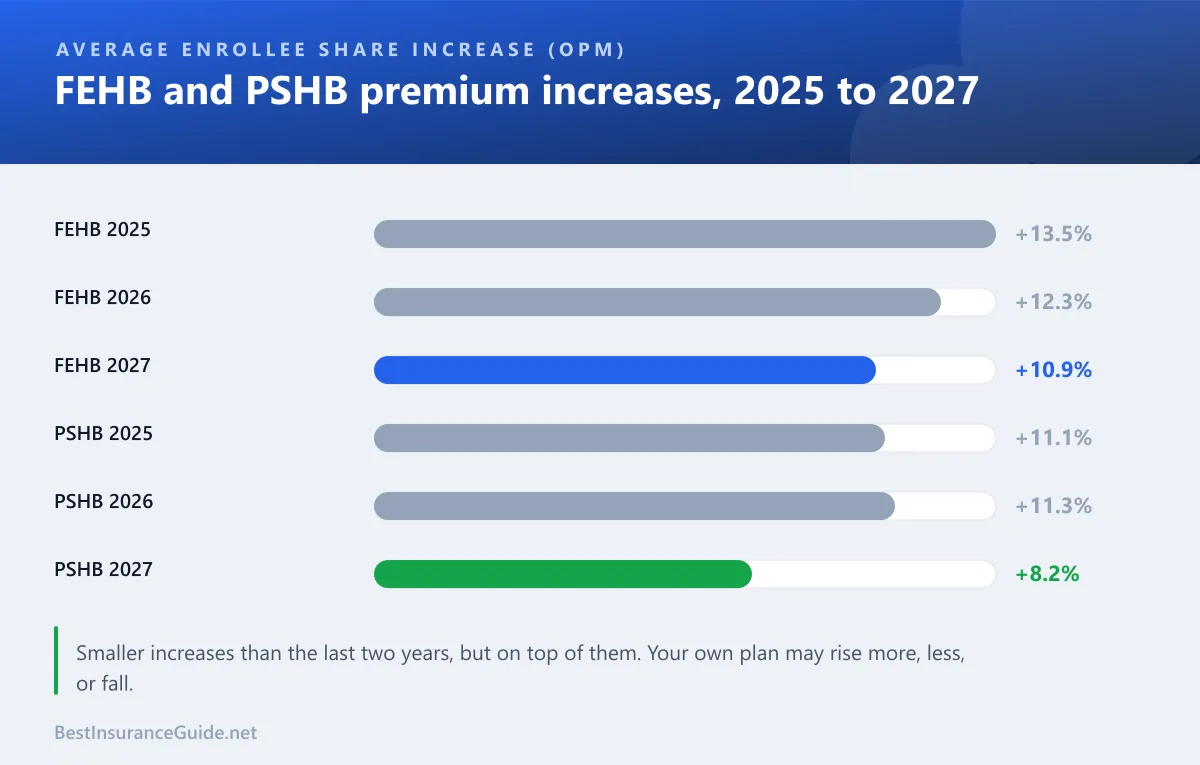
Federal employees and retirees will pay more for health insurance again in 2027. The Office of Personnel Management (OPM) announced on September 30, 2026 that the average enrollee share of Federal Employees Health Benefits (FEHB) premiums will rise 10.9% in 2027, after increases of 12.3% in 2026 and 13.5% in 2025. For the Postal Service Health Benefits (PSHB) program, the average enrollee share rises 8.2%.
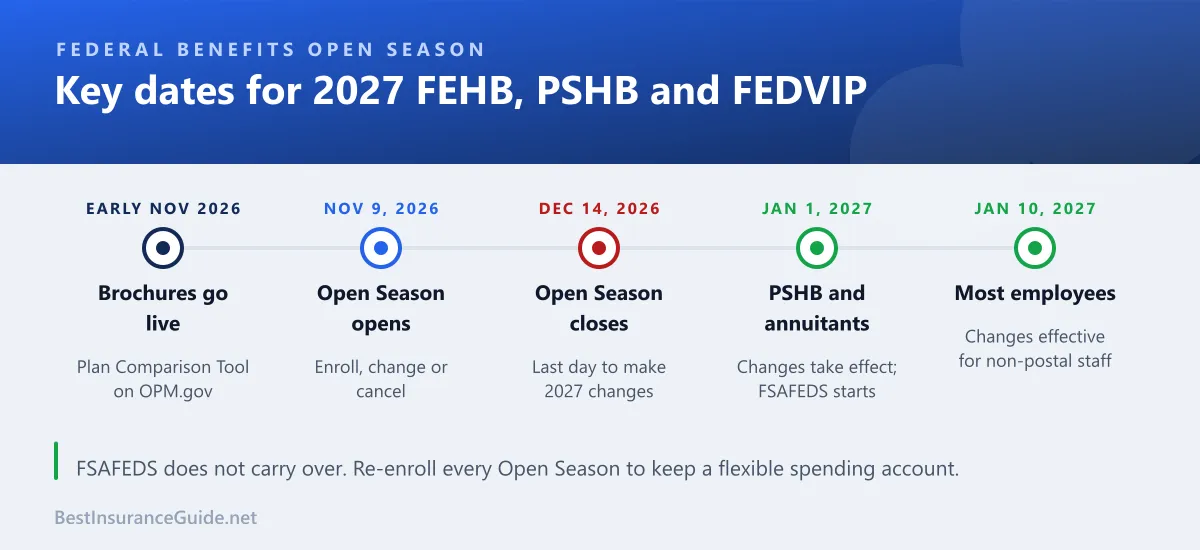
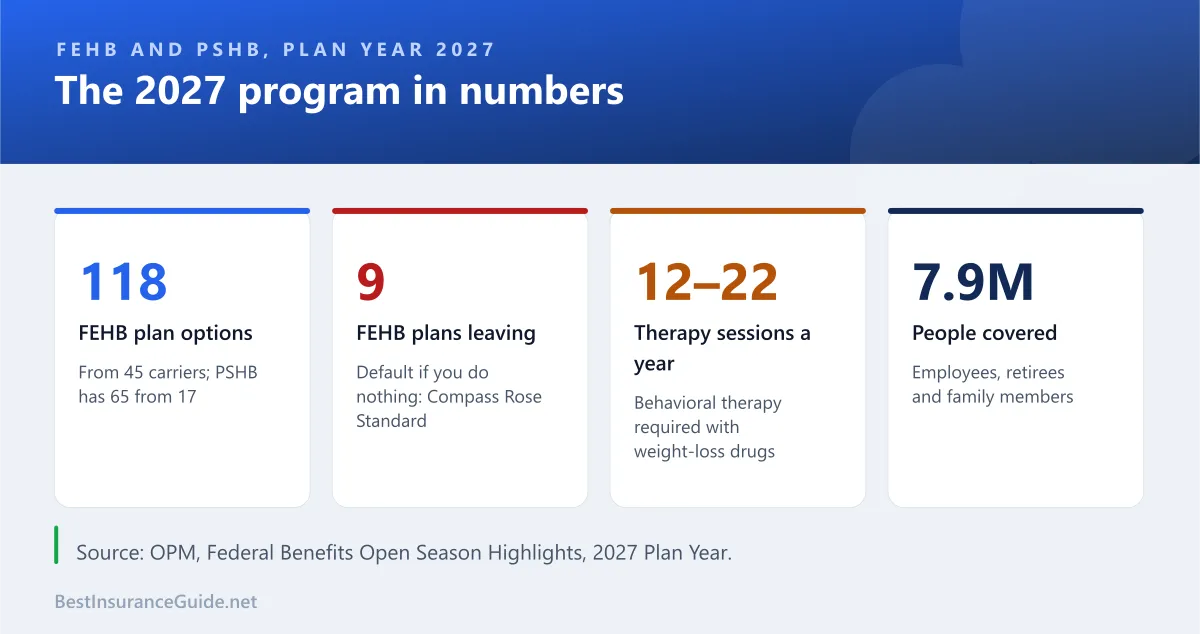
The increases are smaller than the last two years, but they come on top of two double-digit years. That makes this year’s Federal Benefits Open Season, November 9 to December 14, 2026, one of the most important in years for the program’s roughly 7.9 million covered employees, retirees and family members.
This guide covers the 2027 FEHB and PSHB numbers, the plans leaving the program, the new rules on weight-loss drugs, what changes for retirees, and how to compare FEHB plans so you pay less. This site is independent and not affiliated with OPM or any FEHB carrier. All program figures come from OPM’s Federal Benefits Open Season Highlights for the 2027 plan year.
2027 FEHB and PSHB premiums at a glance
| Detail | FEHB 2027 | FEHB 2026 | PSHB 2027 | PSHB 2026 |
|---|---|---|---|---|
| Average enrollee share increase | 10.9% | 12.3% | 8.2% | 11.3% |
| Overall average premium increase | 9.3% | 10.2% | 6.7% | 9.0% |
| Government contribution increase | 8.6% | 9.2% | 6.0% | 8.0% |
| Carriers / plan options | 45 / 118 | – | 17 / 65 | – |
Source: OPM, Federal Benefits Open Season Highlights, 2027 Plan Year.
Why is the enrollee share rising faster than the overall premium? The government’s contribution is set by a “Fair Share” formula in law. It is the lesser of 72% of the program-wide weighted average premium or 75% of your plan’s premium. When premiums rise, the government’s dollar contribution grows more slowly than the total, so the enrollee share grows faster. OPM puts the 2027 government contribution increase at 8.6% for FEHB and 6.0% for PSHB.
Over three years, the cumulative effect is large. The National Active and Retired Federal Employees Association (NARFE) calculates that across the three years from 2025 to 2027, the average FEHB enrollee share has risen about 41%, and PSHB about 33%.
Dental and vision (FEDVIP)
Dental and vision premiums are barely moving. OPM puts the average FEDVIP dental increase at 1.0% and vision at 1.6%, with 11 dental and 5 vision carriers offering 31 plan options.
What is driving the increases
OPM points to three main drivers:
- Rising prices and utilization for hospital, physician, outpatient and surgical care.
- Continued growth in behavioral and mental health care.
- Higher prescription drug spending, particularly on GLP-1s, specialty drugs and other high-cost therapies.
Those are the same pressures hitting private employers. The Business Group on Health projects large employers’ costs will rise a median 9.2% in 2027 before plan changes. FEHB is not an outlier; it is the largest employer plan in the country going through the same squeeze.
Key Open Season dates
| Date | What happens |
|---|---|
| Early November 2026 | 2027 plan brochures and the Plan Comparison Tool go live on OPM.gov; PSHB information in the PSHB System |
| November 9, 2026 | Open Season opens |
| December 14, 2026 | Open Season closes |
| January 1, 2027 | Changes take effect for PSHB enrollees and annuitants; FEDVIP and FSAFEDS start |
| January 10, 2027 | Changes take effect for most non-postal employees (first full pay period) |
Nine FEHB plans are leaving: are you in one?
If you are enrolled in any of these plans, you must pick a new plan during Open Season. If you don’t, OPM will automatically move you to the default plan, Compass Rose Standard, which may not suit your doctors or budget.
FEHB plans not available in 2027:
- Independent Health Standard
- Independent Health HDHP
- Blue Care Network of Michigan – Southeast High
- UHC (Choice Primary West) High
- UHC (Choice Plus Primary West) High
- Health Net of California (Northern) High
- Health Net of California (Southern) Standard
- Health Net of California (Southern) Basic
- Health Net of California (Southern) High
PSHB plan not available in 2027: UnitedHealthcare Choice Plus Primary Postal East, which serves a long list of states mostly in the South, Midwest and Mid-Atlantic. The PSHB default plan is Blue Cross and Blue Shield FEP Blue Focus.
What else is new for 2027
New rules for weight-loss drugs
Plans must still cover at least one GLP-1 anti-obesity medication and at least two oral anti-obesity medications. But starting in 2027, every FEHB and PSHB carrier will require documented participation in an evidence-based intensive behavioral therapy (IBT) program, both before and during treatment with anti-obesity medications. Plans are expected to cover 12 to 22 IBT sessions a year plus medical nutrition therapy. If you take Wegovy or Zepbound for weight loss, check how your plan will apply this to people already on treatment. Our guide to GLP-1 coverage in 2027 explains how private employers are handling the same drugs.
Proof required for new family members
Under the FEHB Protection Act of 2025, anyone adding a family member during Open Season must now submit documents proving eligibility, such as a marriage or birth certificate. Gather them before you make the change.
FSAFEDS debit card
FSAFEDS is adding a Visa FSA debit card for health care and limited expense health care FSAs, so you can pay at the point of service instead of waiting for reimbursement. Remember, FSAFEDS does not roll over automatically. You must re-enroll every Open Season. See FSA limits 2027 for the new contribution limits.
Other benefit changes
OPM also highlights coordinated coverage of non-drug treatments such as nutrition counseling, physical therapy and behavioral therapy for diabetes, hypertension, obesity and pain; perinatal depression prevention with no cost-sharing; expanded wellness incentives; and information on the TrumpRx cash-price program in plan materials.
How much more will you pay? A worked example
OPM publishes dollar rates for each plan on OPM.gov. To see what a 10.9% increase means, take an illustrative enrollee share. This is not any specific plan’s rate.
| Detail | Employee (biweekly, 26 pay periods) | Retiree (monthly, 12 payments) |
|---|---|---|
| 2026 enrollee share, Self Plus One (illustrative) | $150.00 | $325.00 |
| 2027 at +10.9% | $166.35 | $360.43 |
| Extra cost in 2027 | $425 a year | $425 a year |
Your plan may rise much more or much less than average, and some plans will fall. Check whether Self Plus One costs more than Self and Family in your plan, which happens in some plans, because a family of two may be better off in the family tier.
Self Plus One or Self and Family?
Since Self Plus One was introduced in 2016, couples and single parents with one child have had a choice of tiers. Usually Self Plus One is cheaper, but not in every plan. Federal benefits analysts have flagged plans where Self Plus One costs more than Self and Family. When the 2027 rates are posted, compare both tiers for every plan you are considering. Self and Family also covers a new child automatically, without a coverage change.
High option, standard option, or HDHP?
As premiums rise, more enrollees are looking at lower-premium options. The trade-off works like this:
| Detail | Higher premium plan (e.g. high option) | Lower premium plan (e.g. HDHP or CDHP) |
|---|---|---|
| Premium | Highest | Lowest |
| Deductible | Low or none for many services | Higher, but the plan often funds an HSA or HRA |
| Best for | Frequent doctor visits, ongoing prescriptions, planned surgery | Healthy enrollees, people building tax-free savings |
| Watch out for | Paying for coverage you don’t use | A large bill early in the year if something unexpected happens |
A simple test: add the 2027 premium to your expected out-of-pocket costs for each plan, using last year’s claims as a guide. Then look at the out-of-pocket maximum as your worst case. The cheapest plan on premium alone is often not the cheapest overall.
New employees and life events
Open Season is not the only time you can change plans. New employees have 60 days from their start date to enroll, and a qualifying life event, such as marriage, a birth or adoption, a move out of a plan’s service area, or losing other coverage, lets you change enrollment outside Open Season. Under the new verification rules, expect to provide documents for any family member you add.
FEHB for retirees: what to check
FEHB is one of the most valuable benefits to keep into retirement. A few rules are worth checking this Open Season.
- The five-year rule. To carry FEHB into retirement, you generally must be enrolled for the five years immediately before you retire (or for all the time you were eligible, if less).
- Coordinating with Medicare. Once you have Medicare Parts A and B, Medicare usually pays first. Many FEHB plans waive deductibles, coinsurance and copays for Medicare-covered services, and some offer a Part B premium reimbursement or a Medicare Advantage option. Compare whether paying for Part B and choosing a cheaper FEHB option costs less overall than keeping a high option without Part B.
- PSHB and Medicare Part B. Most Postal Service retirees who become entitled to Medicare Part A must enroll in Part B to keep PSHB coverage. There are exceptions for people who were already retired, or aged 64 or older, on January 1, 2025. PSHB plans include Medicare Part D drug coverage for Medicare-enrolled members.
- Medicare open enrollment overlaps. Medicare’s own open enrollment runs October 15 to December 7, 2026, so retirees weighing a Medicare Advantage plan should look at both. See Medicare 2027 changes.
 Photo: Rhoda Baer, National Cancer Institute (public domain).
How to compare FEHB plans and pay less
- Start with your current plan’s 2027 rate on OPM.gov, for your enrollment type.
- Use OPM’s Plan Comparison Tool when it goes live in early November. Filter by ZIP code, plan type and enrollment type.
- Estimate total yearly cost, not just premium: premium + deductible + expected copays and coinsurance, up to the out-of-pocket maximum.
- Check your doctors, hospitals and prescriptions in each plan’s 2027 network and formulary.
- Look at HDHP and consumer-driven options. They often carry lower premiums and include a plan contribution to an HSA or HRA. They suit people with lower expected costs, and HSA money rolls over. See HSA contribution limits 2027.
- Consider dental and vision separately through FEDVIP, which is barely rising.
- Re-enroll in FSAFEDS if you want an FSA in 2027.
Retirees should also compare plans as a Medicare-coordinated package: Part B premium plus FEHB premium, minus any Part B reimbursement, set against expected out-of-pocket costs.
Related reading
Health insurance terms explained covers deductibles, coinsurance and out-of-pocket maximums. Deductible vs out-of-pocket maximum helps when comparing high and low options, and HMO vs PPO explains the plan types you will see in the comparison tool.
Sources and notes
- U.S. Office of Personnel Management, Federal Benefits Open Season Highlights, 2027 Plan Year: premium changes, Fair Share formula, plan counts, terminating plans, effective dates, obesity treatment requirements, FSAFEDS card and family member verification.
- OPM announcement of 2027 premiums, September 30, 2026, as reported by Federal News Network and FedSmith.
- NARFE, “FEHB/PSHB Premiums to Increase in 2027”, October 6, 2026 (three-year cumulative increases).
- Business Group on Health, 2027 Employer Healthcare Strategy Survey, August 2026.
- Photos: Rhoda Baer, National Cancer Institute, public domain, via Wikimedia Commons.
This article is general information, not benefits or financial advice. FEHB and PSHB rules have exceptions, and plan premiums and benefits vary. Check OPM.gov, your plan brochure or your agency benefits officer before making changes.