MetLife Pet Insurance Review 2026: Coverage, MyPets Login, Claims and What the Policy Really Says
MetLife Pet Insurance review from the sample policy: coverage, the $50-a-year shrinking deductible, waiting periods, MyPets login, claims and cancelling.

Table of contents

If you’ve ever typed “MetLife pet insurance login” into Google, you’re in good company: it’s one of the most searched pet insurance phrases in the country. But a login page can’t tell you whether the policy behind it is any good.
This review does. It’s based on MetLife’s own published sample policy (form PET21-01-V, issued by Metropolitan General Insurance Company), MetLife’s FAQs, and what we’ve learned comparing pet policies line by line. Sample policies are more reliable than review-site summaries, which often disagree with each other. One caveat: MetLife publishes an Ohio version of the sample, and your state’s version may differ, so your own declarations page always wins.
This site is independent and not affiliated with MetLife or any insurer.
MetLife Pet Insurance at a glance
| Feature | What MetLife’s policy says |
|---|---|
| Issued by | Metropolitan General Insurance Company |
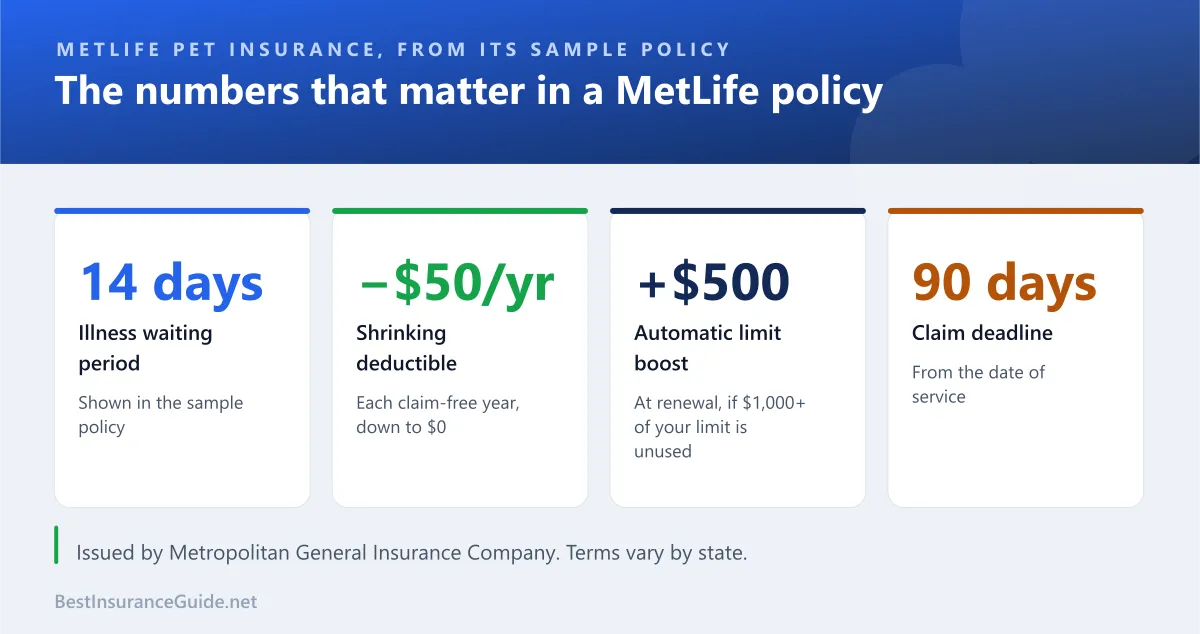
| Illness waiting period | 14 days (sample policy) |
| Accident waiting period | None reported by review sites; check your declarations page |
| Deductible | Annual, applied once per policy period; wide range of options |
| Reimbursement | Several options, commonly reported as 50%, 70%, 80% or 90% |
| Exams | Covered, including specialty and emergency exams |
| Shrinking deductible | Drops $50 per claim-free year, down to $0 |
| Automatic limit increase | +$500 at renewal if you meet the conditions |
| Claims deadline | 90 days after the date of service |
| Age limits | MetLife says you can enroll regardless of age |
| Login | MyPets portal (mypets.metlife.com) and the MetLife Pet app |
How to log in to MetLife Pet Insurance (MyPets)
MetLife Pet policyholders manage everything through MyPets, which is available on the web at mypets.metlife.com and in the MetLife Pet app.
- Register first. The first time, create an account using the details from your welcome email or policy documents.
- Log in at mypets.metlife.com or in the app.
- Find your Pet Card. Each pet has its own card on the home screen. Click See Details, then See Details again under your pet’s name to see coverage, status and the policy number.
- Download your policy packet from the same screen. Keep a copy, because it’s the document that decides every claim.
- File claims from the portal or app (see below).
Can’t log in? Use the password reset link, and make sure you’re on mypets.metlife.com, not a look-alike site. MetLife will never ask for your password by phone or email. For account help, call MetLife Pet customer service using the number in your policy documents.
What MetLife Pet Insurance covers
The sample policy covers the costs of treating an injury from an accident or an illness, including chronic, congenital and hereditary conditions. Within that, it pays for:
- Exams by a veterinary provider: primary, specialty and emergency.
- Diagnostics: lab work, blood tests, urinalysis, X-rays, MRIs, CT scans and ultrasounds.
- Treatment: surgery, hospitalization, outpatient treatment, physical therapy and emergency dental treatment.
- Medications, including over-the-counter products if a vet prescribes them.
- Telemedicine visits with a veterinarian, when appropriate.
The extras that stand out
MetLife’s policy includes several benefits most insurers either charge for or leave out:
- Prescription food to treat a covered condition.
- Holistic treatments prescribed by a vet, such as herbal remedies and CBD oil.
- Boarding fees, up to $500, if you or someone in your household is hospitalized for more than 48 hours.
- Lost or stolen pet: up to $500 for advertising and a reward (once in your lifetime), and up to $500 if your pet is stolen or strays and isn’t found within 60 days.
- End-of-life costs: up to $500 for cremation or burial. If a dog under eight dies, the policy also repays what you paid for the dog, up to $500.
- Grief counseling through a third-party provider.
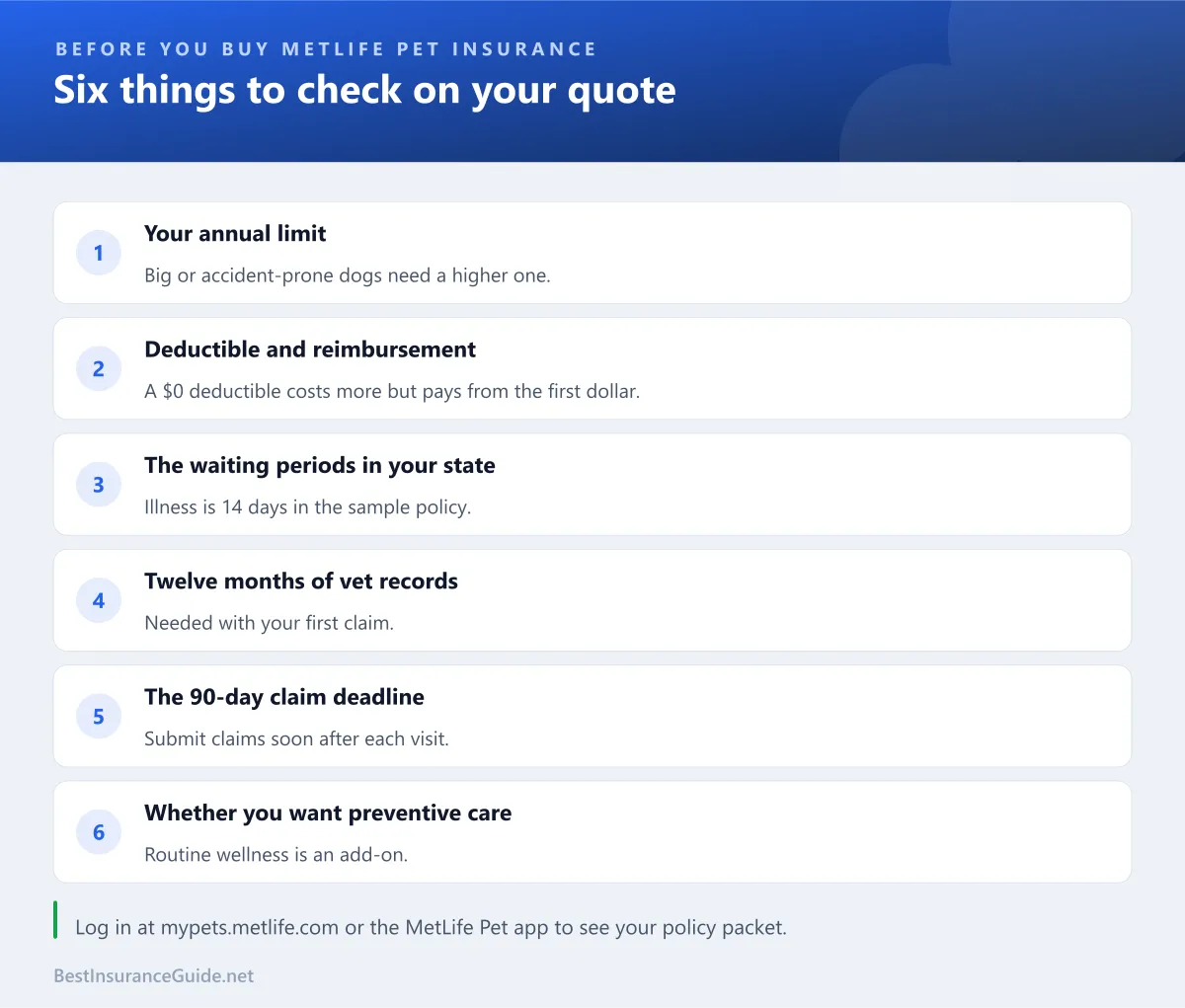
Preventive care (routine wellness) is available as an add-on.
What it doesn’t cover
- Pre-existing conditions, the biggest exclusion with every pet insurer.
- Treatment outside the U.S.
- Cosmetic procedures and their complications, such as tail docking or declawing.
- Neglect or deliberate harm, and injuries from commercial use such as racing, paid exhibition, law enforcement or guarding.
- Things that aren’t medically necessary: grooming, nail trims, anal gland expression, training, vitamins, and regular or “therapeutic” pet food you can buy without a prescription.
How MetLife pays a claim: a worked example
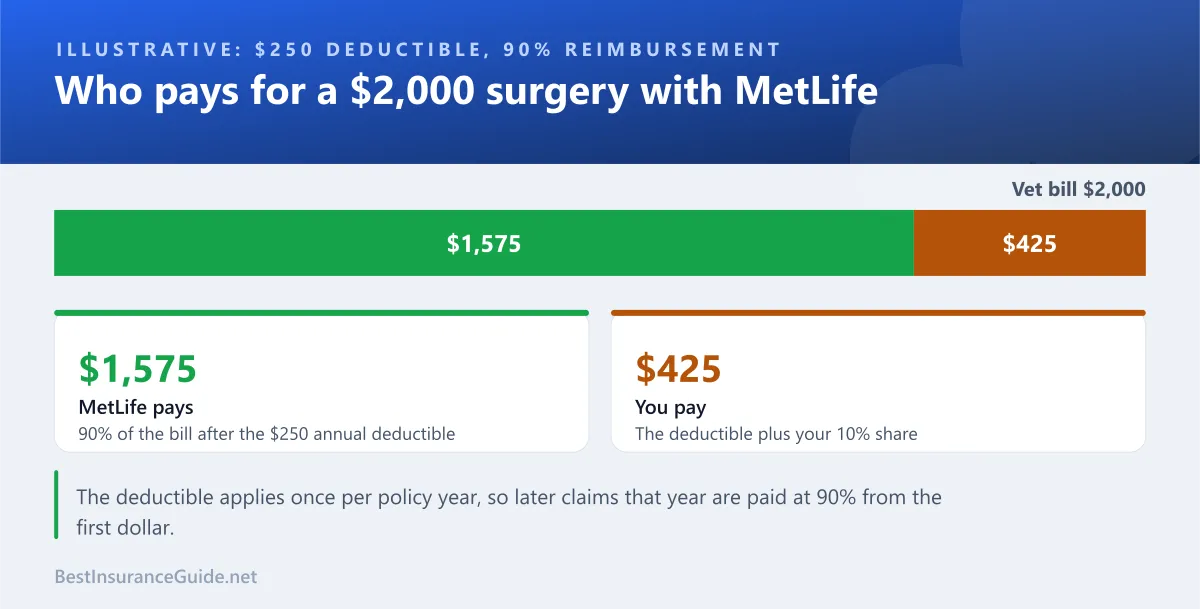
MetLife’s deductible applies once per policy period, not per condition. Say you have a $250 deductible and 90% reimbursement, and your dog swallows a toy that costs $2,000 to remove:
- $2,000 − $250 deductible = $1,750
- $1,750 × 90% = $1,575 paid by MetLife
- You pay $425 (the deductible plus 10%).
If your dog needs more treatment later in the same policy year, you’ve already met the deductible, so MetLife pays 90% from the first dollar.
The shrinking deductible (Healthy Pet Incentive)
This is one of MetLife’s best features. For each policy period in which you receive no claim payments, your deductible drops by $50 at renewal, down to $0. A $250 deductible becomes $0 after five claim-free years. If you get a claim payment, it resets to the original amount at the next renewal. Preventive care claims don’t reset it.
The automatic limit increase
If your annual limit is at least $5,000 and you have $1,000 or more unused at the end of the policy period, MetLife adds $500 to your limit at renewal at no extra cost. It doesn’t stack, and it doesn’t apply if you change your plan at renewal.
Waiting periods and pre-existing conditions
The sample policy shows a 14-day waiting period for illnesses. Review sites report no waiting period for accidents. Anything that starts during a waiting period, or before the policy began, is treated as pre-existing and isn’t covered.
You don’t have to send medical records to enroll, but your first claim must include the last 12 months of your pet’s medical and adoption records. That’s when MetLife checks for pre-existing conditions. Enroll while your pet is young and healthy, and the list of exclusions stays short.
How to file a MetLife pet insurance claim
- Pay the vet and get an itemized invoice and the medical records for the visit.
- Log in to MyPets or the app and submit the claim with the invoice and records. On your first claim, include 12 months of history.
- Submit within 90 days of the date of service, or the claim won’t be paid.
- MetLife says it decides within 30 days of receiving everything it needs. Payment goes to you, not the vet.
How to cancel MetLife Pet Insurance
MetLife’s FAQ says to call (877) 549-1671 or (877) 503-2217. Under the sample policy:
- You can cancel at any time.
- If you cancel more than 30 days after the policy starts, you get a pro-rata refund of unused premium.
- If your pet dies or is lost under the policy’s terms, the policy ends and the unused premium is refunded pro-rata.
Before you cancel, think about what happens next. The main risk is losing coverage for conditions that would count as pre-existing with a new insurer. Our guide to cancelling Fetch pet insurance walks through the same switching checks, and they apply to MetLife too.
MetLife Pet Insurance pros and cons
Pros
- Exams covered, including specialty and emergency visits.
- Generous extras: prescription food, holistic care, boarding, lost-pet and end-of-life benefits.
- The deductible falls $50 for every claim-free year, all the way to $0.
- An automatic $500 limit increase if you don’t use much of your limit.
- No upper age limit to enroll, according to MetLife.
- Wide range of deductible and reimbursement options.
Cons
- A 90-day claim deadline, shorter than some rivals.
- Annual limits, not unlimited cover, on many plans. Choose the limit carefully for large or accident-prone dogs.
- Price varies a lot by breed, age and ZIP code, so get a quote for your own pet.
- The published sample is one state’s form, so check your own state’s version.
MetLife vs Lemonade and Embrace
| Feature | MetLife | Lemonade | Embrace |
|---|---|---|---|
| Exam fees | Included | Add-on (vet visit fees) | Covered if on your schedule |
| Shrinking deductible | Yes, $50 a year | No | Yes, $50 a year |
| Illness wait | 14 days | 14 days | 14 days |
| Orthopedic wait | Not shown in sample | 30 days (FAQ) | 180 days, waivable with an exam |
| Claim deadline | 90 days after treatment | 180 days (90 in Texas) | 60 days after policy end or renewal |
From each insurer’s published sample policy or FAQ. Terms vary by state. See our Lemonade and Embrace reviews.
Insuring more than one pet with MetLife
Read this before you add a second pet to the same policy. In MetLife’s sample policy, “the amount We pay for all Pets insured under this Policy combined during the Policy Period is subject to a limit”. In other words, the annual limit can be shared across every pet on the policy rather than applying to each one separately.
That matters if you have two dogs and one of them has an expensive year. A $5,000 shared limit could be used up by one cruciate surgery, leaving nothing for the other dog until renewal. When you get a quote:
- Ask whether the limit is per pet or shared across the policy.
- If it’s shared, choose a higher limit or consider separate policies for each pet.
- Compare the multi-pet discount against the risk of one pet using the whole limit.
Who MetLife suits, and who should look elsewhere
MetLife is a good fit if you:
- want exam fees included without buying an add-on;
- expect a few claim-free years and want the deductible to fall toward $0;
- value the extras: boarding if you’re hospitalized, lost-pet help, end-of-life and grief support;
- have an older pet, since MetLife says it enrolls pets regardless of age (pre-existing conditions are still excluded).
Look elsewhere, or compare carefully, if you:
- tend to file claims late, because the 90-day deadline is tight;
- have several large dogs on one policy and the limit is shared;
- want routine wellness included as standard, since preventive care is an add-on.
Tips for a smooth first claim
- Collect 12 months of records now, not when your pet is sick. MetLife needs them with the first claim.
- Ask your vet for itemized invoices. A single total makes it harder to see what’s covered.
- Claim every eligible bill, even small ones that won’t exceed the deductible, so your deductible progress is clear. But remember that a paid claim resets the shrinking deductible.
- Set a reminder to submit within 90 days of each visit.
- Keep your Pet Card details handy in the app so your policy number is always to hand at the vet.
Our verdict
MetLife is a strong choice if you want exam fees covered, value the shrinking deductible, and like the extra benefits for boarding, lost pets and end-of-life costs. It suits owners who expect few claims early on (the deductible falls) but want solid protection for the big, unexpected bills. Watch the 90-day claim deadline, and get the 12 months of medical records together early so your first claim isn’t delayed.
Related reading
Pet insurance cost guide explains how deductibles, reimbursement and limits change your premium. Does pet insurance cover medication? and pet insurance that starts immediately answer two common questions before you buy.
Sources and notes
- MetLife sample pet insurance policy, form PET21-01-V (Ohio), issued by Metropolitan General Insurance Company: coverage, extras, deductible and Healthy Pet Incentive, automatic limit increase, exclusions, claims and cancellation terms.
- MetLife Pet Insurance FAQs: MyPets portal and app, enrollment regardless of age, medical records, cancellation phone numbers.
- U.S. News & World Report, MetLife Pet Insurance review, 2026: accident waiting period and reimbursement options.
This review is general information, not insurance advice. Coverage and prices vary by state and pet. Read your own policy and declarations page before you rely on any benefit.