Dental Insurance for Veterans: VA Dental, VADIP, TRICARE and FEDVIP
Dental insurance for veterans: who qualifies for VA dental care, how VADIP works, TRICARE Dental for families and FEDVIP for retirees.

Table of contents

Many veterans assume that VA health care includes dental care. For most, it does not. VA dental benefits are limited to veterans who meet specific criteria, and the majority of veterans enrolled in VA health care fall outside them. The good news is that there are several routes to affordable dental coverage built specifically for veterans, service members, their families and military retirees — they just work very differently from one another.
This guide sets out who qualifies for VA dental care, how the VA Dental Insurance Program works for everyone else, and where TRICARE dental and FEDVIP fit in.
The four programmes, and who each is for
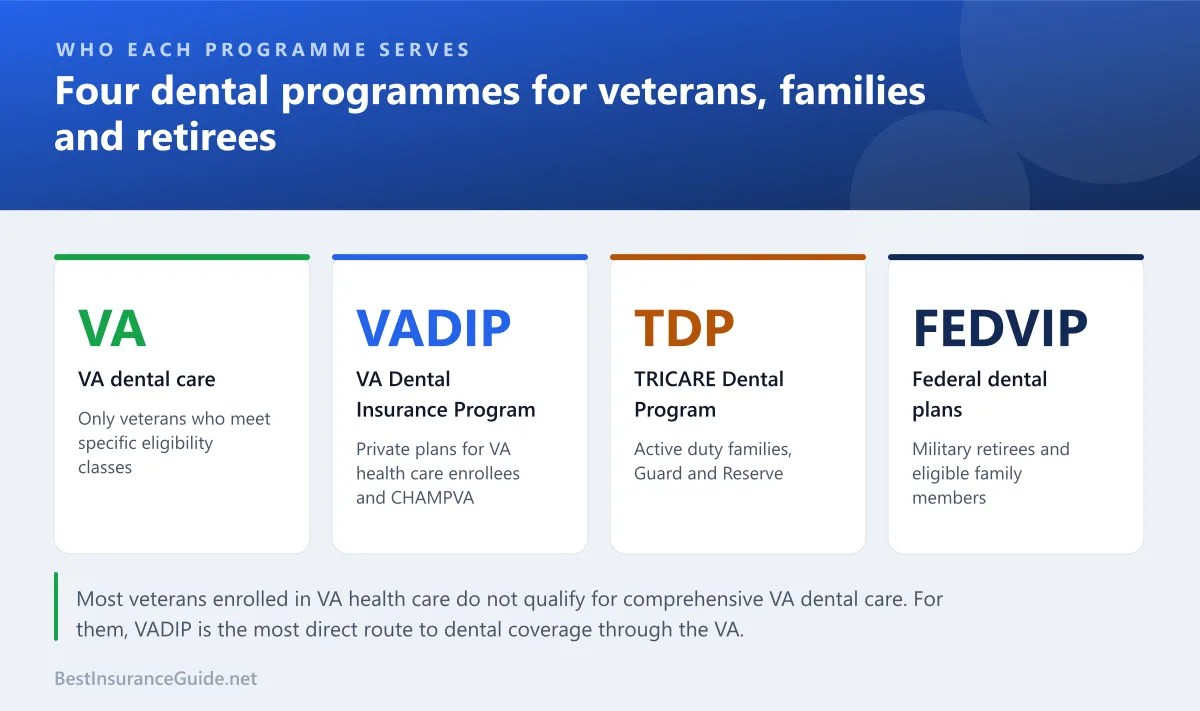
VA dental care — care provided or paid for by the VA, for veterans who meet specific eligibility criteria.
VADIP — the VA Dental Insurance Program, which offers discounted private dental insurance to veterans enrolled in VA health care and to CHAMPVA beneficiaries.
The TRICARE Dental Program — for family members of active duty service members, and for National Guard and Reserve members and their families.
FEDVIP — the Federal Employees Dental and Vision Insurance Program, open to military retirees and their eligible family members, as well as federal employees and some other groups.
Who qualifies for VA dental care
VA dental eligibility is organised into classes, and the rules are specific. Broadly, veterans may qualify if they:
Have a service-connected dental condition or disability that is compensable — that is, rated for compensation. These veterans are eligible for dental care for any dental condition.
Have a 100% service-connected disability rating, or are paid at the 100% rate because of individual unemployability. These veterans are eligible for comprehensive dental care.
Are former prisoners of war.
Have a service-connected, non-compensable dental condition resulting from combat wounds or service trauma, for care related to that condition.
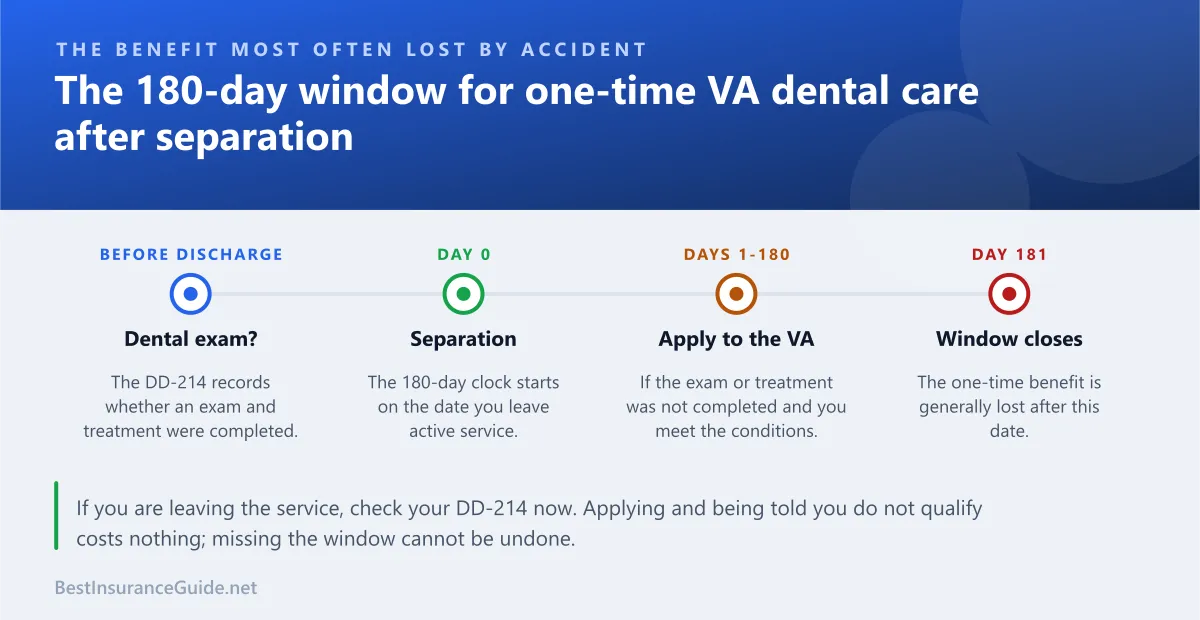
Recently separated from active service and did not receive a complete dental exam and all appropriate treatment before discharge. These veterans may be eligible for one-time dental care if they apply within 180 days of separation and meet the other conditions.
Have a dental condition that is complicating a service-connected medical condition being treated by the VA.
Are participating in certain VA vocational rehabilitation programmes, or are enrolled in certain VA homeless programmes, for defined dental care.
The VA’s own dental eligibility pages set out the classes in detail, and eligibility decisions are made by the VA. If you think you might qualify, apply rather than assuming you do not.
The 180-day window
This deserves its own section because it is the benefit veterans most often lose by accident.
Veterans who served on active duty for a qualifying period and were not given a complete dental examination and all appropriate treatment within a set period before discharge may be entitled to one-time VA dental care — but only if they apply within 180 days of separation. The DD-214 records whether a dental exam and treatment were completed.
If you are leaving the service, check your DD-214, and if you may qualify, apply to the VA promptly. Once the window closes, this benefit is generally gone.
VADIP: dental insurance for veterans who do not qualify for VA dental care
For most veterans, VADIP is the most direct route to dental coverage through the VA.
Who can join. Veterans enrolled in VA health care, and beneficiaries of CHAMPVA. There is no requirement to have a service-connected disability.
How it works. VADIP plans are private dental insurance plans offered by insurers under contract with the VA. You choose a plan, enrol with the insurer, and pay the premiums yourself. The VA does not subsidise the premium, but the programme’s group structure is designed to make the coverage affordable.
What it covers. Plans typically cover diagnostic and preventive care, fillings, root canals, extractions, crowns, dentures and emergency care, with the usual features of private dental insurance: coinsurance by service tier, annual maximums, and in some cases waiting periods. Multiple plan options may be available.
Using it alongside VA dental care. Veterans who qualify for limited VA dental care — for example, care for one specific service-connected condition — can use VADIP for everything else.
VADIP has been authorised by Congress for set periods and extended over time. Check the VA’s current VADIP page for the participating insurers, enrolment details and the programme’s current authorisation.
TRICARE Dental Program: for service members’ families, the Guard and Reserve
Active duty service members receive dental care through military dental treatment facilities and do not enrol in the TRICARE Dental Program themselves.
Family members of active duty service members can enrol in the TRICARE Dental Program, a voluntary premium-based plan with government cost sharing for many enrollees.
National Guard and Reserve members, and their family members, can also enrol.
Cost shares vary by pay grade and service, and coverage continues in some circumstances after a service member’s death or separation. When a service member retires, family members transition off the TRICARE Dental Program — which is where FEDVIP comes in.
FEDVIP: dental insurance for military retirees
The TRICARE Retiree Dental Program ended at the close of 2018. Military retirees and their eligible family members can now buy dental coverage through FEDVIP, the programme also used by federal employees.
FEDVIP offers a choice of dental plans from several insurers, generally with self-only, self-plus-one and family options. Enrolment normally happens during the Federal Benefits Open Season each autumn, or after a qualifying life event such as retirement. Premiums are paid by the enrollee.
Retirees who are also enrolled in VA health care may be eligible for both VADIP and FEDVIP, and should compare the two directly.
A worked example: comparing options for one veteran
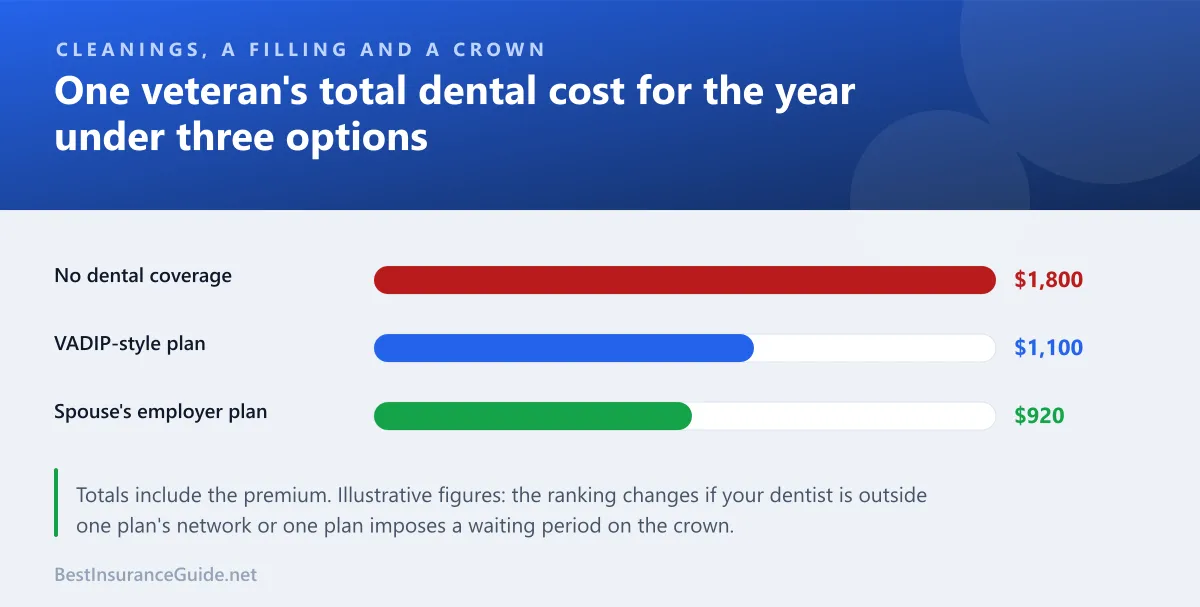
Take a veteran enrolled in VA health care with no service-connected dental condition, who expects two cleanings, a filling and one crown this year. Use illustrative fees of $400, $200 and $1,200, a 100/80/50 benefit structure with a $50 deductible, and compare a VADIP-style plan with a spouse’s employer plan and no coverage.
| Detail | No dental coverage | VADIP-style plan | Spouse’s employer plan |
|---|---|---|---|
| Annual premium to the veteran | $0 | $420 | $240 |
| Plan pays toward preventive care | $0 | $400 | $400 |
| Plan pays toward filling | $0 | $120 | $120 |
| Plan pays toward crown | $0 | $600 | $600 |
| Out-of-pocket at the dentist | $1,800 | $680 | $680 |
| Total cost for the year | $1,800 | $1,100 | $920 |
Both plans beat going without. The spouse’s plan wins here because of its lower premium, but that changes if the veteran’s dentist is outside the spouse’s network, if the spouse’s plan has a lower annual maximum, or if the VADIP plan has no waiting period on the crown and the other plan does. The figures are illustrative; the method — list the care, apply the terms, add the premium — is what matters.
Survivors and dependants
Surviving spouses and dependent children of certain veterans may be eligible for CHAMPVA, the VA’s health care programme for eligible family members. CHAMPVA itself provides only limited dental coverage, generally for dental care that is medically necessary as part of treating a covered medical condition. CHAMPVA beneficiaries are, however, eligible for VADIP, which is the most direct route to routine dental coverage for them.
Family members of service members who die on active duty may be able to continue TRICARE Dental Program coverage for a period under survivor benefit rules. Check the current rules with TRICARE.
VA community care for dental
Veterans who are eligible for VA dental care do not always receive it at a VA dental clinic. Where a VA facility cannot provide timely care, or the veteran lives far from one, the VA may authorise community care with a local dentist, paid for by the VA. Community care must be authorised in advance; treatment arranged without authorisation is generally not reimbursed. If you are eligible for VA dental care and struggling to get an appointment, ask your VA facility about community care.
Veterans on Medicare
Veterans aged 65 and over often have three potential sources of dental coverage at once: VA dental care if eligible, VADIP, and a Medicare Advantage plan with dental benefits. Original Medicare does not cover routine dental care, and VA eligibility is not changed by enrolling in Medicare.
A veteran who is not eligible for VA dental care should compare a Medicare Advantage plan’s built-in dental benefit with a VADIP plan, on the same terms: network, annual maximum, coinsurance, waiting periods and total annual cost. Some choose both — the Medicare Advantage benefit for preventive care and a VADIP plan with a higher maximum for major work — though the extra premium has to be justified by expected treatment. Our guide to dental insurance for seniors on Medicare covers the Medicare side in detail.
Documents to have ready
Whichever route you take, these documents make the process faster.
Your DD-214, which shows your service dates and whether a dental exam and treatment were completed before discharge.
Your VA disability rating letter, if you have one, showing any service-connected dental condition and your overall rating.
Your VA health care enrolment confirmation, needed for VADIP.
Proof of any recent dental coverage, which may help waive waiting periods on a VADIP or other private plan.
Your retirement orders, if you are a military retiree enrolling in FEDVIP after retirement.
How to choose
1. Check VA dental eligibility first. If you qualify for comprehensive VA dental care, you may not need insurance at all.
2. If you recently separated, check the 180-day window.
3. If you are enrolled in VA health care but not eligible for VA dental, compare VADIP plans.
4. If you are a retiree, compare FEDVIP with VADIP if you are eligible for both.
5. Compare with a spouse’s employer plan or a regular individual plan.
6. Choose on network, waiting periods, annual maximum and total cost, the same way you would choose any dental plan. See secondary dental insurance if you are considering carrying two plans.
Common mistakes
Assuming VA health care includes dental care. For most veterans, it does not.
Missing the 180-day window after separation.
Letting family members’ TRICARE Dental coverage lapse at retirement without enrolling in FEDVIP.
Not reapplying after a rating change. If your disability rating rises to 100%, or a dental condition is later rated as service-connected, your VA dental eligibility may change. Ask the VA to review it.
Arranging private treatment and expecting the VA to reimburse it. Community care must be authorised in advance.
Buying a plan with a long waiting period for work that cannot wait. See dental insurance with no waiting period.
The short version
VA dental care is available only to veterans who meet specific criteria, including compensable service-connected dental conditions, a 100% disability rating or individual unemployability, former prisoner of war status, and one-time care for recently separated veterans who apply within 180 days.
Veterans enrolled in VA health care who do not qualify can buy discounted private coverage through VADIP. Active duty families and the Guard and Reserve use the TRICARE Dental Program, and military retirees use FEDVIP.
A note on scope
This guide is general information rather than advice about eligibility or any specific plan. VA dental eligibility is determined by the Department of Veterans Affairs, VADIP and FEDVIP plan options and premiums change, and TRICARE Dental Program rules are set by the Defense Health Agency. The VA, TRICARE and the Office of Personnel Management publish the authoritative details. This site is independent and not affiliated with the VA, the Department of Defense or any insurer.