Dental Insurance for a Root Canal: What It Covers and What You Pay
Does dental insurance cover a root canal? Basic vs major tiers, the crown afterwards, waiting periods, annual maximums and worked cost examples.

Table of contents
A root canal is usually bought in a hurry. The tooth hurts, the dentist says the pulp is infected, and the question stops being whether to do it and becomes how much of it insurance will pay. The honest answer is that it depends on three settings in your plan that most people have never looked at — and on the crown that usually follows, which is often the larger bill.
This guide explains how dental insurance treats a root canal, works through the numbers, and covers what to do if you need one before your coverage is ready.
What a root canal costs before insurance
Root canal fees depend mainly on which tooth is treated, because back teeth have more canals and are harder to reach.
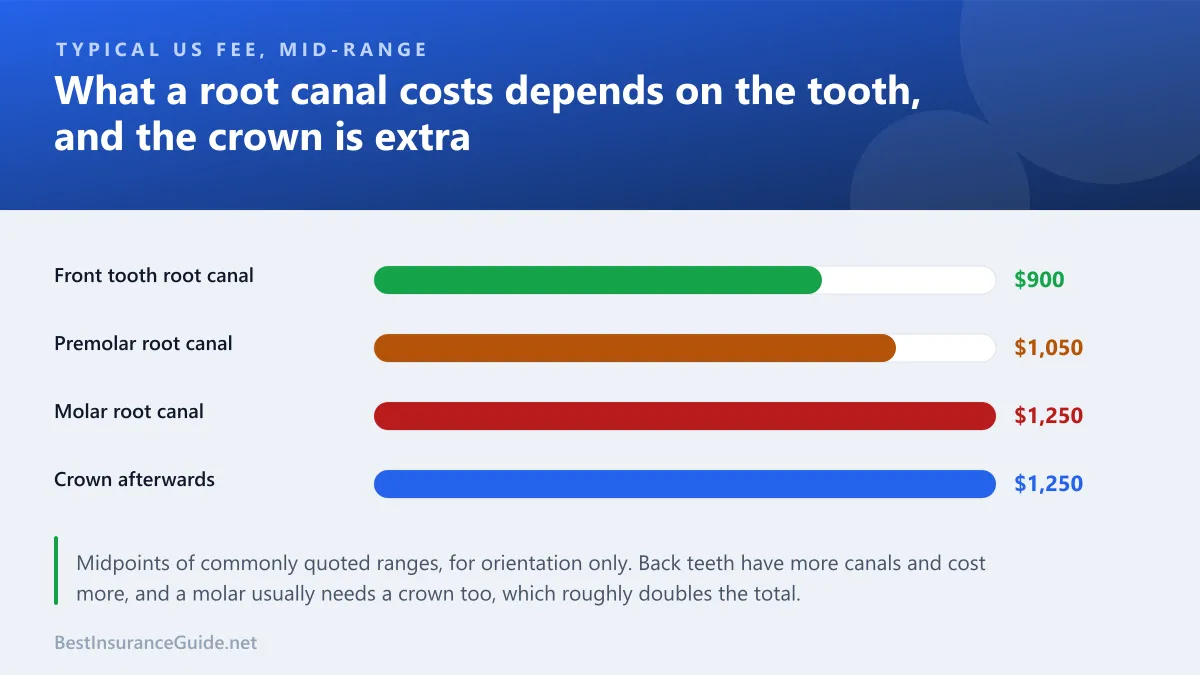
Typical fee ranges in the United States are roughly:
Front tooth: often around $700 to $1,100.
Premolar: often around $800 to $1,300.
Molar: often around $1,000 to $1,500, and more if an endodontist performs it.
A crown afterwards: often around $1,000 to $1,500, depending on the material.
These are orientation figures rather than quotes. Fees vary with region, with whether a general dentist or a specialist endodontist does the work, and with how complicated the tooth turns out to be.
How insurance classifies a root canal
Most dental PPO plans organise covered services into three tiers, a pattern often written as 100-80-50.
Preventive — exams, cleanings, X-rays — covered at or near 100%.
Basic — fillings, simple extractions and, on many plans, root canals — covered at around 80%.
Major — crowns, bridges, dentures and, on some plans, root canals — covered at around 50%.
The key point is that root canals move between tiers from plan to plan. The dental term for root canal treatment is endodontics, and some plans list endodontics under basic services while others list it under major. On a $1,100 procedure, the difference between 80% and 50% is around $330.
Dental HMO plans work differently: instead of coinsurance, they publish a fixed copay for each procedure. A root canal on a DHMO might carry a copay of a few hundred dollars, with no annual maximum, provided you stay with the assigned network dentist.
The crown is usually the bigger bill
A back tooth that has had a root canal is more brittle, and most dentists recommend a crown to protect it. On most plans, that crown is a major service covered at around 50%, with its own waiting period if the plan is new.
That means a root canal on a molar is really two claims: the root canal itself, and a crown that may cost as much or more. Both draw on the same annual maximum.
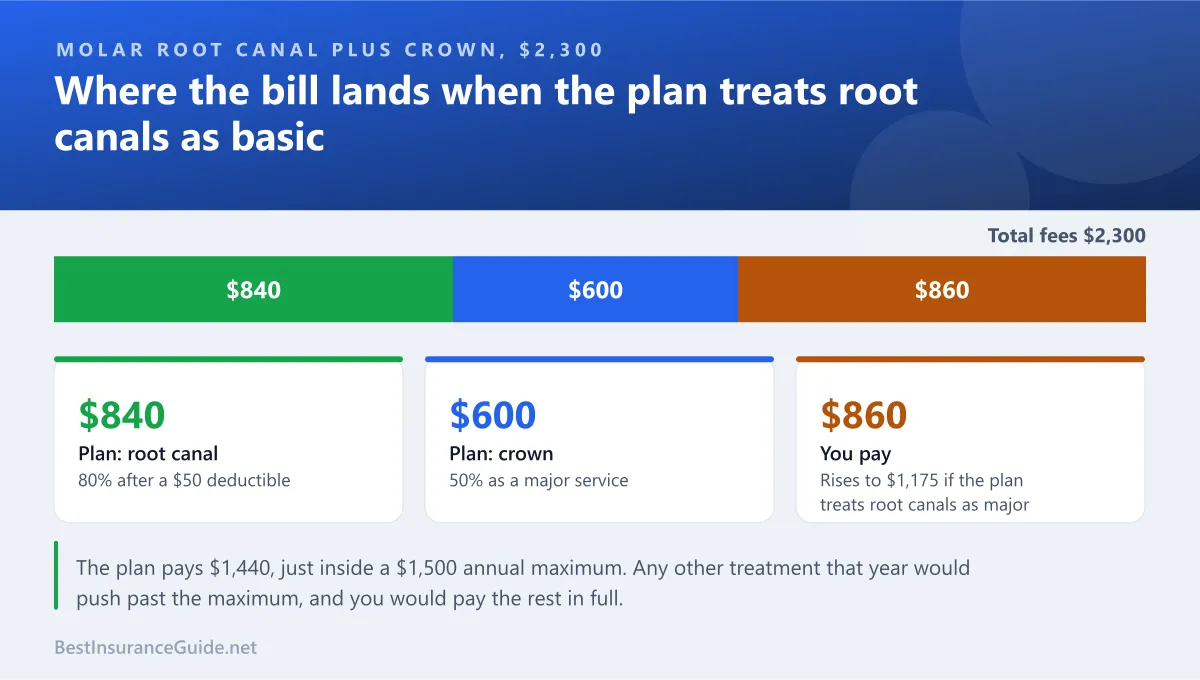
A worked example: molar root canal plus crown
Assume an in-network fee of $1,100 for the molar root canal, $1,200 for the crown, a $50 deductible, and an annual maximum of $1,500.
| Detail | Plan treats root canal as basic (80%) | Plan treats root canal as major (50%) |
|---|---|---|
| Root canal fee | $1,100 | $1,100 |
| Plan pays after $50 deductible | $840 | $525 |
| Crown fee | $1,200 | $1,200 |
| Plan pays at 50% | $600 | $600 |
| Total plan payment before maximum | $1,440 | $1,125 |
| Annual maximum | $1,500 | $1,500 |
| You pay in total | $860 | $1,175 |
In the first column the plan pays $1,440, just inside the $1,500 maximum. Anything else during the year — a filling, a second crown — would push past the maximum, and you would pay the rest in full.
If the root canal is done late in one benefit year and the crown early in the next, each can draw on a separate annual maximum. That is worth discussing with your dentist when timing is flexible, but it should never override clinical advice about how long a tooth can safely wait for a crown.
Waiting periods: the most common surprise
A newly purchased individual dental plan typically imposes a waiting period before basic and major services are covered — often three to six months for basic services and six to twelve months for major ones. During the waiting period, the plan pays nothing toward those services, however much you pay in premium.
That creates a hard problem for someone who needs a root canal now and has no coverage. Four realistic options:
An employer plan, if one is available. Group plans frequently have no waiting periods at all.
A plan that waives waiting periods for prior coverage. If you had dental insurance recently — often within the past 60 to 90 days — some insurers will credit that coverage and waive the wait. Keep proof of your previous plan.
A plan with no waiting period on basic services. Some exist, usually with a lower first-year benefit or a higher premium. Read the details carefully; see our guide to dental insurance with no waiting period.
A dental discount plan, which reduces the fee immediately at participating dentists but pays nothing itself.
Should you ever buy insurance just for a root canal?
Do the arithmetic before buying. A plan costing $40 a month with a six-month waiting period on basic services costs $240 before it pays anything toward a root canal. If the tooth cannot wait six months — and an infected tooth usually cannot — the plan does nothing for this treatment.
A plan is good value when it covers the work you need within the time you can wait, and when the benefit exceeds the premium you pay to get there.
Root canal or extraction?
Extraction is cheaper on the day, and insurance usually covers a simple extraction as a basic service. But a missing back tooth usually needs replacing to prevent neighbouring teeth drifting and to keep chewing function, and replacement with a bridge or implant typically costs far more than the root canal and crown it replaced. Many plans also limit or exclude implants; see dental insurance for implants.
The clinical decision belongs to you and your dentist. The financial point is simply that the cheaper option today is often the more expensive option over several years.
How to get the most from your plan
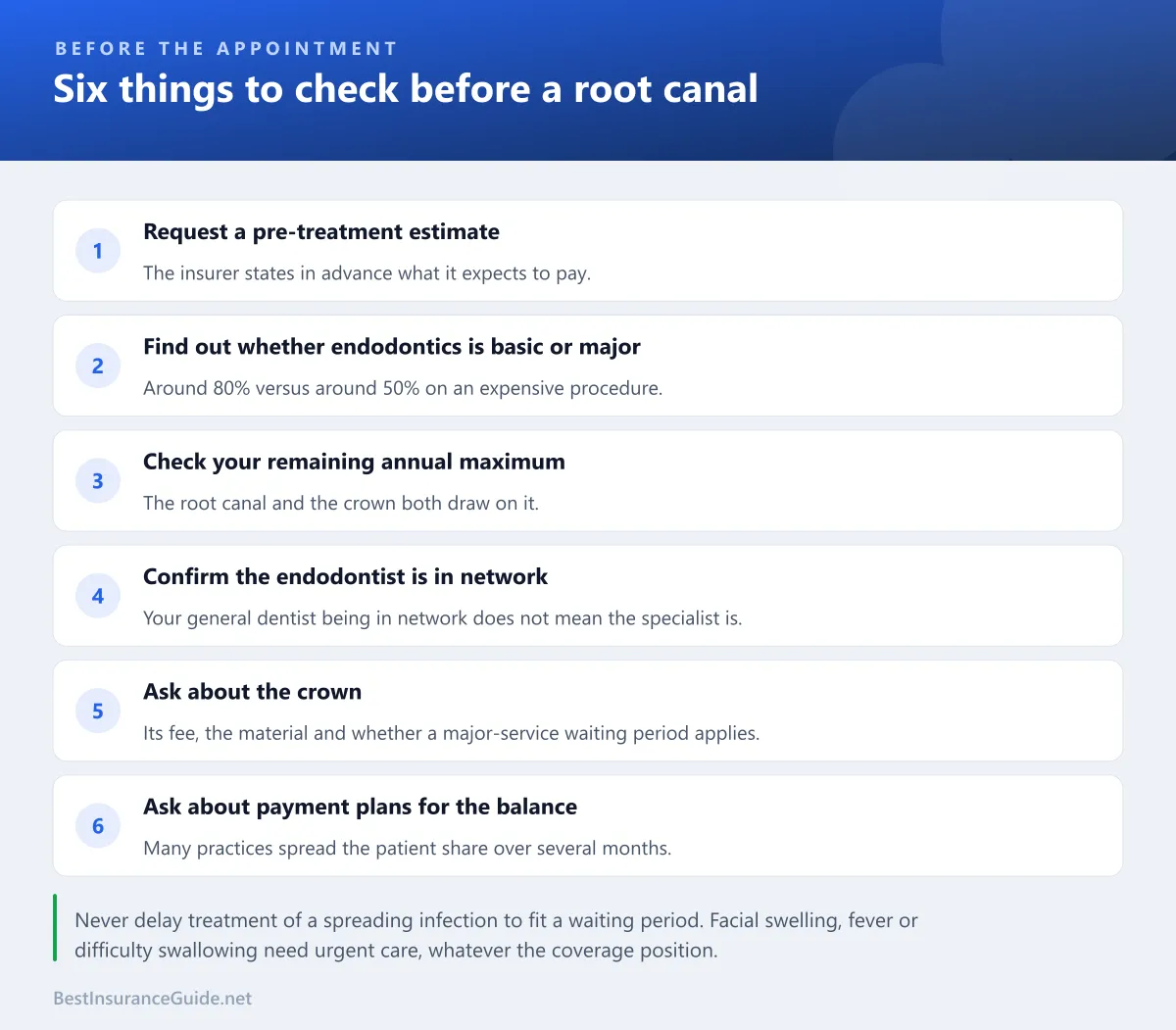
Ask for a pre-treatment estimate. Your dentist sends the treatment plan to the insurer, which states in advance what it expects to pay. It is not a guarantee, but it removes most surprises.
Check how your plan classifies endodontics. Basic or major changes the bill by hundreds of dollars.
Check how much of your annual maximum is left. The insurer or your dentist’s office can tell you.
Confirm the endodontist is in network if you are referred to a specialist. Your general dentist being in network does not mean the specialist is.
Ask about the crown — its fee, the material, and whether any waiting period applies to it.
Ask about payment plans for the balance. Many practices offer them.
The emergency visit before the root canal
Many root canals start with an emergency appointment: a painful tooth, an X-ray, a diagnosis, and perhaps an initial procedure to relieve pressure and remove infected pulp. Insurance often treats these pieces separately.
The emergency exam and X-ray are usually covered as diagnostic or preventive services, often at a high percentage and without a waiting period, though some plans count an emergency exam against the number of exams allowed each year.
Palliative treatment — procedures to relieve pain — is commonly covered as a basic service.
The initial pulp removal, sometimes done on the emergency day, may be billed separately and later offset against the full root canal fee.
Antibiotics and pain medication are prescriptions, covered, if at all, by your medical plan’s pharmacy benefit rather than the dental plan.
It helps to ask the office how the emergency visit will be billed, and whether any of it counts toward the root canal fee.
Retreatment and apicoectomy
Most root canals succeed, but some teeth need further treatment years later.
Retreatment means reopening the tooth, cleaning the canals again and resealing it. It is usually more complex than the original treatment and billed at a higher fee. Plans typically cover it under the same tier as the original root canal, and some limit how soon after the first treatment it will be paid.
An apicoectomy is a surgical procedure to remove the tip of the root and seal it from the end. It is usually performed by an endodontist or oral surgeon, and plans commonly place it in the basic or major tier.
In both cases, ask for a pre-treatment estimate, check your remaining annual maximum, and check for any frequency limit on endodontic treatment of the same tooth.
Frequency limits that affect root canal patients
Plans limit how often certain services are covered, and a root canal can run into those limits.
Crowns on the same tooth are commonly limited to one every five years or so. If a crown was placed recently and the tooth now needs a root canal, a replacement crown may not be covered.
X-rays are often limited to a set number per year, and a root canal involves several.
Exams may be limited to two a year, including emergency exams.
The dental office can usually check these limits in advance with the insurer.
Root canal treatment on a child’s tooth
Children’s baby teeth sometimes need a simpler form of pulp treatment, called a pulpotomy, usually followed by a stainless steel crown. Plans commonly cover both as basic services, and fees are considerably lower than for an adult molar root canal. For the wider picture, see dental insurance for kids.
If the claim is denied
Root canal claims are occasionally denied for waiting periods, frequency limits, missing X-rays or coding errors. Read the explanation of benefits to find the reason, ask the dental office to resubmit with any missing documentation, and appeal in writing if the plan still refuses. Your state insurance department handles complaints if the appeal fails.
If you have two dental plans
A second plan can pick up some of the balance and brings its own annual maximum, which helps in exactly this situation — a root canal and crown in the same year. How much it pays depends on its coordination method; see our guide to secondary dental insurance.
The short version
Most dental plans cover root canals, but some pay around 80% as a basic service and others around 50% as a major service. The crown that usually follows is a separate major-service claim at around 50%, and both draw on the same annual maximum.
A new individual plan will usually impose a waiting period before paying for either. If you need treatment now, look at employer coverage, plans that waive waiting periods for prior coverage, or a discount plan as a bridge.
Before treatment, get a pre-treatment estimate, confirm the classification and your remaining maximum, and check the endodontist’s network status. For the vocabulary, see health insurance terms.
A note on scope
This guide is general information rather than dental or financial advice. Fees vary by region and provider, and coverage, tiers, waiting periods and annual maximums are set by each plan. Your plan documents and a pre-treatment estimate are the authoritative sources, and your dentist is the right source on whether a root canal is clinically appropriate. This site is independent and not affiliated with any insurer.