Dental Insurance in Florida: How to Choose a Plan That Actually Pays
Dental insurance in Florida: plan types, coverage, waiting periods, annual maximums, Medicaid and KidCare dental, and discount plans.

Table of contents

Florida has one of the largest individual insurance markets in the country and a population that skews older than almost anywhere else, which means dental coverage here gets bought, compared and argued about more than most places. It also means there are a lot of plans that look similar on the surface and behave very differently the first time you need a crown.
This guide covers how dental coverage works for Floridians, where it comes from, and the four or five plan terms that decide whether a policy is worth its premium. It does not name a “best company”, because the right answer depends on your dentist, your mouth and your budget far more than on the logo on the card.
Where Floridians get dental coverage
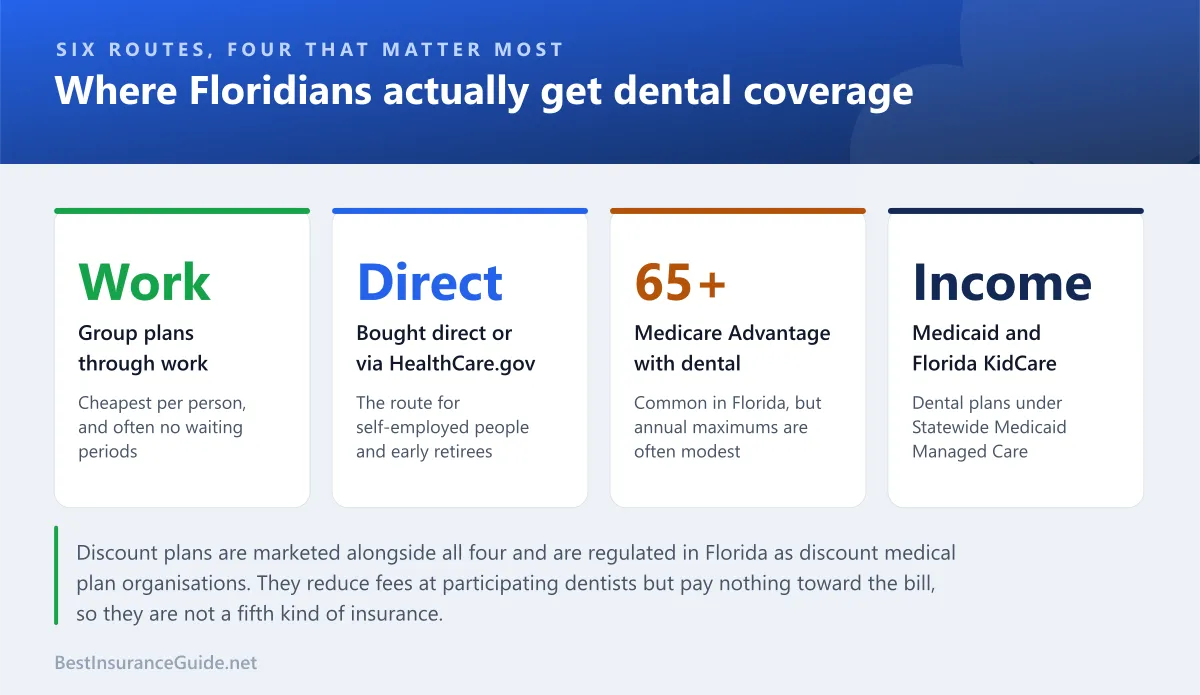
There are six realistic routes, and most people only use one or two of them.
An employer plan. Still the most common source. Group dental plans are usually cheaper per person than individual plans, and many waive waiting periods entirely, which is the single biggest advantage over buying on your own.
A stand-alone individual plan, bought directly from an insurer or through a broker. This is where most self-employed people, early retirees and gig workers end up.
The marketplace. Florida uses HealthCare.gov, and stand-alone dental plans are sold there during open enrolment. Dental for children under 19 is an essential health benefit under the Affordable Care Act; adult dental through the marketplace is optional.
Medicare Advantage. Many Florida Medicare Advantage plans include some dental benefit, which we cover in detail in our guide to dental insurance for seniors on Medicare.
Florida Medicaid and Florida KidCare, for people who qualify on income.
A dental discount plan, which is not insurance at all but is sold alongside it and is worth understanding before you buy one by mistake.
The three plan types you will see
Dental HMO (often called DHMO)
You choose a primary dentist from the plan’s network, and that dentist handles most of your care and refers you to specialists. There is usually no annual maximum or a very high one, no deductible, and a published list of fixed copays for each procedure.
The trade-off is choice. Out-of-network care is generally not covered at all, and in rural parts of the state the network can be thin. DHMOs are strongest in the big metros — Miami-Dade, Broward, Palm Beach, Tampa Bay, Orlando and Jacksonville — where network density is high.
Dental PPO
You can see any dentist, but you pay less in network because the plan has negotiated fees. PPOs have a deductible, coinsurance that varies by the type of treatment, and an annual maximum that caps what the plan will pay in a year.
This is the most common individual plan type, and the one most people picture when they think of dental insurance.
Indemnity or fee-for-service
You see any dentist and the plan reimburses a percentage of a set allowance. These plans are less common and usually more expensive, but they suit people who want complete freedom and have a dentist who does not participate in any network.
The terms that decide what you actually pay
Premium is the number everyone compares. It is rarely the number that matters most.
The coinsurance split. Most PPO plans follow a pattern often written as 100-80-50: preventive care covered at or near 100%, basic care such as fillings at around 80%, and major care such as crowns, bridges and dentures at around 50%. Some plans use different splits, and some place root canals and extractions in the major tier rather than basic, which changes the maths considerably.
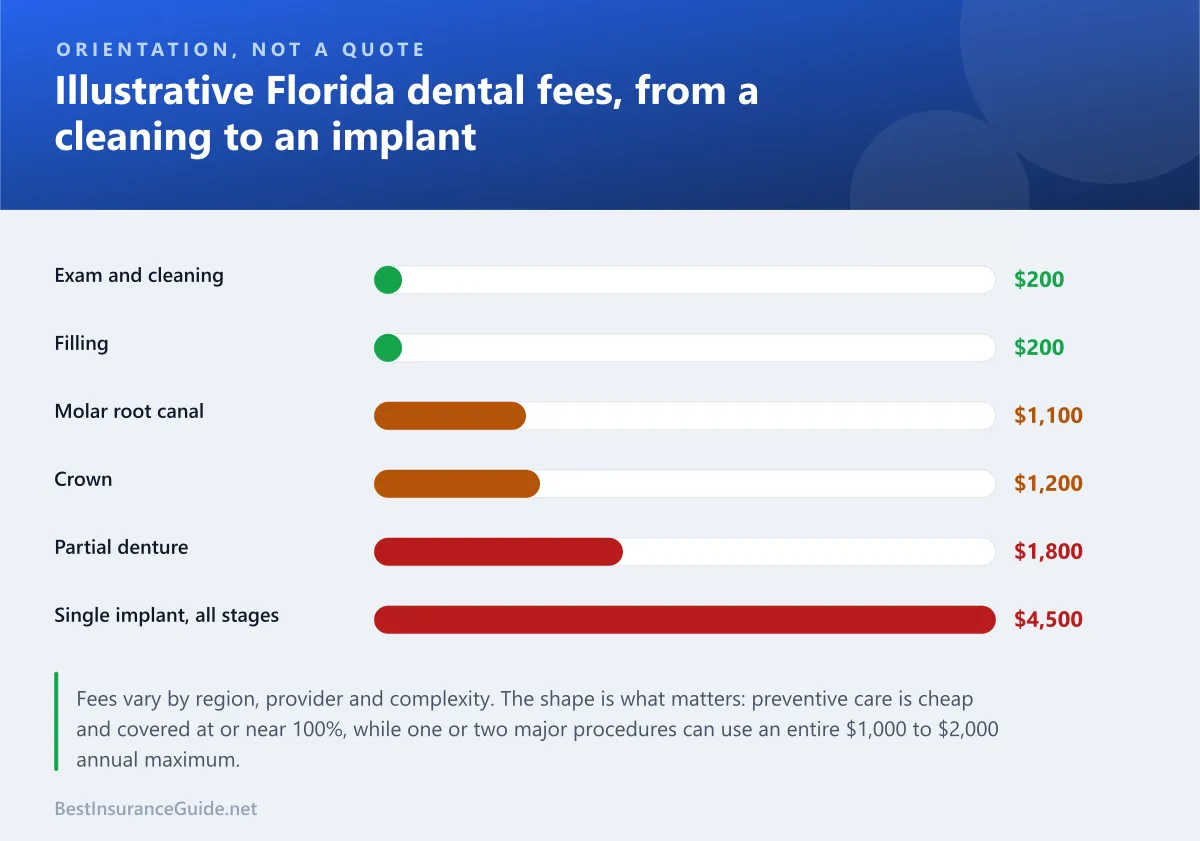
The annual maximum. This is the most the plan will pay in a benefit year. Maximums of $1,000 to $2,000 are typical, and they have barely moved in decades while dental fees have risen steadily. A single crown can use half of a $1,000 maximum.
The deductible. Usually modest — often around $50 per person — and frequently waived for preventive care.
Waiting periods. Individual plans commonly impose no wait for preventive care, a wait of several months for basic care and six to twelve months or more for major care. We cover how to avoid these in our guide to dental insurance with no waiting period.
The network. In Florida this is more important than most buyers realise, because dentist participation varies enormously between regions and between insurers.
A worked example: one crown, two plans
To see why the headline premium misleads, take a Tampa resident who needs a crown on a molar. Assume an in-network fee of $1,200 for illustration.
| Detail | Plan A (lower premium) | Plan B (higher premium) |
|---|---|---|
| Monthly premium | $28 | $46 |
| Annual premium | $336 | $552 |
| Deductible | $100 | $50 |
| Major care coinsurance | 50% | 50% |
| Waiting period for major care | 12 months | 6 months |
| Annual maximum | $1,000 | $2,000 |
| Plan pays toward crown (after waiting period) | $550 | $575 |
| You pay toward crown | $650 | $625 |
On a single crown the two plans are almost identical, and Plan A is cheaper overall. Add a second crown in the same year and the picture flips: Plan A’s $1,000 maximum is exhausted, while Plan B still pays its share. And if the crown cannot wait twelve months, Plan A pays nothing at all.
The lesson is that the right plan depends on what you expect to need, and that a cheap plan with a long waiting period is only cheap if you can wait.
Florida Medicaid dental
Florida delivers Medicaid dental benefits through dental plans under the Statewide Medicaid Managed Care programme, administered by the Agency for Health Care Administration. When you enrol in Medicaid you are assigned to, or choose, a dental plan separately from your medical plan.
For children and young people under 21, dental coverage is comprehensive where care is medically necessary, because of the federal EPSDT requirement that applies in every state.
For adults, Florida provides a defined dental benefit through the same dental plans. It is narrower than the children’s benefit, and the specific covered services, limits and prior authorisation rules are set by the programme and can change with the state budget. The reliable source is your dental plan’s member handbook and member services line, not a summary on a website — including this one.
If you are on Medicaid and struggling to find a dentist, ask the dental plan directly for a list of dentists currently accepting new patients. That is a different question from which dentists participate, and the answer is often shorter.
Florida KidCare dental
Florida KidCare is the umbrella name for the state’s health coverage programmes for children, including its Children’s Health Insurance Program. Dental coverage is included for eligible children, typically with check-ups, cleanings, X-rays, fillings and many other treatments covered.
Families with income too high for Medicaid but not high enough to make private coverage comfortable should check KidCare eligibility before buying a private children’s dental plan. For the wider picture, see our guide to dental insurance for kids.
Dental discount plans in Florida
Discount plans are heavily marketed in Florida, especially to retirees. You pay a membership fee, and participating dentists agree to charge you a reduced fee.
That can be useful. There are no waiting periods, no annual maximum and usually no claim forms. But the plan pays nothing toward the bill; you pay the whole discounted fee yourself.
Florida regulates these products as discount medical plan organisations under the Office of Insurance Regulation, and they are required to disclose that they are not insurance. If a product’s marketing is vague about whether it is insurance or a discount programme, read the disclosure — and if the disclosure is hard to find, treat that as information.
A discount plan can make sense for someone who needs major work immediately and cannot wait out a waiting period, or as a bridge. It is rarely a substitute for insurance for someone who expects ongoing care.
How to choose, in order
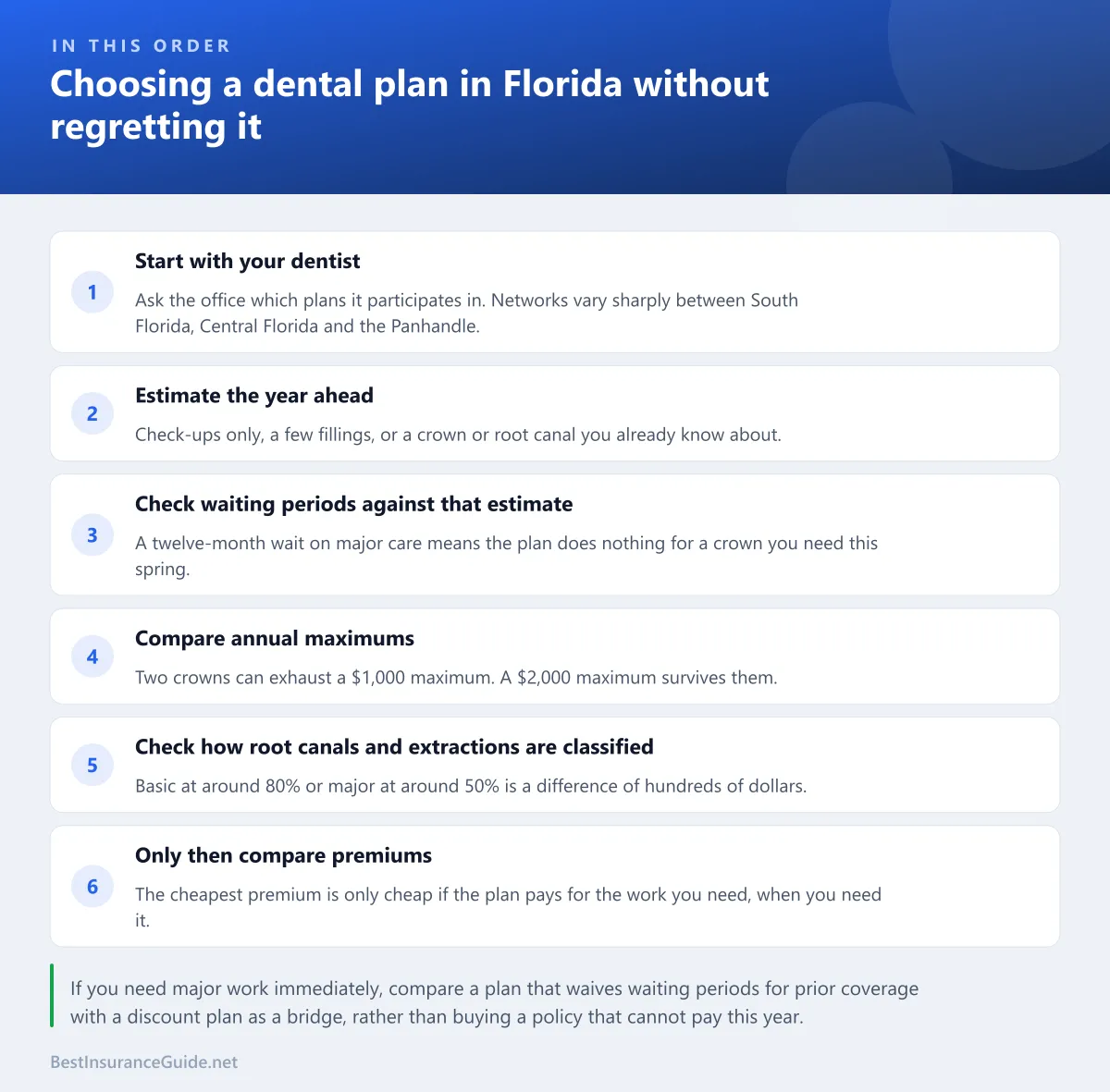
1. Start with your dentist. Call the office and ask which plans they participate in. If you are happy with your dentist, this narrows the field immediately and avoids the most common regret.
2. Estimate the year ahead. Is this a check-ups-only year, or do you already know you need a filling, a crown or a root canal? The answer decides whether a low-premium plan or a high-maximum plan is better value.
3. Check the waiting periods against that estimate. If the treatment you need is in the major tier and the plan has a twelve-month wait, that plan does nothing for you this year.
4. Compare annual maximums, particularly if you expect major work.
5. Check how the plan classifies root canals, extractions and periodontal treatment. Basic at 80% or major at 50% is a large difference on an expensive procedure.
6. Only then compare premiums.
Premiums across the state
Where you live in Florida affects both the premium and the network. Premiums and networks tend to differ between the dense South Florida metros, Central Florida and the Panhandle, partly because dental fees themselves vary by region and partly because network sizes do.
As a broad guide, stand-alone individual plans in Florida commonly fall somewhere between twenty and sixty dollars a month for an adult, with DHMO plans at the lower end and PPO plans with larger annual maximums toward the upper end. Treat that range as orientation rather than a quote; the only reliable price is the one you are offered for your ZIP code and age.
Mistakes worth avoiding
Buying a plan for a treatment you need right now without checking whether a waiting period applies to it.
Assuming a crown, root canal or implant is covered because the plan says it covers “major services”. Implants in particular are frequently excluded or limited; see dental insurance for implants.
Missing the missing-tooth clause, which excludes replacing a tooth that was lost before your coverage started.
Confusing a discount plan with insurance.
Not asking for a pre-treatment estimate before major work. Your dentist can submit the treatment plan and the insurer will tell you in advance what it expects to pay.
If something goes wrong
The Florida Office of Insurance Regulation regulates insurers and discount medical plan organisations, and the Florida Department of Financial Services runs the consumer helpline and complaints process for insurance disputes. If an insurer denies a claim you believe is covered, appeal with the insurer first, keeping the denial letter, the explanation of benefits and your dentist’s notes. If that fails, the Department of Financial Services is the next stop.
The short version
Dental insurance in Florida comes from employers, stand-alone plans, the HealthCare.gov marketplace, Medicare Advantage, Medicaid and KidCare, with discount plans marketed alongside.
The plan that is best for you is the one your dentist participates in, whose waiting periods do not block what you need, and whose annual maximum covers the work you expect. Compare those before comparing premiums.
For the vocabulary, see health insurance terms, and if you are considering carrying two plans, read how secondary dental insurance works first.
A note on scope
This guide is general information rather than advice about any specific plan or insurer. Premiums, networks, waiting periods and benefit limits vary by insurer, plan and location, and Medicaid and KidCare benefits are set by the state and can change. Check current terms with the plan, the Agency for Health Care Administration, Florida KidCare or the Florida Office of Insurance Regulation. This site is independent and not affiliated with any insurer.