Irrevocable Life Insurance Trust (ILIT): How It Works, Who Needs One and the Rules to Follow
How an irrevocable life insurance trust keeps a policy payout out of your estate, plus Crummey notices, the 3-year rule and who needs one in 2026.

Table of contents

An irrevocable life insurance trust (ILIT) is a trust that owns a life insurance policy on your life, so that when you die the payout goes to the trust instead of becoming part of your taxable estate. A trustee then uses the money for your family under the rules you wrote. Done properly, an ILIT can save heirs hundreds of thousands of dollars in estate tax on a large estate. Done carelessly, the payout is taxed anyway.
We are an independent site, not a law firm, and this is not legal or tax advice. The rules below are taken from the Internal Revenue Code and IRS guidance, linked in the sources at the end. Examples are labelled illustrative.
The most important fact for 2026 is that the federal estate tax exclusion is $15 million per person, according to the IRS. That means most families do not need an ILIT for federal estate tax. It can still make sense for very large estates, for people in states with their own estate tax, and for anyone who wants a trustee to control how the money is used.
Irrevocable life insurance trust at a glance
| Question | Short answer |
|---|---|
| What is it? | A trust that owns a life insurance policy on your life |
| Main purpose | Keep the death benefit out of your taxable estate |
| Other uses | Control payouts for children, special needs or blended families |
| Federal estate tax exclusion | $15 million per person in 2026 (IRS) |
| Top federal estate tax rate | 40% on the amount above the exclusion |
| Can you change it? | Generally no; it is irrevocable |
| Can you be trustee? | Generally no |
| How are premiums paid? | You gift money to the trust; the trustee pays the insurer |
| Key timing rule | Transfer an existing policy and die within 3 years, and it is taxed in your estate |
| Who sets it up? | An estate planning attorney |
Why life insurance can be taxed in your estate
Many people are surprised that life insurance can be subject to estate tax at all. It is usually free of income tax: section 101 of the Internal Revenue Code excludes death benefits from the beneficiary’s income. But estate tax works differently.
Under section 2042, your taxable estate includes life insurance on your life if:
- the payout goes to your estate; or
- you held any “incidents of ownership” in the policy when you died, such as the right to change the beneficiary, cancel or surrender the policy, borrow against it or assign it.
So if you own a $3 million policy on your own life, that $3 million counts toward your estate, even though it is paid straight to your children. Our guide to life insurance and taxes covers the income tax side in more detail.
An ILIT solves this by making the trust, not you, the owner and the beneficiary of the policy.
How an irrevocable life insurance trust works
There are four roles:
- Grantor: you, the person who creates and funds the trust and whose life is insured.
- Trustee: the person or company that owns and manages the policy for the trust. This should not be you.
- Beneficiaries: the people the trust benefits, often a spouse, children or grandchildren.
- Insurer: the life insurance company that issues the policy to the trust.
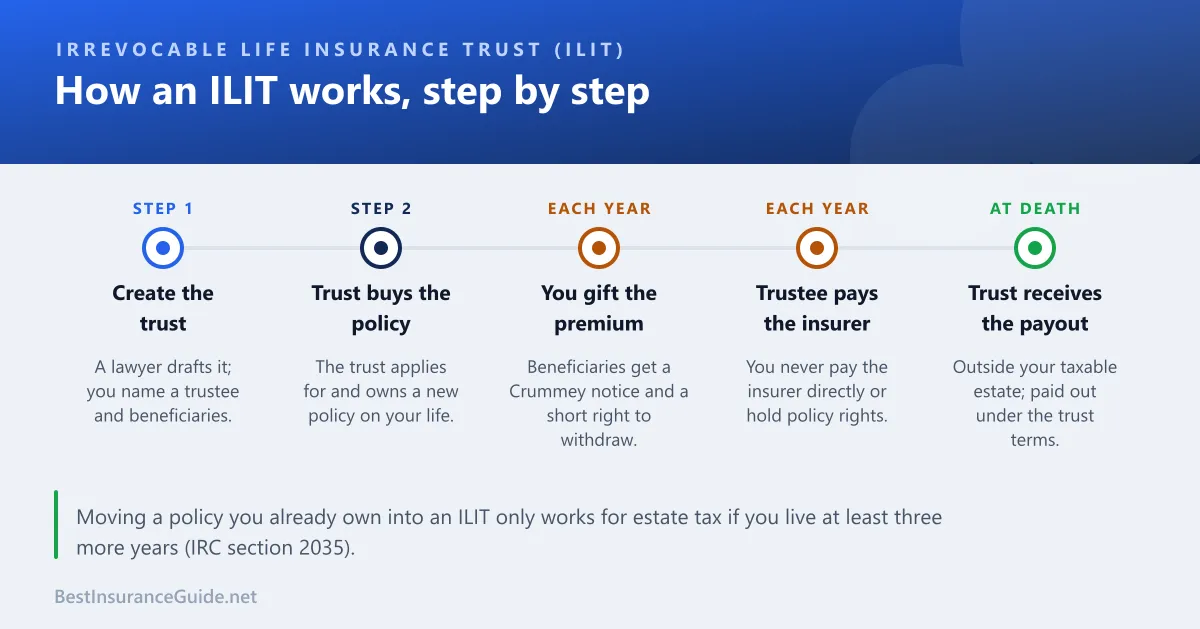
In practice, the process usually runs like this:
- An attorney drafts the trust. You choose the trustee, the beneficiaries and the rules for paying out the money, such as at certain ages or for education and health costs.
- The trust gets a tax ID number and a bank account.
- The trustee applies for a new policy on your life, with the trust as owner and beneficiary. You still take the medical exam.
- Each year you gift the premium to the trust, and the trustee sends Crummey notices to the beneficiaries.
- The trustee pays the premium to the insurer from the trust’s account.
- When you die, the insurer pays the trust. The trustee can lend money to your estate or buy assets from it to help pay estate tax, then manages or distributes the rest under the trust terms.
Crummey notices and the gift tax annual exclusion
Money you give the trust to pay premiums is a gift. To avoid using up your lifetime exclusion, you want those gifts to qualify for the gift tax annual exclusion, which the IRS sets at $19,000 per recipient for 2026.
The catch is that the annual exclusion only applies to gifts of a present interest, something the recipient can use now. Money placed in a trust for later is normally a future interest.
The solution is a Crummey power, named after a 1968 court case. Each time you add money to the trust, each beneficiary gets a temporary right to withdraw their share, often for 30 days. The trustee sends a written Crummey notice explaining the right. Beneficiaries usually let it lapse, and the trustee then pays the premium.
Two technical points to raise with your attorney:
- The “5 and 5” limit. Under section 2514(e), when a beneficiary lets a withdrawal right lapse, the lapse is only free of gift tax for that beneficiary up to the greater of $5,000 or 5% of the trust assets. Trusts are often drafted with “hanging” powers to deal with larger gifts.
- Grandchildren. If the trust can benefit grandchildren, generation-skipping transfer tax rules apply, and you may need to allocate GST exemption on a gift tax return.
Illustrative example: funding the premiums
Illustrative. Elena’s ILIT has three adult children as beneficiaries. Each child’s withdrawal right can cover up to $19,000 of gifts, so Elena can give the trust up to 3 × $19,000 = $57,000 a year in 2026 within the annual exclusion, subject to the 5-and-5 limit above. Her policy’s premium is $42,000 a year, so the gifts fit comfortably.
The three-year rule for existing policies
Many people already own a policy and want to move it into an ILIT. That is allowed, but section 2035 of the tax code adds a lookback: if you transfer a policy and die within three years, the death benefit is included in your estate as if you had never transferred it.
There are two common ways round this:
- Have the trust buy a new policy from the start, so you never owned it. This is why most ILITs are set up before the policy is bought.
- Have the trust buy the existing policy from you at fair value. This needs careful handling, because a sale can trigger the transfer-for-value rule in section 101(a)(2), which can make part of the payout taxable as income. Sales to a trust treated as owned by you for income tax purposes are often structured to fall within an exception, but this is specialist territory.
Transferring an old policy can still make sense if you are in good health, or if new cover would be expensive or unavailable. Just plan for the three-year window.
How much estate tax an ILIT can save
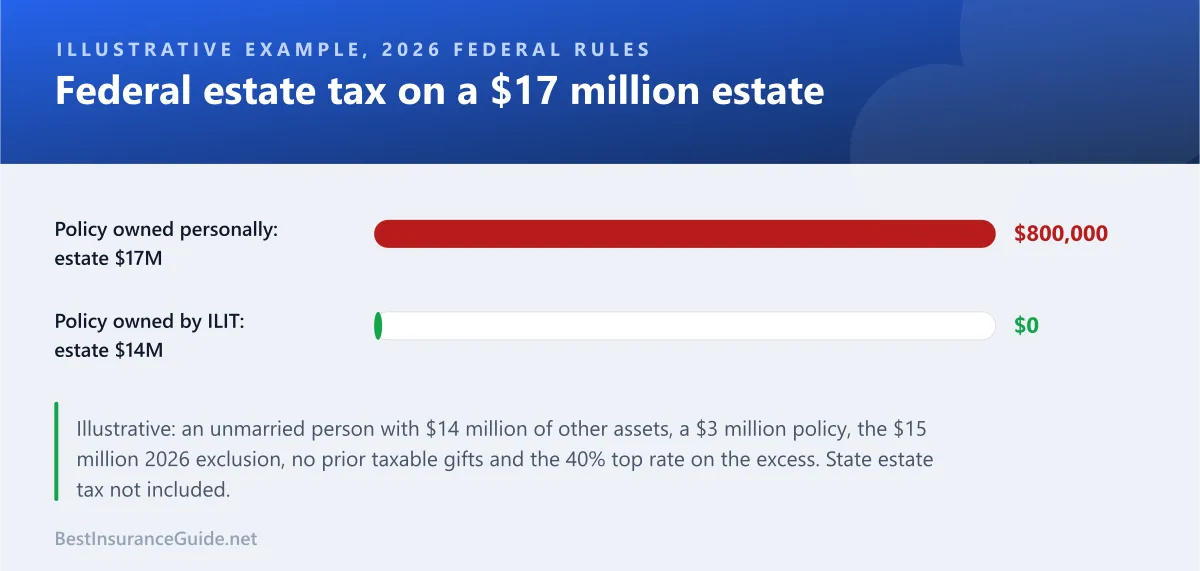
Illustrative. James is unmarried and lives in a state with no estate tax. He has $14 million of other assets and a $3 million life insurance policy. He has made no taxable gifts during his life and dies in 2026.
- If James owns the policy, his taxable estate is $17 million. That is $2 million over the $15 million exclusion. The top estate tax rate in section 2001 is 40%, so the federal estate tax is about $2,000,000 × 40% = $800,000.
- If an ILIT owns the policy and it was set up correctly, his taxable estate is $14 million, below the exclusion, so there is no federal estate tax. The trust receives the full $3 million.
In real estates, deductions, prior gifts and state taxes change the numbers, so ask an estate planner to run yours.
Married couples
Married couples can usually leave everything to each other free of estate tax because of the unlimited marital deduction. A surviving spouse may also be able to use the unused exclusion of the spouse who died first, known as portability, if the executor files an estate tax return to elect it.
That means estate tax often falls due at the second death. Couples with large estates commonly pair an ILIT with a survivorship (second-to-die) policy, which pays out when both spouses have died. Our guide to joint life insurance explains how survivorship policies work.
Do you need an ILIT now that the exclusion is $15 million?
For federal estate tax alone, most people do not. The IRS sets the 2026 basic exclusion at $15 million per person, under the July 2025 tax law that raised it from $13.99 million in 2025. The law indexes the amount for inflation in later years.
An ILIT may still be worth discussing with an attorney if:
- Your estate could exceed the federal exclusion, including the payout from your policies, business interests and property.
- You live in a state with its own estate tax. About a dozen states and Washington, D.C. tax estates, several at far lower levels. In 2026, Oregon taxes estates above $1 million, Massachusetts above $2 million, Washington above $3 million for deaths from July 1, 2026, and New York above $7.35 million.
- You want control over the money. A trustee can pay for education, health and living costs over time instead of handing a large sum to a young adult.
- A beneficiary has special needs. A properly drafted trust can help avoid disrupting means-tested benefits.
- You have a blended family and want to be sure children from an earlier marriage are provided for.
- You want creditor protection for the payout, which a trust can offer under many states’ laws.
If none of these apply, naming your beneficiaries directly, with contingent beneficiaries as a backup, is usually simpler and cheaper.
Owning the policy yourself vs an ILIT
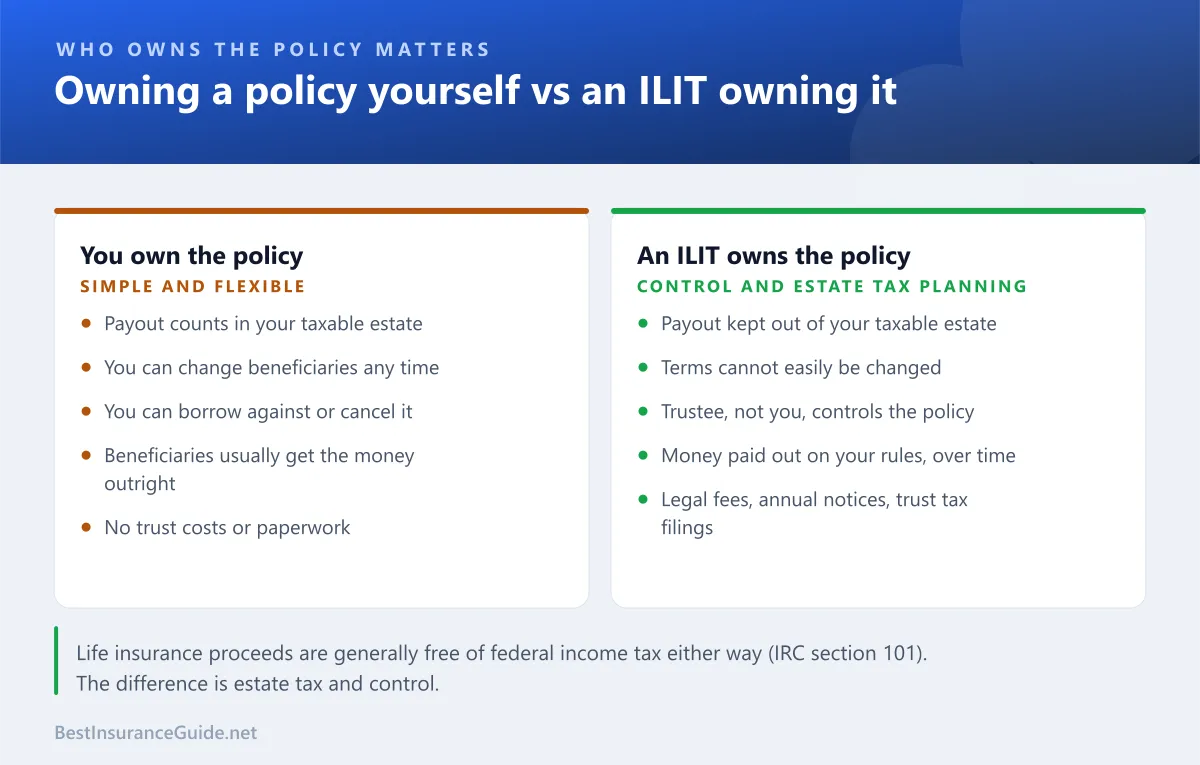
| You own the policy | An ILIT owns the policy | |
|---|---|---|
| In your taxable estate? | Yes | No, if set up and run correctly |
| Change beneficiaries? | Any time | Generally not |
| Borrow against or cancel it? | Yes | No; the trustee decides |
| How heirs get the money | Usually a lump sum | Under the trust’s rules |
| Costs | None beyond premiums | Legal fees, possible trustee fees, annual notices, trust tax filings |
What an ILIT costs you
The trade-offs are real:
- Loss of control. You cannot take the policy back, change the beneficiaries on a whim or borrow its cash value.
- Set-up costs. An estate planning attorney drafts the trust. Fees vary widely by location and complexity, so ask for a written quote.
- Ongoing administration. Crummey notices every time you add money, a separate bank account, record keeping, and possibly trust tax returns and trustee fees.
- Premium planning. If you stop gifting and the trust cannot pay the premium, the policy may lapse and the plan fails.
- Divorce. If your spouse is a beneficiary, the trust may not change automatically on divorce. Discuss this when it is drafted.
Common ILIT mistakes
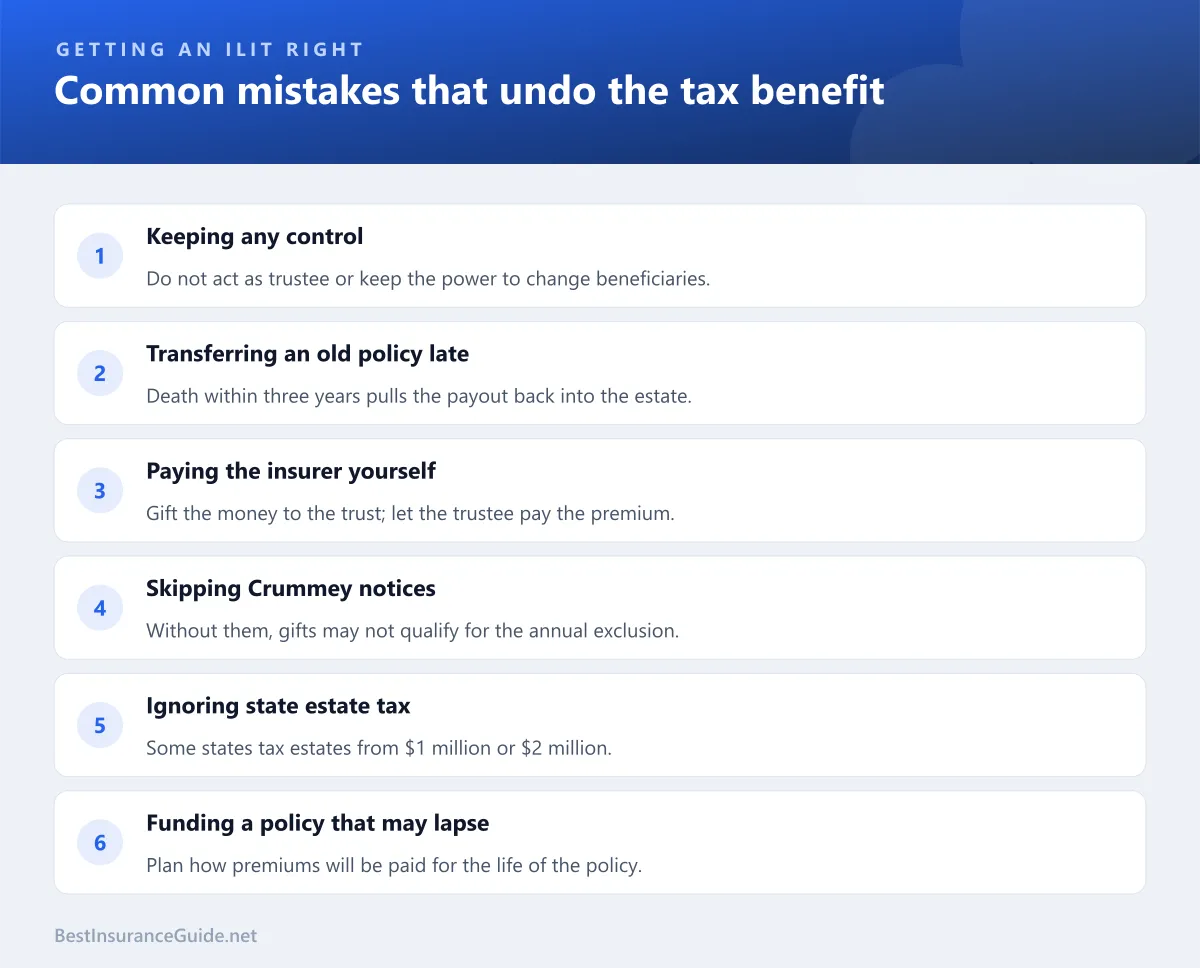
- Keeping control. Serving as trustee or keeping the power to change beneficiaries can bring the payout back into your estate under section 2042.
- Transferring an existing policy late in life without planning for the three-year rule.
- Paying the insurer directly. Gift the money to the trust and let the trustee pay.
- Skipping Crummey notices, which can cost you the annual exclusion.
- Naming your estate as beneficiary of a policy outside the trust, which puts it straight back into your estate.
- Choosing the wrong policy. Term cover that expires before you die leaves the trust with nothing. Our guide to term vs whole life insurance explains the difference.
- Forgetting state taxes and portability when deciding whether the trust is worth it.
How to set up an irrevocable life insurance trust
- Check whether you need one. Add up your estate, including the full death benefit of every policy you own.
- Find an estate planning attorney licensed in your state.
- Choose a trustee you trust to manage money for decades, and a successor.
- Decide the payout rules, such as ages, purposes and what happens if a beneficiary dies before you.
- Sign the trust and get its tax ID number and bank account before the policy is issued.
- Have the trustee apply for the policy, with the trust as owner and beneficiary.
- Set up the annual routine: your gift, Crummey notices, the trustee’s premium payment and records.
Related reading
- Life insurance and taxes explains when a payout is taxable.
- Joint life insurance compares first-to-die and survivorship policies.
- Term vs whole life insurance helps you choose the policy type.
- What is a contingent beneficiary? covers backup beneficiaries.
- How long does life insurance take to pay out? explains the claims process.
Sources and notes
- IRS, Estate tax: basic exclusion amounts of $13,990,000 for 2025 and $15,000,000 for 2026.
- IRS, What’s new: estate and gift tax: $15 million exclusion for 2026 under Public Law 119-21 and the $19,000 annual gift exclusion for 2025 and 2026.
- 26 U.S.C. § 2042, Proceeds of life insurance: life insurance included in the gross estate where the decedent held incidents of ownership.
- 26 U.S.C. § 2035, Adjustments for certain gifts made within 3 years of decedent’s death: the three-year rule.
- 26 U.S.C. § 101, Certain death benefits: exclusion of death benefits from income and the transfer-for-value rule.
- 26 U.S.C. § 2001, Imposition and rate of tax: the 40% top estate tax rate.
- 26 U.S.C. § 2514, Powers of appointment: the $5,000 or 5% lapse rule.
- Creative Planning, 2026 state estate and inheritance taxes: state thresholds for Oregon, Massachusetts, Washington and New York. Check your state’s revenue department for current figures.
- Crummey v. Commissioner, 397 F.2d 82 (9th Cir. 1968): the origin of Crummey withdrawal powers.
- Elena’s and James’s examples are illustrative and simplified; they ignore deductions, prior gifts and state taxes unless stated.
This article is general information, not legal or tax advice. Trust and tax rules are complex and change; an ILIT is irrevocable once signed. Speak to an estate planning attorney and a tax professional licensed in your state before creating or funding a trust.