Dental Insurance for Kids: How Children's Dental Coverage Works
Dental insurance for kids: family plans, ACA pediatric dental, Medicaid and CHIP, sealants, braces, the birthday rule and how to choose.

Table of contents

Children are the part of the family most likely to need a dentist and least likely to be able to wait. They need check-ups twice a year from infancy, sealants when their molars come in, fillings more often than parents expect, and — for many — orthodontic treatment in their early teens. Children’s dental coverage is built around that pattern, and it comes from more places than most parents realise.
This guide covers where children’s dental insurance comes from, what it covers, what it does not, and how to choose the right option for your family.
Where children’s dental coverage comes from
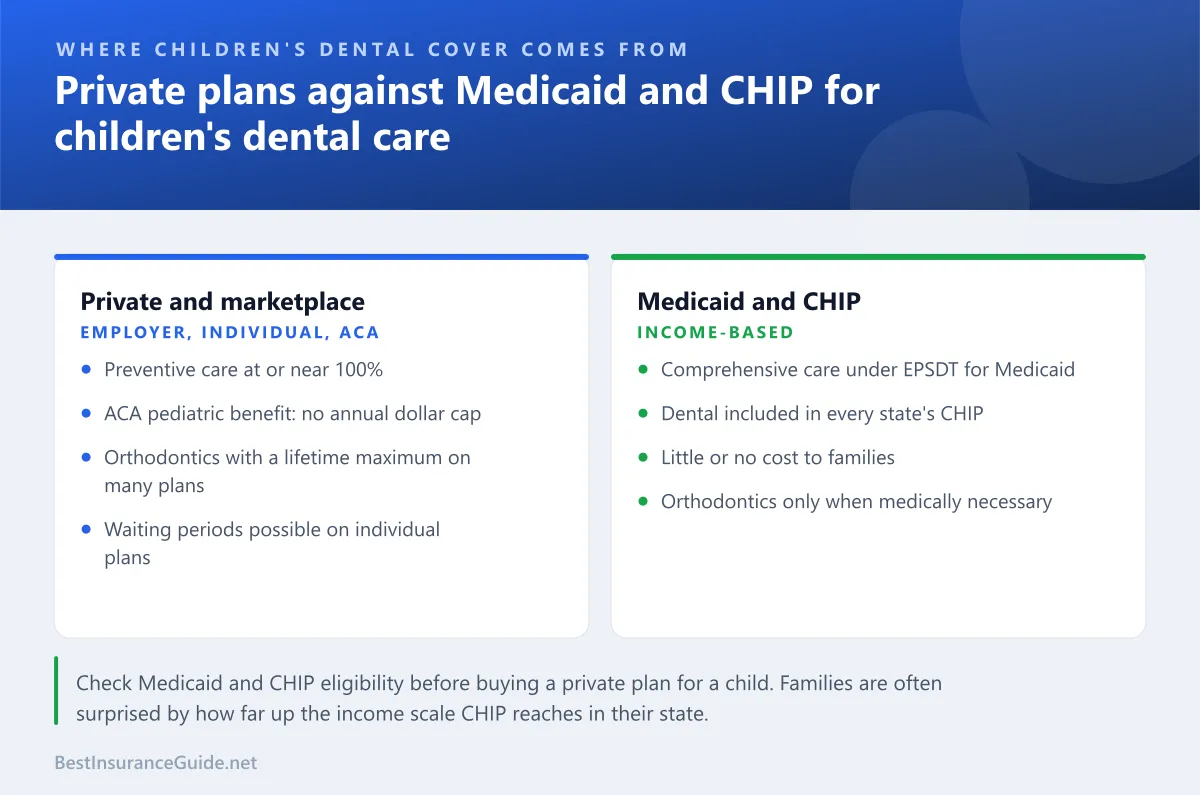
A parent’s employer plan. The most common route. Adding children to a family dental plan through work is usually the cheapest per child, and group plans often have no waiting periods.
A stand-alone individual or family plan, bought directly or through a broker.
The marketplace. Pediatric dental is one of the Affordable Care Act’s ten essential health benefits. Marketplace health plans either include pediatric dental (“embedded”) or a stand-alone pediatric dental plan is offered alongside.
Medicaid. Children on Medicaid are entitled to comprehensive dental care under the federal EPSDT requirement — early and periodic screening, diagnostic and treatment — which applies in every state.
CHIP. Every state’s Children’s Health Insurance Program includes dental coverage for enrolled children. CHIP covers children in families with incomes too high for Medicaid but who may struggle to afford private coverage.
What children’s dental coverage typically includes
Preventive care — exams, cleanings, X-rays, fluoride treatments and sealants — is usually covered at or near 100% on private plans, and fully on Medicaid and CHIP.
Basic care — fillings, simple extractions and space maintainers — is typically covered at around 80% on private PPO plans.
Major care — crowns, including stainless steel crowns on baby teeth, and root canal treatment on permanent teeth — is typically covered at around 50%, though some pediatric plans treat these more generously.
Orthodontics is the most variable benefit, discussed below.
The ACA pediatric dental benefit
Pediatric dental coverage under the Affordable Care Act has some features adult dental plans do not.
No annual dollar maximum on the essential pediatric benefit. Adult dental plans commonly cap annual benefits at $1,000 to $2,000; the pediatric essential benefit cannot impose an annual dollar limit on covered essential services.
An out-of-pocket maximum. Stand-alone pediatric dental plans sold on the marketplace have a capped out-of-pocket maximum for the essential benefit, set annually by federal rules. That is a meaningful protection in a year with extensive treatment.
Medically necessary orthodontics only. Orthodontics is covered under the essential benefit only when it is medically necessary — for serious conditions such as a cleft palate or a severe malocclusion — not for cosmetic straightening.
The benefit ends at age 19. From then on, children need adult coverage, whether through a parent’s plan, an employer or an individual policy. For the wider rules on dependants, see staying on your parents’ health insurance.
Sealants: the cheapest dental protection there is
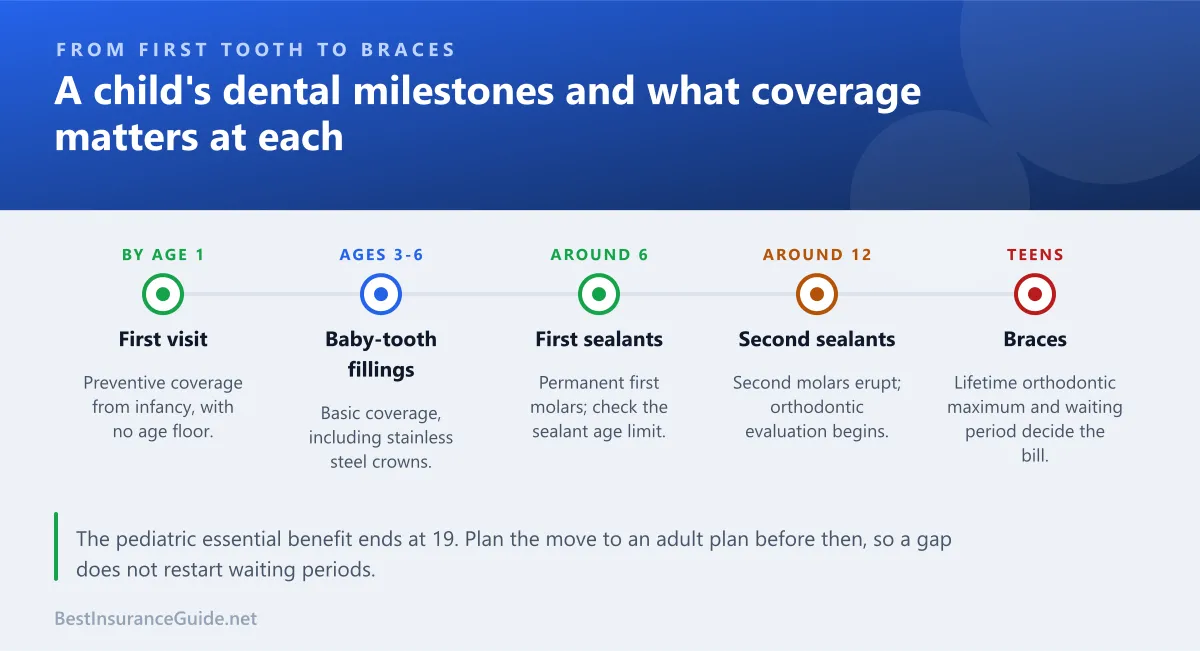
Sealants are thin protective coatings painted onto the chewing surfaces of back teeth, where most childhood cavities start. They are usually applied when the permanent molars come in, around age 6 and again around age 12.
Most private plans cover sealants on permanent molars, commonly as a preventive or basic service, and often with an age limit. Medicaid and CHIP cover them. The cost of a sealant is a fraction of the cost of the filling it prevents.
Braces and orthodontic coverage
For parents, orthodontics is usually the largest single dental expense of childhood. Comprehensive orthodontic treatment commonly costs several thousand dollars.
Employer and individual plans that include orthodontics usually pay around 50% up to a lifetime orthodontic maximum — often in the range of $1,000 to $2,000 — separate from the annual maximum. Many limit the benefit to children under a certain age, often 19, and individual plans commonly impose a waiting period of twelve months or more.
The ACA essential benefit, Medicaid and CHIP cover orthodontics only when it is medically necessary, according to the programme’s criteria.
Two plans help most here. If both parents have dental plans with orthodontic benefits, each plan’s lifetime orthodontic maximum can apply, subject to coordination rules. See secondary dental insurance for how that works.
A worked example: a 12-year-old’s year
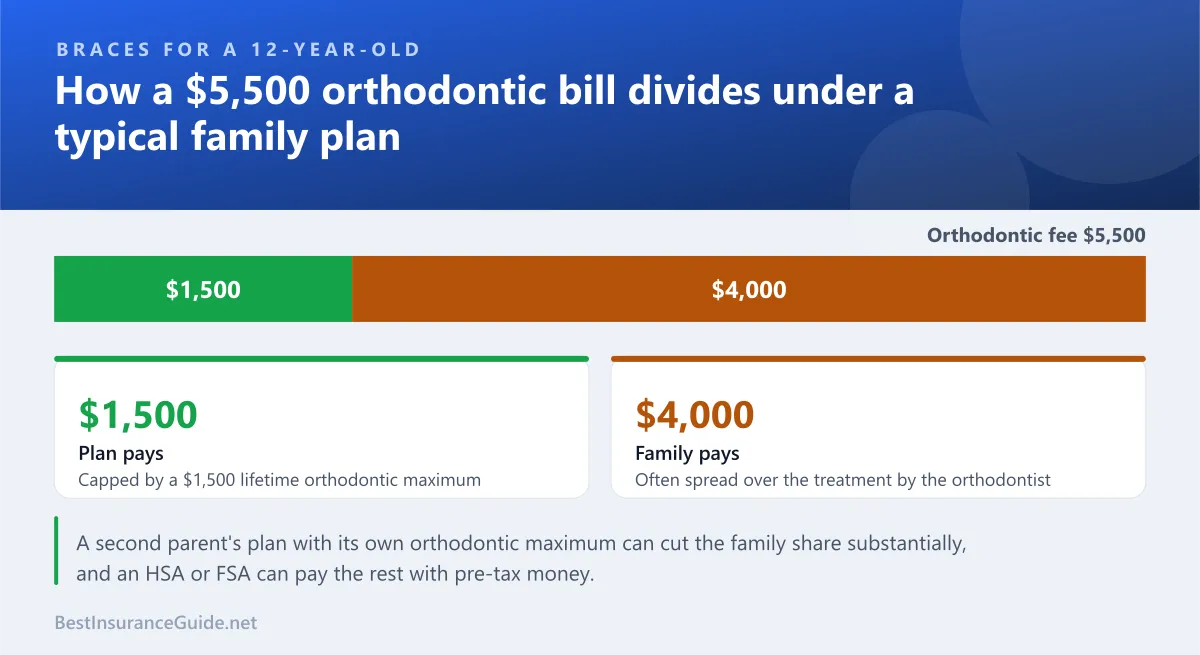
Take a 12-year-old in a year that includes two check-ups, sealants on the new molars, two fillings, and the start of orthodontic treatment. Use illustrative fees and a family PPO paying 100/80/50, with a $1,500 lifetime orthodontic maximum at 50%.
| Care | Illustrative fee | Plan pays | Family pays |
|---|---|---|---|
| 2 exams and cleanings | $400 | $400 | $0 |
| Sealants on four molars | $240 | $240 | $0 |
| 2 fillings | $400 | $280 (80% after $50 deductible) | $120 |
| Orthodontic treatment | $5,500 | $1,500 (lifetime maximum) | $4,000 |
| Totals | $6,540 | $2,420 | $4,120 |
The routine care is almost entirely covered. The orthodontic treatment is where the family’s money goes, because the lifetime maximum caps the benefit long before the fee is reached. Many orthodontists spread the family’s share over the treatment period, and some families use a health or flexible spending account to pay it with pre-tax money.
Which parent’s plan pays first
If both parents have dental coverage, the birthday rule usually decides which plan is primary for the children: the plan of the parent whose birthday comes first in the calendar year pays first. For separated or divorced parents, a court order assigning responsibility for coverage generally takes precedence.
Tell the dentist about both plans and which is primary, so claims go to the right plan first.
How to choose
1. Check Medicaid and CHIP eligibility first if your income is modest. Coverage is comprehensive and costs little or nothing.
2. If you have employer coverage, compare adding the children with a stand-alone plan. The employer plan is usually cheaper and often has no waiting periods.
3. Check the pediatric dentist’s networks. Many families want a pediatric dentist specifically, and networks vary.
4. Check orthodontic coverage if your child is approaching the age for braces: whether it is included, the lifetime maximum, any age limit and any waiting period.
5. Check sealant and fluoride coverage, including age limits.
Mistakes worth avoiding
Waiting until braces are needed to buy a plan with orthodontic coverage. Waiting periods for orthodontics are often a year or longer.
Assuming the ACA pediatric benefit covers braces. Only medically necessary orthodontics is included.
Dropping coverage at 19 without replacing it. The pediatric benefit ends, and a gap can mean a waiting period on the next plan.
Not using the preventive benefit. Twice-yearly check-ups and sealants are usually free under the plan and prevent the more expensive treatment later.
What coverage matters at each age
A child’s dental needs change quickly, and so does the part of a plan that matters most.
| Age | What usually happens | Plan feature that matters most |
|---|---|---|
| 0 to 3 | First visit by the first birthday, fluoride varnish, checks for early decay | Preventive coverage from infancy, with no age floor on exams |
| 3 to 6 | Regular check-ups, first X-rays, fillings on baby teeth | Basic coverage, including stainless steel crowns on baby teeth |
| 6 to 9 | First permanent molars erupt; sealants; space maintainers if baby teeth are lost early | Sealant coverage and its age limit |
| 9 to 14 | Second molars and sealants; orthodontic evaluation; braces begin for many | Orthodontic benefit, lifetime maximum and waiting period |
| 14 to 18 | Braces continue or finish; wisdom teeth monitored; sports injuries | Coverage for extractions, emergency care and mouthguards |
| 19 | Pediatric essential benefit ends | Continuity into an adult plan without a new waiting period |
The table explains why the “best” children’s plan for a toddler is not the best for a 12-year-old. Parents of young children should prioritise preventive and basic coverage; parents approaching the braces years should look hard at the orthodontic benefit well before treatment is likely.
Children with special health care needs
Children with developmental, medical or physical conditions often need more frequent visits, longer appointments or treatment under sedation or general anaesthesia.
Sedation and general anaesthesia for dental treatment may be covered under the dental plan, the medical plan, or neither, depending on the reason and the plan. When a child needs treatment in a hospital or surgery centre, the facility and anaesthesia charges are sometimes billed to the medical plan, which is worth asking about before treatment.
Pediatric dentists complete additional training in treating young children and children with special needs. Check whether the pediatric dentist you prefer is in network, because some plans have fewer pediatric specialists than general dentists.
Medicaid’s EPSDT benefit is broad for children with special health care needs: medically necessary dental care must be covered, even where it goes beyond the state’s standard benefit list.
Sports, mouthguards and knocked-out teeth
Dental injuries are among the most common sports injuries in children, and they tend to happen to front permanent teeth, which are expensive to restore.
Custom mouthguards made by a dentist are sometimes covered by dental plans, often with an age limit or a once-per-year restriction, and many plans exclude them. A store-bought mouthguard is not covered but costs little.
Treatment after an injury — reattaching or splinting a tooth, root canal treatment, and eventually a crown or implant — is covered under the plan’s usual tiers. Because a young adult’s permanent restoration may be delayed until growth finishes, the full cost of an injury can stretch over several years and several annual maximums.
Medical plans sometimes cover accidental dental injury, particularly emergency treatment in the first days after the accident. If your child injures a tooth, ask whether the first treatment should be submitted to the medical plan.
A school or sports league accident policy may also pay toward dental injuries that happen during organised activities. Ask the school or league whether one exists.
Teenagers heading to college
A child who leaves home for college may be out of network if the family plan is a regional dental HMO. Check whether the plan has participating dentists near the campus, or whether a PPO would serve better during those years. Many colleges offer student dental plans, but they are often limited; compare them with keeping the student on the family plan.
The short version
Children’s dental coverage comes from employer family plans, stand-alone plans, the marketplace’s pediatric dental benefit, Medicaid and CHIP. Preventive care, including sealants, is usually covered at or near 100%, and the ACA pediatric essential benefit has no annual dollar maximum and a capped out-of-pocket maximum.
Orthodontics is the exception: covered only when medically necessary under the ACA, Medicaid and CHIP, and limited by a lifetime maximum on most private plans. Check that benefit early if braces are likely.
For state-specific programmes, see our guides to dental insurance in Florida, Texas and Illinois.
A note on scope
This guide is general information rather than advice about any specific plan. Benefits, age limits, waiting periods and orthodontic maximums vary by plan, and Medicaid and CHIP dental benefits vary by state. Your plan documents, your state Medicaid or CHIP agency and HealthCare.gov or your state marketplace are the authoritative sources. This site is independent and not affiliated with any insurer.