Best Dental Insurance for Implants: What to Look For Before You Buy
Dental insurance that covers implants: the missing tooth clause, alternate benefits, waiting periods, annual maximums and medical coverage.

Table of contents

Implants are the dental treatment where the gap between what people expect insurance to pay and what it actually pays is widest. Many plans exclude them altogether. Many of those that cover them pay only for the tooth you lost after joining, only up to an annual maximum that one implant can exceed on its own, and sometimes only what a cheaper bridge would have cost.
That does not mean insurance is useless for implants. It means the best dental insurance for implants is defined by four or five clauses, not by the brand or the premium. This guide explains what they are and how to check for them.
What an implant costs
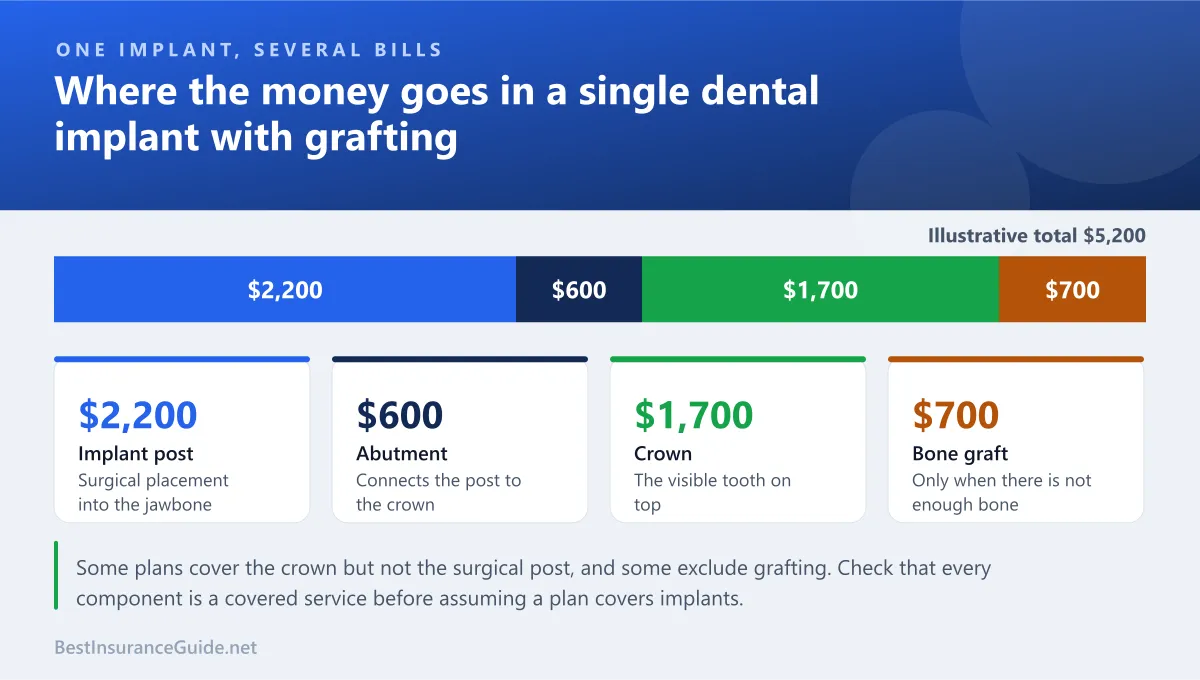
A single implant is really three components, often billed separately and sometimes over several months.
The implant post, placed surgically into the jawbone.
The abutment, which connects the post to the crown.
The crown on top.
In addition, some patients need bone grafting or a sinus lift to build up enough bone for the post, and some need an extraction first.
Taken together, a single implant commonly costs several thousand dollars — frequently in the range of $3,000 to $5,000 or more — and considerably more with grafting. Fees vary widely by region and by whether a general dentist, periodontist or oral surgeon places the implant.
Five things that make a plan good for implants
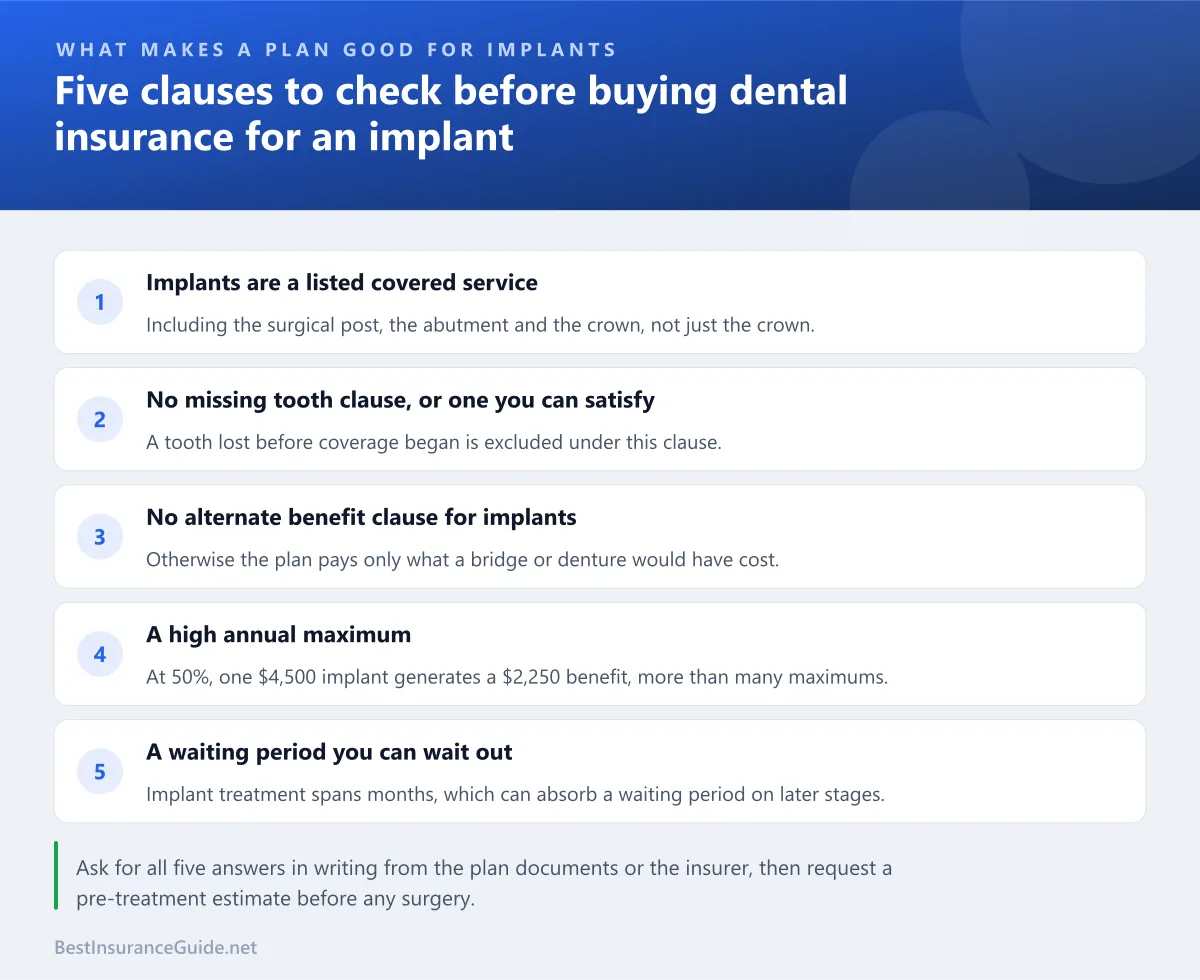
1. Implants are a listed covered service
This sounds obvious, but many plans exclude implants in the exclusions section, or cover only the crown on the implant but not the surgical placement. Look for implants named in the list of covered major services, and check whether the surgical post, abutment and crown are all included.
2. No missing tooth clause — or one you can satisfy
The missing tooth clause excludes replacing any tooth that was already missing before your coverage began. If the tooth you want to replace was extracted last year, a plan with this clause will not pay toward it, however long you keep the plan.
Some plans have no missing tooth clause. Some apply it only for a limited time, after which previously missing teeth become eligible. Some waive it if you had continuous prior coverage. Read this clause before anything else if the tooth is already gone.
3. No alternate benefit clause for implants
An alternate benefit clause — also called a least expensive alternative treatment provision — lets the plan pay only what it would have paid for a cheaper acceptable treatment. For a missing tooth, that is typically a bridge or a partial denture.
If you choose an implant under a plan with this clause, the plan pays its percentage of the bridge fee rather than the implant fee, and you pay the rest. Plans that explicitly cover implants without applying the alternate benefit are considerably more valuable for implant patients.
4. A high annual maximum
Most dental PPO plans cap annual benefits at $1,000 to $2,000. At 50% coinsurance, a $4,500 implant would generate a plan benefit of $2,250 — more than many annual maximums. Some plans offer higher maximums, and some raise the maximum after the first year or two of coverage.
A higher maximum only helps if implants are covered and the other clauses allow payment.
5. A waiting period you can wait out
Individual plans commonly impose waiting periods of six to twelve months, and sometimes longer, for major services including implants. Some waive them with proof of recent prior coverage.
Implant treatment often spans months anyway — extraction, healing, placement, integration, crown — so a waiting period can sometimes be absorbed within the treatment timeline. Discuss the sequence with your dentist before assuming it cannot.
A worked example: one implant, three plans
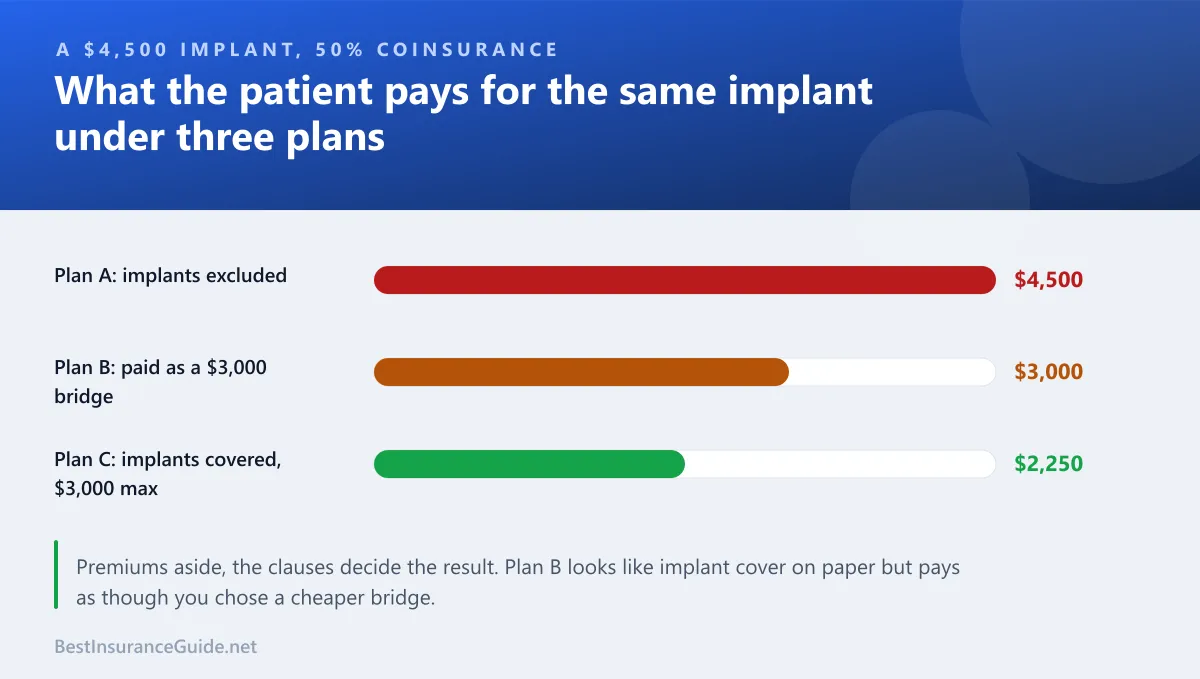
Assume an implant with a total fee of $4,500, and a three-unit bridge alternative with a fee of $3,000. All three plans pay 50% for major services, and the tooth was lost while the patient was covered.
| Detail | Plan A: implants excluded | Plan B: alternate benefit applies | Plan C: implants covered |
|---|---|---|---|
| Annual maximum | $1,500 | $1,500 | $3,000 |
| Basis for payment | None | Bridge fee, $3,000 | Implant fee, $4,500 |
| Plan pays at 50% | $0 | $1,500 | $2,250 |
| Patient pays | $4,500 | $3,000 | $2,250 |
Plan C is the one worth paying for if an implant is on the horizon. Plan B pays something, but only as if you had chosen a bridge. Plan A pays nothing toward the implant itself, though it may cover the extraction as a basic service.
Split the treatment across two benefit years — placement in one, the crown in the next — and each part can draw on a separate annual maximum. The timing of implant treatment often makes this happen naturally.
When medical insurance can help
Medical insurance does not usually cover dental implants. There are exceptions.
Accidental injury. Tooth loss from an accident may be covered in part under some medical plans.
Cancer treatment. Tooth loss or bone loss caused by treatment for head and neck cancer may qualify.
Congenital conditions, such as missing teeth associated with certain syndromes or a cleft palate.
Related procedures. Bone grafting or reconstructive surgery may be covered medically in some circumstances even where the implant is not.
Coverage depends on the specific medical plan and on documentation of medical necessity. Ask your oral surgeon whether any part of the treatment could be submitted to your medical plan, and request prior authorisation before treatment rather than after. Original Medicare does not cover dental implants; some Medicare Advantage plans include limited implant benefits within their dental coverage — see dental insurance for seniors on Medicare.
Other ways to reduce the cost
Dental schools offer implant treatment by supervised residents at reduced fees.
A health savings or flexible spending account lets you pay with pre-tax money.
Phased treatment, spreading stages across two benefit years to use two annual maximums.
A second dental plan, which brings its own annual maximum. How much it pays depends on its coordination method; see secondary dental insurance.
A discount plan, which reduces fees at participating dentists but does not pay the bill.
How implant treatment lines up with benefit years
Implant treatment is rarely completed in a single visit, and the time between stages can work in your favour.
| Stage | Typical timing | Common benefit tier |
|---|---|---|
| Extraction, if needed | Month 0 | Basic or major, depending on complexity |
| Bone graft, if needed | Month 0, with the extraction, or later | Major, or excluded on some plans |
| Healing | Around 2 to 4 months | No claim |
| Implant post placed | Around month 3 to 4 | Major, if implants are covered |
| Integration with the bone | Around 3 to 6 months | No claim |
| Abutment and crown | Around month 6 to 10 | Major |
Timings vary with the patient and the procedure. The point is that treatment often spans many months, which means two things. The later stages may fall outside a waiting period that would have blocked the early ones. And the stages may fall into two benefit years, each with its own annual maximum.
Talk to your dentist about the sequence, and ask the insurer for a pre-treatment estimate for each stage, so you know which claims fall in which year.
Implant-supported dentures
For people missing most or all of their teeth, implant-supported dentures — a denture that clips onto two or more implants — are increasingly common. They are usually more stable than a conventional denture and considerably more expensive.
Insurance treats them the way it treats other implant work, with the same clauses. A plan with an alternate benefit clause may pay only what a conventional denture would have cost. A plan with a missing tooth clause may pay nothing toward replacing teeth lost before coverage began. The annual maximum usually covers only a small part of the total. For people on Medicare, see our guide to dental insurance for seniors on Medicare, since some Medicare Advantage plans offer limited implant or denture benefits.
What a good pre-treatment estimate shows
Before implant treatment, ask your dentist to submit a pre-treatment estimate, and check that the response shows:
Each procedure code — extraction, graft, implant post, abutment and crown — and whether each is covered.
The amount the plan expects to pay for each, and whether it is based on the implant fee or on an alternate benefit.
Your remaining annual maximum and how the estimate uses it.
Any waiting period or missing tooth exclusion applied.
An estimate that pays only for the crown, or that values the treatment at a bridge fee, tells you before you commit that the plan is not an implant plan.
If an implant fails
Implants have high success rates, but a small share fail to integrate with the bone or loosen later. Replacement is where plan limits reappear.
Many plans cover an implant on the same tooth only once in a set period, often five years or more, so a replacement within that window may not be covered. Some practices offer their own warranty or reduced fee for a failed implant; ask about this before treatment, and get it in writing.
Implant or not?
The clinical decision between an implant, a bridge and a denture belongs to you and your dentist. It is worth knowing that insurance often favours the bridge or denture financially, through lower fees and alternate benefit clauses, even where an implant may be the better long-term clinical option. Make the clinical decision first, then work out the funding.
If you are still deciding whether to save the tooth at all, see dental insurance for a root canal. Saving a tooth is usually cheaper than replacing it.
Questions to ask before you buy
Are implants a covered service, including the surgical placement, abutment and crown?
Is there a missing tooth clause, and how does it apply to a tooth I have already lost?
Does an alternate benefit clause apply to implants?
What is the annual maximum, and does it increase with time on the plan?
What is the waiting period for implants, and is it waived for prior coverage?
Is there a frequency limit on implants or replacement?
Get the answers in writing, from the plan documents or the insurer, rather than from marketing material.
The short version
The best dental insurance for implants lists implants as a covered service, has no missing tooth clause or one you can satisfy, does not reduce implants to a bridge benefit through an alternate benefit clause, has a high annual maximum, and has a waiting period you can realistically wait out.
Many plans fail one or more of those tests. Check each one before buying, get a pre-treatment estimate before treatment, and ask whether any part of the treatment qualifies for medical coverage.
A note on scope
This guide is general information rather than dental or financial advice. Implant coverage, clauses, waiting periods and annual maximums vary by plan, and medical coverage for implant-related treatment depends on the medical plan and on medical necessity. Your plan documents and a pre-treatment estimate are the authoritative sources, and your dentist or oral surgeon is the right source on clinical options. This site is independent and not affiliated with any insurer.