How to Switch Car Insurance Without Creating a Gap
How to switch car insurance mid-policy without a lapse. The correct order, what refund to expect, and the overlap mistake that raises your next premium.

Table of contents

Switching car insurance is one of the highest-return hours available in personal finance, and most people avoid it because they assume it is complicated or that there is a penalty for leaving early.
There is not. You can switch on a Tuesday in March if you want to, and you get the unused premium back.
What matters is the order. Get that wrong and a saving turns into a multi-year surcharge.
The order, which is the whole thing
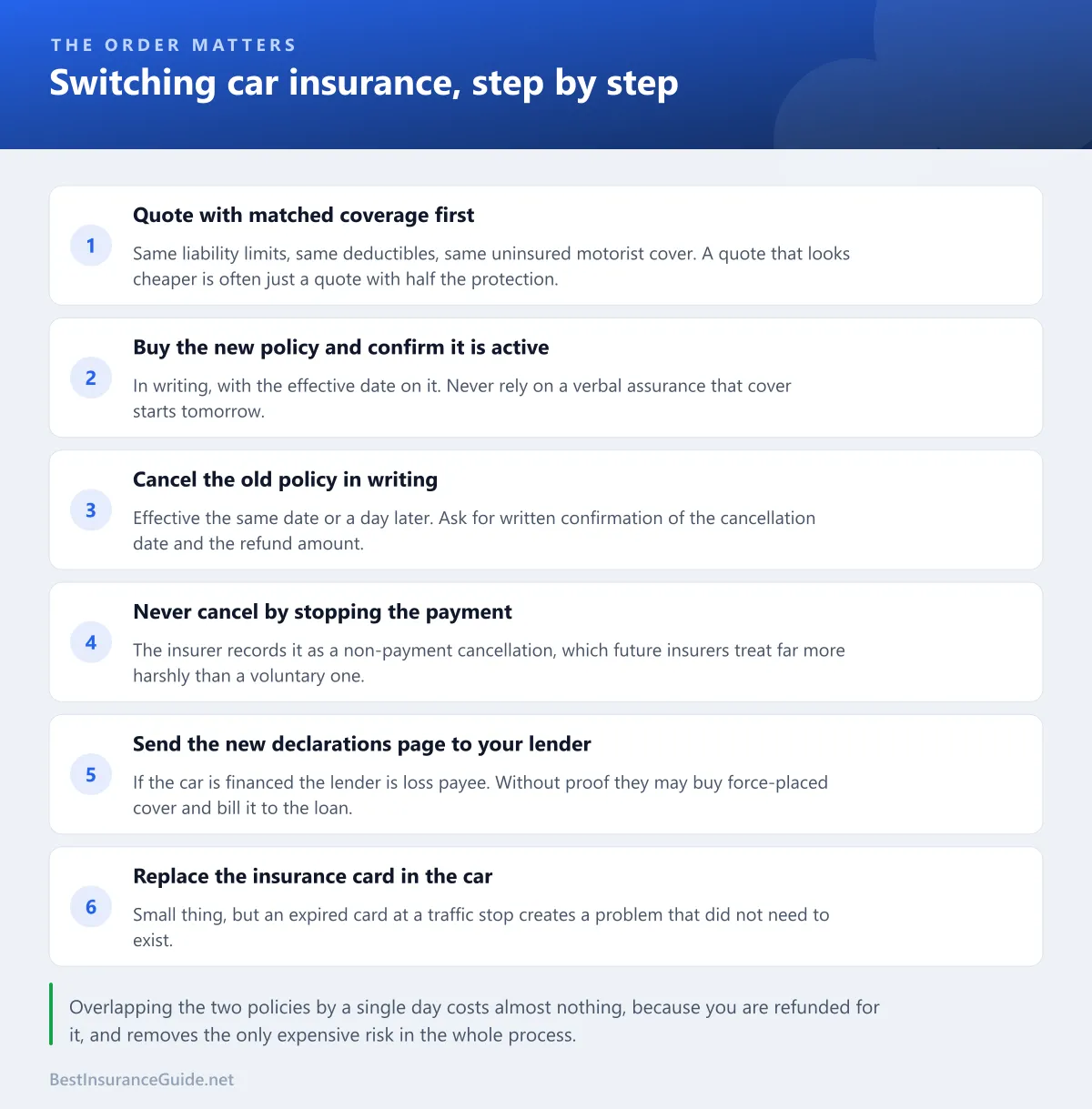
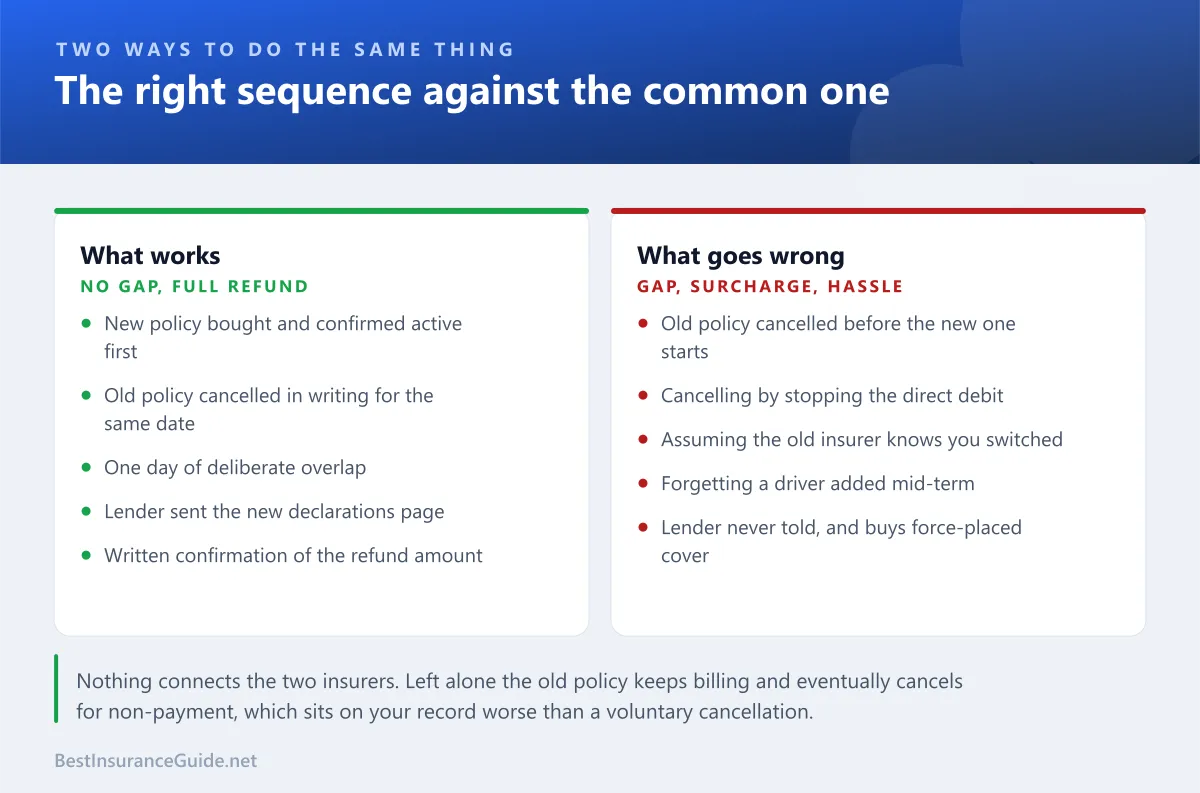
Buy the new policy before you cancel the old one. Not the same day. Not an hour apart. The new policy should be active and confirmed in writing before the cancellation of the old one takes effect.
That single rule prevents the only genuinely costly mistake in this process, and I will explain why in a moment.
Set the cancellation date to match the new start date. Most people want them flush, and flush is fine. A one-day overlap is safer still and costs almost nothing, because you get a refund for it anyway.
Cancel in writing, and get confirmation. A phone call is usually enough to start it, but ask for written confirmation of the cancellation date and the refund amount. Simply cancelling the direct debit is not cancelling the policy: the insurer will treat it as non-payment, and a non-payment cancellation looks materially worse on your record than a voluntary one.
Tell the lender or leaseholder. If the car is financed, the lender is listed as loss payee and needs the new declarations page. If they do not receive it, they may buy force-placed cover and bill it to your loan, which is expensive and entirely avoidable.
Remove the old proof of insurance from the car. A small thing, but presenting an expired card at a traffic stop creates a problem that does not need to exist.
Why a lapse is the expensive mistake
A gap in coverage, even one day, is not treated as an administrative detail. It is treated as a risk signal.
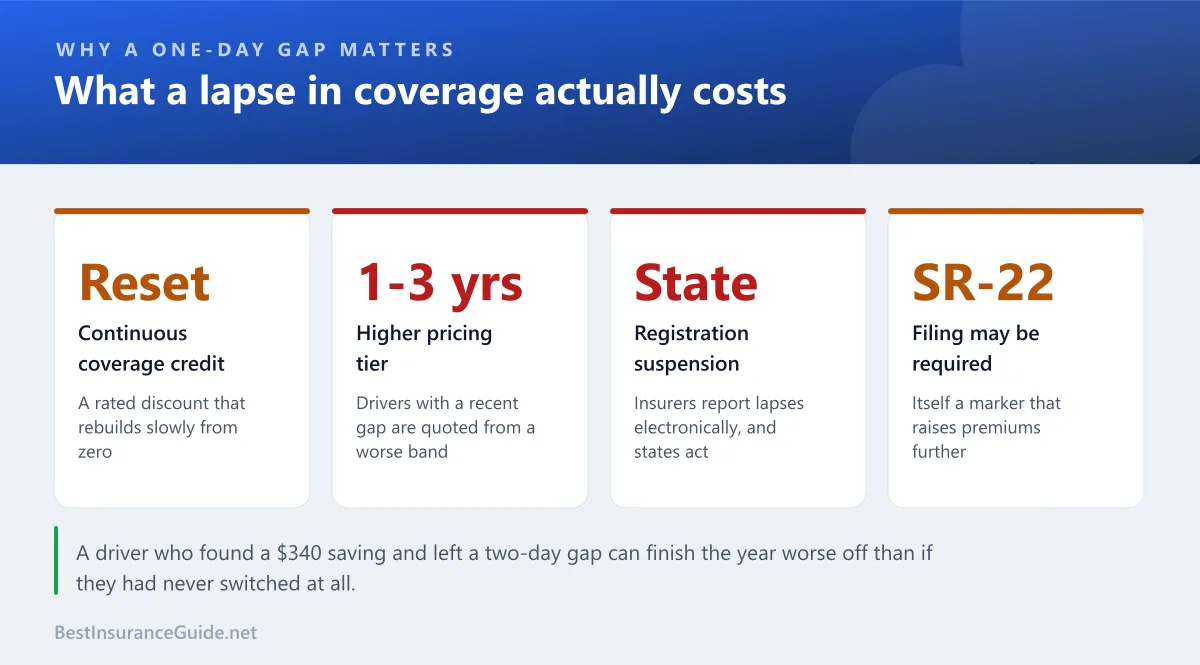
Continuous coverage is a rated factor. Most insurers give a discount for having been continuously insured, and the size of that discount usually steps up with the length of the unbroken period. A lapse resets it.
You move pricing tiers. Drivers with a recent gap are quoted from a higher-risk band, and that pricing can follow you for one to three years depending on the insurer.
States notice. Insurers report coverage electronically. Many states will suspend a registration on a reported lapse and charge reinstatement fees, and some require an SR-22 filing afterwards, which is itself a marker that raises premiums further.
Worked example: what a two-day gap actually cost
A driver cancelled on the 1st and started the new policy on the 3rd, having misread the effective date.
| Detail | Amount |
|---|---|
| Saving they had found by switching | $340 a year |
| Continuous coverage discount lost | $190 a year |
| Higher-tier pricing for 12 months | $265 a year |
| State reinstatement fee | $85 once |
| Net position, year one | $200 worse off |
They did the hard part correctly, found a genuinely better price, and lost it to a two-day administrative gap.
What refund to expect
Cancelling mid-term does not forfeit the premium you have already paid.
Pro-rata is the common method and the fair one. Six months into a twelve-month policy paid in full returns roughly half, less any fee.
Short-rate is used by a minority of insurers and keeps a small penalty for early cancellation, typically around 10% of the unearned premium.
If you pay monthly, there is usually little or nothing to refund, because you have only paid for the time you have used. That also means switching monthly-billed policies is the cheapest of all, since there is no capital tied up.
Worked example: switching seven months into a twelve-month policy
| Detail | Amount |
|---|---|
| Annual premium paid in full | $1,584 |
| Months used | 7 |
| Unearned premium | $462 |
| Pro-rata refund | $462 |
| New policy, remaining 5 months | $385 |
| Effective cost of the switch | Saves $77 immediately |
And the new premium continues at the lower rate afterwards, which is where the real money is.
When switching is most likely to pay
Some moments are much better than others, because your risk profile just improved and your current insurer has not repriced you for it.
Your renewal arrived with an increase. Premiums have risen broadly, but a rise well above the market is a signal that your file has been repriced rather than the whole book. Our piece on insurance rate trends covers how to tell those two apart.
A violation or accident just aged off. Most surcharges drop off at three years, some at five. Insurers do not always reprice you promptly the day it happens.
You moved. Territory is one of the strongest rating factors, and a move can change the right insurer entirely.
Your commute changed. Remote or hybrid work often cuts annual mileage substantially, and low-mileage pricing varies a lot between insurers.
You turned 25, married, or bought a home. All three are rated events, and a home purchase opens bundling discounts that can exceed the value of shopping the auto policy alone.
Your credit improved. In most states a credit-based insurance score is a rating factor, and improvement is not automatically reflected until you re-quote.
Quoting so the comparison means something
The most common failure here is not laziness, it is comparing quotes that were never comparable.
Match five fields across every quote before you look at a single price: bodily injury liability limits, property damage liability, the comprehensive deductible, the collision deductible, and uninsured or underinsured motorist coverage. A quote that looks $400 cheaper is often just a quote with half the liability limit.
Our guide to comparing insurance quotes the right way works through this in detail, and auto insurance discounts lists the reductions most drivers never ask for, which are worth applying to the new quote before you accept it.
One practical note: shopping does not affect your credit score. Insurers use a soft inquiry to pull the credit-based insurance score, and soft inquiries are invisible to lenders.
The things people get wrong
Two deserve calling out specifically.
Cancelling by stopping the payment. The insurer records a non-payment cancellation, which some future insurers treat almost as badly as a lapse. Always cancel properly.
Assuming the old policy auto-cancels when the new one starts. It does not. Nothing connects the two companies. Left alone, the old insurer keeps billing, and eventually cancels you for non-payment.
Forgetting a mid-term add. If you added a driver or a car during the term, make sure the new policy reflects the current household rather than what was true a year ago. An unlisted household driver is a common source of denied claims.
What to check on the new policy before the old one ends
The window between buying and cancelling is the last easy moment to catch an error, and errors at this stage are common because the new insurer is working from what you told them.
Read the declarations page line by line. Liability limits, both deductibles, uninsured and underinsured motorist coverage, medical payments or personal injury protection, and every listed driver and vehicle.
Confirm the endorsements carried over. Rental reimbursement, roadside assistance, gap cover, custom equipment, accident forgiveness. These are the items that quietly do not transfer, and people discover it at claim time.
Check the effective date and time. Policies start at a specific hour, not merely a date. A new policy starting at 12:01am on the 3rd does not cover an incident at 9pm on the 2nd.
Verify every discount you were quoted actually appears. Multi-policy, safe driver, telematics, paid-in-full, good student. Discounts drop off between quote and issue more often than anyone admits, and reinstating them is easy if caught in the first weeks.
Confirm the lienholder is listed if the car is financed, with the exact entity and loan number.
Worked example: what a ten-minute check caught
| Item | Quoted | Issued | Fixed |
|---|---|---|---|
| Uninsured motorist limits | 100/300 | 25/50 | Yes |
| Rental reimbursement | Included | Missing | Yes |
| Multi-policy discount | Applied | Not applied | Yes |
| Comprehensive deductible | $500 | $1,000 | Yes |
None of that was dishonest. It was data entry, and it would have been discovered at the worst possible moment.
Only once the new policy is confirmed correct and active should you cancel the old one, in writing, effective the same date or a day later.
How often to shop, and when not to
Shopping constantly is as much a mistake as never shopping, and the sensible cadence is somewhere in between.
Every second renewal is a reasonable default, plus any time a rated event occurs: a move, a marriage, a new vehicle, a violation ageing off, a change in commuting, or a home purchase that opens bundling.
Do not shop the month after a claim. Your record is at its worst and quotes will reflect it. Wait until the claim has been settled and, ideally, until any surcharge period is closer to ending.
Do not switch for a trivial saving. Under about five per cent, the administrative effort and the loss of any loyalty or claims-free accrual usually outweighs it. Some insurers award accident forgiveness or diminishing deductibles based on tenure, and those reset when you move.
Do watch the first renewal at a new insurer. Introductory pricing that rises sharply at the first renewal is a real pattern. The saving you calculated at purchase may not survive twelve months, so re-check rather than assuming.
One thing worth doing regardless of whether you switch: use the quotes as leverage. Calling your existing insurer with a competitor’s number sometimes produces a matching adjustment or surfaces a discount that was never applied, and that outcome keeps your tenure intact.
Switching because you moved
Moving state is the one situation where switching is not optional, and it is the moment where the largest surprises appear, because the requirements themselves change rather than just the price.
Your policy must be rewritten for the new state. Minimum limits, mandatory coverages and the underlying liability system all differ, and an insurer that writes in both states will rewrite rather than transfer.
Some differences are structural rather than numerical. A driver moving into a no-fault state acquires personal injury protection they did not have; one moving into a choice state acquires an election they have to make.
The states we have covered in detail, and the rule in each that most changes what to buy:
Connecticut mandates uninsured and underinsured motorist cover and offers conversion coverage, which removes the offset against the at-fault driver’s limits.
Pennsylvania sets among the lowest minimums in the country and asks every driver to choose between full and limited tort.
Kansas is a no-fault state requiring personal injury protection, which many drivers there do not realise.
Kentucky lets drivers reject no-fault in writing and keep an unrestricted right to sue, which almost nobody does deliberately.
Alabama applies pure contributory negligence, where being one percent at fault bars recovery entirely.
South Carolina permits a lawful uninsured vehicle population through a registration fee, and mandates uninsured motorist cover for everybody else.
Missouri mandates uninsured motorist cover and leaves underinsured motorist optional, which is the larger of the two problems.
Oklahoma pairs a high uninsured driver rate with automated plate-reader enforcement and heavy hail exposure.
Arkansas requires insurers to offer personal injury protection and uninsured motorist cover, both of which cheap quotes decline on a written form.
Montana combines the highest animal collision odds in the country with long distances to medical care.
Atlanta is a metro rather than a state, and it shows how much the garaging address alone moves a premium inside one state.
Whichever direction you are moving, the sequence is the same as any other switch: quote the new state’s requirements before you go, and never cancel the old policy until the new one is confirmed in force.
How quickly cover can start
One practical point that comes up in every switch. For a straightforward driver with the information ready, a policy can be quoted, bought and in force in well under half an hour, with digital proof issued immediately. What causes delay is almost never the insurer; it is a missing licence number, an unlocated declarations page, or a record discrepancy the insurer needs to check. Our guide to how long it takes to get car insurance sets out what to gather first and which situations genuinely take longer.
Related reading
Switching mid-term usually earns you money back. Car insurance refunds explains how much and how fast.
The short version
You can switch car insurance any day of the year, you will get the unused premium back, and shopping costs you nothing in credit terms.
Do it in this order: quote with matched coverage, buy the new policy and confirm it is active, cancel the old one in writing effective the same date or a day later, send the new declarations page to your lender, and bin the old insurance card.
The only way to lose money on this is to leave a gap. Overlap the dates by a day and that risk disappears entirely.
If you are also wondering whose policy responds when someone else drives your car, does insurance follow the car or the driver answers that one directly.