Replacement Cost vs Actual Cash Value: How Your Claim Is Really Paid
Replacement cost vs actual cash value, with worked claims: the depreciation holdback and what extended and guaranteed replacement cost mean.

Table of contents
Two homeowners with identical houses suffer identical fires. One receives a check large enough to rebuild the kitchen. The other receives a little over half that and has to find the rest. The difference is not their insurer, their deductible or their claim. It is two words on the declarations page: replacement cost versus actual cash value.
This is the single most important setting on any property policy, and one of the least understood. This guide explains the difference between replacement value and actual cash value with worked claims, how the depreciation holdback works, and what extended, guaranteed and functional replacement cost actually add.
The difference in one sentence each
Replacement cost (RC) pays what it would cost today to repair or replace damaged property with new property of like kind and quality.
Actual cash value (ACV) pays what the property was worth at the time of the loss, which in most cases means replacement cost minus depreciation for age, wear and obsolescence.
For new property the two are close. For older property they can be very far apart, because depreciation keeps growing as the property ages while the cost of replacing it keeps rising.
How actual cash value is calculated
The usual formula is:
Actual cash value = Replacement cost − Depreciation
Depreciation is typically estimated from the item’s age against its expected useful life, adjusted for its condition. A water heater with a 12-year expected life that is 9 years old has used three-quarters of its life, so the insurer might depreciate it by around 75%.
A few points that surprise people:
- Depreciation can apply to labor, not just materials, in some states. Others prohibit depreciating labor. This has been litigated in several states and can make a large difference on building claims.
- Not every state uses the same definition. Some use fair market value, and some courts apply a “broad evidence” rule that considers several factors. Your policy wording and state law decide.
- Condition matters. A well-maintained 15-year-old roof may be depreciated less than a neglected 10-year-old one.
For cars, actual cash value is the market value of the vehicle just before the loss, which is why a total loss rarely pays what you owe on the loan. Our guide to gap insurance covers that shortfall.
How a replacement cost claim is actually paid
Here is the part most people do not know until they claim: replacement cost policies usually pay in two stages.
- The initial payment is the actual cash value, less your deductible.
- The depreciation is held back until you repair or replace the property.
- When you send proof of the completed work, such as invoices or receipts, the insurer releases the held-back amount, often called recoverable depreciation.
There is usually a deadline for completing the work and claiming the holdback, set by the policy and sometimes extended by state law. California, for example, gives policyholders at least 12 months from the first actual cash value payment, and at least 36 months for losses relating to a declared state of emergency. If you miss the deadline, or decide not to rebuild, you may receive only the actual cash value.
Worked example: a kitchen fire
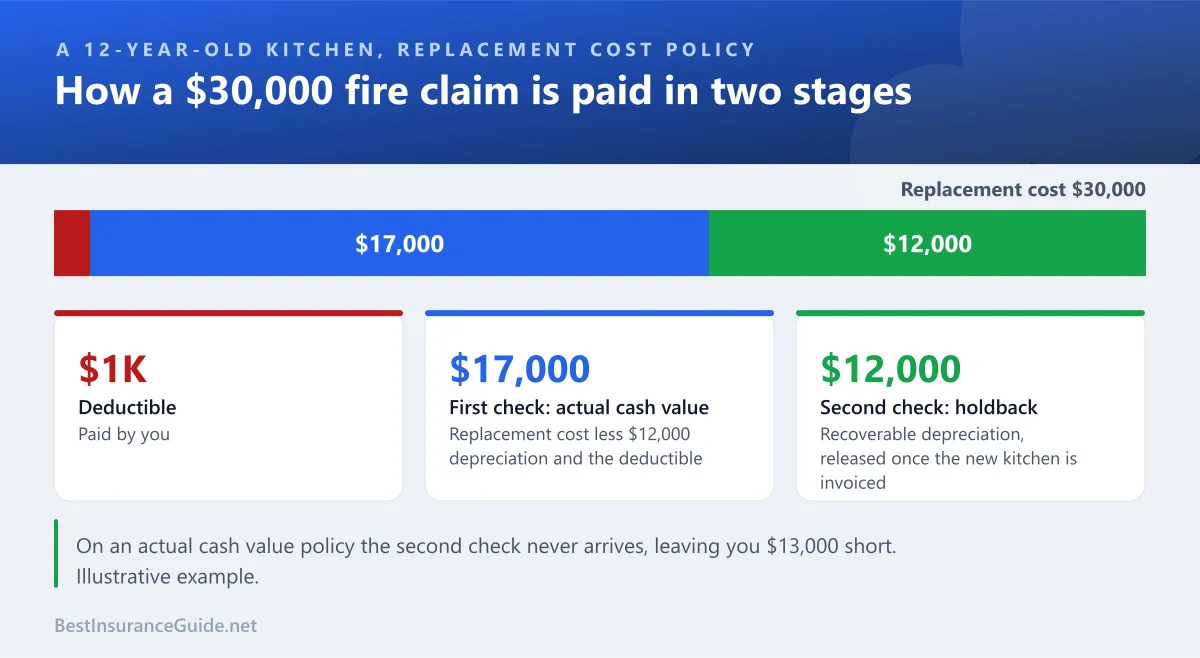
A cooking fire destroys a 12-year-old kitchen. Replacing the cabinets, counters and appliances with equivalent new ones costs $30,000. The adjuster depreciates the damaged items by $12,000 based on their age and condition. The deductible is $1,000.
On a replacement cost policy:
- Initial payment: $30,000 − $12,000 depreciation − $1,000 deductible = $17,000
- After the new kitchen is installed and invoiced: $12,000 released
- Total paid: $29,000. You pay only the deductible.
On an actual cash value policy:
- Payment: $30,000 − $12,000 − $1,000 = $17,000
- Total paid: $17,000. You find the other $13,000 yourself.
That $12,000 gap, on one room, is the practical difference between the two.
How to challenge a depreciation estimate
Depreciation is an estimate, not a fixed number, and it is one of the most negotiable parts of a property claim.
- Ask for the itemized estimate. It should show the replacement cost, age, expected life and depreciation percentage for each item or building component.
- Check the ages. Adjusters often assume the age of the house for everything in it. If you replaced the cabinets five years ago, send the receipt or photos.
- Challenge the condition. Well-maintained items can justify less depreciation than the default schedule applies.
- Check whether labor was depreciated and whether your state allows it.
- Use the appraisal clause if you and the insurer still disagree on the amount. Most property policies let each side appoint an appraiser, with an umpire deciding differences.
Every dollar of depreciation removed raises the first payment, and on an actual cash value policy, it raises the only payment.
When actual cash value applies even on a good policy
Many policies are replacement cost for most things but actual cash value for some. Check for these:
- Roof surfaces. Insurers in hail- and wind-prone states increasingly settle roofs on an actual cash value basis or a roof payment schedule that pays less as the roof ages, even on otherwise replacement cost policies.
- Personal property on a basic policy. Many homeowners and renters policies pay actual cash value for belongings unless you add a replacement cost endorsement. Our guide to whether renters insurance covers electronics shows how much that removes from a claim.
- Other structures and dwelling fire policies. Detached garages, fences and rental properties on landlord or DP policies are often settled at ACV. Our guide to dwelling insurance covers how DP-1, DP-2 and DP-3 policies differ.
- Underinsured homes. Most homeowners policies require your dwelling limit to be at least 80% of the home’s replacement cost for partial losses to be paid on a replacement cost basis. Fall below it and the insurer may pay less, often the actual cash value. It works much like the coinsurance clause explained in our coinsurance guide.
Extended, guaranteed and functional replacement cost
Standard replacement cost pays up to your dwelling limit. Several variations change that ceiling or the way the home is rebuilt.
Extended replacement cost
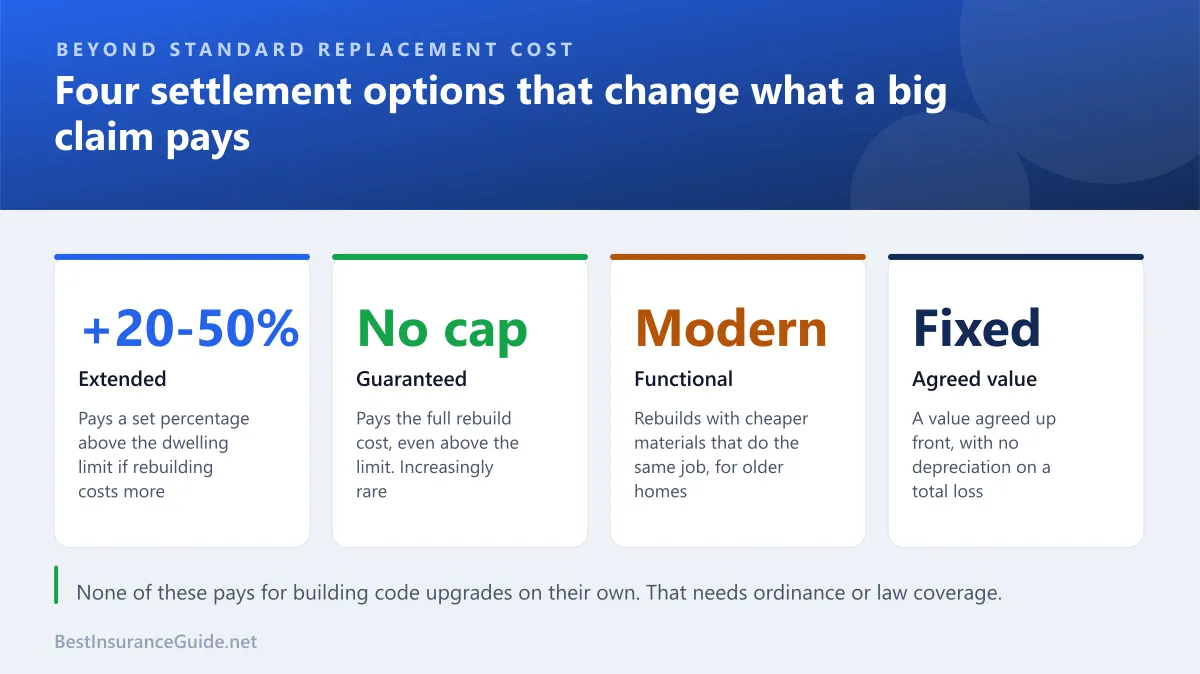
Extended replacement cost pays a set percentage above your dwelling limit, commonly 20% to 50%, if rebuilding costs more than you are insured for. It exists because rebuilding costs can jump after a regional disaster, when labor and materials are in short supply, and because dwelling limits drift out of date between renewals.
It is inexpensive relative to what it protects against, and it is one of the endorsements we suggest checking for on almost every homeowners policy.
Guaranteed replacement cost
Guaranteed replacement cost pays whatever it actually costs to rebuild, even if that exceeds the dwelling limit. It removes the risk of being underinsured entirely.
It has become harder to find, because it leaves insurers exposed to unlimited rebuilding cost increases. Where it is offered, insurers typically require the home to be insured to 100% of their own replacement cost estimate and require you to report renovations.
Functional replacement cost
Functional replacement cost pays to repair or replace with materials that do the same job but cost less. The classic example is an older home with lath and plaster walls, ornate trim or old-growth hardwood. Replacing them exactly would be very expensive; functional replacement cost pays for drywall, standard trim and modern flooring instead.
It is common on policies written for older homes, including the HO-8 form, and it keeps premiums affordable for houses whose exact replacement cost is far above their market value. The trade-off is that the rebuilt home will not match the original.
Agreed value
Agreed value is a different approach, used mostly for collectibles, classic vehicles and some commercial property. The insurer and you agree a value up front, and a total loss pays that amount with no depreciation. Our guide to classic motorcycle insurance explains why it matters for vehicles that appreciate.
A total loss under each settlement type
Here is how the options compare for the same total loss. The home would cost $500,000 to rebuild today, but the dwelling limit is $400,000 because it has not been updated since construction costs rose. The home is 30 years old, and the insurer’s actual cash value estimate is $325,000. Deductibles are ignored for simplicity.
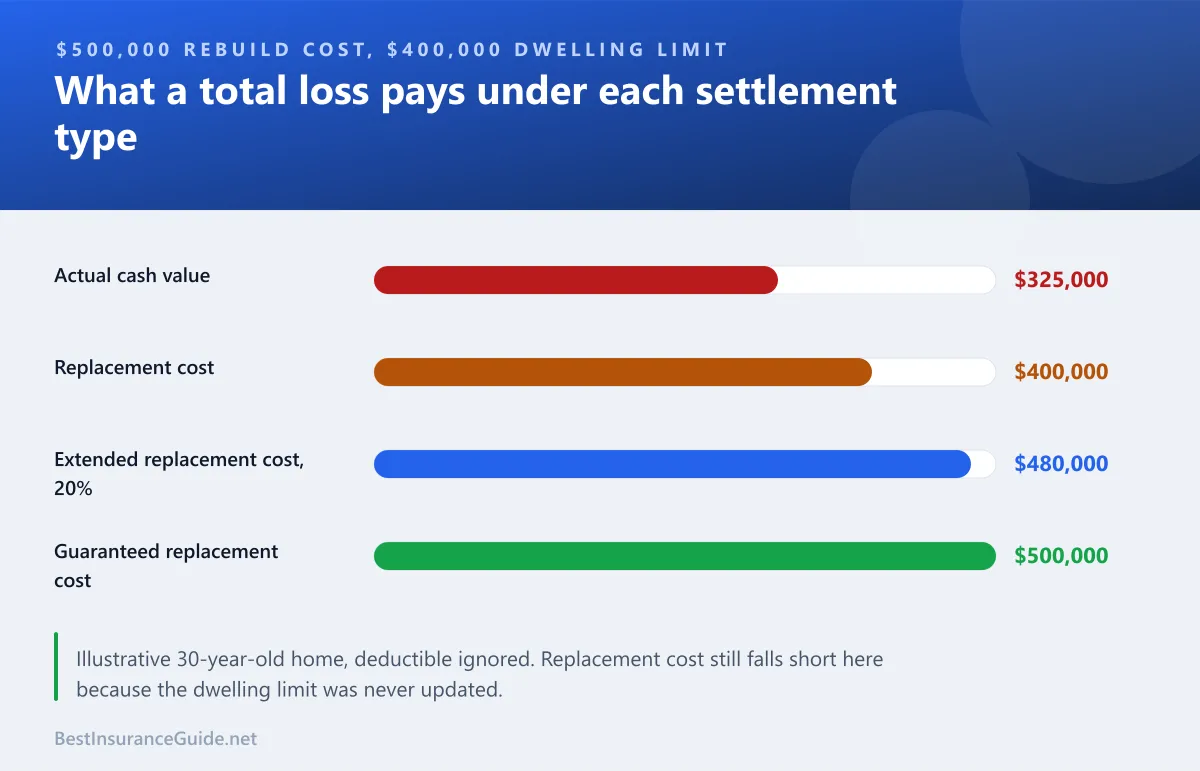
| Settlement type | Payment for the dwelling | Shortfall you cover |
|---|---|---|
| Actual cash value | $325,000 | $175,000 |
| Replacement cost, $400,000 limit | $400,000 | $100,000 |
| Extended replacement cost, 20% | $480,000 | $20,000 |
| Guaranteed replacement cost | $500,000 | $0 |
The replacement cost policy still leaves a large gap, not because of depreciation but because the limit was too low. That is why the dwelling limit and the settlement type need to be checked together. Our guide to homeowners insurance on a $400,000 house covers how to set that limit.
Ordinance or law coverage fills a separate gap
None of the settlement types above automatically pays for upgrades required by current building codes when you rebuild, such as new electrical standards, energy codes or wind-resistant construction. That is covered by ordinance or law coverage, which is often limited to a small percentage of the dwelling limit by default. For older homes it is worth raising.
Replacement cost estimators and your dwelling limit
When people search for a replacement cost estimator or calculator, they are usually trying to answer the right question: what would it cost to rebuild my home from the ground up? That is not the same as the market value, the purchase price or the tax assessment.
- Market value includes the land, which does not burn down, and reflects local demand.
- Rebuild cost reflects square footage, construction quality, finishes, local labor costs and code requirements.
Insurers use their own estimating software, and many offer an online estimator. Treat the result as a starting point. Walk through it and correct anything the estimator guessed: square footage, number of bathrooms, roof type, finishes, attached structures and recent upgrades. Our guide to using insurance calculators covers how to get a sensible number from them.
Which should you choose?
Choose replacement cost for your home and its contents in almost every case. The premium difference is usually modest compared with what depreciation removes from a claim, and the holdback process means you only receive the full amount when you actually replace what you lost.
Actual cash value can make sense for:
- a rental property or second structure you would not necessarily rebuild the same way;
- an older vehicle, where market value is the only realistic basis;
- items you would not replace if they were lost;
- keeping premiums down on a very old property, provided you understand the gap.
Whichever you choose, check four things at every renewal: the settlement basis for the dwelling, for personal property and for the roof; whether extended replacement cost is included; whether the dwelling limit still reflects rebuild cost; and how much ordinance or law coverage you have.
The bottom line
Replacement cost pays to replace what you lost. Actual cash value pays what it was worth, after depreciation. On a 12-year-old kitchen that difference was $12,000; on a whole house it can be well over $100,000. Replacement cost is usually paid in two stages, so keep your receipts and watch the deadline for claiming the holdback. And because even replacement cost stops at your limit, extended replacement cost and an up-to-date dwelling limit matter as much as the settlement type itself.
For a fuller view of what a standard policy covers and excludes, see our guide to what home insurance covers.
BestInsuranceGuide.net is an independent publisher and is not affiliated with any insurer. Worked examples are illustrative; depreciation methods, holdback deadlines and settlement rules vary by policy and state.